Karen Barton Director, Legal Practice Courses  University of Strathclyde Authentic Assessment in Law: SIMPLE
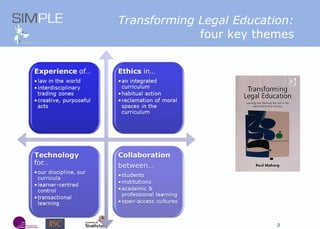
Transforming Legal Education: four key themes
simulations in legal learning… Are  close to the world of practice , but safe from the (possible) realities of malpractice and negligent representation.  Enable students to practise legal transactions , discuss the transactions with other tutors, students, and use a variety of instruments or tools, online or textual, to help them understand the nature and consequences of their actions Facilitate a wide variety of assessment , from high-stakes assignments with automatic fail points, to coursework that can double as a learning zone and an assessment assignment Encourage collaborative learning .  The guilds and groups of hunters in multi-player online games can be replicated for very different purposes in legal education. Students begin to  see the potential for the C in ICT ; and that technology is not merely a matter of word-processed essays & quizzes, but a  form of learning that changes quite fundamentally what and how they learn .
educational approaches to simulation concept of  transactional learning is active learning,  is based on doing legal transactions,  involves reflection on learning,  enables deep collaborative learning,  requires holistic or process learning, facilitates ethical and professional learning encourages immersion in professional role play develops task authenticity  Paul Maharg (2004)
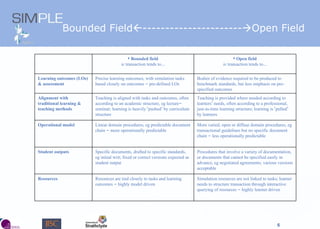
Bounded Field  ----------------------  Open Field Bounded field   ie  transaction tends to … Open field   ie  transaction tends to … Learning outcomes (LOs) & assessment Precise learning outcomes, with simulation tasks based closely on outcomes  –  pre-defined LOs Bodies of evidence required to be produced to benchmark standards, but less emphasis on pre-specified outcomes Alignment with traditional learning & teaching methods Teaching is aligned with tasks and outcomes, often according to an academic structure, eg lecture – seminar; learning is heavily  ‘ pushed ’  by curriculum structure Teaching is provided where needed according to learners ’  needs, often according to a professional, just-in-time learning structure; learning is  ‘ pulled ’  by learners Operational model Linear domain procedures, eg predictable document chain  –  more operationally predictable More varied, open or diffuse domain procedures, eg transactional guidelines but no specific document chain  –  less operationally predictable Student outputs Specific documents, drafted to specific standards, eg initial writ; fixed or correct versions expected as student output Procedures that involve a variety of documentation, or documents that cannot be specified easily in advance, eg negotiated agreements; various versions acceptable Resources Resources are tied closely to tasks and learning outcomes  –  highly model driven Simulation resources are not linked to tasks; learner needs to structure transaction through interactive querying of resources  –  highly learner driven
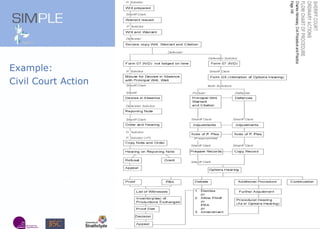
Example: Civil Court Action


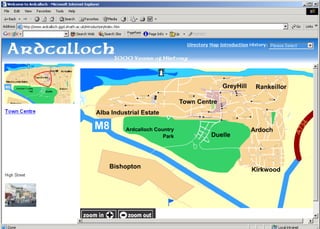
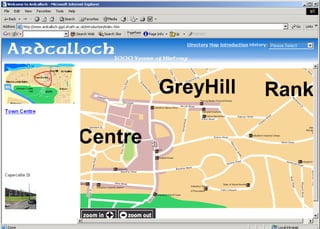
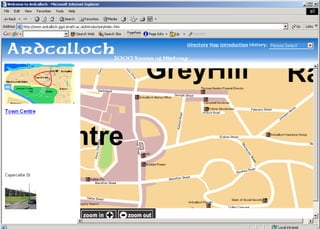
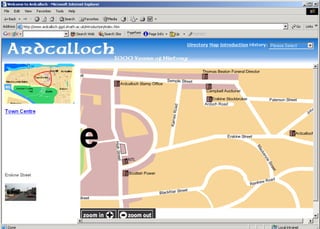
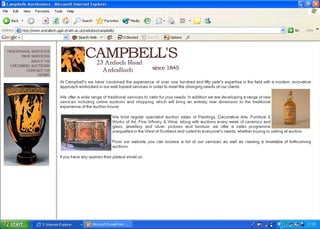
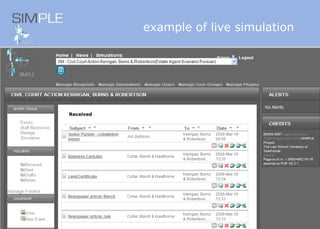
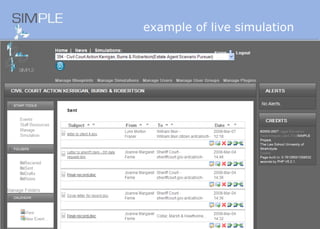
example of live simulation Received
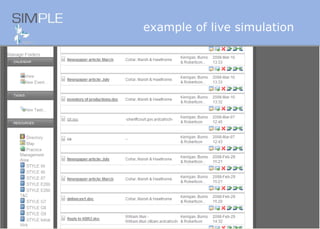
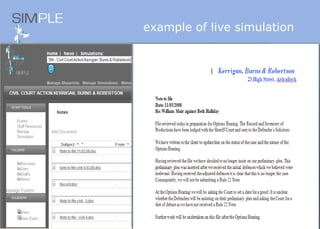
example of live simulation
 
 
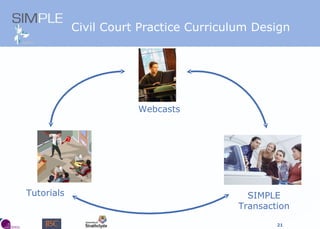
Civil Court Practice Curriculum Design  Webcasts Tutorials SIMPLE Transaction
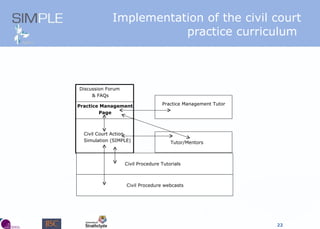
Implementation of the civil court practice curriculum  Discussion Forum  & FAQs Civil Court Action Simulation (SIMPLE) Practice Management Tutor Tutor/Mentors Civil Procedure Tutorials Practice Management Page Civil Procedure webcasts
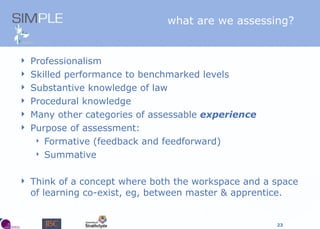
w hat are we assessing? P rofessionalism S killed performance to benchmarked levels S ubstantive knowledge of law P rocedural knowledge Many other categories of assessable  experience Purpose of assessment: Formative (feedback and feedforward) Summative Think of a concept where both the workspace and a space of learning co-exist, eg, between master & apprentice.
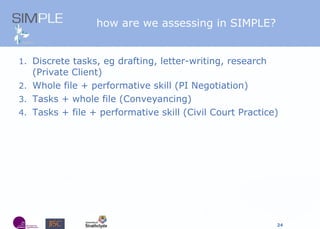
Discrete tasks, eg drafting, letter-writing, research (Private Client) Whole file + performative skill (PI Negotiation) Tasks + whole file (Conveyancing) Tasks + file + performative skill (Civil Court Practice) h ow are we assessing in SIMPLE?
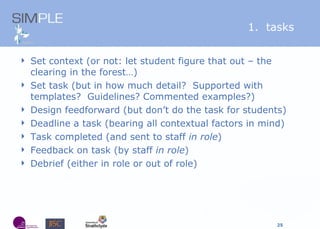
Set context (or not: let student figure that out  –  the clearing in the forest … ) S et task (but in how much detail?  Supported with templates?  Guidelines? Commented examples?) Design feedforward (but don’t do the task for students) Deadline a task (bearing all contextual factors in mind) Task completed (and sent to staff  in role ) Feedback on task (by staff  in role ) Debrief (either in role or out of role) 1.  tasks
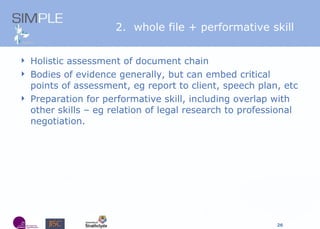
Holistic assessment of document chain Bodies of evidence generally, but can embed critical points of assessment, eg report to client, speech plan, etc P reparation for performative skill, including overlap with other skills  –  eg relation of legal research to professional negotiation.  2.  w hole file + performative skill
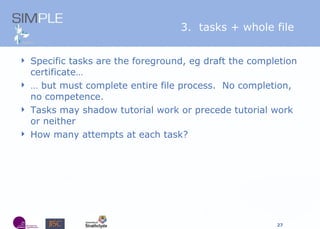
Specific tasks are the foreground, eg draft the completion certificate … …  but must complete entire file process.  No completion, no competence.  Tasks may shadow tutorial work or precede tutorial work or neither How many attempts at each task?  3.  t asks + whole file
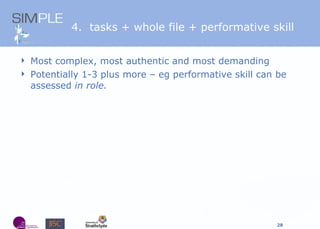
Most complex, most authentic and most demanding Potentially 1-3 plus more  –  eg performative skill can be assessed  in role.  4.  t asks + whole file + performative skill
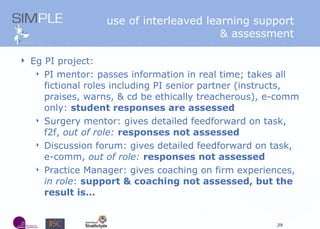
Eg PI project: PI mentor: passes information in real time; takes all fictional roles including PI senior partner (instructs, praises, warns, & cd be ethically treacherous), e-comm only:  student responses are assessed Surgery mentor: gives detailed feedforward on task, f2f,  out of role:  responses not assessed Discussion forum: gives detailed feedforward on task, e-comm,  out of role:  responses not assessed Practice Manager: gives coaching on firm experiences,  in role :  support & coaching not assessed, but the result is … u se of interleaved learning support & assessment
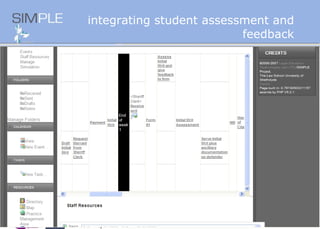
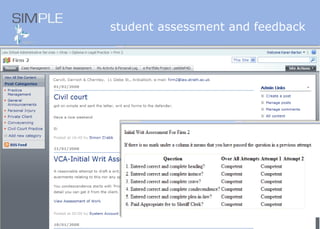
integrating student assessment and feedback
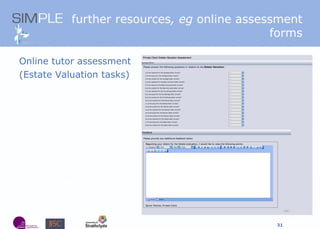
Online tutor assessment ( Estate Valuation tasks) further resources , eg  online assessment forms
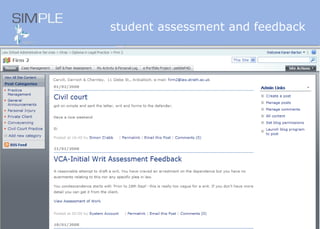
student assessment and feedback
Enhanced professional skills Heightened awareness of client care Improved IT skills Improved understanding of the subject matter Welcomed the authenticity Encouraged peer review Needed regular feedback student experiences
(some of) what students learned extended team working real legal fact-finding real legal research process thinking in the project setting out negotiation strategies in the context of (un)known information writing to specific audiences handling project alongside other work commitments structuring the argument of a case from start to finish keeping cool in face-to-face negotiations more effective delegation keeping files taking notes on the process...
feedback on learning… “… working in the virtual environment has also helped me focus on the concepts of individual and collective responsibility” “… our projects were quite clearly not completed in isolation…it was therefore vital to prioritize our workloads” “… the [Project] really emphasized the importance of client care…this aspect was vital to the successful completion of the project (as well as any future transaction in my traineeship).”
feedback on learning… “… taught me the importance of a client-oriented focus and strong client relationships… I believe we all learned valuable lessons in relation to people management that we will take with us to our respective traineeships.” “ Specifically…I was able to visualize transactions and the chain of events…this knowledge is something that cannot effectively be taught in lectures.” “… prioritization was imperative to the success of our firm.”
“ Assignments were excellent from a practical point of view – I would feel confident enough to complete these tasks in the office now.  Our assignments were also returned promptly which was great.” “ Assignments were a good way of bringing together knowledge obtained at tutorials.  It is a practical subject and it makes sense to assess with practical assignments.” “ Again excellent practice for traineeship.” “ Realistic and a very reasonable form of assessment.” feedback on assessment…
“ Provided with good feedback when made mistakes with any of these assignments.  Allowed us to complete them properly the second time round.  Good idea that students have an opportunity to correct work as I feel that I learned more and got more from the exercise as a result.” “ Support and advice was given by the tutor on relevant problem areas of the assignments.” “ Very good assessments – helped understand work done in tutorials.  Very useful.” “ Good learning tool – feel I learned more doing this than just reading about it.” feedback on assessment…
curricular themes   Staff c ontrol: open sims vs bounded sims Disruptive sims vs convergent sims Identity exploration (personal + law) vs rote learning (personal + law) Knowledge object-forming via play vs knowledge resumption by traditional means Transactional learning vs conventional teaching Front-loading timetable vs conventional timetabling Curriculum organised around spaces & resources vs curriculum organised around teaching interventions & resources Replay/remix/feedforward culture vs snapshot assessment culture

Authentic Assessment in Law: SIMPLE

  • 1.
    Karen Barton Director,Legal Practice Courses University of Strathclyde Authentic Assessment in Law: SIMPLE
  • 2.
  • 3.
    simulations in legallearning… Are close to the world of practice , but safe from the (possible) realities of malpractice and negligent representation. Enable students to practise legal transactions , discuss the transactions with other tutors, students, and use a variety of instruments or tools, online or textual, to help them understand the nature and consequences of their actions Facilitate a wide variety of assessment , from high-stakes assignments with automatic fail points, to coursework that can double as a learning zone and an assessment assignment Encourage collaborative learning . The guilds and groups of hunters in multi-player online games can be replicated for very different purposes in legal education. Students begin to see the potential for the C in ICT ; and that technology is not merely a matter of word-processed essays & quizzes, but a form of learning that changes quite fundamentally what and how they learn .
  • 4.
    educational approaches tosimulation concept of transactional learning is active learning, is based on doing legal transactions, involves reflection on learning, enables deep collaborative learning, requires holistic or process learning, facilitates ethical and professional learning encourages immersion in professional role play develops task authenticity Paul Maharg (2004)
  • 5.
    Bounded Field ----------------------  Open Field Bounded field ie transaction tends to … Open field ie transaction tends to … Learning outcomes (LOs) & assessment Precise learning outcomes, with simulation tasks based closely on outcomes – pre-defined LOs Bodies of evidence required to be produced to benchmark standards, but less emphasis on pre-specified outcomes Alignment with traditional learning & teaching methods Teaching is aligned with tasks and outcomes, often according to an academic structure, eg lecture – seminar; learning is heavily ‘ pushed ’ by curriculum structure Teaching is provided where needed according to learners ’ needs, often according to a professional, just-in-time learning structure; learning is ‘ pulled ’ by learners Operational model Linear domain procedures, eg predictable document chain – more operationally predictable More varied, open or diffuse domain procedures, eg transactional guidelines but no specific document chain – less operationally predictable Student outputs Specific documents, drafted to specific standards, eg initial writ; fixed or correct versions expected as student output Procedures that involve a variety of documentation, or documents that cannot be specified easily in advance, eg negotiated agreements; various versions acceptable Resources Resources are tied closely to tasks and learning outcomes – highly model driven Simulation resources are not linked to tasks; learner needs to structure transaction through interactive querying of resources – highly learner driven
  • 6.
  • 7.
  • 8.
  • 9.
  • 10.
  • 11.
  • 12.
  • 13.
  • 14.
  • 15.
    example of livesimulation Received
  • 16.
    example of livesimulation
  • 17.
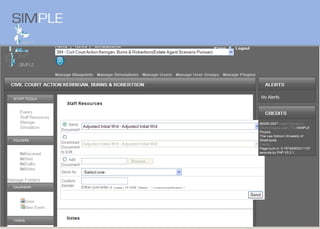
    example of livesimulation
  • 18.
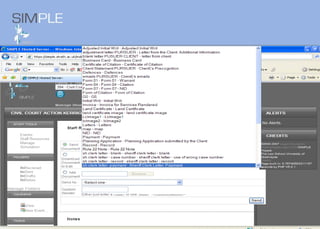
    example of livesimulation
  • 19.
  • 20.
  • 21.
    Civil Court PracticeCurriculum Design Webcasts Tutorials SIMPLE Transaction
  • 22.
    Implementation of thecivil court practice curriculum Discussion Forum & FAQs Civil Court Action Simulation (SIMPLE) Practice Management Tutor Tutor/Mentors Civil Procedure Tutorials Practice Management Page Civil Procedure webcasts
  • 23.
    w hat arewe assessing? P rofessionalism S killed performance to benchmarked levels S ubstantive knowledge of law P rocedural knowledge Many other categories of assessable experience Purpose of assessment: Formative (feedback and feedforward) Summative Think of a concept where both the workspace and a space of learning co-exist, eg, between master & apprentice.
  • 24.
    Discrete tasks, egdrafting, letter-writing, research (Private Client) Whole file + performative skill (PI Negotiation) Tasks + whole file (Conveyancing) Tasks + file + performative skill (Civil Court Practice) h ow are we assessing in SIMPLE?
  • 25.
    Set context (ornot: let student figure that out – the clearing in the forest … ) S et task (but in how much detail? Supported with templates? Guidelines? Commented examples?) Design feedforward (but don’t do the task for students) Deadline a task (bearing all contextual factors in mind) Task completed (and sent to staff in role ) Feedback on task (by staff in role ) Debrief (either in role or out of role) 1. tasks
  • 26.
    Holistic assessment ofdocument chain Bodies of evidence generally, but can embed critical points of assessment, eg report to client, speech plan, etc P reparation for performative skill, including overlap with other skills – eg relation of legal research to professional negotiation. 2. w hole file + performative skill
  • 27.
    Specific tasks arethe foreground, eg draft the completion certificate … … but must complete entire file process. No completion, no competence. Tasks may shadow tutorial work or precede tutorial work or neither How many attempts at each task? 3. t asks + whole file
  • 28.
    Most complex, mostauthentic and most demanding Potentially 1-3 plus more – eg performative skill can be assessed in role. 4. t asks + whole file + performative skill
  • 29.
    Eg PI project:PI mentor: passes information in real time; takes all fictional roles including PI senior partner (instructs, praises, warns, & cd be ethically treacherous), e-comm only: student responses are assessed Surgery mentor: gives detailed feedforward on task, f2f, out of role: responses not assessed Discussion forum: gives detailed feedforward on task, e-comm, out of role: responses not assessed Practice Manager: gives coaching on firm experiences, in role : support & coaching not assessed, but the result is … u se of interleaved learning support & assessment
  • 30.
  • 31.
    Online tutor assessment( Estate Valuation tasks) further resources , eg online assessment forms
  • 32.
  • 33.
  • 34.
    Enhanced professional skillsHeightened awareness of client care Improved IT skills Improved understanding of the subject matter Welcomed the authenticity Encouraged peer review Needed regular feedback student experiences
  • 35.
    (some of) whatstudents learned extended team working real legal fact-finding real legal research process thinking in the project setting out negotiation strategies in the context of (un)known information writing to specific audiences handling project alongside other work commitments structuring the argument of a case from start to finish keeping cool in face-to-face negotiations more effective delegation keeping files taking notes on the process...
  • 36.
    feedback on learning…“… working in the virtual environment has also helped me focus on the concepts of individual and collective responsibility” “… our projects were quite clearly not completed in isolation…it was therefore vital to prioritize our workloads” “… the [Project] really emphasized the importance of client care…this aspect was vital to the successful completion of the project (as well as any future transaction in my traineeship).”
  • 37.
    feedback on learning…“… taught me the importance of a client-oriented focus and strong client relationships… I believe we all learned valuable lessons in relation to people management that we will take with us to our respective traineeships.” “ Specifically…I was able to visualize transactions and the chain of events…this knowledge is something that cannot effectively be taught in lectures.” “… prioritization was imperative to the success of our firm.”
  • 38.
    “ Assignments wereexcellent from a practical point of view – I would feel confident enough to complete these tasks in the office now. Our assignments were also returned promptly which was great.” “ Assignments were a good way of bringing together knowledge obtained at tutorials. It is a practical subject and it makes sense to assess with practical assignments.” “ Again excellent practice for traineeship.” “ Realistic and a very reasonable form of assessment.” feedback on assessment…
  • 39.
    “ Provided withgood feedback when made mistakes with any of these assignments. Allowed us to complete them properly the second time round. Good idea that students have an opportunity to correct work as I feel that I learned more and got more from the exercise as a result.” “ Support and advice was given by the tutor on relevant problem areas of the assignments.” “ Very good assessments – helped understand work done in tutorials. Very useful.” “ Good learning tool – feel I learned more doing this than just reading about it.” feedback on assessment…
  • 40.
    curricular themes Staff c ontrol: open sims vs bounded sims Disruptive sims vs convergent sims Identity exploration (personal + law) vs rote learning (personal + law) Knowledge object-forming via play vs knowledge resumption by traditional means Transactional learning vs conventional teaching Front-loading timetable vs conventional timetabling Curriculum organised around spaces & resources vs curriculum organised around teaching interventions & resources Replay/remix/feedforward culture vs snapshot assessment culture

Editor's Notes

  • #3 Perhaps the first thing we ought to do is stop training them to ‘think like lawyers’. Experiential learning is a route to this. Ethics beyond the regulatory codes of conduct model. Technology as a facilitator to extend and deepen learning. Collaboration at all levels