Incorporating sim clients into JD &
continuing legal education programs
Shelley Kierstead & Paul Maharg
Osgoode Hall Law School
Slides at: https://paulmaharg.com/slides
https://simclient.osgoode.yorku.ca/workshop-resources/
preview
1. The Simulated Client Initiative (SCI) - origins
2. The SCI at Osgoode: in JD and CLE
3. Enablers, challenges and lessons learned
‘The situation of action is … an inexhaustibly rich resource’
Lucy Suchman (1987) Plans and Situated Actions.
The Problem of Human Machine Communication.
Cambridge, CUP, 33.
Shelley Kierstead, Paul Maharg| CC BY-NC-ND 2.5 CANADA 1
Slides at: https://paulmaharg.com/slides
https://simclient.osgoode.yorku.ca/workshop-resources/
1. The Simulated Client Initiative (SCI) - origins
origin in Scotland
• Strathclyde University, 2005, pilot project (partners Georgia
State University College of Law, Dundee University Medical
Faculty)
• Used model from medical profession of Simulated Patients
(SPs), non-lawyers were trained to be Simulated Clients (SCs)
• Concluded SCs assessed important aspects of client
interviewing with better validity and reliability than teachers
• Made what client thinks important the most salient for the
student: most of the interview grade is given by the client
• SCs evaluate those aspects of the interview that can be
assessed by non-lawyers
• This has changed how we enable students, trainees and
lawyers to learn interviewing & client-facing ethical
behaviour
Shelley Kierstead, Paul Maharg | CC BY-NC-ND 2.5 CANADA
SC training day 1: script conference
• intro to the method; discussion of roles
• read scenario script as group
• discuss the roles and unconscious bias
• discuss SCs’ feelings, reactions; amend the script
• clear up ambiguities re role of lawyer
• facilitator uses SC feedback to modify the scenario
SC training day 2: practising the role
There’s a need for the SCs to calibrate:
• Body language
• Tone of voice
• Attitudinal swings
• Dealing with the lawyer’s open questions…
• Improvising on the lawyer’s closed questions…
• Performance analysis on video review: ‘What prompted you to
say…?’ ‘How did you feel…?’
And to:
• Be aware of their orientation towards lawyer at first sight
• Respond congruently to the lawyer
• Consult their internal ‘invigilator’…
SC training days 3 & 4: assessing
lawyers/law students
• We discuss the marking system, and form a
common understanding of it
• SCs view and mark videos, comparing to ‘standard’
• SCs view each other’s ‘live’ performances with
lawyers & actors and assess lawyers & actors
• Process repeated until everyone has role-played at
least once, ideally three times
• Rich comment on performance
• Marks are collated in the room (suspense factor…)
• SCs are also trained to give formative feedback
after initial training?
• SCs role-play clients with students, real lawyers
and other professionals
• SCs are given refresher training on the scenario
• If they are trained on a new scenario they will
have the same pattern of training
• They should form a community of practice with
two core members of staff – ideally, admin +
academic to:
– improve practice
– suggest ways they may be used inside or
outside the law school
training SCs online
• Three components in person: review script,
standardize feedback, benchmark grading
• The principles remain the same online, with
different tools:
Breakout rooms
Demonstration videos
Screen sharing
Change screen view
Chat function
Shelley Kierstead, Paul Maharg | CC BY-NC-ND 2.5 CANADA
learner interviews online
• Again, same principles…
• But context always affects communications…
• So some of the issues that arose online:
Social representation, warmth, intimacy,
formality, pose, repose, affective presence on
video?
Bandwidth: is there still a digital divide?
Recording: how does it enhance / constrain
learning?
Assessment: digital digital affects formative
feedback. And summative…?
Shelley Kierstead, Paul Maharg | CC BY-NC-ND 2.5 CANADA
four provocations on digital legal education +
SCs
1. Post COVID, resist go-backery, (aka ‘dynamic
conservatism’, Donald Schön’s concept)
2. Don’t recreate analog teaching styles and
assessments (eg learning management
systems built to enhance f2f programs)
3. Digital isn’t second-best: it has its own
powerful affordances: use them
4. Digital can transform professional learning,
eg by adopting leading-edge professional
apps (cf Alberta’s innovation sandbox +
articling placement program + SCs – why not
fuse them?) 10
Shelley Kierstead, Paul Maharg | CC BY-NC-ND 2.5 CANADA
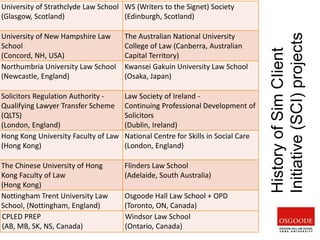
University of Strathclyde Law School
(Glasgow, Scotland)
WS (Writers to the Signet) Society
(Edinburgh, Scotland)
University of New Hampshire Law
School
(Concord, NH, USA)
The Australian National University
College of Law (Canberra, Australian
Capital Territory)
Northumbria University Law School
(Newcastle, England)
Kwansei Gakuin University Law School
(Osaka, Japan)
Solicitors Regulation Authority -
Qualifying Lawyer Transfer Scheme
(QLTS)
(London, England)
Law Society of Ireland -
Continuing Professional Development of
Solicitors
(Dublin, Ireland)
Hong Kong University Faculty of Law
(Hong Kong)
National Centre for Skills in Social Care
(London, England)
The Chinese University of Hong
Kong Faculty of Law
(Hong Kong)
Flinders Law School
(Adelaide, South Australia)
Nottingham Trent University Law
School, (Nottingham, England)
Osgoode Hall Law School + OPD
(Toronto, ON, Canada)
History
of
Sim
CIient
Initiative
(SCI)
projects
CPLED PREP
(AB, MB, SK, NS, Canada)
Windsor Law School
(Ontario, Canada)
SCs: people as co-producers, co-designers
The SC approach challenges:
1. Curriculum methods
2. Ethics of the client encounter
3. The cognitive poverty of conventional law school assessment
4. Law school as a self-regarding, monolithic construct
5. Law school categories of employment
6. The curricular isolation of clinic within law schools
7. Hollowed-out skills rhetoric
8. Conventional forms of regulation by regulatory bodies
9. The role of regulator, as encourager of innovation & radical reform…?
10.Disciplinary boundaries – what about a SC Unit that’s interdisciplinary?
11.Local jurisdictional practices: how might such a project work globally?
Shelley Kierstead, Paul Maharg | CC BY-NC-ND 2.5 CANADA
2. The SCI at Osgoode: in JD and CLE
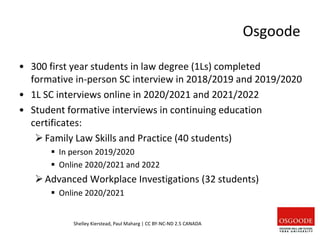
Osgoode
• 300 first year students in law degree (1Ls) completed
formative in-person SC interview in 2018/2019 and 2019/2020
• 1L SC interviews online in 2020/2021 and 2021/2022
• Student formative interviews in continuing education
certificates:
Family Law Skills and Practice (40 students)
 In person 2019/2020
 Online 2020/2021 and 2022
Advanced Workplace Investigations (32 students)
 Online 2020/2021
Shelley Kierstead, Paul Maharg | CC BY-NC-ND 2.5 CANADA
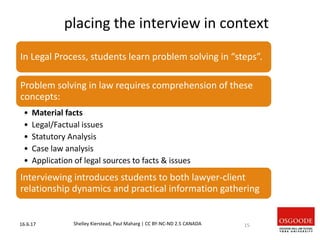
placing the interview in context
In Legal Process, students learn problem solving in “steps”.
Problem solving in law requires comprehension of these
concepts:
• Material facts
• Legal/Factual issues
• Statutory Analysis
• Case law analysis
• Application of legal sources to facts & issues
Interviewing introduces students to both lawyer-client
relationship dynamics and practical information gathering
16.6.17 15
Shelley Kierstead, Paul Maharg | CC BY-NC-ND 2.5 CANADA
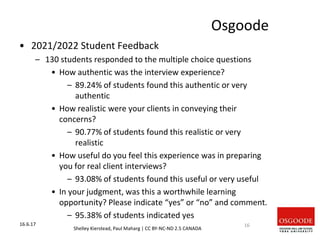
Osgoode
• 2021/2022 Student Feedback
– 130 students responded to the multiple choice questions
• How authentic was the interview experience?
– 89.24% of students found this authentic or very
authentic
• How realistic were your clients in conveying their
concerns?
– 90.77% of students found this realistic or very
realistic
• How useful do you feel this experience was in preparing
you for real client interviews?
– 93.08% of students found this useful or very useful
• In your judgment, was this a worthwhile learning
opportunity? Please indicate “yes” or “no” and comment.
– 95.38% of students indicated yes
16.6.17 16
Shelley Kierstead, Paul Maharg | CC BY-NC-ND 2.5 CANADA
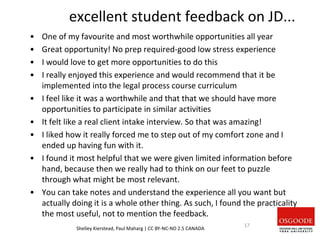
excellent student feedback on JD...
• One of my favourite and most worthwhile opportunities all year
• Great opportunity! No prep required-good low stress experience
• I would love to get more opportunities to do this
• I really enjoyed this experience and would recommend that it be
implemented into the legal process course curriculum
• I feel like it was a worthwhile and that that we should have more
opportunities to participate in similar activities
• It felt like a real client intake interview. So that was amazing!
• I liked how it really forced me to step out of my comfort zone and I
ended up having fun with it.
• I found it most helpful that we were given limited information before
hand, because then we really had to think on our feet to puzzle
through what might be most relevant.
• You can take notes and understand the experience all you want but
actually doing it is a whole other thing. As such, I found the practicality
the most useful, not to mention the feedback.
17
Shelley Kierstead, Paul Maharg | CC BY-NC-ND 2.5 CANADA
student concerns
• I think that the challenge came mainly from the fact that as a 1L I
feel like I lack the knowledge to really advise the client or come
up with next steps. I think it was still helpful, I just have to build
my confidence.
• The legal aspect or intertwined legal facts seemed a little extra
because we've never had experience dealing with a legal issue or
any practice in that frame. Made it feel a little more
overwhelming because of that lack of knowledge.
• It was hard to follow a topic that I didn’t have any legal
knowledge in
• I know we can't help this, but the Zoom format naturally lends
itself to impersonality (though both myself and my client tried as
hard as possible to make it a warm and realistic environment!)
Looking forward to being able to do these in person in the future.
16.6.17 18
Shelley Kierstead, Paul Maharg | CC BY-NC-ND 2.5 CANADA
Family Law skills and practice
• Key difference – Licensed Lawyers (vs 1L
students), therefore less concern about
knowing “the law”
• 9 Day Intensive Skills Program
– 3 points for Client Interaction:
• Initial Client Interview (Same focal points as LP
Interview)
• “Challenging Client” Meeting
• “Pre-Negotiation” Meeting
• Case Conference – Meeting (before and) with a
Judge
16.6.17 19
Shelley Kierstead, Paul Maharg | CC BY-NC-ND 2.5 CANADA
3. Enablers, challenges and lessons learned
enablers
1. Digital tech – the many paradoxes of intimacy
and distance
2. Pace of learning – easy for students to level
up quickly by reflecting on stored past
experiences
3. Covid has sped the uptake of video comms,
and students know they need to learn how to
act professionally in the new context.
Shelley Kierstead, Paul Maharg | CC BY-NC-ND 2.5 CANADA
lessons learned re digital transfer
1. Necessity for high-quality SC training in the f2f &
digital environments
2. Adaption of f2f to video interview practices and
assessment criteria
3. Even more important to plan out entrances & exits,
who does what when and where
4. Detailed & timely comms with students is vital
5. Preserve the core authenticity of the encounter
6. Embed within a culture of digital learning that goes
beyond JD and into lifelong professional learning
Shelley Kierstead, Paul Maharg | CC BY-NC-ND 2.5 CANADA
23
Shelley Kierstead, Paul Maharg | CC BY-NC-ND 2.5 CANADA
Email: skierstead@osgoode.yorku.ca
pmaharg@osgoode.yorku.ca
Web: paulmaharg.com
Slides: paulmaharg.com/slides

Kierstead Maharg slides, v.4.pptx

  • 1.
    Incorporating sim clientsinto JD & continuing legal education programs Shelley Kierstead & Paul Maharg Osgoode Hall Law School Slides at: https://paulmaharg.com/slides https://simclient.osgoode.yorku.ca/workshop-resources/
  • 2.
    preview 1. The SimulatedClient Initiative (SCI) - origins 2. The SCI at Osgoode: in JD and CLE 3. Enablers, challenges and lessons learned ‘The situation of action is … an inexhaustibly rich resource’ Lucy Suchman (1987) Plans and Situated Actions. The Problem of Human Machine Communication. Cambridge, CUP, 33. Shelley Kierstead, Paul Maharg| CC BY-NC-ND 2.5 CANADA 1 Slides at: https://paulmaharg.com/slides https://simclient.osgoode.yorku.ca/workshop-resources/
  • 3.
    1. The SimulatedClient Initiative (SCI) - origins
  • 4.
    origin in Scotland •Strathclyde University, 2005, pilot project (partners Georgia State University College of Law, Dundee University Medical Faculty) • Used model from medical profession of Simulated Patients (SPs), non-lawyers were trained to be Simulated Clients (SCs) • Concluded SCs assessed important aspects of client interviewing with better validity and reliability than teachers • Made what client thinks important the most salient for the student: most of the interview grade is given by the client • SCs evaluate those aspects of the interview that can be assessed by non-lawyers • This has changed how we enable students, trainees and lawyers to learn interviewing & client-facing ethical behaviour Shelley Kierstead, Paul Maharg | CC BY-NC-ND 2.5 CANADA
  • 5.
    SC training day1: script conference • intro to the method; discussion of roles • read scenario script as group • discuss the roles and unconscious bias • discuss SCs’ feelings, reactions; amend the script • clear up ambiguities re role of lawyer • facilitator uses SC feedback to modify the scenario
  • 6.
    SC training day2: practising the role There’s a need for the SCs to calibrate: • Body language • Tone of voice • Attitudinal swings • Dealing with the lawyer’s open questions… • Improvising on the lawyer’s closed questions… • Performance analysis on video review: ‘What prompted you to say…?’ ‘How did you feel…?’ And to: • Be aware of their orientation towards lawyer at first sight • Respond congruently to the lawyer • Consult their internal ‘invigilator’…
  • 7.
    SC training days3 & 4: assessing lawyers/law students • We discuss the marking system, and form a common understanding of it • SCs view and mark videos, comparing to ‘standard’ • SCs view each other’s ‘live’ performances with lawyers & actors and assess lawyers & actors • Process repeated until everyone has role-played at least once, ideally three times • Rich comment on performance • Marks are collated in the room (suspense factor…) • SCs are also trained to give formative feedback
  • 8.
    after initial training? •SCs role-play clients with students, real lawyers and other professionals • SCs are given refresher training on the scenario • If they are trained on a new scenario they will have the same pattern of training • They should form a community of practice with two core members of staff – ideally, admin + academic to: – improve practice – suggest ways they may be used inside or outside the law school
  • 9.
    training SCs online •Three components in person: review script, standardize feedback, benchmark grading • The principles remain the same online, with different tools: Breakout rooms Demonstration videos Screen sharing Change screen view Chat function Shelley Kierstead, Paul Maharg | CC BY-NC-ND 2.5 CANADA
  • 10.
    learner interviews online •Again, same principles… • But context always affects communications… • So some of the issues that arose online: Social representation, warmth, intimacy, formality, pose, repose, affective presence on video? Bandwidth: is there still a digital divide? Recording: how does it enhance / constrain learning? Assessment: digital digital affects formative feedback. And summative…? Shelley Kierstead, Paul Maharg | CC BY-NC-ND 2.5 CANADA
  • 11.
    four provocations ondigital legal education + SCs 1. Post COVID, resist go-backery, (aka ‘dynamic conservatism’, Donald Schön’s concept) 2. Don’t recreate analog teaching styles and assessments (eg learning management systems built to enhance f2f programs) 3. Digital isn’t second-best: it has its own powerful affordances: use them 4. Digital can transform professional learning, eg by adopting leading-edge professional apps (cf Alberta’s innovation sandbox + articling placement program + SCs – why not fuse them?) 10 Shelley Kierstead, Paul Maharg | CC BY-NC-ND 2.5 CANADA
  • 12.
    University of StrathclydeLaw School (Glasgow, Scotland) WS (Writers to the Signet) Society (Edinburgh, Scotland) University of New Hampshire Law School (Concord, NH, USA) The Australian National University College of Law (Canberra, Australian Capital Territory) Northumbria University Law School (Newcastle, England) Kwansei Gakuin University Law School (Osaka, Japan) Solicitors Regulation Authority - Qualifying Lawyer Transfer Scheme (QLTS) (London, England) Law Society of Ireland - Continuing Professional Development of Solicitors (Dublin, Ireland) Hong Kong University Faculty of Law (Hong Kong) National Centre for Skills in Social Care (London, England) The Chinese University of Hong Kong Faculty of Law (Hong Kong) Flinders Law School (Adelaide, South Australia) Nottingham Trent University Law School, (Nottingham, England) Osgoode Hall Law School + OPD (Toronto, ON, Canada) History of Sim CIient Initiative (SCI) projects CPLED PREP (AB, MB, SK, NS, Canada) Windsor Law School (Ontario, Canada)
  • 13.
    SCs: people asco-producers, co-designers The SC approach challenges: 1. Curriculum methods 2. Ethics of the client encounter 3. The cognitive poverty of conventional law school assessment 4. Law school as a self-regarding, monolithic construct 5. Law school categories of employment 6. The curricular isolation of clinic within law schools 7. Hollowed-out skills rhetoric 8. Conventional forms of regulation by regulatory bodies 9. The role of regulator, as encourager of innovation & radical reform…? 10.Disciplinary boundaries – what about a SC Unit that’s interdisciplinary? 11.Local jurisdictional practices: how might such a project work globally? Shelley Kierstead, Paul Maharg | CC BY-NC-ND 2.5 CANADA
  • 14.
    2. The SCIat Osgoode: in JD and CLE
  • 15.
    Osgoode • 300 firstyear students in law degree (1Ls) completed formative in-person SC interview in 2018/2019 and 2019/2020 • 1L SC interviews online in 2020/2021 and 2021/2022 • Student formative interviews in continuing education certificates: Family Law Skills and Practice (40 students)  In person 2019/2020  Online 2020/2021 and 2022 Advanced Workplace Investigations (32 students)  Online 2020/2021 Shelley Kierstead, Paul Maharg | CC BY-NC-ND 2.5 CANADA
  • 16.
    placing the interviewin context In Legal Process, students learn problem solving in “steps”. Problem solving in law requires comprehension of these concepts: • Material facts • Legal/Factual issues • Statutory Analysis • Case law analysis • Application of legal sources to facts & issues Interviewing introduces students to both lawyer-client relationship dynamics and practical information gathering 16.6.17 15 Shelley Kierstead, Paul Maharg | CC BY-NC-ND 2.5 CANADA
  • 17.
    Osgoode • 2021/2022 StudentFeedback – 130 students responded to the multiple choice questions • How authentic was the interview experience? – 89.24% of students found this authentic or very authentic • How realistic were your clients in conveying their concerns? – 90.77% of students found this realistic or very realistic • How useful do you feel this experience was in preparing you for real client interviews? – 93.08% of students found this useful or very useful • In your judgment, was this a worthwhile learning opportunity? Please indicate “yes” or “no” and comment. – 95.38% of students indicated yes 16.6.17 16 Shelley Kierstead, Paul Maharg | CC BY-NC-ND 2.5 CANADA
  • 18.
    excellent student feedbackon JD... • One of my favourite and most worthwhile opportunities all year • Great opportunity! No prep required-good low stress experience • I would love to get more opportunities to do this • I really enjoyed this experience and would recommend that it be implemented into the legal process course curriculum • I feel like it was a worthwhile and that that we should have more opportunities to participate in similar activities • It felt like a real client intake interview. So that was amazing! • I liked how it really forced me to step out of my comfort zone and I ended up having fun with it. • I found it most helpful that we were given limited information before hand, because then we really had to think on our feet to puzzle through what might be most relevant. • You can take notes and understand the experience all you want but actually doing it is a whole other thing. As such, I found the practicality the most useful, not to mention the feedback. 17 Shelley Kierstead, Paul Maharg | CC BY-NC-ND 2.5 CANADA
  • 19.
    student concerns • Ithink that the challenge came mainly from the fact that as a 1L I feel like I lack the knowledge to really advise the client or come up with next steps. I think it was still helpful, I just have to build my confidence. • The legal aspect or intertwined legal facts seemed a little extra because we've never had experience dealing with a legal issue or any practice in that frame. Made it feel a little more overwhelming because of that lack of knowledge. • It was hard to follow a topic that I didn’t have any legal knowledge in • I know we can't help this, but the Zoom format naturally lends itself to impersonality (though both myself and my client tried as hard as possible to make it a warm and realistic environment!) Looking forward to being able to do these in person in the future. 16.6.17 18 Shelley Kierstead, Paul Maharg | CC BY-NC-ND 2.5 CANADA
  • 20.
    Family Law skillsand practice • Key difference – Licensed Lawyers (vs 1L students), therefore less concern about knowing “the law” • 9 Day Intensive Skills Program – 3 points for Client Interaction: • Initial Client Interview (Same focal points as LP Interview) • “Challenging Client” Meeting • “Pre-Negotiation” Meeting • Case Conference – Meeting (before and) with a Judge 16.6.17 19 Shelley Kierstead, Paul Maharg | CC BY-NC-ND 2.5 CANADA
  • 21.
    3. Enablers, challengesand lessons learned
  • 22.
    enablers 1. Digital tech– the many paradoxes of intimacy and distance 2. Pace of learning – easy for students to level up quickly by reflecting on stored past experiences 3. Covid has sped the uptake of video comms, and students know they need to learn how to act professionally in the new context. Shelley Kierstead, Paul Maharg | CC BY-NC-ND 2.5 CANADA
  • 23.
    lessons learned redigital transfer 1. Necessity for high-quality SC training in the f2f & digital environments 2. Adaption of f2f to video interview practices and assessment criteria 3. Even more important to plan out entrances & exits, who does what when and where 4. Detailed & timely comms with students is vital 5. Preserve the core authenticity of the encounter 6. Embed within a culture of digital learning that goes beyond JD and into lifelong professional learning Shelley Kierstead, Paul Maharg | CC BY-NC-ND 2.5 CANADA
  • 24.
    23 Shelley Kierstead, PaulMaharg | CC BY-NC-ND 2.5 CANADA Email: skierstead@osgoode.yorku.ca pmaharg@osgoode.yorku.ca Web: paulmaharg.com Slides: paulmaharg.com/slides