Beyond Zoom: Building a Simulation
Ecosystem Online
Paul Maharg and Angela Yenssen
Newcastle University Law School
Osgoode Hall Law School, York University
Toronto, Ontario
Slides at: https://paulmaharg.com/slides
preview
1. The Canadian context of legal education and regulation
2. The Simulated Client Initiative (SCI)
3. The SCI at Osgoode and CPLED
4. The role of technology in the SCI in Canada
5. Enablers, challenges and lessons learned in cross-jurisdictional
cooperation
‘The situation of action is … an inexhaustibly rich resource’
Lucy Suchman (1987) Plans and Situated Actions.
The Problem of Human Machine Communication.
Cambridge, CUP, 33.
Paul Maharg, Angela Yenssen | CC BY-NC-ND 2.5 CANADA 1
Slides at: https://paulmaharg.com/slides
1. Canadian context of legal education and
regulation
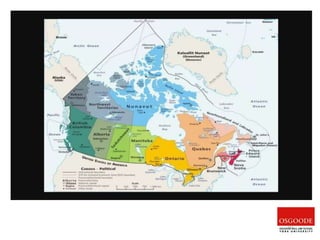
Canada is a federal system
Paul Maharg, Angela Yenssen | CC BY-NC-ND 2.5 CANADA
• 10 provinces and 3 territories
• No national regulator or educational standard
for domestic students
• Each province and territory regulates the legal
profession and sets standards for legal
education
• Law Societies are still our provincial/territorial
regulators
Requirements of provincial/territorial
Law Societies for entry to the legal
profession
Paul Maharg, Angela Yenssen | CC BY-NC-ND 2.5 CANADA
• Obtain university degree in law
• Pass one or more exams
• Experiential training (usually articling)
• Some provinces/territories also have bar
admission courses
2. Simulated Client Initiative (SCI)
origin in Scotland
Paul Maharg, Angela Yenssen | CC BY-NC-ND 2.5 CANADA
• Strathclyde University, 2005, pilot project (partners Georgia
State University College of Law, Dundee University Medical
Faculty)
• Used model from medical profession of Simulated Patients
(SPs), non-lawyers were trained to be Simulated Clients (SCs)
• Concluded SCs could assess important aspects of client
interviewing with better validity and reliability than teachers
• Made what client thinks important the most salient for the
student: most of the interview grade is given by the client
• SCs evaluate those aspects of the interview that can be
assessed by non-lawyers
• This has changed the way we enable students, trainees and
lawyers to learn interviewing & client-facing ethical behaviour
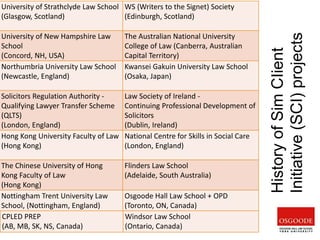
University of Strathclyde Law School
(Glasgow, Scotland)
WS (Writers to the Signet) Society
(Edinburgh, Scotland)
University of New Hampshire Law
School
(Concord, NH, USA)
The Australian National University
College of Law (Canberra, Australian
Capital Territory)
Northumbria University Law School
(Newcastle, England)
Kwansei Gakuin University Law School
(Osaka, Japan)
Solicitors Regulation Authority -
Qualifying Lawyer Transfer Scheme
(QLTS)
(London, England)
Law Society of Ireland -
Continuing Professional Development of
Solicitors
(Dublin, Ireland)
Hong Kong University Faculty of Law
(Hong Kong)
National Centre for Skills in Social Care
(London, England)
The Chinese University of Hong
Kong Faculty of Law
(Hong Kong)
Flinders Law School
(Adelaide, South Australia)
Nottingham Trent University Law
School, (Nottingham, England)
Osgoode Hall Law School + OPD
(Toronto, ON, Canada)
History
of
Sim
CIient
Initiative
(SCI)
projects
CPLED PREP
(AB, MB, SK, NS, Canada)
Windsor Law School
(Ontario, Canada)
3. SCI at Osgoode and CPLED
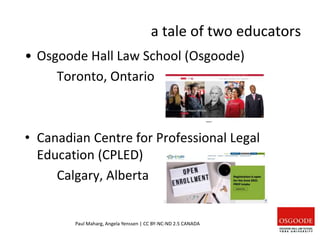
a tale of two educators
Paul Maharg, Angela Yenssen | CC BY-NC-ND 2.5 CANADA
• Osgoode Hall Law School (Osgoode)
Toronto, Ontario
• Canadian Centre for Professional Legal
Education (CPLED)
Calgary, Alberta
10
Osgoode
• 300 first year students in law degree (1Ls) completed
formative in-person SC interview in 2018/2019 and 2019/2020
• 1L SC interviews online in 2020/2021
• Student formative interviews in continuing education
certificates
Family Law Skills and Practice (40 students)
 In person 2019/2020
 Online 2020/2021
Advanced Workplace Investigations (32 students)
 Online 2020/2021
Paul Maharg, Angela Yenssen | CC BY-NC-ND 2.5 CANADA
excellent student feedback...
• One of my favourite and most worthwhile opportunities all year
• Great opportunity! No prep required-good low stress experience
• Yes! I loved the feedback that the simulated client gave me. She was
honest (but also very kind). I haven’t viewed my video yet , but I’m sure
it will be extremely useful to go back and review my
questions/demeanour/etc.
• Helpful feedback
• I would love to get more opportunities to do this
• Yes, I feel better prepared and the feedback I got was very reassuring
• I really enjoyed this experience and would recommend that it be
implemented into the legal process course curriculum
• The feedback was splendid I see where I need to improve and at the
same time I was made aware of my strengths that I need to hone
• I feel like it was a worthwhile and that that we should have more
opportunities to participate in similar activities
Paul Maharg, Angela Yenssen | CC BY-NC-ND 2.5 CANADA
12
CPLED
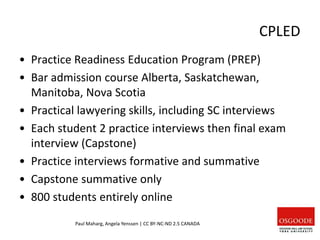
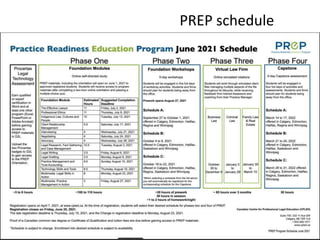
• Practice Readiness Education Program (PREP)
• Bar admission course Alberta, Saskatchewan,
Manitoba, Nova Scotia
• Practical lawyering skills, including SC interviews
• Each student 2 practice interviews then final exam
interview (Capstone)
• Practice interviews formative and summative
• Capstone summative only
• 800 students entirely online
Paul Maharg, Angela Yenssen | CC BY-NC-ND 2.5 CANADA
PREP schedule
14
4. Role of technology in the SCI in Canada
training SCs online
• Three components in person: review script,
standardize feedback, benchmark grading
• Tools online:
Breakout rooms
Demonstration videos
Screen sharing
Change screen view
Chat function
Paul Maharg, Angela Yenssen | CC BY-NC-ND 2.5 CANADA
interviews online
• Meeting program (Osgoode) v. Learning
management system (CPLED)
• Some of the issues that arose:
Social representation, warmth, intimacy,
formality, pose, repose, affective presence
Bandwidth
Recording
Grading
Comments
Paul Maharg, Angela Yenssen | CC BY-NC-ND 2.5 CANADA
benefits and challenges
• Accessibility – huge benefit, across 4 provinces
• The basics: visual and audio
• Non-verbal cues
• Eye contact
• Minimals vs immersion
• Talking over (esp with satellite connectivity, ie ‘lag’)
• Staying for feedback
Paul Maharg, Angela Yenssen | CC BY-NC-ND 2.5 CANADA
5. Enablers, challenges and lessons learned in
cross-jurisdictional cooperation
enablers
1. Digital tech – the many paradoxes of intimacy
and distance
2. Pace of learning – easy for students to level
up quickly by reflecting on stored past
experiences
3. Covid has sped the uptake of video comms,
and students know they need to learn how to
act professionally in the new context.
Paul Maharg, Angela Yenssen | CC BY-NC-ND 2.5 CANADA
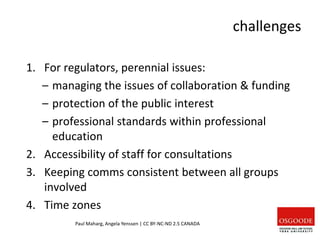
challenges
1. For regulators, perennial issues:
– managing the issues of collaboration & funding
– protection of the public interest
– professional standards within professional
education
2. Accessibility of staff for consultations
3. Keeping comms consistent between all groups
involved
4. Time zones
Paul Maharg, Angela Yenssen | CC BY-NC-ND 2.5 CANADA
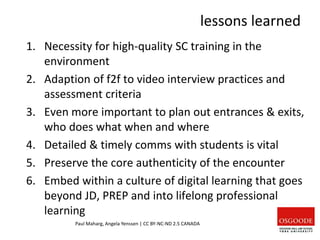
lessons learned
1. Necessity for high-quality SC training in the
environment
2. Adaption of f2f to video interview practices and
assessment criteria
3. Even more important to plan out entrances & exits,
who does what when and where
4. Detailed & timely comms with students is vital
5. Preserve the core authenticity of the encounter
6. Embed within a culture of digital learning that goes
beyond JD, PREP and into lifelong professional
learning
Paul Maharg, Angela Yenssen | CC BY-NC-ND 2.5 CANADA
23
Email: pmaharg@osgoode.yorku.ca
yenssena@yorku.ca
Osgoode: https//works.bepress.com/paul-maharg
Web: paulmaharg.com
Slides: paulmaharg.com/slides

Yenssen maharg slides

  • 1.
    Beyond Zoom: Buildinga Simulation Ecosystem Online Paul Maharg and Angela Yenssen Newcastle University Law School Osgoode Hall Law School, York University Toronto, Ontario Slides at: https://paulmaharg.com/slides
  • 2.
    preview 1. The Canadiancontext of legal education and regulation 2. The Simulated Client Initiative (SCI) 3. The SCI at Osgoode and CPLED 4. The role of technology in the SCI in Canada 5. Enablers, challenges and lessons learned in cross-jurisdictional cooperation ‘The situation of action is … an inexhaustibly rich resource’ Lucy Suchman (1987) Plans and Situated Actions. The Problem of Human Machine Communication. Cambridge, CUP, 33. Paul Maharg, Angela Yenssen | CC BY-NC-ND 2.5 CANADA 1 Slides at: https://paulmaharg.com/slides
  • 3.
    1. Canadian contextof legal education and regulation
  • 4.
    Canada is afederal system Paul Maharg, Angela Yenssen | CC BY-NC-ND 2.5 CANADA • 10 provinces and 3 territories • No national regulator or educational standard for domestic students • Each province and territory regulates the legal profession and sets standards for legal education • Law Societies are still our provincial/territorial regulators
  • 5.
    Requirements of provincial/territorial LawSocieties for entry to the legal profession Paul Maharg, Angela Yenssen | CC BY-NC-ND 2.5 CANADA • Obtain university degree in law • Pass one or more exams • Experiential training (usually articling) • Some provinces/territories also have bar admission courses
  • 6.
    2. Simulated ClientInitiative (SCI)
  • 7.
    origin in Scotland PaulMaharg, Angela Yenssen | CC BY-NC-ND 2.5 CANADA • Strathclyde University, 2005, pilot project (partners Georgia State University College of Law, Dundee University Medical Faculty) • Used model from medical profession of Simulated Patients (SPs), non-lawyers were trained to be Simulated Clients (SCs) • Concluded SCs could assess important aspects of client interviewing with better validity and reliability than teachers • Made what client thinks important the most salient for the student: most of the interview grade is given by the client • SCs evaluate those aspects of the interview that can be assessed by non-lawyers • This has changed the way we enable students, trainees and lawyers to learn interviewing & client-facing ethical behaviour
  • 8.
    University of StrathclydeLaw School (Glasgow, Scotland) WS (Writers to the Signet) Society (Edinburgh, Scotland) University of New Hampshire Law School (Concord, NH, USA) The Australian National University College of Law (Canberra, Australian Capital Territory) Northumbria University Law School (Newcastle, England) Kwansei Gakuin University Law School (Osaka, Japan) Solicitors Regulation Authority - Qualifying Lawyer Transfer Scheme (QLTS) (London, England) Law Society of Ireland - Continuing Professional Development of Solicitors (Dublin, Ireland) Hong Kong University Faculty of Law (Hong Kong) National Centre for Skills in Social Care (London, England) The Chinese University of Hong Kong Faculty of Law (Hong Kong) Flinders Law School (Adelaide, South Australia) Nottingham Trent University Law School, (Nottingham, England) Osgoode Hall Law School + OPD (Toronto, ON, Canada) History of Sim CIient Initiative (SCI) projects CPLED PREP (AB, MB, SK, NS, Canada) Windsor Law School (Ontario, Canada)
  • 9.
    3. SCI atOsgoode and CPLED
  • 10.
    a tale oftwo educators Paul Maharg, Angela Yenssen | CC BY-NC-ND 2.5 CANADA • Osgoode Hall Law School (Osgoode) Toronto, Ontario • Canadian Centre for Professional Legal Education (CPLED) Calgary, Alberta
  • 11.
  • 12.
    Osgoode • 300 firstyear students in law degree (1Ls) completed formative in-person SC interview in 2018/2019 and 2019/2020 • 1L SC interviews online in 2020/2021 • Student formative interviews in continuing education certificates Family Law Skills and Practice (40 students)  In person 2019/2020  Online 2020/2021 Advanced Workplace Investigations (32 students)  Online 2020/2021 Paul Maharg, Angela Yenssen | CC BY-NC-ND 2.5 CANADA
  • 13.
    excellent student feedback... •One of my favourite and most worthwhile opportunities all year • Great opportunity! No prep required-good low stress experience • Yes! I loved the feedback that the simulated client gave me. She was honest (but also very kind). I haven’t viewed my video yet , but I’m sure it will be extremely useful to go back and review my questions/demeanour/etc. • Helpful feedback • I would love to get more opportunities to do this • Yes, I feel better prepared and the feedback I got was very reassuring • I really enjoyed this experience and would recommend that it be implemented into the legal process course curriculum • The feedback was splendid I see where I need to improve and at the same time I was made aware of my strengths that I need to hone • I feel like it was a worthwhile and that that we should have more opportunities to participate in similar activities Paul Maharg, Angela Yenssen | CC BY-NC-ND 2.5 CANADA 12
  • 14.
    CPLED • Practice ReadinessEducation Program (PREP) • Bar admission course Alberta, Saskatchewan, Manitoba, Nova Scotia • Practical lawyering skills, including SC interviews • Each student 2 practice interviews then final exam interview (Capstone) • Practice interviews formative and summative • Capstone summative only • 800 students entirely online Paul Maharg, Angela Yenssen | CC BY-NC-ND 2.5 CANADA
  • 15.
  • 16.
    4. Role oftechnology in the SCI in Canada
  • 17.
    training SCs online •Three components in person: review script, standardize feedback, benchmark grading • Tools online: Breakout rooms Demonstration videos Screen sharing Change screen view Chat function Paul Maharg, Angela Yenssen | CC BY-NC-ND 2.5 CANADA
  • 18.
    interviews online • Meetingprogram (Osgoode) v. Learning management system (CPLED) • Some of the issues that arose: Social representation, warmth, intimacy, formality, pose, repose, affective presence Bandwidth Recording Grading Comments Paul Maharg, Angela Yenssen | CC BY-NC-ND 2.5 CANADA
  • 19.
    benefits and challenges •Accessibility – huge benefit, across 4 provinces • The basics: visual and audio • Non-verbal cues • Eye contact • Minimals vs immersion • Talking over (esp with satellite connectivity, ie ‘lag’) • Staying for feedback Paul Maharg, Angela Yenssen | CC BY-NC-ND 2.5 CANADA
  • 20.
    5. Enablers, challengesand lessons learned in cross-jurisdictional cooperation
  • 21.
    enablers 1. Digital tech– the many paradoxes of intimacy and distance 2. Pace of learning – easy for students to level up quickly by reflecting on stored past experiences 3. Covid has sped the uptake of video comms, and students know they need to learn how to act professionally in the new context. Paul Maharg, Angela Yenssen | CC BY-NC-ND 2.5 CANADA
  • 22.
    challenges 1. For regulators,perennial issues: – managing the issues of collaboration & funding – protection of the public interest – professional standards within professional education 2. Accessibility of staff for consultations 3. Keeping comms consistent between all groups involved 4. Time zones Paul Maharg, Angela Yenssen | CC BY-NC-ND 2.5 CANADA
  • 23.
    lessons learned 1. Necessityfor high-quality SC training in the environment 2. Adaption of f2f to video interview practices and assessment criteria 3. Even more important to plan out entrances & exits, who does what when and where 4. Detailed & timely comms with students is vital 5. Preserve the core authenticity of the encounter 6. Embed within a culture of digital learning that goes beyond JD, PREP and into lifelong professional learning Paul Maharg, Angela Yenssen | CC BY-NC-ND 2.5 CANADA
  • 24.
    Paul Maharg, AngelaYenssen | CC BY-NC-ND 2.5 CANADA 23 Email: pmaharg@osgoode.yorku.ca yenssena@yorku.ca Osgoode: https//works.bepress.com/paul-maharg Web: paulmaharg.com Slides: paulmaharg.com/slides