Professional legal education:
Regulation, technology and design
Paul Maharg
Osgoode Hall Law School
http://paulmaharg.com/slides
https://www.slideshare.net/paulmaharg
preview
Legal education and…
1. Regulation: ‘Shared space’ – eg simulated clients
2. Technology: ‘Houston in the blind’ – eg digital professional
learning research
You can find these slides at:
http://paulmaharg.com/slides
https://www.slideshare.net/paulmaharg
Professor Paul Maharg | CC BY-NC-ND 2.5 CANADA 1
Legal education and regulation
the shared space – eg simulated clients
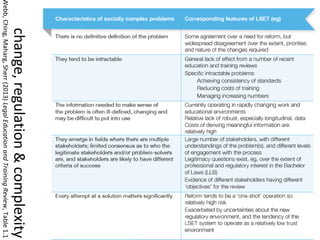
change,
regulation
&
complexity
Webb,
Ching,
Maharg,
Sherr
(2013)
Legal
Education
and
Training
Review,
Table
1.1
Professor Paul Maharg | CC BY-NC-ND 2.5 CANADA 3
regulatory roles? The key is shared
space
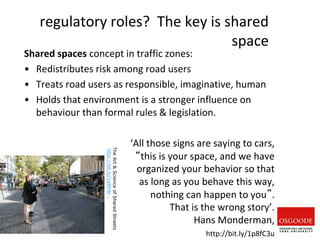
Shared spaces concept in traffic zones:
• Redistributes risk among road users
• Treats road users as responsible, imaginative, human
• Holds that environment is a stronger influence on
behaviour than formal rules & legislation.
‘All those signs are saying to cars,
“this is your space, and we have
organized your behavior so that
as long as you behave this way,
nothing can happen to you”.
That is the wrong story’.
Hans Monderman,
http://bit.ly/1p8fC3u
The
Art
&
Science
of
Shared
Streets
http://bit.ly/1p8fr8r
.
redesign
relations
2
shared space =
participative regulation
Portrait of the regulator as:
1. Not QA but QE – Quality Enhancer, to focus on
culture shifts towards innovation, imagination,
change for a democratic society
2. A hub of creativity, shared research, shared
practices & guardian of debate around that hub
3. Initiating cycles of funding, research, feedback,
feedforward
4. Archive of ed tech memory in the discipline
5. Founder of interdisciplinary, inter-professional
trading zones
Regulator as democratic designer
Simulated Client Initiative -
we proved our hypothesis in our 2005
study
With proper training and carefully designed assessment
procedures, Standardised or Simulated Clients (SCs) can
assess important aspects of client interviewing with
validity and reliability comparable to assessment by law
teachers and adjuncts.
Professor Paul Maharg | CC BY-NC-ND 2.5 CANADA
Simulated Client Initiative -
we proved our hypothesis in our 2005
study
With proper training and carefully designed assessment
procedures, Standardised or Simulated Clients (SCs) can
assess important aspects of client interviewing with
validity and reliability comparable to assessment by law
teachers.
Professor Paul Maharg | CC BY-NC-ND 2.5 CANADA
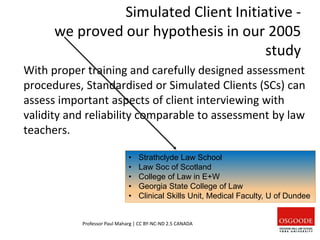
• Strathclyde Law School
• Law Soc of Scotland
• College of Law in E+W
• Georgia State College of Law
• Clinical Skills Unit, Medical Faculty, U of Dundee
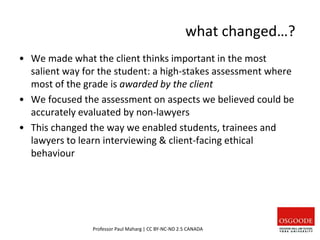
what changed…?
• We made what the client thinks important in the most
salient way for the student: a high-stakes assessment where
most of the grade is awarded by the client
• We focused the assessment on aspects we believed could be
accurately evaluated by non-lawyers
• This changed the way we enabled students, trainees and
lawyers to learn interviewing & client-facing ethical
behaviour
Professor Paul Maharg | CC BY-NC-ND 2.5 CANADA
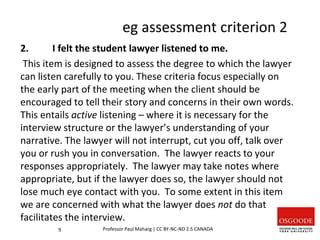
eg assessment criterion 2
2. I felt the student lawyer listened to me.
This item is designed to assess the degree to which the lawyer
can listen carefully to you. These criteria focus especially on
the early part of the meeting when the client should be
encouraged to tell their story and concerns in their own words.
This entails active listening – where it is necessary for the
interview structure or the lawyer’s understanding of your
narrative. The lawyer will not interrupt, cut you off, talk over
you or rush you in conversation. The lawyer reacts to your
responses appropriately. The lawyer may take notes where
appropriate, but if the lawyer does so, the lawyer should not
lose much eye contact with you. To some extent in this item
we are concerned with what the lawyer does not do that
facilitates the interview.
9 Professor Paul Maharg | CC BY-NC-ND 2.5 CANADA
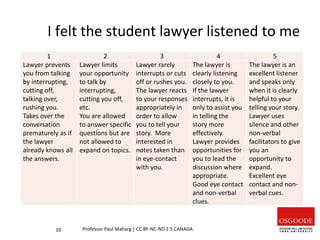
I felt the student lawyer listened to me
1 2 3 4 5
Lawyer prevents
you from talking
by interrupting,
cutting off,
talking over,
rushing you.
Takes over the
conversation
prematurely as if
the lawyer
already knows all
the answers.
Lawyer limits
your opportunity
to talk by
interrupting,
cutting you off,
etc.
You are allowed
to answer specific
questions but are
not allowed to
expand on topics.
Lawyer rarely
interrupts or cuts
off or rushes you.
The lawyer reacts
to your responses
appropriately in
order to allow
you to tell your
story. More
interested in
notes taken than
in eye-contact
with you.
The lawyer is
clearly listening
closely to you.
If the lawyer
interrupts, it is
only to assist you
in telling the
story more
effectively.
Lawyer provides
opportunities for
you to lead the
discussion where
appropriate.
Good eye contact
and non-verbal
clues.
The lawyer is an
excellent listener
and speaks only
when it is clearly
helpful to your
telling your story.
Lawyer uses
silence and other
non-verbal
facilitators to give
you an
opportunity to
expand.
Excellent eye
contact and non-
verbal cues.
10 Professor Paul Maharg | CC BY-NC-ND 2.5 CANADA
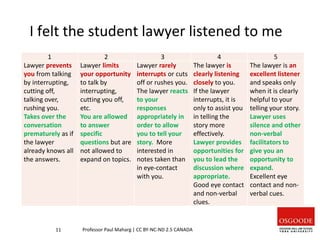
I felt the student lawyer listened to me
1 2 3 4 5
Lawyer prevents
you from talking
by interrupting,
cutting off,
talking over,
rushing you.
Takes over the
conversation
prematurely as if
the lawyer
already knows all
the answers.
Lawyer limits
your opportunity
to talk by
interrupting,
cutting you off,
etc.
You are allowed
to answer
specific
questions but are
not allowed to
expand on topics.
Lawyer rarely
interrupts or cuts
off or rushes you.
The lawyer reacts
to your
responses
appropriately in
order to allow
you to tell your
story. More
interested in
notes taken than
in eye-contact
with you.
The lawyer is
clearly listening
closely to you.
If the lawyer
interrupts, it is
only to assist you
in telling the
story more
effectively.
Lawyer provides
opportunities for
you to lead the
discussion where
appropriate.
Good eye contact
and non-verbal
clues.
The lawyer is an
excellent listener
and speaks only
when it is clearly
helpful to your
telling your story.
Lawyer uses
silence and other
non-verbal
facilitators to
give you an
opportunity to
expand.
Excellent eye
contact and non-
verbal cues.
11 Professor Paul Maharg | CC BY-NC-ND 2.5 CANADA
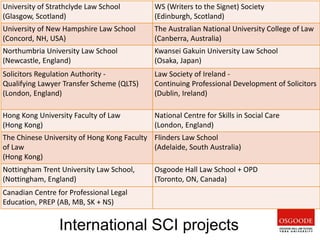
current status of SCI
University of Strathclyde Law School
(Glasgow, Scotland)
WS (Writers to the Signet) Society
(Edinburgh, Scotland)
University of New Hampshire Law School
(Concord, NH, USA)
The Australian National University College of Law
(Canberra, Australia)
Northumbria University Law School
(Newcastle, England)
Kwansei Gakuin University Law School
(Osaka, Japan)
Solicitors Regulation Authority -
Qualifying Lawyer Transfer Scheme (QLTS)
(London, England)
Law Society of Ireland -
Continuing Professional Development of Solicitors
(Dublin, Ireland)
Hong Kong University Faculty of Law
(Hong Kong)
National Centre for Skills in Social Care
(London, England)
The Chinese University of Hong Kong Faculty
of Law
(Hong Kong)
Flinders Law School
(Adelaide, South Australia)
Nottingham Trent University Law School,
(Nottingham, England)
Osgoode Hall Law School + OPD
(Toronto, ON, Canada)
International SCI projects
Canadian Centre for Professional Legal
Education, PREP (AB, MB, SK + NS)
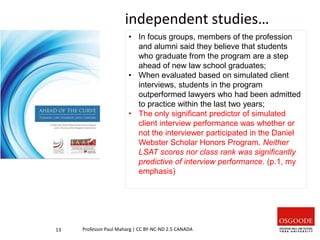
independent studies…
13 Professor Paul Maharg | CC BY-NC-ND 2.5 CANADA
• In focus groups, members of the profession
and alumni said they believe that students
who graduate from the program are a step
ahead of new law school graduates;
• When evaluated based on simulated client
interviews, students in the program
outperformed lawyers who had been admitted
to practice within the last two years;
• The only significant predictor of simulated
client interview performance was whether or
not the interviewer participated in the Daniel
Webster Scholar Honors Program. Neither
LSAT scores nor class rank was significantly
predictive of interview performance. (p.1, my
emphasis)
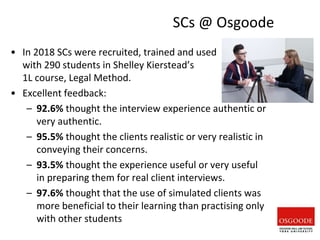
SCs @ Osgoode
• In 2018 SCs were recruited, trained and used
with 290 students in Shelley Kierstead’s
1L course, Legal Method.
• Excellent feedback:
– 92.6% thought the interview experience authentic or
very authentic.
– 95.5% thought the clients realistic or very realistic in
conveying their concerns.
– 93.5% thought the experience useful or very useful
in preparing them for real client interviews.
– 97.6% thought that the use of simulated clients was
more beneficial to their learning than practising only
with other students
• One of my favourite and most worthwhile opportunities all year
• Great opportunity! […] Good low stress experience
• I loved the feedback that the simulated client gave me. She was
honest (but also very kind). I haven’t viewed my video yet , but I’m
sure it will be extremely useful to go back and review my
questions/demeanour/etc.
• Helpful feedback
• I would love to get more opportunities to do this
• Yes, I feel better prepared and the feedback I got was very
reassuring
• I really enjoyed this experience and would recommend that it be
implemented into the legal process course curriculum
• The feedback was splendid I see where I need to improve and at
the same time I was made aware of my strengths that I need to
hone
• I feel like it was worthwhile and that we should have more
opportunities to participate in similar activities
Professor Paul Maharg | CC BY-NC-ND 2.5 CANADA 15
Some comments
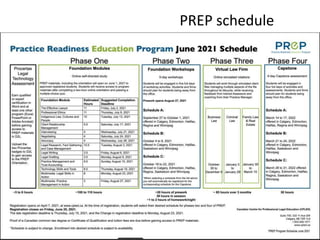
PREP schedule
16
Legal education and technology
‘Houston in the blind’* –
digital professional learning
* See Gravity (2013); and
https://en.wikipedia.org/wiki/Blind_transmission
four provocations on digital legal education
1. Post COVID, resist go-backery, (aka ‘dynamic
conservatism’, Donald Schön’s concept)
2. Don’t recreate analog learning platforms (eg
learning management systems built to
enhance f2f programs)
3. Digital isn’t second-best: it has its own
powerful affordances: use them
4. Digital can transform professional learning
and by adopting leading-edge professional
apps (cf Alberta’s innovation sandbox +
articling placement program – why not fuse
them? )Professor Paul Maharg | CC BY-NC-ND 2.5 CANADA 18
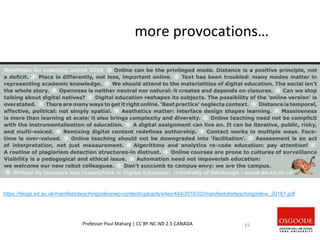
more provocations…
Professor Paul Maharg | CC BY-NC-ND 2.5 CANADA 19
https://blogs.ed.ac.uk/manifestoteachingonline/wp-content/uploads/sites/484/2016/02/manifestoforteachingonline_20161.pdf
some big questions to ask…
• How can we help students transfer learning
from JD academic to professional contexts?
• When students / lawyers work in professional
groupings, how do they do it?
• How do students / lawyers learn to focus on
professional tasks, ethics, relationships, all
simultaneously?
Professor Paul Maharg | CC BY-NC-ND 2.5 CANADA 20
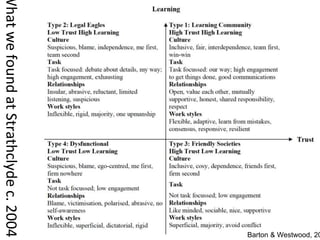
What
we
found
at
Strathclyde
c.
2004
Professor Paul Maharg | CC BY-NC-ND 2.5 CANADA 21
Barton & Westwood, 20
some answers we can give…
Give students / lawyers spaces to practise:
• Agency in their learning
• Habitually enacting high-quality
feedback/forward in their learning
• Flexible, imaginative, critical thinking on
professional platforms
• Confidence, through fusions of trust and
learning
Professor Paul Maharg | CC BY-NC-ND 2.5 CANADA 22
some answers we can give…
Give students / lawyers spaces to practise:
• Agency in their learning
• Habitually enacting high-quality
feedback/forward in their learning
• Flexible, imaginative,
critical thinking
on professional platforms
• Confidence,
through fusions
of trust and learning
Professor Paul Maharg | CC BY-NC-ND 2.5 CANADA 23
The only significant predictor of
simulated client interview
performance was whether or not
the interviewer participated in the
Daniel Webster Scholar Honors
Program. Neither LSAT scores nor
class rank was significantly
predictive of interview performance.
(p.1, my emphasis)
some references…
1. Websites:
1. See Simulated Client Initiative, http://zeugma.typepad.com/sci
2. These slides @ http://paulmaharg.com.
2. Barton, K., Cunningham, C.D., Jones, G.T., Maharg, P. (2006). Valuing what clients think:
standardized clients and the assessment of communicative competence. Clinical Law Review,
13, 1, 1-65.
3. Barton, K., Westwood, F. (2011). Developing professional character - trust, values and
learning. In Maharg, P., Maugham, C. (eds), Affect and Legal Education: Emotion in Learning
and Teaching the Law. London, Routledge.
4. Maharg, P. (2007). Transforming Legal Education: Learning and Teaching the Law in the Early
Twenty-first Century. Aldershot, Ashgate Publishing, chapter 2, 64-67.
5. Garvey, J.B. (2010). A performance-based approach to licensing lawyers: The New Hampshire
‘Two-Year Bar Examination’.
http://www.teachinglegalethics.org/sites/default/files/conference/NH-Conference.pdf
6. Barton, K., Garvey, J.B., Maharg (2013). ‘You are here’: learning law, practice and
professionalism in the academy. In Bankowski, Z., Maharg, P. del Mar, M., editors, The Arts
and the Legal Academy. Beyond Text in Legal Education, vol 1. Routledge.
7. Gerkman, A., Harman, E., Bond, L., Sullivan, .M. (2015). Ahead of the Curve: Turning Law
Students into Lawyers. A Study of the Daniel Webster Honors Program at the University of
New Hampshire School of Law. IAALS, University of Denver.
Professor Paul Maharg | CC BY-NC-ND 2.5 CANADA
25
Email: pmaharg@osgoode.yorku.ca
Osgoode: https//works.bepress.com/paul-maharg
Web: paulmaharg.com
Slides: paulmaharg.com/slides
Professor Paul Maharg | CC BY-NC-ND 2.5 CANADA

Flsc slides, maharg

  • 1.
    Professional legal education: Regulation,technology and design Paul Maharg Osgoode Hall Law School http://paulmaharg.com/slides https://www.slideshare.net/paulmaharg
  • 2.
    preview Legal education and… 1.Regulation: ‘Shared space’ – eg simulated clients 2. Technology: ‘Houston in the blind’ – eg digital professional learning research You can find these slides at: http://paulmaharg.com/slides https://www.slideshare.net/paulmaharg Professor Paul Maharg | CC BY-NC-ND 2.5 CANADA 1
  • 3.
    Legal education andregulation the shared space – eg simulated clients
  • 4.
  • 5.
    regulatory roles? Thekey is shared space Shared spaces concept in traffic zones: • Redistributes risk among road users • Treats road users as responsible, imaginative, human • Holds that environment is a stronger influence on behaviour than formal rules & legislation. ‘All those signs are saying to cars, “this is your space, and we have organized your behavior so that as long as you behave this way, nothing can happen to you”. That is the wrong story’. Hans Monderman, http://bit.ly/1p8fC3u The Art & Science of Shared Streets http://bit.ly/1p8fr8r . redesign relations 2
  • 6.
    shared space = participativeregulation Portrait of the regulator as: 1. Not QA but QE – Quality Enhancer, to focus on culture shifts towards innovation, imagination, change for a democratic society 2. A hub of creativity, shared research, shared practices & guardian of debate around that hub 3. Initiating cycles of funding, research, feedback, feedforward 4. Archive of ed tech memory in the discipline 5. Founder of interdisciplinary, inter-professional trading zones Regulator as democratic designer
  • 7.
    Simulated Client Initiative- we proved our hypothesis in our 2005 study With proper training and carefully designed assessment procedures, Standardised or Simulated Clients (SCs) can assess important aspects of client interviewing with validity and reliability comparable to assessment by law teachers and adjuncts. Professor Paul Maharg | CC BY-NC-ND 2.5 CANADA
  • 8.
    Simulated Client Initiative- we proved our hypothesis in our 2005 study With proper training and carefully designed assessment procedures, Standardised or Simulated Clients (SCs) can assess important aspects of client interviewing with validity and reliability comparable to assessment by law teachers. Professor Paul Maharg | CC BY-NC-ND 2.5 CANADA • Strathclyde Law School • Law Soc of Scotland • College of Law in E+W • Georgia State College of Law • Clinical Skills Unit, Medical Faculty, U of Dundee
  • 9.
    what changed…? • Wemade what the client thinks important in the most salient way for the student: a high-stakes assessment where most of the grade is awarded by the client • We focused the assessment on aspects we believed could be accurately evaluated by non-lawyers • This changed the way we enabled students, trainees and lawyers to learn interviewing & client-facing ethical behaviour Professor Paul Maharg | CC BY-NC-ND 2.5 CANADA
  • 10.
    eg assessment criterion2 2. I felt the student lawyer listened to me. This item is designed to assess the degree to which the lawyer can listen carefully to you. These criteria focus especially on the early part of the meeting when the client should be encouraged to tell their story and concerns in their own words. This entails active listening – where it is necessary for the interview structure or the lawyer’s understanding of your narrative. The lawyer will not interrupt, cut you off, talk over you or rush you in conversation. The lawyer reacts to your responses appropriately. The lawyer may take notes where appropriate, but if the lawyer does so, the lawyer should not lose much eye contact with you. To some extent in this item we are concerned with what the lawyer does not do that facilitates the interview. 9 Professor Paul Maharg | CC BY-NC-ND 2.5 CANADA
  • 11.
    I felt thestudent lawyer listened to me 1 2 3 4 5 Lawyer prevents you from talking by interrupting, cutting off, talking over, rushing you. Takes over the conversation prematurely as if the lawyer already knows all the answers. Lawyer limits your opportunity to talk by interrupting, cutting you off, etc. You are allowed to answer specific questions but are not allowed to expand on topics. Lawyer rarely interrupts or cuts off or rushes you. The lawyer reacts to your responses appropriately in order to allow you to tell your story. More interested in notes taken than in eye-contact with you. The lawyer is clearly listening closely to you. If the lawyer interrupts, it is only to assist you in telling the story more effectively. Lawyer provides opportunities for you to lead the discussion where appropriate. Good eye contact and non-verbal clues. The lawyer is an excellent listener and speaks only when it is clearly helpful to your telling your story. Lawyer uses silence and other non-verbal facilitators to give you an opportunity to expand. Excellent eye contact and non- verbal cues. 10 Professor Paul Maharg | CC BY-NC-ND 2.5 CANADA
  • 12.
    I felt thestudent lawyer listened to me 1 2 3 4 5 Lawyer prevents you from talking by interrupting, cutting off, talking over, rushing you. Takes over the conversation prematurely as if the lawyer already knows all the answers. Lawyer limits your opportunity to talk by interrupting, cutting you off, etc. You are allowed to answer specific questions but are not allowed to expand on topics. Lawyer rarely interrupts or cuts off or rushes you. The lawyer reacts to your responses appropriately in order to allow you to tell your story. More interested in notes taken than in eye-contact with you. The lawyer is clearly listening closely to you. If the lawyer interrupts, it is only to assist you in telling the story more effectively. Lawyer provides opportunities for you to lead the discussion where appropriate. Good eye contact and non-verbal clues. The lawyer is an excellent listener and speaks only when it is clearly helpful to your telling your story. Lawyer uses silence and other non-verbal facilitators to give you an opportunity to expand. Excellent eye contact and non- verbal cues. 11 Professor Paul Maharg | CC BY-NC-ND 2.5 CANADA
  • 13.
    current status ofSCI University of Strathclyde Law School (Glasgow, Scotland) WS (Writers to the Signet) Society (Edinburgh, Scotland) University of New Hampshire Law School (Concord, NH, USA) The Australian National University College of Law (Canberra, Australia) Northumbria University Law School (Newcastle, England) Kwansei Gakuin University Law School (Osaka, Japan) Solicitors Regulation Authority - Qualifying Lawyer Transfer Scheme (QLTS) (London, England) Law Society of Ireland - Continuing Professional Development of Solicitors (Dublin, Ireland) Hong Kong University Faculty of Law (Hong Kong) National Centre for Skills in Social Care (London, England) The Chinese University of Hong Kong Faculty of Law (Hong Kong) Flinders Law School (Adelaide, South Australia) Nottingham Trent University Law School, (Nottingham, England) Osgoode Hall Law School + OPD (Toronto, ON, Canada) International SCI projects Canadian Centre for Professional Legal Education, PREP (AB, MB, SK + NS)
  • 14.
    independent studies… 13 ProfessorPaul Maharg | CC BY-NC-ND 2.5 CANADA • In focus groups, members of the profession and alumni said they believe that students who graduate from the program are a step ahead of new law school graduates; • When evaluated based on simulated client interviews, students in the program outperformed lawyers who had been admitted to practice within the last two years; • The only significant predictor of simulated client interview performance was whether or not the interviewer participated in the Daniel Webster Scholar Honors Program. Neither LSAT scores nor class rank was significantly predictive of interview performance. (p.1, my emphasis)
  • 15.
    SCs @ Osgoode •In 2018 SCs were recruited, trained and used with 290 students in Shelley Kierstead’s 1L course, Legal Method. • Excellent feedback: – 92.6% thought the interview experience authentic or very authentic. – 95.5% thought the clients realistic or very realistic in conveying their concerns. – 93.5% thought the experience useful or very useful in preparing them for real client interviews. – 97.6% thought that the use of simulated clients was more beneficial to their learning than practising only with other students
  • 16.
    • One ofmy favourite and most worthwhile opportunities all year • Great opportunity! […] Good low stress experience • I loved the feedback that the simulated client gave me. She was honest (but also very kind). I haven’t viewed my video yet , but I’m sure it will be extremely useful to go back and review my questions/demeanour/etc. • Helpful feedback • I would love to get more opportunities to do this • Yes, I feel better prepared and the feedback I got was very reassuring • I really enjoyed this experience and would recommend that it be implemented into the legal process course curriculum • The feedback was splendid I see where I need to improve and at the same time I was made aware of my strengths that I need to hone • I feel like it was worthwhile and that we should have more opportunities to participate in similar activities Professor Paul Maharg | CC BY-NC-ND 2.5 CANADA 15 Some comments
  • 17.
  • 18.
    Legal education andtechnology ‘Houston in the blind’* – digital professional learning * See Gravity (2013); and https://en.wikipedia.org/wiki/Blind_transmission
  • 19.
    four provocations ondigital legal education 1. Post COVID, resist go-backery, (aka ‘dynamic conservatism’, Donald Schön’s concept) 2. Don’t recreate analog learning platforms (eg learning management systems built to enhance f2f programs) 3. Digital isn’t second-best: it has its own powerful affordances: use them 4. Digital can transform professional learning and by adopting leading-edge professional apps (cf Alberta’s innovation sandbox + articling placement program – why not fuse them? )Professor Paul Maharg | CC BY-NC-ND 2.5 CANADA 18
  • 20.
    more provocations… Professor PaulMaharg | CC BY-NC-ND 2.5 CANADA 19 https://blogs.ed.ac.uk/manifestoteachingonline/wp-content/uploads/sites/484/2016/02/manifestoforteachingonline_20161.pdf
  • 21.
    some big questionsto ask… • How can we help students transfer learning from JD academic to professional contexts? • When students / lawyers work in professional groupings, how do they do it? • How do students / lawyers learn to focus on professional tasks, ethics, relationships, all simultaneously? Professor Paul Maharg | CC BY-NC-ND 2.5 CANADA 20
  • 22.
    What we found at Strathclyde c. 2004 Professor Paul Maharg| CC BY-NC-ND 2.5 CANADA 21 Barton & Westwood, 20
  • 23.
    some answers wecan give… Give students / lawyers spaces to practise: • Agency in their learning • Habitually enacting high-quality feedback/forward in their learning • Flexible, imaginative, critical thinking on professional platforms • Confidence, through fusions of trust and learning Professor Paul Maharg | CC BY-NC-ND 2.5 CANADA 22
  • 24.
    some answers wecan give… Give students / lawyers spaces to practise: • Agency in their learning • Habitually enacting high-quality feedback/forward in their learning • Flexible, imaginative, critical thinking on professional platforms • Confidence, through fusions of trust and learning Professor Paul Maharg | CC BY-NC-ND 2.5 CANADA 23 The only significant predictor of simulated client interview performance was whether or not the interviewer participated in the Daniel Webster Scholar Honors Program. Neither LSAT scores nor class rank was significantly predictive of interview performance. (p.1, my emphasis)
  • 25.
    some references… 1. Websites: 1.See Simulated Client Initiative, http://zeugma.typepad.com/sci 2. These slides @ http://paulmaharg.com. 2. Barton, K., Cunningham, C.D., Jones, G.T., Maharg, P. (2006). Valuing what clients think: standardized clients and the assessment of communicative competence. Clinical Law Review, 13, 1, 1-65. 3. Barton, K., Westwood, F. (2011). Developing professional character - trust, values and learning. In Maharg, P., Maugham, C. (eds), Affect and Legal Education: Emotion in Learning and Teaching the Law. London, Routledge. 4. Maharg, P. (2007). Transforming Legal Education: Learning and Teaching the Law in the Early Twenty-first Century. Aldershot, Ashgate Publishing, chapter 2, 64-67. 5. Garvey, J.B. (2010). A performance-based approach to licensing lawyers: The New Hampshire ‘Two-Year Bar Examination’. http://www.teachinglegalethics.org/sites/default/files/conference/NH-Conference.pdf 6. Barton, K., Garvey, J.B., Maharg (2013). ‘You are here’: learning law, practice and professionalism in the academy. In Bankowski, Z., Maharg, P. del Mar, M., editors, The Arts and the Legal Academy. Beyond Text in Legal Education, vol 1. Routledge. 7. Gerkman, A., Harman, E., Bond, L., Sullivan, .M. (2015). Ahead of the Curve: Turning Law Students into Lawyers. A Study of the Daniel Webster Honors Program at the University of New Hampshire School of Law. IAALS, University of Denver. Professor Paul Maharg | CC BY-NC-ND 2.5 CANADA
  • 26.
    25 Email: pmaharg@osgoode.yorku.ca Osgoode: https//works.bepress.com/paul-maharg Web:paulmaharg.com Slides: paulmaharg.com/slides Professor Paul Maharg | CC BY-NC-ND 2.5 CANADA