z
SUBMITTED TO:- SUBMITTD BY :-
Ms. Aruna Ms. Nriti Supolia
(Assistant Professor) (M.Sc. Nursing 1st year)
{2240982502}
PRESENTATION ON :-
SIMULATION
z
INTRODUCTION:-
Simulation is the basis of sensitive training , sociodrama role playing and
psychodrama. It is not actual training . It is assumed that through role
perception the psychological appreciation of the classroom problems will
grow and develop in the student – teacher a basis for handling the
problem in the class.
MEANING:-
According to international dictionary of education , simulation is a
teaching technique used particularly in management education and
training in which a ‘real life situation’ and values are simulated by
‘substitute’ displaying similar characteristics.
DEFINITION:-
Simulation have been defined as an operating representation of central
features of reality.
-BT Basavanthappa ,2003
z
CONTINUE………
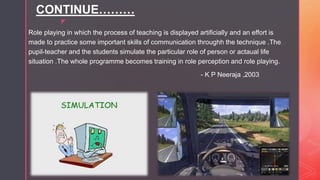
Role playing in which the process of teaching is displayed artificially and an effort is
made to practice some important skills of communication throughh the technique .The
pupil-teacher and the students simulate the particular role of person or actaual life
situation .The whole programme becomes training in role perception and role playing.
- K P Neeraja ,2003
z
 TYPESOF SIMULATION
z
CHARACTERISTISTICS OFSIMULATION:-
A good simulation will be: Mirror real situation.
Provide a safe environment in which learning has priority
over patient care or system demands.
Provide immediate feedback on performance.
It is very convenient method.
z
APPLICATIONOF SIMULATIONINTEACHERTRAINING:-
Crruikshank (1968) has developed a teacher training system which includes.
 The participant is introduced into the situation i.e . If he is a new teacher in
school.
 The participant is provided with information and opportunities to solve the
problems.
 The participant is exposed to a variety of potential solutions to a particular
problem.
 The participant is given to the opportunity of observing the result of his
chosen line of action.
 The participants is also given the material.
 The participant is presented with role playing situations.
 The participants the identifies the factors influencing the problem.
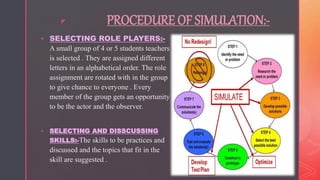
z PROCEDURE OF SIMULATION:-
 SELECTING ROLE PLAYERS:-
A small group of 4 or 5 students teachers
is selected . They are assigned different
letters in an alphabetical order. The role
assignment are rotated with in the group
to give chance to everyone . Every
member of the group gets an opportunity
to be the actor and the observer.
 SELECTING AND DISSCUSSING
SKILLS:-The skills to be practices and
discussed and the topics that fit in the
skill are suggested .
z
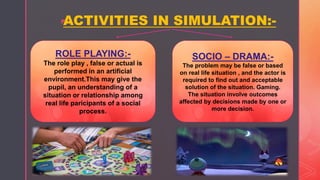
ACTIVITIES IN SIMULATION:-
ROLE PLAYING:-
The role play , false or actual is
performed in an artificial
environment.This may give the
pupil, an understanding of a
situation or relationship among
real life paricipants of a social
process.
SOCIO – DRAMA:-
The problem may be false or based
on real life situation , and the actor is
required to find out and acceptable
solution of the situation. Gaming.
The situation involve outcomes
affected by decisions made by one or
more decision.
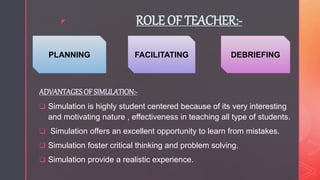
z ROLE OF TEACHER:-
ADVANTAGESOF SIMULATION:-
 Simulation is highly student centered because of its very interesting
and motivating nature , effectiveness in teaching all type of students.
 Simulation offers an excellent opportunity to learn from mistakes.
 Simulation foster critical thinking and problem solving.
 Simulation provide a realistic experience.
PLANNING FACILITATING DEBRIEFING
z
DISADVANTAGES:-
z
BIBLIOGRAPHY:-
 Raj Bhashara Elakkuvana , Bhaskar Nima , Text Book of Nursing
Education , EMMESS Publisher , Second Edition , Page No.
{121 – 125}.
 Bassvanthappa BT. , Nursing Education ,Jaypee Publisher, 2nd
Edition.
 https://www.slideshare.com
 https://study.com
 https://www.sciencedirect.com.
simulation peer group.pptx

simulation peer group.pptx

  • 1.
    z SUBMITTED TO:- SUBMITTDBY :- Ms. Aruna Ms. Nriti Supolia (Assistant Professor) (M.Sc. Nursing 1st year) {2240982502} PRESENTATION ON :- SIMULATION
  • 2.
    z INTRODUCTION:- Simulation is thebasis of sensitive training , sociodrama role playing and psychodrama. It is not actual training . It is assumed that through role perception the psychological appreciation of the classroom problems will grow and develop in the student – teacher a basis for handling the problem in the class. MEANING:- According to international dictionary of education , simulation is a teaching technique used particularly in management education and training in which a ‘real life situation’ and values are simulated by ‘substitute’ displaying similar characteristics. DEFINITION:- Simulation have been defined as an operating representation of central features of reality. -BT Basavanthappa ,2003
  • 3.
    z CONTINUE……… Role playing inwhich the process of teaching is displayed artificially and an effort is made to practice some important skills of communication throughh the technique .The pupil-teacher and the students simulate the particular role of person or actaual life situation .The whole programme becomes training in role perception and role playing. - K P Neeraja ,2003
  • 4.
  • 5.
    z CHARACTERISTISTICS OFSIMULATION:- A goodsimulation will be: Mirror real situation. Provide a safe environment in which learning has priority over patient care or system demands. Provide immediate feedback on performance. It is very convenient method.
  • 6.
    z APPLICATIONOF SIMULATIONINTEACHERTRAINING:- Crruikshank (1968)has developed a teacher training system which includes.  The participant is introduced into the situation i.e . If he is a new teacher in school.  The participant is provided with information and opportunities to solve the problems.  The participant is exposed to a variety of potential solutions to a particular problem.  The participant is given to the opportunity of observing the result of his chosen line of action.  The participants is also given the material.  The participant is presented with role playing situations.  The participants the identifies the factors influencing the problem.
  • 7.
    z PROCEDURE OFSIMULATION:-  SELECTING ROLE PLAYERS:- A small group of 4 or 5 students teachers is selected . They are assigned different letters in an alphabetical order. The role assignment are rotated with in the group to give chance to everyone . Every member of the group gets an opportunity to be the actor and the observer.  SELECTING AND DISSCUSSING SKILLS:-The skills to be practices and discussed and the topics that fit in the skill are suggested .
  • 8.
    z ACTIVITIES IN SIMULATION:- ROLEPLAYING:- The role play , false or actual is performed in an artificial environment.This may give the pupil, an understanding of a situation or relationship among real life paricipants of a social process. SOCIO – DRAMA:- The problem may be false or based on real life situation , and the actor is required to find out and acceptable solution of the situation. Gaming. The situation involve outcomes affected by decisions made by one or more decision.
  • 9.
    z ROLE OFTEACHER:- ADVANTAGESOF SIMULATION:-  Simulation is highly student centered because of its very interesting and motivating nature , effectiveness in teaching all type of students.  Simulation offers an excellent opportunity to learn from mistakes.  Simulation foster critical thinking and problem solving.  Simulation provide a realistic experience. PLANNING FACILITATING DEBRIEFING
  • 10.
  • 11.
    z BIBLIOGRAPHY:-  Raj BhasharaElakkuvana , Bhaskar Nima , Text Book of Nursing Education , EMMESS Publisher , Second Edition , Page No. {121 – 125}.  Bassvanthappa BT. , Nursing Education ,Jaypee Publisher, 2nd Edition.  https://www.slideshare.com  https://study.com  https://www.sciencedirect.com.