SIMULATION
By
Kripa Susan Babu
I Med
KRTC Kollam
INTRODUCTION
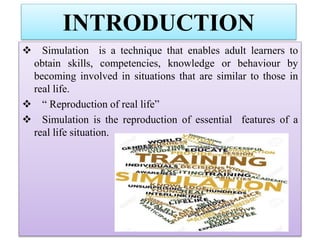
 Simulation is a technique that enables adult learners to
obtain skills, competencies, knowledge or behaviour by
becoming involved in situations that are similar to those in
real life.
 “ Reproduction of real life”
 Simulation is the reproduction of essential features of a
real life situation.
MEANING OF SIMULATION
• Simulation may be defined as a role playing in
which the process of teaching is enacted
artificially and an effort is made to practise
some important skill of communication
through this.
• The student teacher and the students simulate a
particular role and try to develop an identity
with the actual classroom environment.
DEFINITION OF SIMULATION
1. R Wynn (1964)
“ Simulation is an accurate representation of
realistic situation”.
2. W.R. Fritz (1965)
“ Simulation may be considered as a
dynamic implementation of a model representing a
physical or mathematical system.”
Simulations have the potential to
engage students in “ deep learning”
that empowers understanding as
opposed to “ surface learning” that
requires only memorization.
• Simulation promote the use of critical and
evaluative thinking
• Promote concept attainment through
experimental practice
• Avoids the expensive, time consuming and
disruptive nature of traditional trial and error
techniques.
• Simulation method is risk free
• Encourages thinking outside the box
Advantages of Simulation
• Test the behaviour
• Analyse the system
• Give accurate results
• Get faults in the system
• Animation and Modelling
• Help Students
Disadvantages of Simulation
• Expensive
• Interpretation of simulation data is
difficult
• Does not generate an optimal
solution
• Takes a long time
• Computer limitation
Simulation Software
• AUTODESK
• Simul8
• Math Works
• Arena
• MATHLAB
• Algodoo
• Any Logic
• Simulation X
THANK YOU

Simulation

  • 1.
  • 2.
    INTRODUCTION  Simulation isa technique that enables adult learners to obtain skills, competencies, knowledge or behaviour by becoming involved in situations that are similar to those in real life.  “ Reproduction of real life”  Simulation is the reproduction of essential features of a real life situation.
  • 3.
    MEANING OF SIMULATION •Simulation may be defined as a role playing in which the process of teaching is enacted artificially and an effort is made to practise some important skill of communication through this. • The student teacher and the students simulate a particular role and try to develop an identity with the actual classroom environment.
  • 4.
    DEFINITION OF SIMULATION 1.R Wynn (1964) “ Simulation is an accurate representation of realistic situation”. 2. W.R. Fritz (1965) “ Simulation may be considered as a dynamic implementation of a model representing a physical or mathematical system.”
  • 5.
    Simulations have thepotential to engage students in “ deep learning” that empowers understanding as opposed to “ surface learning” that requires only memorization.
  • 6.
    • Simulation promotethe use of critical and evaluative thinking • Promote concept attainment through experimental practice • Avoids the expensive, time consuming and disruptive nature of traditional trial and error techniques. • Simulation method is risk free • Encourages thinking outside the box
  • 7.
    Advantages of Simulation •Test the behaviour • Analyse the system • Give accurate results • Get faults in the system • Animation and Modelling • Help Students
  • 8.
    Disadvantages of Simulation •Expensive • Interpretation of simulation data is difficult • Does not generate an optimal solution • Takes a long time • Computer limitation
  • 9.
    Simulation Software • AUTODESK •Simul8 • Math Works • Arena • MATHLAB • Algodoo • Any Logic • Simulation X
  • 10.