MATH
   VOCABULARY


7/12/2012   Source: teachers.rmcity.org
calculate
• Perform (do) an operation (+,-,x,÷)


   7/12/2012      Source: teachers.rmcity.org
operation
Describes any of these:
– ADDITION
– SUBTRACTION
– MULTIPLICATION
– DIVISION


 7/12/2012     Source: teachers.rmcity.org
evaluate


• To find the value of something.
  – Value is what something is worth.


   7/12/2012     Source: teachers.rmcity.org
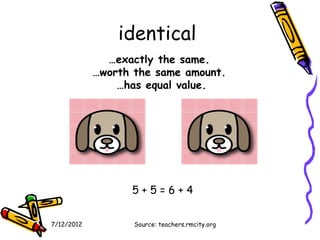
identical
              …exactly the same.
            …worth the same amount.
                …has equal value.


                  5+5=6+4


7/12/2012          Source: teachers.rmcity.org
standard form
• A number as we are used to seeing it
  in everyday life…
• Examples are:
  – 24
  – 765
  – 8,758,215… etc.


   7/12/2012     Source: teachers.rmcity.org
expanded form
• A number written out to show the
  place value of each of its digits.
• Examples:
  – 20 + 4
  – 700 + 60 + 5
  – 8,000,000 + 700,000 + 50,000 + 8,000 +
    200 + 10 + 5


   7/12/2012    Source: teachers.rmcity.org
word form
• A number written out in words.
• Examples:
  – twenty-four
  – seven hundred sixty-five
  – eight million, seven hundred fifty-eight
    thousand, two hundred fifteen


   7/12/2012      Source: teachers.rmcity.org
natural numbers
• Also called whole numbers.
• These are the numbers we use to
  count things.


   7/12/2012   Source: teachers.rmcity.org
digit
• One of the TEN symbols that are
  used to write numbers.
• 0,1,2,3,4,5,6,7,8 and 9
• “0” is a DIGIT, not a NUMBER!


   7/12/2012    Source: teachers.rmcity.org
place value
• The value of a digit that is based on
  it’s position in a number.
• Example:
  – In the number “674”, the 7 is in the
    tens place, so it’s place value is 70.


   7/12/2012       Source: teachers.rmcity.org
period
• A number is divided into groups of
  three, starting from the right and
  each separated by a comma. These
  groups are called periods.
• Example:
  – The number 127,453,989 has THREE
    periods.


   7/12/2012    Source: teachers.rmcity.org
7/12/2012   Source: teachers.rmcity.org
inequality
• A statement that one quantity (also
  called “amount”) is greater than or
  less than another.
• Uses the symbols:
     Greater than >
     Less than <
     **Remember that when you read these symbols
      from the left to the right, the open end is
      open to the bigger quantity, no matter how
      you look at it.
   7/12/2012      Source: teachers.rmcity.org
infinite
• Goes on and on FOREVER
• Doesn’t end


   7/12/2012     Source: teachers.rmcity.org
line
• A type of curve that is straight.
• It extends INFINITELY in both
  directions.


   7/12/2012    Source: teachers.rmcity.org
line segment
• The part of a line between two
  points, called endpoints.


   7/12/2012        Source: teachers.rmcity.org
ray
• A straight curve that has exactly
  ONE ENDPOINT.
• Then it extends INFINITELY in one
  direction.


   7/12/2012   Source: teachers.rmcity.org
7/12/2012   Source: teachers.rmcity.org
round number
• A natural number ending in one or
  more zeros.
  – Examples include:
     •   20
     •   300,000
     •   100
     •   7,000,000


   7/12/2012         Source: teachers.rmcity.org
approximate value
• A value that is close to, but not
  exactly, the real value.
• Approximate value is easier to work
  with than real value.
• Example:
  – 750,000 is an approximate value for the
    real value of 748,362.


   7/12/2012     Source: teachers.rmcity.org
exact
• The actual amount, the real value.
• Example:
  – The exact amount of students in this
    school is 639.
  – What would be the approximate
    amount?


   7/12/2012     Source: teachers.rmcity.org
estimate
• To find a number that may not be the
  exact answer to a question, but is
  close enough.
• We say, then, that it is an estimate
  of the exact value.
  – Which is an example of an estimate?
    Exact or approximate value?


   7/12/2012     Source: teachers.rmcity.org
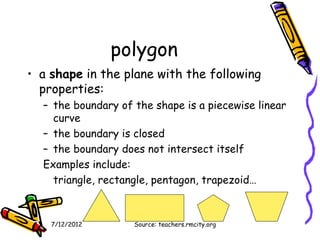
polygon
• a shape in the plane with the following
  properties:
  – the boundary of the shape is a piecewise linear
    curve
  – the boundary is closed
  – the boundary does not intersect itself
  Examples include:
    triangle, rectangle, pentagon, trapezoid…


    7/12/2012       Source: teachers.rmcity.org
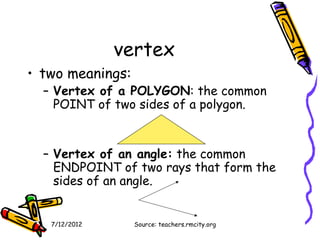
vertex
• two meanings:
  – Vertex of a POLYGON: the common
    POINT of two sides of a polygon.


  – Vertex of an angle: the common
    ENDPOINT of two rays that form the
    sides of an angle.


   7/12/2012      Source: teachers.rmcity.org
perimeter
• The length of a boundary of a shape
  in a plane.
• The SUM of the sides of a polygon!
• 3cm+3cm+3cm+3cm+3cm+3cm+3cm+3cm= 24 cm
                            3 cm
                 3 cm                 3 cm


               3 cm                        3 cm


                3 cm                   3 cm
   7/12/2012
                             3 cm
                       Source: teachers.rmcity.org
compatible numbers
• Add together to make a round number (a
  number that ends in zero).
• Example:
  17 and 3 are compatible because when you add
    them, the answer is 20. (20 is a round number)
• Non-Example:
  – 24 and 5 are NOTcompatible because when you
    add them, the answer is 29. (29 is not round)


   7/12/2012        Source: teachers.rmcity.org
Commutative Property
     (of Addition)
• When adding numbers, the order of
  the addition does not matter.

               2 + 3 = 3 + 2

  **You can move the numbers around, just
    like people commute…


   7/12/2012    Source: teachers.rmcity.org
Associative Property
      (of Addition)

• When adding numbers, it doesn’t matter
  which ones you group together to do the
  addition.

                (5 + 2) + 8 = 5 + (2 + 8)

**Associates are friends, so think about
  groups of friends…

    7/12/2012          Source: teachers.rmcity.org
sum
• The answer to an addition problem.


• Example:
   5+3=8
    8 is the sum.


   7/12/2012        Source: teachers.rmcity.org
summand
• The numbers you are adding together
  in an addition problem.

 5+3=8
   5 and 3 are the summands.

*same thing as “addends”

   7/12/2012     Source: teachers.rmcity.org
convenient addition
• Convenient means “easy”.
• So, convenient addition is the
  process of using compatible numbers,
  the Commutative Property and the
  Associative Property to make your
  addition easier and quicker.


   7/12/2012   Source: teachers.rmcity.org
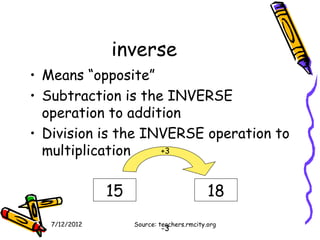
inverse
• Means “opposite”
• Subtraction is the INVERSE
  operation to addition
• Division is the INVERSE operation to
  multiplication    +3


               15                           18
   7/12/2012        Source: teachers.rmcity.org
                            -3
subtraction
• An operation that means finding a
  missing summand, given the sum and
  the other summand…

   2 + __ = 5 …to solve it, use 5 – 2 = __


   7/12/2012       Source: teachers.rmcity.org
difference
• The answer to a subtraction problem.

                 5–2=3

 3 is the difference between 5 and 2


   7/12/2012      Source: teachers.rmcity.org
subtrahend and minuend
• minuend – subtrahend = difference
• Minuend is the number you start
  with…
• Subtrahend is the number you
  subtract…
              5–2=3


   7/12/2012   Source: teachers.rmcity.org
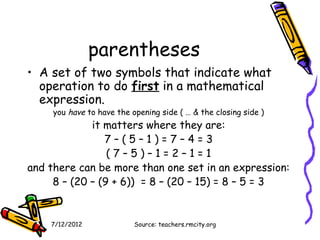
parentheses
• A set of two symbols that indicate what
  operation to do first in a mathematical
  expression.
     you have to have the opening side ( … & the closing side )
             it matters where they are:
                7–(5–1)=7–4=3
                 (7–5)–1=2–1=1
and there can be more than one set in an expression:
     8 – (20 – (9 + 6)) = 8 – (20 – 15) = 8 – 5 = 3


    7/12/2012              Source: teachers.rmcity.org
numerical expression
• A mathematically meaningful sequence of
  numbers, operation signs and parentheses.

                5 + (9 – 2)

     Numerical expressions tell us what
   operations to do FIRST, SECOND… etc.


    7/12/2012    Source: teachers.rmcity.org
algebraic expression
• A mathematically meaningful sequence of
  numbers, letters that stand for numbers,
  operation signs and parentheses.

                 3 + (a – 4)

We can replace that “a” with any number we
  want to… it’s called a VARIABLE because
 it can change. Any letter can be a variable.


   7/12/2012      Source: teachers.rmcity.org
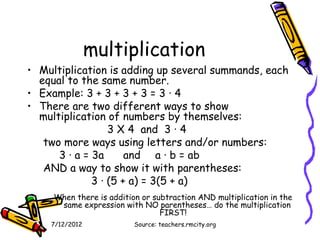
multiplication
• Multiplication is adding up several summands, each
  equal to the same number.
• Example: 3 + 3 + 3 + 3 = 3 · 4
• There are two different ways to show
  multiplication of numbers by themselves:
                  3 X 4 and 3 · 4
   two more ways using letters and/or numbers:
      3 · a = 3a      and a · b = ab
   AND a way to show it with parentheses:
              3 · (5 + a) = 3(5 + a)
     When there is addition or subtraction AND multiplication in the
      same expression with NO parentheses… do the multiplication
                                 FIRST!
    7/12/2012             Source: teachers.rmcity.org
factors
• The numbers we multiply together.
               3·4 = 12
        3 and 4 are factors of 12

                7·(6+4) = 70
           7 and (6+4) are factors


   7/12/2012      Source: teachers.rmcity.org
product
• The result of multiplication.

                3 · 4 = 12
     12 is the product of 3 times 4


   7/12/2012     Source: teachers.rmcity.org
Commutative Property of
    Multiplication
• The product of two numbers does not
  change if we swap (change the order)
  of the factors…
              m·n=n·m
              3·4=4·3


   7/12/2012   Source: teachers.rmcity.org
Associative Property of
     Multiplication
• Changing the grouping of the factors
  does not change the product…
          (a · b) · c = a · (b · c)
         (3 · 4) · 2 = 3 · (4 · 2)


   7/12/2012   Source: teachers.rmcity.org
Zero Property of
        Multiplication
• The product of any number and zero
  is zero.
               0·n=0
               n·0=0


   7/12/2012   Source: teachers.rmcity.org
One (Identity) Property
    of Multiplication
• The product of any number and 1 is
  that number…
          4 · 1 = 1+1+1+1 = 4
                n·1=n
                1·n=n


   7/12/2012   Source: teachers.rmcity.org
exponent
• The “little” number in the following
  expression:
                    5³
 … which means that we need to take 5
    and multiply it by itself 3 times
             5 x 5 x 5 = 125
      …it is also called a “power”

   7/12/2012      Source: teachers.rmcity.org
protractor
• An instrument used to measure
  angles.


   7/12/2012      Source: teachers.rmcity.org
degree
• The unit used to measure angles.
• Usually written as a small circle in
  the superscript after a number:
     Example: 60°


   7/12/2012     Source: teachers.rmcity.org
right angle
• An angle measuring exactly 90°


   7/12/2012       Source: teachers.rmcity.org
obtuse angle
• Any angle that is larger than 90°


   7/12/2012       Source: teachers.rmcity.org
acute angle
• Any angle that is less than 90°


   7/12/2012       Source: teachers.rmcity.org
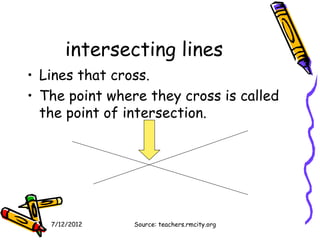
intersecting lines
• Lines that cross.
• The point where they cross is called
  the point of intersection.


   7/12/2012    Source: teachers.rmcity.org
parallel lines
• Two lines that will never cross.
• They stay the same distance apart
  forever.


   7/12/2012        Source: teachers.rmcity.org
perpendicular lines
• Two lines that meet to form right
  (90°) angles.


   7/12/2012   Source: teachers.rmcity.org
dividend
• The number that is being divided

                   A÷B=C

               A is the dividend


   7/12/2012       Source: teachers.rmcity.org
divisor
• The number we are dividing by

                  A÷B=C

               B is the divisor


   7/12/2012       Source: teachers.rmcity.org
quotient
• The result of division

                  A÷B=C

               C is the quotient


   7/12/2012       Source: teachers.rmcity.org
remainder
• The number left over after the
  divisor has gone into the dividend as
  many times as it can.

             7÷3=2R1
 …because 3 goes into 7 two times and
           has one leftover


   7/12/2012      Source: teachers.rmcity.org
area
• The measure of the total amount of
  surface on a plane that an object
  takes up.
• We use “square” units to measure
  area


   7/12/2012    Source: teachers.rmcity.org
vertical
• UP and DOWN
• Goes from top to bottom in a
  straight line.


   7/12/2012     Source: teachers.rmcity.org
horizontal
• Goes side to side, from left to right
  or right to left in a straight line.


   7/12/2012      Source: teachers.rmcity.org
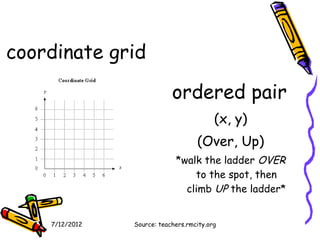
coordinate grid

                            ordered pair
                                          (x, y)
                                    (Over, Up)
                             *walk the ladder OVER
                                 to the spot, then
                               climb UP the ladder*


    7/12/2012   Source: teachers.rmcity.org
bar graph
- Shows data that tells how many or how much

 Single bar                      Double bar


  7/12/2012      Source: teachers.rmcity.org
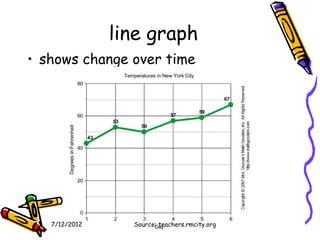
line graph
• shows change over time


   7/12/2012     Source: teachers.rmcity.org
circle graph
• shows a part-whole relationship


   7/12/2012       Source: teachers.rmcity.org
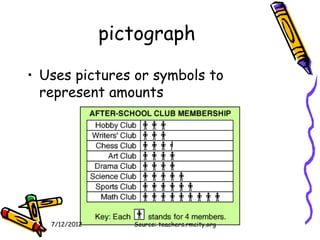
pictograph

• Uses pictures or symbols to
  represent amounts


   7/12/2012      Source: teachers.rmcity.org
prime
• Having EXACTLY two factors
• Those factors are 1 and itself

Examples:
    5    7     23     51         113…


   7/12/2012    Source: teachers.rmcity.org
composite
• Has MORE THAN two factors…

Examples:
 4 12 24          27        56         144      169


   7/12/2012      Source: teachers.rmcity.org
Greatest Common Factor
         (GCF)
• the GCF of a group of numbers is the
  greatest natural number that divides
  (is a factor of) each of the numbers
  in the group (common).

• The GCF of 8 and 12 is the factor 4 because it is
  the biggest number that both of them can be
  divided by.


    7/12/2012        Source: teachers.rmcity.org
Least Common Multiple
          (LCM)
• The smallest number that is divisible by
  both numbers in question.
• Example: the LCM of 6 and 9
  List the first 9 multiples of each number:
     6: 6, 12, 18, 24, 30, 36, 42, 48, 54
     9: 9, 18, 27, 36, 45, 54, 63, 72, 81
   – Then look for the least number that is listed
     under both… so, 18 is the LCM of 6 and 9


    7/12/2012        Source: teachers.rmcity.org
fraction
• A collection of several equal parts
  into which a whole is divided.
• A fraction always divides a whole into
  EQUAL PARTS.


   7/12/2012     Source: teachers.rmcity.org
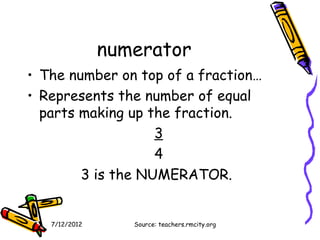
numerator
• The number on top of a fraction…
• Represents the number of equal
  parts making up the fraction.
                   3
                   4
        3 is the NUMERATOR.


   7/12/2012      Source: teachers.rmcity.org
denominator
• The number on the bottom of a fraction.
• Represents the TOTAL number of equal
  parts into which the whole is divided.
                      3
                      4
          4 is the DENOMINATOR.


   7/12/2012       Source: teachers.rmcity.org
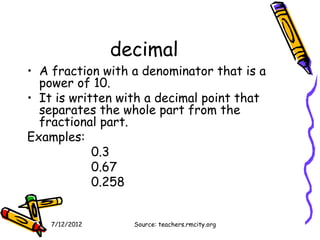
decimal
• A fraction with a denominator that is a
  power of 10.
• It is written with a decimal point that
  separates the whole part from the
  fractional part.
Examples:
            0.3
            0.67
            0.258


    7/12/2012     Source: teachers.rmcity.org
equivalent fractions
•   When you multiply or divide BOTH
    the numerator and denominator of a
    fraction by the SAME number, you
    generate equivalent fractions.
•   They are worth the same amount,
    but they appear different.


    7/12/2012   Source: teachers.rmcity.org
simplest form of a
          fraction
• When the GCF of the numerator and
  denominator is 1.
• To find Simplest Form, simply find
  the GCF of the numerator and
  denominator, then divide them both
  by that number.


   7/12/2012   Source: teachers.rmcity.org
improper fraction
• A fraction where the numerator is
  greater than or equal to the
  denominator.
• all improper fractions are greater
  than or equal to one whole.


   7/12/2012   Source: teachers.rmcity.org
mixed number
• A way of writing numbers that is the
  sum of a whole number and a
  fraction.


   7/12/2012    Source: teachers.rmcity.org
volume


7/12/2012     Source: teachers.rmcity.org
median


7/12/2012     Source: teachers.rmcity.org
mode


7/12/2012    Source: teachers.rmcity.org
range


7/12/2012    Source: teachers.rmcity.org

Mathvocabulary

  • 1.
    MATH VOCABULARY 7/12/2012 Source: teachers.rmcity.org
  • 2.
    calculate • Perform (do)an operation (+,-,x,÷) 7/12/2012 Source: teachers.rmcity.org
  • 3.
    operation Describes any ofthese: – ADDITION – SUBTRACTION – MULTIPLICATION – DIVISION 7/12/2012 Source: teachers.rmcity.org
  • 4.
    evaluate • To findthe value of something. – Value is what something is worth. 7/12/2012 Source: teachers.rmcity.org
  • 5.
    identical …exactly the same. …worth the same amount. …has equal value. 5+5=6+4 7/12/2012 Source: teachers.rmcity.org
  • 6.
    standard form • Anumber as we are used to seeing it in everyday life… • Examples are: – 24 – 765 – 8,758,215… etc. 7/12/2012 Source: teachers.rmcity.org
  • 7.
    expanded form • Anumber written out to show the place value of each of its digits. • Examples: – 20 + 4 – 700 + 60 + 5 – 8,000,000 + 700,000 + 50,000 + 8,000 + 200 + 10 + 5 7/12/2012 Source: teachers.rmcity.org
  • 8.
    word form • Anumber written out in words. • Examples: – twenty-four – seven hundred sixty-five – eight million, seven hundred fifty-eight thousand, two hundred fifteen 7/12/2012 Source: teachers.rmcity.org
  • 9.
    natural numbers • Alsocalled whole numbers. • These are the numbers we use to count things. 7/12/2012 Source: teachers.rmcity.org
  • 10.
    digit • One ofthe TEN symbols that are used to write numbers. • 0,1,2,3,4,5,6,7,8 and 9 • “0” is a DIGIT, not a NUMBER! 7/12/2012 Source: teachers.rmcity.org
  • 11.
    place value • Thevalue of a digit that is based on it’s position in a number. • Example: – In the number “674”, the 7 is in the tens place, so it’s place value is 70. 7/12/2012 Source: teachers.rmcity.org
  • 12.
    period • A numberis divided into groups of three, starting from the right and each separated by a comma. These groups are called periods. • Example: – The number 127,453,989 has THREE periods. 7/12/2012 Source: teachers.rmcity.org
  • 13.
    7/12/2012 Source: teachers.rmcity.org
  • 14.
    inequality • A statementthat one quantity (also called “amount”) is greater than or less than another. • Uses the symbols: Greater than > Less than < **Remember that when you read these symbols from the left to the right, the open end is open to the bigger quantity, no matter how you look at it. 7/12/2012 Source: teachers.rmcity.org
  • 15.
    infinite • Goes onand on FOREVER • Doesn’t end 7/12/2012 Source: teachers.rmcity.org
  • 16.
    line • A typeof curve that is straight. • It extends INFINITELY in both directions. 7/12/2012 Source: teachers.rmcity.org
  • 17.
    line segment • Thepart of a line between two points, called endpoints. 7/12/2012 Source: teachers.rmcity.org
  • 18.
    ray • A straightcurve that has exactly ONE ENDPOINT. • Then it extends INFINITELY in one direction. 7/12/2012 Source: teachers.rmcity.org
  • 19.
    7/12/2012 Source: teachers.rmcity.org
  • 20.
    round number • Anatural number ending in one or more zeros. – Examples include: • 20 • 300,000 • 100 • 7,000,000 7/12/2012 Source: teachers.rmcity.org
  • 21.
    approximate value • Avalue that is close to, but not exactly, the real value. • Approximate value is easier to work with than real value. • Example: – 750,000 is an approximate value for the real value of 748,362. 7/12/2012 Source: teachers.rmcity.org
  • 22.
    exact • The actualamount, the real value. • Example: – The exact amount of students in this school is 639. – What would be the approximate amount? 7/12/2012 Source: teachers.rmcity.org
  • 23.
    estimate • To finda number that may not be the exact answer to a question, but is close enough. • We say, then, that it is an estimate of the exact value. – Which is an example of an estimate? Exact or approximate value? 7/12/2012 Source: teachers.rmcity.org
  • 24.
    polygon • a shapein the plane with the following properties: – the boundary of the shape is a piecewise linear curve – the boundary is closed – the boundary does not intersect itself Examples include: triangle, rectangle, pentagon, trapezoid… 7/12/2012 Source: teachers.rmcity.org
  • 25.
    vertex • two meanings: – Vertex of a POLYGON: the common POINT of two sides of a polygon. – Vertex of an angle: the common ENDPOINT of two rays that form the sides of an angle. 7/12/2012 Source: teachers.rmcity.org
  • 26.
    perimeter • The lengthof a boundary of a shape in a plane. • The SUM of the sides of a polygon! • 3cm+3cm+3cm+3cm+3cm+3cm+3cm+3cm= 24 cm 3 cm 3 cm 3 cm 3 cm 3 cm 3 cm 3 cm 7/12/2012 3 cm Source: teachers.rmcity.org
  • 27.
    compatible numbers • Addtogether to make a round number (a number that ends in zero). • Example: 17 and 3 are compatible because when you add them, the answer is 20. (20 is a round number) • Non-Example: – 24 and 5 are NOTcompatible because when you add them, the answer is 29. (29 is not round) 7/12/2012 Source: teachers.rmcity.org
  • 28.
    Commutative Property (of Addition) • When adding numbers, the order of the addition does not matter. 2 + 3 = 3 + 2 **You can move the numbers around, just like people commute… 7/12/2012 Source: teachers.rmcity.org
  • 29.
    Associative Property (of Addition) • When adding numbers, it doesn’t matter which ones you group together to do the addition. (5 + 2) + 8 = 5 + (2 + 8) **Associates are friends, so think about groups of friends… 7/12/2012 Source: teachers.rmcity.org
  • 30.
    sum • The answerto an addition problem. • Example: 5+3=8 8 is the sum. 7/12/2012 Source: teachers.rmcity.org
  • 31.
    summand • The numbersyou are adding together in an addition problem. 5+3=8 5 and 3 are the summands. *same thing as “addends” 7/12/2012 Source: teachers.rmcity.org
  • 32.
    convenient addition • Convenientmeans “easy”. • So, convenient addition is the process of using compatible numbers, the Commutative Property and the Associative Property to make your addition easier and quicker. 7/12/2012 Source: teachers.rmcity.org
  • 33.
    inverse • Means “opposite” •Subtraction is the INVERSE operation to addition • Division is the INVERSE operation to multiplication +3 15 18 7/12/2012 Source: teachers.rmcity.org -3
  • 34.
    subtraction • An operationthat means finding a missing summand, given the sum and the other summand… 2 + __ = 5 …to solve it, use 5 – 2 = __ 7/12/2012 Source: teachers.rmcity.org
  • 35.
    difference • The answerto a subtraction problem. 5–2=3 3 is the difference between 5 and 2 7/12/2012 Source: teachers.rmcity.org
  • 36.
    subtrahend and minuend •minuend – subtrahend = difference • Minuend is the number you start with… • Subtrahend is the number you subtract… 5–2=3 7/12/2012 Source: teachers.rmcity.org
  • 37.
    parentheses • A setof two symbols that indicate what operation to do first in a mathematical expression. you have to have the opening side ( … & the closing side ) it matters where they are: 7–(5–1)=7–4=3 (7–5)–1=2–1=1 and there can be more than one set in an expression: 8 – (20 – (9 + 6)) = 8 – (20 – 15) = 8 – 5 = 3 7/12/2012 Source: teachers.rmcity.org
  • 38.
    numerical expression • Amathematically meaningful sequence of numbers, operation signs and parentheses. 5 + (9 – 2) Numerical expressions tell us what operations to do FIRST, SECOND… etc. 7/12/2012 Source: teachers.rmcity.org
  • 39.
    algebraic expression • Amathematically meaningful sequence of numbers, letters that stand for numbers, operation signs and parentheses. 3 + (a – 4) We can replace that “a” with any number we want to… it’s called a VARIABLE because it can change. Any letter can be a variable. 7/12/2012 Source: teachers.rmcity.org
  • 40.
    multiplication • Multiplication isadding up several summands, each equal to the same number. • Example: 3 + 3 + 3 + 3 = 3 · 4 • There are two different ways to show multiplication of numbers by themselves: 3 X 4 and 3 · 4 two more ways using letters and/or numbers: 3 · a = 3a and a · b = ab AND a way to show it with parentheses: 3 · (5 + a) = 3(5 + a) When there is addition or subtraction AND multiplication in the same expression with NO parentheses… do the multiplication FIRST! 7/12/2012 Source: teachers.rmcity.org
  • 41.
    factors • The numberswe multiply together. 3·4 = 12 3 and 4 are factors of 12 7·(6+4) = 70 7 and (6+4) are factors 7/12/2012 Source: teachers.rmcity.org
  • 42.
    product • The resultof multiplication. 3 · 4 = 12 12 is the product of 3 times 4 7/12/2012 Source: teachers.rmcity.org
  • 43.
    Commutative Property of Multiplication • The product of two numbers does not change if we swap (change the order) of the factors… m·n=n·m 3·4=4·3 7/12/2012 Source: teachers.rmcity.org
  • 44.
    Associative Property of Multiplication • Changing the grouping of the factors does not change the product… (a · b) · c = a · (b · c) (3 · 4) · 2 = 3 · (4 · 2) 7/12/2012 Source: teachers.rmcity.org
  • 45.
    Zero Property of Multiplication • The product of any number and zero is zero. 0·n=0 n·0=0 7/12/2012 Source: teachers.rmcity.org
  • 46.
    One (Identity) Property of Multiplication • The product of any number and 1 is that number… 4 · 1 = 1+1+1+1 = 4 n·1=n 1·n=n 7/12/2012 Source: teachers.rmcity.org
  • 47.
    exponent • The “little”number in the following expression: 5³ … which means that we need to take 5 and multiply it by itself 3 times 5 x 5 x 5 = 125 …it is also called a “power” 7/12/2012 Source: teachers.rmcity.org
  • 48.
    protractor • An instrumentused to measure angles. 7/12/2012 Source: teachers.rmcity.org
  • 49.
    degree • The unitused to measure angles. • Usually written as a small circle in the superscript after a number: Example: 60° 7/12/2012 Source: teachers.rmcity.org
  • 50.
    right angle • Anangle measuring exactly 90° 7/12/2012 Source: teachers.rmcity.org
  • 51.
    obtuse angle • Anyangle that is larger than 90° 7/12/2012 Source: teachers.rmcity.org
  • 52.
    acute angle • Anyangle that is less than 90° 7/12/2012 Source: teachers.rmcity.org
  • 53.
    intersecting lines • Linesthat cross. • The point where they cross is called the point of intersection. 7/12/2012 Source: teachers.rmcity.org
  • 54.
    parallel lines • Twolines that will never cross. • They stay the same distance apart forever. 7/12/2012 Source: teachers.rmcity.org
  • 55.
    perpendicular lines • Twolines that meet to form right (90°) angles. 7/12/2012 Source: teachers.rmcity.org
  • 56.
    dividend • The numberthat is being divided A÷B=C A is the dividend 7/12/2012 Source: teachers.rmcity.org
  • 57.
    divisor • The numberwe are dividing by A÷B=C B is the divisor 7/12/2012 Source: teachers.rmcity.org
  • 58.
    quotient • The resultof division A÷B=C C is the quotient 7/12/2012 Source: teachers.rmcity.org
  • 59.
    remainder • The numberleft over after the divisor has gone into the dividend as many times as it can. 7÷3=2R1 …because 3 goes into 7 two times and has one leftover 7/12/2012 Source: teachers.rmcity.org
  • 60.
    area • The measureof the total amount of surface on a plane that an object takes up. • We use “square” units to measure area 7/12/2012 Source: teachers.rmcity.org
  • 61.
    vertical • UP andDOWN • Goes from top to bottom in a straight line. 7/12/2012 Source: teachers.rmcity.org
  • 62.
    horizontal • Goes sideto side, from left to right or right to left in a straight line. 7/12/2012 Source: teachers.rmcity.org
  • 63.
    coordinate grid ordered pair (x, y) (Over, Up) *walk the ladder OVER to the spot, then climb UP the ladder* 7/12/2012 Source: teachers.rmcity.org
  • 64.
    bar graph - Showsdata that tells how many or how much Single bar Double bar 7/12/2012 Source: teachers.rmcity.org
  • 65.
    line graph • showschange over time 7/12/2012 Source: teachers.rmcity.org
  • 66.
    circle graph • showsa part-whole relationship 7/12/2012 Source: teachers.rmcity.org
  • 67.
    pictograph • Uses picturesor symbols to represent amounts 7/12/2012 Source: teachers.rmcity.org
  • 68.
    prime • Having EXACTLYtwo factors • Those factors are 1 and itself Examples: 5 7 23 51 113… 7/12/2012 Source: teachers.rmcity.org
  • 69.
    composite • Has MORETHAN two factors… Examples: 4 12 24 27 56 144 169 7/12/2012 Source: teachers.rmcity.org
  • 70.
    Greatest Common Factor (GCF) • the GCF of a group of numbers is the greatest natural number that divides (is a factor of) each of the numbers in the group (common). • The GCF of 8 and 12 is the factor 4 because it is the biggest number that both of them can be divided by. 7/12/2012 Source: teachers.rmcity.org
  • 71.
    Least Common Multiple (LCM) • The smallest number that is divisible by both numbers in question. • Example: the LCM of 6 and 9 List the first 9 multiples of each number: 6: 6, 12, 18, 24, 30, 36, 42, 48, 54 9: 9, 18, 27, 36, 45, 54, 63, 72, 81 – Then look for the least number that is listed under both… so, 18 is the LCM of 6 and 9 7/12/2012 Source: teachers.rmcity.org
  • 72.
    fraction • A collectionof several equal parts into which a whole is divided. • A fraction always divides a whole into EQUAL PARTS. 7/12/2012 Source: teachers.rmcity.org
  • 73.
    numerator • The numberon top of a fraction… • Represents the number of equal parts making up the fraction. 3 4 3 is the NUMERATOR. 7/12/2012 Source: teachers.rmcity.org
  • 74.
    denominator • The numberon the bottom of a fraction. • Represents the TOTAL number of equal parts into which the whole is divided. 3 4 4 is the DENOMINATOR. 7/12/2012 Source: teachers.rmcity.org
  • 75.
    decimal • A fractionwith a denominator that is a power of 10. • It is written with a decimal point that separates the whole part from the fractional part. Examples: 0.3 0.67 0.258 7/12/2012 Source: teachers.rmcity.org
  • 76.
    equivalent fractions • When you multiply or divide BOTH the numerator and denominator of a fraction by the SAME number, you generate equivalent fractions. • They are worth the same amount, but they appear different. 7/12/2012 Source: teachers.rmcity.org
  • 77.
    simplest form ofa fraction • When the GCF of the numerator and denominator is 1. • To find Simplest Form, simply find the GCF of the numerator and denominator, then divide them both by that number. 7/12/2012 Source: teachers.rmcity.org
  • 78.
    improper fraction • Afraction where the numerator is greater than or equal to the denominator. • all improper fractions are greater than or equal to one whole. 7/12/2012 Source: teachers.rmcity.org
  • 79.
    mixed number • Away of writing numbers that is the sum of a whole number and a fraction. 7/12/2012 Source: teachers.rmcity.org
  • 80.
    volume 7/12/2012 Source: teachers.rmcity.org
  • 81.
    median 7/12/2012 Source: teachers.rmcity.org
  • 82.
    mode 7/12/2012 Source: teachers.rmcity.org
  • 83.
    range 7/12/2012 Source: teachers.rmcity.org