Parallel Processing
& SIMD Architecture
Muhammad Anas
Muhammad Abuzar
Muzammil Ahmad
PARALLEL PROCESSING
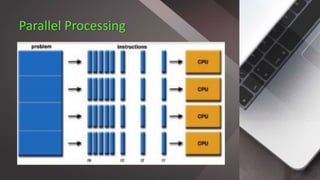
Parallel Processing
• Simultaneous use of multiple computing resources to solve a
computational problem by the use of multiple CPUs
• Problem is broken down into discrete parts that can be solve
concurrently
• Use to fulfill increasing demands for higher performance
Parallel Processing
Examples of Parallel Processing
• An Operating System running on the multicore processor is
an example of the parallel operating system
• Windows 7, 8, 10 are examples of operating systems which
do parallel processing
• Most modern CPUs exhibit parallel processing via the
concept of hyper-threading
Why Use Parallel Computing
• Saves Time
• Solves Larger Problems
• Cost Saving
• Provides Concurrency
Vector Processing
• In Computing, a vector processor or array processor is a central
processing unit (CPU) that implements an instruction set containing
instructions that operate on one-dimensional array of data called
vectors
• Vector Processors can greatly improve performance on certain
workloads, notably numerical simulation
• Two Popular Architectures :
SIMD & MIMD
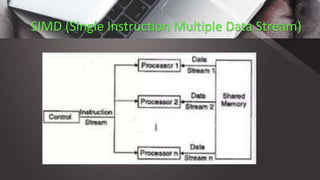
SIMD (Single Instruction Multiple Data Stream)
• All Processing units execute the same instruction at any given
clock cycle
• Each processing unit operates on a different data element
• They have multiple processing/execution units and one control
unit
SIMD (Single Instruction Multiple Data Stream)
SIMD & INTEL
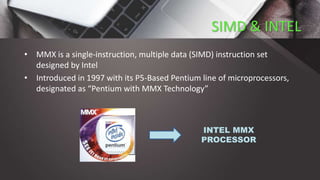
• MMX is a single-instruction, multiple data (SIMD) instruction set
designed by Intel
• Introduced in 1997 with its P5-Based Pentium line of microprocessors,
designated as “Pentium with MMX Technology”
INTEL MMX
PROCESSOR
Advantages of SIMD
• The main advantage of SIMD is that processing multiple data
elements at the same time, with a single instruction, can
dramatically improve performance
• If the SIMD system works by loading up eight data points at
once, the add operation being applied to the data will
happen to all eight values at the same time.
Disadvantages of SIMD
• Major Disadvantages of SIMD are as follows:-
1. Large Register Size
2. More Powerful Consumption
3. Requires Large Chip Area
ASSALAMA LAIKUMMMM
ANY QUESTIONS?

SIMD Presentation.pptx

  • 1.
    Parallel Processing & SIMDArchitecture Muhammad Anas Muhammad Abuzar Muzammil Ahmad
  • 2.
  • 3.
    Parallel Processing • Simultaneoususe of multiple computing resources to solve a computational problem by the use of multiple CPUs • Problem is broken down into discrete parts that can be solve concurrently • Use to fulfill increasing demands for higher performance
  • 4.
  • 5.
    Examples of ParallelProcessing • An Operating System running on the multicore processor is an example of the parallel operating system • Windows 7, 8, 10 are examples of operating systems which do parallel processing • Most modern CPUs exhibit parallel processing via the concept of hyper-threading
  • 6.
    Why Use ParallelComputing • Saves Time • Solves Larger Problems • Cost Saving • Provides Concurrency
  • 7.
    Vector Processing • InComputing, a vector processor or array processor is a central processing unit (CPU) that implements an instruction set containing instructions that operate on one-dimensional array of data called vectors • Vector Processors can greatly improve performance on certain workloads, notably numerical simulation • Two Popular Architectures : SIMD & MIMD
  • 8.
    SIMD (Single InstructionMultiple Data Stream) • All Processing units execute the same instruction at any given clock cycle • Each processing unit operates on a different data element • They have multiple processing/execution units and one control unit
  • 9.
    SIMD (Single InstructionMultiple Data Stream)
  • 10.
    SIMD & INTEL •MMX is a single-instruction, multiple data (SIMD) instruction set designed by Intel • Introduced in 1997 with its P5-Based Pentium line of microprocessors, designated as “Pentium with MMX Technology” INTEL MMX PROCESSOR
  • 11.
    Advantages of SIMD •The main advantage of SIMD is that processing multiple data elements at the same time, with a single instruction, can dramatically improve performance • If the SIMD system works by loading up eight data points at once, the add operation being applied to the data will happen to all eight values at the same time.
  • 12.
    Disadvantages of SIMD •Major Disadvantages of SIMD are as follows:- 1. Large Register Size 2. More Powerful Consumption 3. Requires Large Chip Area
  • 13.