Feng’s Classification 
Narayan Kandel 
071/MSCSKE/657
Classification of computer Architectures 
Flynn’s Classification (1966): is based on the multiplicity of instruction stream 
and data stream in a computer system. 
Feng’s Classification (1972): is based on serial versus parallel processing. 
Handler’s Classification (1977): is determined by the degree of parallelism 
and pipelining in various subsystem levels. 
2
Feng’s Classification 
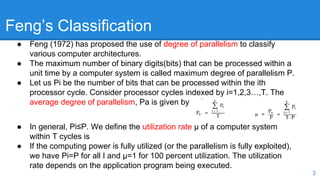
● Feng (1972) has proposed the use of degree of parallelism to classify 
various computer architectures. 
● The maximum number of binary digits(bits) that can be processed within a 
unit time by a computer system is called maximum degree of parallelism P. 
● Let us Pi be the number of bits that can be processed within the ith 
processor cycle. Consider processor cycles indexed by i=1,2,3…,T. The 
average degree of parallelism, Pa is given by 
● In general, Pi≤P. We define the utilization rate μ of a computer system 
within T cycles is 
● If the computing power is fully utilized (or the parallelism is fully exploited), 
we have Pi=P for all I and μ=1 for 100 percent utilization. The utilization 
rate depends on the application program being executed. 
3
Classification based on Word/Bit Count 
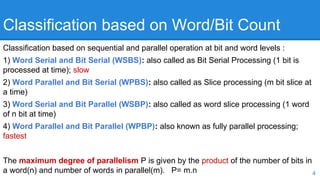
Classification based on sequential and parallel operation at bit and word levels : 
1) Word Serial and Bit Serial (WSBS): also called as Bit Serial Processing (1 bit is 
processed at time); slow 
2) Word Parallel and Bit Serial (WPBS): also called as Slice processing (m bit slice at 
a time) 
3) Word Serial and Bit Parallel (WSBP): also called as word slice processing (1 word 
of n bit at time) 
4) Word Parallel and Bit Parallel (WPBP): also known as fully parallel processing; 
fastest 
The maximum degree of parallelism P is given by the product of the number of bits in 
a word(n) and number of words in parallel(m). P= m.n 4
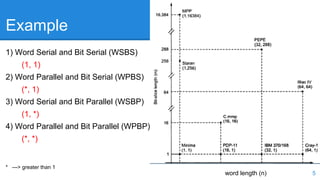
Example 
word length (n) 5 
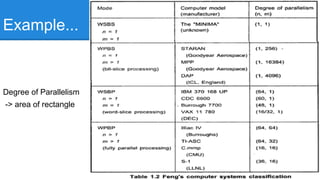
1) Word Serial and Bit Serial (WSBS) 
(1, 1) 
2) Word Parallel and Bit Serial (WPBS) 
(*, 1) 
3) Word Serial and Bit Parallel (WSBP) 
(1, *) 
4) Word Parallel and Bit Parallel (WPBP) 
(*, *) 
* ---> greater than 1
Example... 
Degree of Parallelism 
-> area of rectangle 
6
Limitation 
1. Fails to project the concurrency in pipeline processors as degree of 
parallelism doesn’t account for concurrency handle by pipelined design 
Handler’s schema allow pipeline to be specific... 
7
References... 
1. Advanced Computer Architecture & Computing By S.S.Jadhav, Revised 
Edition 2009, Technical Publication Pune. 
2. Parallel Computing By Moreshwar R. Bhujade , New AGE international 
Publishers. 
8
THANK YOU! 
9 
Narayan Kandel 
Email: npkand@gmail.com

Feng’s classification

  • 1.
    Feng’s Classification NarayanKandel 071/MSCSKE/657
  • 2.
    Classification of computerArchitectures Flynn’s Classification (1966): is based on the multiplicity of instruction stream and data stream in a computer system. Feng’s Classification (1972): is based on serial versus parallel processing. Handler’s Classification (1977): is determined by the degree of parallelism and pipelining in various subsystem levels. 2
  • 3.
    Feng’s Classification ●Feng (1972) has proposed the use of degree of parallelism to classify various computer architectures. ● The maximum number of binary digits(bits) that can be processed within a unit time by a computer system is called maximum degree of parallelism P. ● Let us Pi be the number of bits that can be processed within the ith processor cycle. Consider processor cycles indexed by i=1,2,3…,T. The average degree of parallelism, Pa is given by ● In general, Pi≤P. We define the utilization rate μ of a computer system within T cycles is ● If the computing power is fully utilized (or the parallelism is fully exploited), we have Pi=P for all I and μ=1 for 100 percent utilization. The utilization rate depends on the application program being executed. 3
  • 4.
    Classification based onWord/Bit Count Classification based on sequential and parallel operation at bit and word levels : 1) Word Serial and Bit Serial (WSBS): also called as Bit Serial Processing (1 bit is processed at time); slow 2) Word Parallel and Bit Serial (WPBS): also called as Slice processing (m bit slice at a time) 3) Word Serial and Bit Parallel (WSBP): also called as word slice processing (1 word of n bit at time) 4) Word Parallel and Bit Parallel (WPBP): also known as fully parallel processing; fastest The maximum degree of parallelism P is given by the product of the number of bits in a word(n) and number of words in parallel(m). P= m.n 4
  • 5.
    Example word length(n) 5 1) Word Serial and Bit Serial (WSBS) (1, 1) 2) Word Parallel and Bit Serial (WPBS) (*, 1) 3) Word Serial and Bit Parallel (WSBP) (1, *) 4) Word Parallel and Bit Parallel (WPBP) (*, *) * ---> greater than 1
  • 6.
    Example... Degree ofParallelism -> area of rectangle 6
  • 7.
    Limitation 1. Failsto project the concurrency in pipeline processors as degree of parallelism doesn’t account for concurrency handle by pipelined design Handler’s schema allow pipeline to be specific... 7
  • 8.
    References... 1. AdvancedComputer Architecture & Computing By S.S.Jadhav, Revised Edition 2009, Technical Publication Pune. 2. Parallel Computing By Moreshwar R. Bhujade , New AGE international Publishers. 8
  • 9.
    THANK YOU! 9 Narayan Kandel Email: npkand@gmail.com