2.3 Recursive transition networks
This section describes a more powerful technique for defining languages. The
surface forms of a textual language are a (typically infinite) set of strings.
To define a language, we need to define a system that produces all strings in the
language and no other strings.
A recursive transition network (RTN) is defined by a graph of nodes and edges.
The edges are labeled with output symbols—these are the primitives in the
language. The nodes and edge structure provides the means of combination.
One of the nodes is designated the start node (indicated by an arrow pointing into that
node).
One or more of the nodes may be designated as final nodes (indicated by an
inner circle).
A string is in the language if there exists some path from the start node to a final node in
the graph where the output symbols along the path edges produce the string.
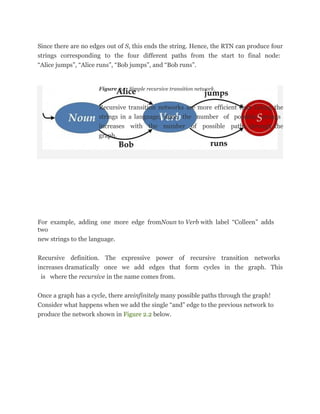
Figure 2.1 shows a simple RTN with three nodes and four edges that can produce four
different sentences.
Starting at the node marked Noun, there are two possible edges to follow. Each edge
outputs a different symbol, and leads to the node marked Verb.
From that node there are two output edges, each leading to the final node marked S.
Since there are no edges out of S, this ends the string. Hence, the RTN can produce four
strings corresponding to the four different paths from the start to final node:
“Alice jumps”, “Alice runs”, “Bob jumps”, and “Bob runs”.
Figure 2.1: Simple recursive transition network.
Recursive transition networks are more efficient than listing the
strings in a language, since the number of possible strings
increases with the number of possible paths through the
graph.
For example, adding one more edge fromNoun to Verb with label “Colleen” adds
two
new strings to the language.
Recursive definition. The expressive power of recursive transition networks
increases dramatically once we add edges that form cycles in the graph. This
is where the recursive in the name comes from.
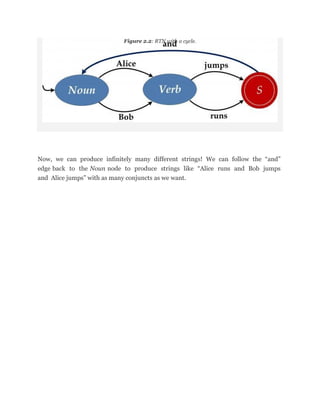
Once a graph has a cycle, there areinfinitely many possible paths through the graph!
Consider what happens when we add the single “and” edge to the previous network to
produce the network shown in Figure 2.2 below.
Figure 2.2: RTN with a cycle.
Now, we can produce infinitely many different strings! We can follow the “and”
edge back to the Noun node to produce strings like “Alice runs and Bob jumps
and Alice jumps” with as many conjuncts as we want.

recursive transition_networks

  • 1.
    2.3 Recursive transitionnetworks This section describes a more powerful technique for defining languages. The surface forms of a textual language are a (typically infinite) set of strings. To define a language, we need to define a system that produces all strings in the language and no other strings. A recursive transition network (RTN) is defined by a graph of nodes and edges. The edges are labeled with output symbols—these are the primitives in the language. The nodes and edge structure provides the means of combination. One of the nodes is designated the start node (indicated by an arrow pointing into that node). One or more of the nodes may be designated as final nodes (indicated by an inner circle). A string is in the language if there exists some path from the start node to a final node in the graph where the output symbols along the path edges produce the string. Figure 2.1 shows a simple RTN with three nodes and four edges that can produce four different sentences. Starting at the node marked Noun, there are two possible edges to follow. Each edge outputs a different symbol, and leads to the node marked Verb. From that node there are two output edges, each leading to the final node marked S.
  • 2.
    Since there areno edges out of S, this ends the string. Hence, the RTN can produce four strings corresponding to the four different paths from the start to final node: “Alice jumps”, “Alice runs”, “Bob jumps”, and “Bob runs”. Figure 2.1: Simple recursive transition network. Recursive transition networks are more efficient than listing the strings in a language, since the number of possible strings increases with the number of possible paths through the graph. For example, adding one more edge fromNoun to Verb with label “Colleen” adds two new strings to the language. Recursive definition. The expressive power of recursive transition networks increases dramatically once we add edges that form cycles in the graph. This is where the recursive in the name comes from. Once a graph has a cycle, there areinfinitely many possible paths through the graph! Consider what happens when we add the single “and” edge to the previous network to produce the network shown in Figure 2.2 below.
  • 3.
    Figure 2.2: RTNwith a cycle. Now, we can produce infinitely many different strings! We can follow the “and” edge back to the Noun node to produce strings like “Alice runs and Bob jumps and Alice jumps” with as many conjuncts as we want.