Unsigned Numbers
- Represent only non-negative integers (0 and positive values).
- All bits are used to store the magnitude.
- Example (8-bit unsigned):
Lecture 2
Binary Codes,
Signed& Unsigned Numbers -
1's & 2's Complement
Department of Computer Science and Engineering, BRAC University
CSE260 : Digital Logic Design
2.
Department of ComputerScience and Engineering CSE260 - Digital Logic Design
2
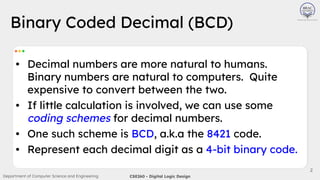
• Decimal numbers are more natural to humans.
Binary numbers are natural to computers. Quite
expensive to convert between the two.
• If little calculation is involved, we can use some
coding schemes for decimal numbers.
• One such scheme is BCD, a.k.a the 8421 code.
• Represent each decimal digit as a 4-bit binary code.
Binary Coded Decimal (BCD)
3.
3
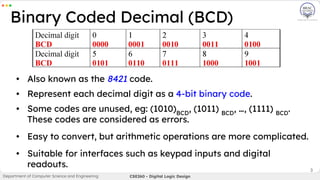
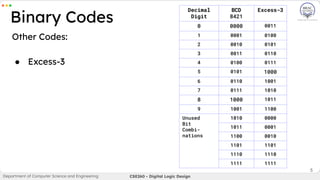
• Also knownas the 8421 code.
• Represent each decimal digit as a 4-bit binary code.
• Some codes are unused, eg: (1010)BCD
, (1011) BCD
, …, (1111) BCD
.
These codes are considered as errors.
• Easy to convert, but arithmetic operations are more complicated.
• Suitable for interfaces such as keypad inputs and digital
readouts.
Binary Coded Decimal (BCD)
Department of Computer Science and Engineering CSE260 - Digital Logic Design
4.
4
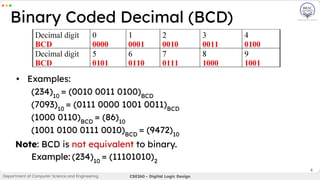
• Examples:
(234)10
= (00100011 0100)BCD
(7093)10
= (0111 0000 1001 0011)BCD
(1000 0110)BCD
= (86)10
(1001 0100 0111 0010)BCD
= (9472)10
Note: BCD is not equivalent to binary.
Example: (234)10
= (11101010)2
Binary Coded Decimal (BCD)
Department of Computer Science and Engineering CSE260 - Digital Logic Design
Department of ComputerScience and Engineering CSE260 - Digital Logic Design
6
Negative Numbers Representation
Sign
and
Magnitude
1s Complement 2s Complement
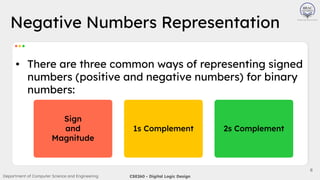
• There are three common ways of representing signed
numbers (positive and negative numbers) for binary
numbers:
7.
7
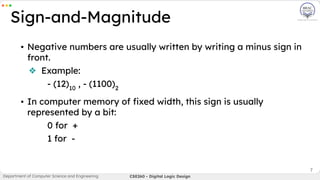
▪ Negative numbersare usually written by writing a minus sign in
front.
❖ Example:
- (12)10
, - (1100)2
▪ In computer memory of fixed width, this sign is usually
represented by a bit:
0 for +
1 for -
Sign-and-Magnitude
Department of Computer Science and Engineering CSE260 - Digital Logic Design
8.
Department of ComputerScience and Engineering CSE260 - Digital Logic Design
8
Sign-and-Magnitude [cont.]
• Example: an 8-bit number can have 1-bit sign and
7-bits magnitude.
sign magnitude
9.
9
Examples:
Signed magnitude representation
Departmentof Computer Science and Engineering CSE260 - Digital Logic Design
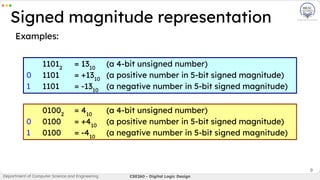
11012
= 1310
(a 4-bit unsigned number)
0 1101 = +1310
(a positive number in 5-bit signed magnitude)
1 1101 = -1310
(a negative number in 5-bit signed magnitude)
01002
= 410
(a 4-bit unsigned number)
0 0100 = +410
(a positive number in 5-bit signed magnitude)
1 0100 = -410
(a negative number in 5-bit signed magnitude)
10.
10
▪ Largest PositiveNumber: 0 1111111 +(127)10
▪ Largest Negative Number: 1 1111111 -(127)10
▪ Zeroes: 0 0000000 +(0)10
1 0000000 -(0)10
▪ Range: -(127)10
to +(127)10
▪ Signed numbers needed for negative numbers.
▪ Representation: Sign-and-magnitude.
Sign-and-Magnitude [Cont.]
Department of Computer Science and Engineering CSE260 - Digital Logic Design
11.
11
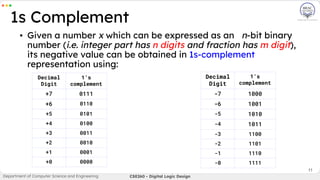
▪ Given anumber x which can be expressed as an n-bit binary
number (i.e. integer part has n digits and fraction has m digit),
its negative value can be obtained in 1s-complement
representation using:
1s Complement
Department of Computer Science and Engineering CSE260 - Digital Logic Design
Decimal
Digit
1’s
complement
+7 0111
+6 0110
+5 0101
+4 0100
+3 0011
+2 0010
+1 0001
+0 0000
Decimal
Digit
1’s
complement
-7 1000
-6 1001
-5 1010
-4 1011
-3 1100
-2 1101
-1 1110
-0 1111
12.
- ( 00 0 0 1 1 0 0 )2
Inverse
( 1 1 1 1 0 0 1 1 )1’s
12
1s Complement [Cont.]
Department of Computer Science and Engineering CSE260 - Digital Logic Design
13.
▪ Essential technique:invert all the bits.
Examples: 1s complement of 00000001 = (11111110)1s
1s complement of 01111111 = (10000000)1s
▪ Range [in 8 bits]: -(127)10
to +(127)10
▪ General Formula=-(2n-1
-1) to + (2n-1
-1)
▪ The most significant bit still represents the sign:
0 = +ve; 1 = -ve.
13
1s Complement [Cont.]
Department of Computer Science and Engineering CSE260 - Digital Logic Design
Note: Range for n bit no. is –(2(n-1)
-1) to +(2(n-1)
-1)
14.
14
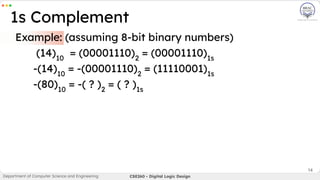
Example: (assuming 8-bitbinary numbers)
(14)10
= (00001110)2
= (00001110)1s
-(14)10
= -(00001110)2
= (11110001)1s
-(80)10
= -( ? )2
= ( ? )1s
1s Complement
Department of Computer Science and Engineering CSE260 - Digital Logic Design
15.
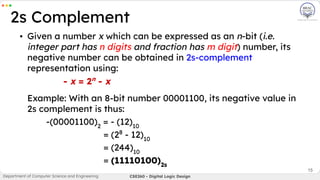
▪ Given anumber x which can be expressed as an n-bit (i.e.
integer part has n digits and fraction has m digit) number, its
negative number can be obtained in 2s-complement
representation using:
- x = 2n
- x
Example: With an 8-bit number 00001100, its negative value in
2s complement is thus:
-(00001100)2
= - (12)10
= (28
- 12)10
= (244)10
= (11110100)2s
15
2s Complement
Department of Computer Science and Engineering CSE260 - Digital Logic Design
16.
• Method 1:Essential technique: invert all the bits and add 1.
Examples:
2s complement of
(00000001)2s
= (11111110)1s
(invert i.e 1’s complement)
= (11111111)2s
(add 1)
2s complement of
(01111110)2s
= (10000001)1s
(invert i.e 1’s complement)
= (10000010)2s
(add 1)
• Method 2: Keep unchanged till 1st
occurrence of 1 from LSB and
invert remaining 1’s into 0’s and 0’s into 1’s till MSB
(01111110)2s
= (10000010)2s
16
2s Complement [cont.]
Department of Computer Science and Engineering CSE260 - Digital Logic Design
Official
Method
Unofficial
Method
17.
Range in 8bits: -(128)10
to +(127)10
General Formula= -(2n-1
) to + (2n-1
-1)
The most significant bit still represents the sign:
0 = +ve; 1 = -ve.
17
2s Complement [Cont.]
Department of Computer Science and Engineering CSE260 - Digital Logic Design
Note: Range for n bit no. is -2(n-1)
to +2(n-1)
-1
18.
18
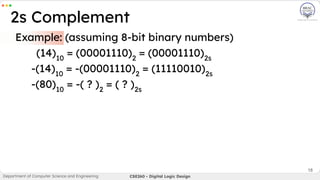
Example: (assuming 8-bitbinary numbers)
(14)10
= (00001110)2
= (00001110)2s
-(14)10
= -(00001110)2
= (11110010)2s
-(80)10
= -( ? )2
= ( ? )2s
2s Complement
Department of Computer Science and Engineering CSE260 - Digital Logic Design
19.
19
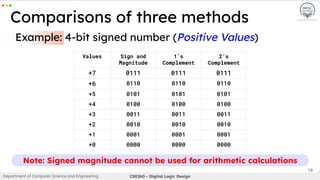
Example: 4-bit signednumber (Positive Values)
Comparisons of three methods
Department of Computer Science and Engineering CSE260 - Digital Logic Design
Values Sign and
Magnitude
1’s
Complement
2’s
Complement
+7 0111 0111 0111
+6 0110 0110 0110
+5 0101 0101 0101
+4 0100 0100 0100
+3 0011 0011 0011
+2 0010 0010 0010
+1 0001 0001 0001
+0 0000 0000 0000
Note: Signed magnitude cannot be used for arithmetic calculations
20.
Note: Signed magnitudecannot be used for arithmetic calculations 20
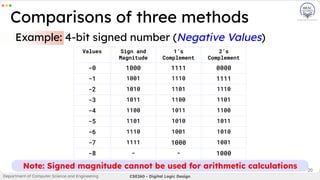
Example: 4-bit signed number (Negative Values)
Comparisons of three methods
Department of Computer Science and Engineering CSE260 - Digital Logic Design
Values Sign and
Magnitude
1’s
Complement
2’s
Complement
-0 1000 1111 0000
-1 1001 1110 1111
-2 1010 1101 1110
-3 1011 1100 1101
-4 1100 1011 1100
-5 1101 1010 1011
-6 1110 1001 1010
-7 1111 1000 1001
-8 - - 1000
21.
21
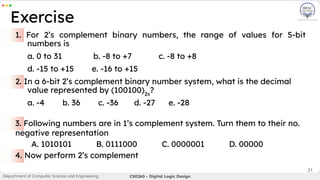
1. For 2’scomplement binary numbers, the range of values for 5-bit
numbers is
a. 0 to 31 b. -8 to +7 c. -8 to +8
d. -15 to +15 e. -16 to +15
2. In a 6-bit 2’s complement binary number system, what is the decimal
value represented by (100100)2s
?
a. -4 b. 36 c. -36 d. -27 e. -28
3. Following numbers are in 1’s complement system. Turn them to their no.
negative representation
A. 1010101 B. 0111000 C. 0000001 D. 00000
4. Now perform 2’s complement
Exercise
Department of Computer Science and Engineering CSE260 - Digital Logic Design
22.
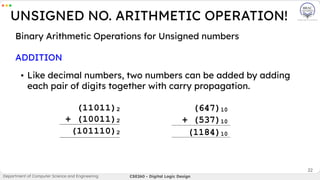
Binary Arithmetic Operationsfor Unsigned numbers
ADDITION
▪ Like decimal numbers, two numbers can be added by adding
each pair of digits together with carry propagation.
22
UNSIGNED NO. ARITHMETIC OPERATION!
Department of Computer Science and Engineering CSE260 - Digital Logic Design
23.
Binary Arithmetic Operationsfor Unsigned numbers
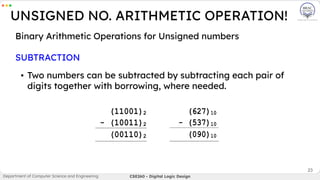
SUBTRACTION
▪ Two numbers can be subtracted by subtracting each pair of
digits together with borrowing, where needed.
23
UNSIGNED NO. ARITHMETIC OPERATION!
Department of Computer Science and Engineering CSE260 - Digital Logic Design
24.
24
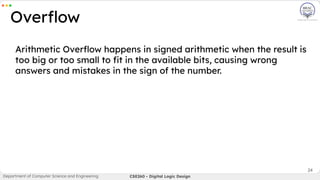
Arithmetic Overflow happensin signed arithmetic when the result is
too big or too small to fit in the available bits, causing wrong
answers and mistakes in the sign of the number.
Overflow
Department of Computer Science and Engineering CSE260 - Digital Logic Design
25.
25
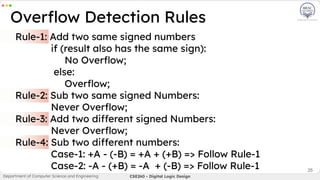
Rule-1: Add twosame signed numbers
if (result also has the same sign):
No Overflow;
else:
Overflow;
Rule-2: Sub two same signed Numbers:
Never Overflow;
Rule-3: Add two different signed Numbers:
Never Overflow;
Rule-4: Sub two different numbers:
Case-1: +A - (-B) = +A + (+B) => Follow Rule-1
Case-2: -A - (+B) = -A + (-B) => Follow Rule-1
Overflow Detection Rules
Department of Computer Science and Engineering CSE260 - Digital Logic Design
26.
26
Department of ComputerScience and Engineering CSE260 - Digital Logic Design
ARITHMETIC OPERATIONS
ON SIGNED NUMBER
27.
27
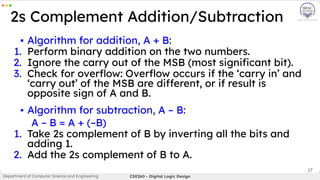
▪ Algorithm foraddition, A + B:
1. Perform binary addition on the two numbers.
2. Ignore the carry out of the MSB (most significant bit).
3. Check for overflow: Overflow occurs if the ‘carry in’ and
‘carry out’ of the MSB are different, or if result is
opposite sign of A and B.
▪ Algorithm for subtraction, A – B:
A – B = A + (–B)
1. Take 2s complement of B by inverting all the bits and
adding 1.
2. Add the 2s complement of B to A.
2s Complement Addition/Subtraction
Department of Computer Science and Engineering CSE260 - Digital Logic Design
28.
28
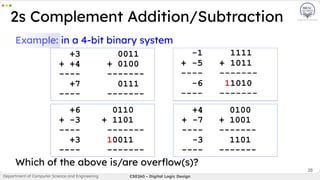
Example: in a4-bit binary system
Which of the above is/are overflow(s)?
2s Complement Addition/Subtraction
Department of Computer Science and Engineering CSE260 - Digital Logic Design
+3 0011
+ +4 + 0100
---- -------
+7 0111
---- -------
+6 0110
+ -3 + 1101
---- -------
+3 10011
---- -------
+4 0100
+ -7 + 1001
---- -------
-3 1101
---- -------
29.
29
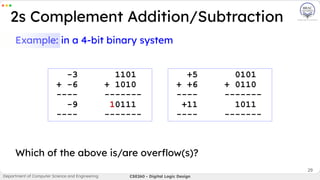
Example: in a4-bit binary system
Which of the above is/are overflow(s)?
2s Complement Addition/Subtraction
Department of Computer Science and Engineering CSE260 - Digital Logic Design
-3 1101
+ -6 + 1010
---- -------
-9 10111
---- -------
+5 0101
+ +6 + 0110
---- -------
+11 1011
---- -------
30.
30
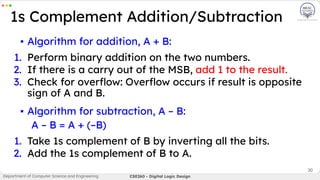
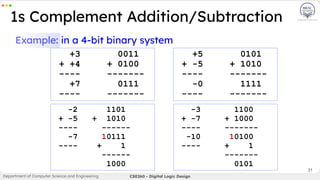
▪ Algorithm foraddition, A + B:
1. Perform binary addition on the two numbers.
2. If there is a carry out of the MSB, add 1 to the result.
3. Check for overflow: Overflow occurs if result is opposite
sign of A and B.
▪ Algorithm for subtraction, A – B:
A – B = A + (–B)
1. Take 1s complement of B by inverting all the bits.
2. Add the 1s complement of B to A.
1s Complement Addition/Subtraction
Department of Computer Science and Engineering CSE260 - Digital Logic Design
32
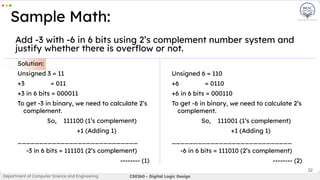
Add -3 with-6 in 6 bits using 2’s complement number system and
justify whether there is overflow or not.
Sample Math:
Department of Computer Science and Engineering CSE260 - Digital Logic Design
Solution:
Unsigned 3 = 11
+3 = 011
+3 in 6 bits = 000011
To get -3 in binary, we need to calculate 2’s
complement.
So, 111100 (1’s complement)
+1 (Adding 1)
____________________________
-3 in 6 bits = 111101 (2’s complement)
-------- (1)
Unsigned 6 = 110
+6 = 0110
+6 in 6 bits = 000110
To get -6 in binary, we need to calculate 2’s
complement.
So, 111001 (1’s complement)
+1 (Adding 1)
____________________________
-6 in 6 bits = 111010 (2’s complement)
-------- (2)
33.
33
Add -3 with-6 in 6 bits using 2’s complement number system and
justify whether there is overflow or not [cont.]
Sample Math [Cont.]:
Department of Computer Science and Engineering CSE260 - Digital Logic Design
Now, adding (1) and (2),
111101
111010
_______
1 110111
Ignoring the carry, final result is 110111
Here, we are adding two negative numbers and the result is also a negative number. Hence, there
is no overflow.

![Department of Computer Science and Engineering CSE260 - Digital Logic Design
8
Sign-and-Magnitude [cont.]
• Example: an 8-bit number can have 1-bit sign and
7-bits magnitude.
sign magnitude](https://image.slidesharecdn.com/lecture2-signedunsignednumbers-1s2scomplement-251214102058-fcd05712/85/Lecture-2-Signed-Unsigned-Numbers-1-s-2-s-Complement-pdf-8-320.jpg)
![10
▪ Largest Positive Number: 0 1111111 +(127)10
▪ Largest Negative Number: 1 1111111 -(127)10
▪ Zeroes: 0 0000000 +(0)10
1 0000000 -(0)10
▪ Range: -(127)10
to +(127)10
▪ Signed numbers needed for negative numbers.
▪ Representation: Sign-and-magnitude.
Sign-and-Magnitude [Cont.]
Department of Computer Science and Engineering CSE260 - Digital Logic Design](https://image.slidesharecdn.com/lecture2-signedunsignednumbers-1s2scomplement-251214102058-fcd05712/85/Lecture-2-Signed-Unsigned-Numbers-1-s-2-s-Complement-pdf-10-320.jpg)
![- ( 0 0 0 0 1 1 0 0 )2
Inverse
( 1 1 1 1 0 0 1 1 )1’s
12
1s Complement [Cont.]
Department of Computer Science and Engineering CSE260 - Digital Logic Design](https://image.slidesharecdn.com/lecture2-signedunsignednumbers-1s2scomplement-251214102058-fcd05712/85/Lecture-2-Signed-Unsigned-Numbers-1-s-2-s-Complement-pdf-12-320.jpg)
![▪ Essential technique: invert all the bits.
Examples: 1s complement of 00000001 = (11111110)1s
1s complement of 01111111 = (10000000)1s
▪ Range [in 8 bits]: -(127)10
to +(127)10
▪ General Formula=-(2n-1
-1) to + (2n-1
-1)
▪ The most significant bit still represents the sign:
0 = +ve; 1 = -ve.
13
1s Complement [Cont.]
Department of Computer Science and Engineering CSE260 - Digital Logic Design
Note: Range for n bit no. is –(2(n-1)
-1) to +(2(n-1)
-1)](https://image.slidesharecdn.com/lecture2-signedunsignednumbers-1s2scomplement-251214102058-fcd05712/85/Lecture-2-Signed-Unsigned-Numbers-1-s-2-s-Complement-pdf-13-320.jpg)
![• Method 1: Essential technique: invert all the bits and add 1.
Examples:
2s complement of
(00000001)2s
= (11111110)1s
(invert i.e 1’s complement)
= (11111111)2s
(add 1)
2s complement of
(01111110)2s
= (10000001)1s
(invert i.e 1’s complement)
= (10000010)2s
(add 1)
• Method 2: Keep unchanged till 1st
occurrence of 1 from LSB and
invert remaining 1’s into 0’s and 0’s into 1’s till MSB
(01111110)2s
= (10000010)2s
16
2s Complement [cont.]
Department of Computer Science and Engineering CSE260 - Digital Logic Design
Official
Method
Unofficial
Method](https://image.slidesharecdn.com/lecture2-signedunsignednumbers-1s2scomplement-251214102058-fcd05712/85/Lecture-2-Signed-Unsigned-Numbers-1-s-2-s-Complement-pdf-16-320.jpg)
![Range in 8 bits: -(128)10
to +(127)10
General Formula= -(2n-1
) to + (2n-1
-1)
The most significant bit still represents the sign:
0 = +ve; 1 = -ve.
17
2s Complement [Cont.]
Department of Computer Science and Engineering CSE260 - Digital Logic Design
Note: Range for n bit no. is -2(n-1)
to +2(n-1)
-1](https://image.slidesharecdn.com/lecture2-signedunsignednumbers-1s2scomplement-251214102058-fcd05712/85/Lecture-2-Signed-Unsigned-Numbers-1-s-2-s-Complement-pdf-17-320.jpg)
![33
Add -3 with -6 in 6 bits using 2’s complement number system and
justify whether there is overflow or not [cont.]
Sample Math [Cont.]:
Department of Computer Science and Engineering CSE260 - Digital Logic Design
Now, adding (1) and (2),
111101
111010
_______
1 110111
Ignoring the carry, final result is 110111
Here, we are adding two negative numbers and the result is also a negative number. Hence, there
is no overflow.](https://image.slidesharecdn.com/lecture2-signedunsignednumbers-1s2scomplement-251214102058-fcd05712/85/Lecture-2-Signed-Unsigned-Numbers-1-s-2-s-Complement-pdf-33-320.jpg)


