NUMBER REPRESENTATION
& ARITHMETIC OPERATIONS
1
Number Representation
• ICs store circuits that operate on electrical current by either letting
current pass through, or blocking the current
• Every circuit in the computer to be in a state of on or off (1 or 0)
• Computer can store information in binary form
• Why do we have different number systems??
2
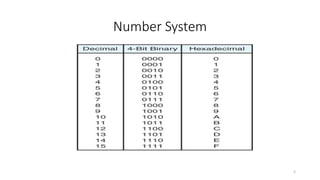
Number System
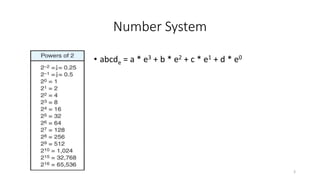
• abcde = a * e3 + b * e2 + c * e1 + d * e0
3
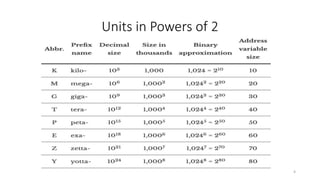
Units in Powers of 2
4
Number System
5
Number Representation
• Sign Magnitude
• 1’s Complement
• 2’s Complement
6
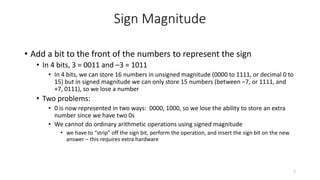
Sign Magnitude
• Add a bit to the front of the numbers to represent the sign
• In 4 bits, 3 = 0011 and –3 = 1011
• In 4 bits, we can store 16 numbers in unsigned magnitude (0000 to 1111, or decimal 0 to
15) but in signed magnitude we can only store 15 numbers (between –7, or 1111, and
+7, 0111), so we lose a number
• Two problems:
• 0 is now represented in two ways: 0000, 1000, so we lose the ability to store an extra
number since we have two 0s
• We cannot do ordinary arithmetic operations using signed magnitude
• we have to “strip” off the sign bit, perform the operation, and insert the sign bit on the new
answer – this requires extra hardware
7
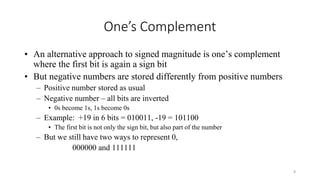
One’s Complement
• An alternative approach to signed magnitude is one’s complement
where the first bit is again a sign bit
• But negative numbers are stored differently from positive numbers
– Positive number stored as usual
– Negative number – all bits are inverted
• 0s become 1s, 1s become 0s
– Example: +19 in 6 bits = 010011, -19 = 101100
• The first bit is not only the sign bit, but also part of the number
– But we still have two ways to represent 0,
000000 and 111111
8
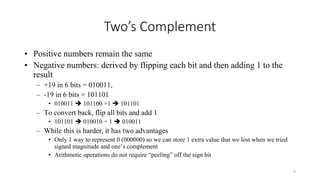
Two’s Complement
• Positive numbers remain the same
• Negative numbers: derived by flipping each bit and then adding 1 to the
result
– +19 in 6 bits = 010011,
– -19 in 6 bits = 101101
• 010011  101100 +1  101101
– To convert back, flip all bits and add 1
• 101101  010010 + 1  010011
– While this is harder, it has two advantages
• Only 1 way to represent 0 (000000) so we can store 1 extra value that we lost when we tried
signed magnitude and one’s complement
• Arithmetic operations do not require “peeling” off the sign bit
9
10
4-bit Two’s Complement
Binary Decimal
0111 7
0110 6
0101 5
0100 4
0011 3
0010 2
0001 1
0000 0
1000 -8
1001 -7
1010 -6
1011 -5
1100 -4
1101 -3
1110 -2
1111 -1
Two’s Complement
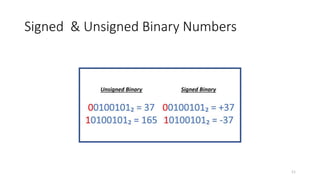
Signed & Unsigned Binary Numbers
11
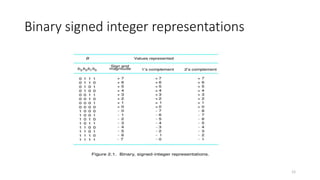
Binary signed integer representations
12
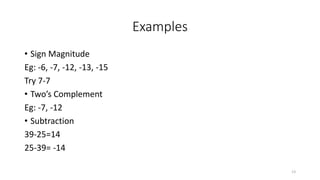
Examples
• Sign Magnitude
Eg: -6, -7, -12, -13, -15
Try 7-7
• Two’s Complement
Eg: -7, -12
• Subtraction
39-25=14
25-39= -14
13

Number Representation and Arithmetic Operations.pptx

  • 1.
  • 2.
    Number Representation • ICsstore circuits that operate on electrical current by either letting current pass through, or blocking the current • Every circuit in the computer to be in a state of on or off (1 or 0) • Computer can store information in binary form • Why do we have different number systems?? 2
  • 3.
    Number System • abcde= a * e3 + b * e2 + c * e1 + d * e0 3
  • 4.
  • 5.
  • 6.
    Number Representation • SignMagnitude • 1’s Complement • 2’s Complement 6
  • 7.
    Sign Magnitude • Adda bit to the front of the numbers to represent the sign • In 4 bits, 3 = 0011 and –3 = 1011 • In 4 bits, we can store 16 numbers in unsigned magnitude (0000 to 1111, or decimal 0 to 15) but in signed magnitude we can only store 15 numbers (between –7, or 1111, and +7, 0111), so we lose a number • Two problems: • 0 is now represented in two ways: 0000, 1000, so we lose the ability to store an extra number since we have two 0s • We cannot do ordinary arithmetic operations using signed magnitude • we have to “strip” off the sign bit, perform the operation, and insert the sign bit on the new answer – this requires extra hardware 7
  • 8.
    One’s Complement • Analternative approach to signed magnitude is one’s complement where the first bit is again a sign bit • But negative numbers are stored differently from positive numbers – Positive number stored as usual – Negative number – all bits are inverted • 0s become 1s, 1s become 0s – Example: +19 in 6 bits = 010011, -19 = 101100 • The first bit is not only the sign bit, but also part of the number – But we still have two ways to represent 0, 000000 and 111111 8
  • 9.
    Two’s Complement • Positivenumbers remain the same • Negative numbers: derived by flipping each bit and then adding 1 to the result – +19 in 6 bits = 010011, – -19 in 6 bits = 101101 • 010011  101100 +1  101101 – To convert back, flip all bits and add 1 • 101101  010010 + 1  010011 – While this is harder, it has two advantages • Only 1 way to represent 0 (000000) so we can store 1 extra value that we lost when we tried signed magnitude and one’s complement • Arithmetic operations do not require “peeling” off the sign bit 9
  • 10.
    10 4-bit Two’s Complement BinaryDecimal 0111 7 0110 6 0101 5 0100 4 0011 3 0010 2 0001 1 0000 0 1000 -8 1001 -7 1010 -6 1011 -5 1100 -4 1101 -3 1110 -2 1111 -1 Two’s Complement
  • 11.
    Signed & UnsignedBinary Numbers 11
  • 12.
    Binary signed integerrepresentations 12
  • 13.
    Examples • Sign Magnitude Eg:-6, -7, -12, -13, -15 Try 7-7 • Two’s Complement Eg: -7, -12 • Subtraction 39-25=14 25-39= -14 13