✗ Lecture 2
 Instincts: The Propelling Forces of the
Personality
 The Levels of Personality
 The Structure of Personality
 Anxiety: A Threat to the Ego
 Defenses against Anxiety
 Psychosexual Stages of Personality
Development
Topics
Psychoanalytic Perspective
✗ Freud’s psychoanalytic perspective proposed
that childhood sexuality and unconscious
motivations influence personality.
✗ Freud called his theory and associated
techniques psychoanalysis.
• Freud’s theory that unconscious forces and childhood act
as determinants of personality
Psychoanalytic Approach
• Approaches that assume that personality is motivated by
inner forces
Neo-psychoanalytic Approach
• personality continues to develop throughout the course of
our life
Life Span Approach
• Theories that suggest that important components of
personality are inherited.
Genetic Approach
• which emphasizes human strengths, virtues, aspirations,
and the fulfillment of our potential
Humanistic approach
• which deals with conscious mental activities
Cognitive approach
• assume that personality differences result from
variations in learning experiences.
behavioral Approach
• Observation
Social learning Approach
Instincts: The Propelling Forces of the
Personality
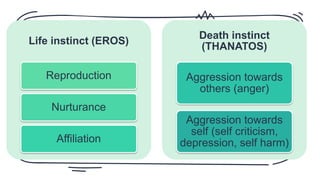
Life instinct
Death instinct
Life instinct (EROS)
Reproduction
Nurturance
Affiliation
Death instinct
(THANATOS)
Aggression towards
others (anger)
Aggression towards
self (self criticism,
depression, self harm)
Instincts: The Propelling Forces of
the Personality
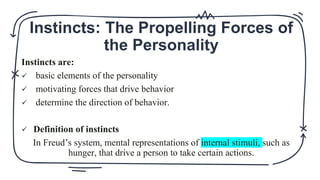
Instincts are:
 basic elements of the personality
 motivating forces that drive behavior
 determine the direction of behavior.
 Definition of instincts
In Freud’s system, mental representations of internal stimuli, such as
hunger, that drive a person to take certain actions.
9
Instincts:
• The stimuli (hunger or thirst, for example) for
instincts are internal.
Internal
stimulus
generates
physiological excitation
or energy
mind transforms this
bodily energy into a
wish
Instincts:
• A body is in a
continuous state of
need, the person
experiences feeling of
tension or pressure.
• Aim is:
 satisfy the need
 reduce the tension
● Instincts are always influencing our behavior.
● Displacements of energy: People may take different
paths to satisfy their needs.
10
Example
• The stimuli for instincts—hunger and thirst, for example—are
internal. When a need such as hunger is aroused in the body, it
generates a state of physiological excitation or energy.
• The mind transforms this bodily energy into a wish. It is this
wish—the mental representation of the physiological need—
that is the instinct or driving force that motivates the person to
behave in a way that satisfies the need. A hungry person, for
example, will look for food.
• The instinct is not the bodily state itself (the hunger). Rather, it
is the bodily need transformed into a mental state, a wish.
12
Types of Instincts
Life instincts:
• The drive for ensuring survival of the individual and the species
by satisfying the needs for food, water, air, and reproduction.
• Oriented toward growth and development.
LIBIDO:
• To Freud, the form of psychic energy, that drives a person
toward pleasurable behaviors and thoughts.
13
• Freud considered most important for
the personality is sex, which he
defined in broad terms.
• He did not refer solely to the erotic
but included almost all pleasurable
behaviors and thoughts.
• He described his view as enlarging
or extending the accepted concept
of sexuality.
Most important life instinct:
14
Death instincts:
• The unconscious drive toward decay,
destruction, and aggression.
• He proposed that people have an unconscious
wish to die.
• Aggression as compelling a part of human
nature as sex.
Aggressive drive:
The compulsion to
destroy, conquer,
and kill.
Death instincts as a reflection
of his own experiences.
(cancer worsened, witnessed the
World War I, daughter died at the age
of 26 leaving two young children)
limited
acceptance
The Levels of
Personality
1. Conscious
2. Pre-conscious / Sub-conscious
3. Unconscious
16
The Structure of
Personality
The Id
The Ego
The Superego
18
Another way of looking
19
20
The Id
21
• the reservoir for the instincts and libido
(the psychic energy manifested by the
instincts)
• operates in accordance with the pleasure
principle
• concern with tension reduction & strives
for immediate satisfaction of its needs
• functions to increase pleasure & avoid
pain.
• no awareness of reality
selfish
pleasure-
seeking
primitive
amoral
insistent
rash
22
The Ego:
23
The Ego:
Comparing Id and Ego
24
Freud compared the relationship
of the ego and the id to that of a
rider on a horse.
The raw, brute power of the horse
must be guided, checked, and
reined in by the rider; otherwise
the horse could bolt and run,
throwing the rider to the ground.
the ego is never
independent of the id. It is
always responsive to the id’s
demands and derives its
power and energy from the
id.
25
The Superego:
• ideas of right and wrong.
• internal morality a conscience
• This moral side of the personality is usually learned by the age of 5
or 6.
• Through praise, punishment, and example, children learn which
behaviors their parents consider good or bad.
• behaviors for which children are punished form one part of the
superego called conscience.
• good, or correct, behaviors for which children have been praised
are second part of the superego called ego-ideal.
26
The Superego in children:
• learn a set of rules that earn
acceptance or rejection from their
parents
• children internalize these teachings,
and the rewards and punishments
become self-administered.
• As a result of this internalization, we
experience guilt or shame whenever
we perform (or even think of
performing) some action contrary to
this moral code.
• Parental control is replaced by self-control.
The superego is
relentless, even
cruel, in its quest for
moral perfection.
27
Comparison of superego with Id & Ego:
• In terms of intensity, irrationality, and insistence on obedience,
superego is not unlike the id.
• Its purpose is not merely to postpone the pleasure-seeking
demands of the id, as the ego does, but to inhibit them
completely, particularly those demands concerned with sex &
aggression.
The superego strives neither for pleasure (as does
the id) nor for attainment of realistic goals (as does
the ego). It strives solely for moral perfection.
28
29
30
Time to think:
31
Challenges for EGO:
• The ego is caught in the middle, pressured by these
insistent and opposing forces.
• To paraphrase Freud, the poor ego has a hard time of
it, pressured on three sides, threatened by three dangers:
the id, reality, and the superego.
• The inevitable result of this friction, when the ego is too
severely strained, is the development of anxiety.
Anxiety: A Threat to the
Ego
 Three Types of Anxiety
1. objective anxiety
2. Neurotic anxiety
3. Moral anxiety
Anxiety: A Threat to the Ego
33
Anxiety: A Threat to the Ego
• Freud described anxiety as an objectless fear; often, we cannot
point to its source, to a specific object that induced it.
• anxiety an important part of his personality theory; fundamental to
the development of neurotic and psychotic behavior.
• The fetus in its mother’s womb is in the most stable and secure of
worlds.
• At birth, the organism is thrust into a hostile environment.
• Birth trauma: (massive motor movements, heightened
breathing, and increased heart rate)
• In adult life, infantile helplessness is reenacted
to some degree whenever the ego is threatened.
34
Three Types of Anxiety
• The first type of anxiety, the one from which the others are
derived, is reality or objective anxiety.
• This involves a fear of tangible dangers in the real world.
• Most of us justifiably fear fires, hurricanes, earthquakes,
and similar disasters. We run from wild animals, speeding
cars, and burning buildings.
• Reality anxiety serves the positive purpose of guiding our
behavior to escape or protect ourselves from actual
dangers.
1. objective anxiety:
35
Three Types of Anxiety
• its basis in childhood, in a conflict between instinctual gratification
and reality.
• Children are often punished for overtly expressing sexual or aggressive
impulses. Therefore, the wish
• to gratify certain id impulses generates anxiety.
• This neurotic anxiety is an unconscious fear of being punished for
impulsively displaying id-dominated behavior.
• Note that the fear is not of the instincts, but of what may happen as a
result of gratifying the instincts.
• The conflict becomes one between the id and the ego, and its origin
has some basis in reality.
2. Neurotic anxiety:
36
Three Types of Anxiety
• results from a conflict between the id and the superego.
• In essence, it is a fear of one’s conscience.
• When you are motivated to express an instinctual impulse that is
contrary to your moral code, your superego retaliates by causing you
to feel shame or guilt. In everyday terms, you might describe yourself
as conscience-stricken.
• Moral anxiety is a function of how well developed the superego is.
A person with a strong inhibiting conscience will experience greater
conflict than a person with a less stringent set of moral guidelines.
• Like neurotic anxiety, moral anxiety has some basis in reality.
• Example: Children are punished for violating their parents’ moral codes, and
adults are punished for violating society’s moral code. The shame and guilt
feelings in moral anxiety arise from within; it is our conscience that causes the
3. Moral anxiety:
37
 Repression
 Denial
 Reaction Formation
 Projection
 Regression
 Rationalization
Defenses against Anxiety
39
Defense Mechanisms
Against Anxiety
40
41
Repression
42
Denial
43
Reaction Formation
For example: Person, disturbed by extreme
aggressive impulses, may become overly
solicitous and friendly. Thus, lust becomes
virtue and hatred becomes love, in the
unconscious mind of the person using this
mechanism.
44
Projection
Lustful, aggressive, and other
unacceptable impulses are seen as
being possessed by other people, not
by oneself. The person says, in effect,
“I don’t hate him. He hates me.”
45
Regression
• involves a return to one of the psychosexual stages of
childhood development.
• The individual returns to this more secure time of life by
manifesting behaviors displayed at that time, such as childish
and dependent behaviors.
46
Rationalization
It is less threatening to blame someone or
something else for our failures than to blame
ourselves.
47
Displacement
48
Sublimation
 The Oral Stage
 The Anal Stage
 The Phallic Stage
 The Latency Period
 The Genital Stage
Psychosexual Stages of Personality
Development
50
51
52
53
54
55
56
57
58

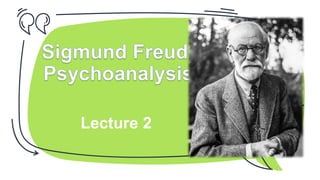
Sigmund freud psychoanalysis

  • 1.
  • 2.
     Instincts: ThePropelling Forces of the Personality  The Levels of Personality  The Structure of Personality  Anxiety: A Threat to the Ego  Defenses against Anxiety  Psychosexual Stages of Personality Development Topics
  • 4.
    Psychoanalytic Perspective ✗ Freud’spsychoanalytic perspective proposed that childhood sexuality and unconscious motivations influence personality. ✗ Freud called his theory and associated techniques psychoanalysis.
  • 5.
    • Freud’s theorythat unconscious forces and childhood act as determinants of personality Psychoanalytic Approach • Approaches that assume that personality is motivated by inner forces Neo-psychoanalytic Approach • personality continues to develop throughout the course of our life Life Span Approach • Theories that suggest that important components of personality are inherited. Genetic Approach • which emphasizes human strengths, virtues, aspirations, and the fulfillment of our potential Humanistic approach • which deals with conscious mental activities Cognitive approach • assume that personality differences result from variations in learning experiences. behavioral Approach • Observation Social learning Approach
  • 6.
    Instincts: The PropellingForces of the Personality Life instinct Death instinct
  • 7.
    Life instinct (EROS) Reproduction Nurturance Affiliation Deathinstinct (THANATOS) Aggression towards others (anger) Aggression towards self (self criticism, depression, self harm)
  • 8.
    Instincts: The PropellingForces of the Personality Instincts are:  basic elements of the personality  motivating forces that drive behavior  determine the direction of behavior.  Definition of instincts In Freud’s system, mental representations of internal stimuli, such as hunger, that drive a person to take certain actions.
  • 9.
    9 Instincts: • The stimuli(hunger or thirst, for example) for instincts are internal. Internal stimulus generates physiological excitation or energy mind transforms this bodily energy into a wish
  • 10.
    Instincts: • A bodyis in a continuous state of need, the person experiences feeling of tension or pressure. • Aim is:  satisfy the need  reduce the tension ● Instincts are always influencing our behavior. ● Displacements of energy: People may take different paths to satisfy their needs. 10
  • 11.
    Example • The stimulifor instincts—hunger and thirst, for example—are internal. When a need such as hunger is aroused in the body, it generates a state of physiological excitation or energy. • The mind transforms this bodily energy into a wish. It is this wish—the mental representation of the physiological need— that is the instinct or driving force that motivates the person to behave in a way that satisfies the need. A hungry person, for example, will look for food. • The instinct is not the bodily state itself (the hunger). Rather, it is the bodily need transformed into a mental state, a wish.
  • 12.
    12 Types of Instincts Lifeinstincts: • The drive for ensuring survival of the individual and the species by satisfying the needs for food, water, air, and reproduction. • Oriented toward growth and development. LIBIDO: • To Freud, the form of psychic energy, that drives a person toward pleasurable behaviors and thoughts.
  • 13.
    13 • Freud consideredmost important for the personality is sex, which he defined in broad terms. • He did not refer solely to the erotic but included almost all pleasurable behaviors and thoughts. • He described his view as enlarging or extending the accepted concept of sexuality. Most important life instinct:
  • 14.
    14 Death instincts: • Theunconscious drive toward decay, destruction, and aggression. • He proposed that people have an unconscious wish to die. • Aggression as compelling a part of human nature as sex. Aggressive drive: The compulsion to destroy, conquer, and kill. Death instincts as a reflection of his own experiences. (cancer worsened, witnessed the World War I, daughter died at the age of 26 leaving two young children) limited acceptance
  • 15.
    The Levels of Personality 1.Conscious 2. Pre-conscious / Sub-conscious 3. Unconscious
  • 16.
  • 17.
    The Structure of Personality TheId The Ego The Superego
  • 18.
  • 19.
  • 20.
  • 21.
    The Id 21 • thereservoir for the instincts and libido (the psychic energy manifested by the instincts) • operates in accordance with the pleasure principle • concern with tension reduction & strives for immediate satisfaction of its needs • functions to increase pleasure & avoid pain. • no awareness of reality selfish pleasure- seeking primitive amoral insistent rash
  • 22.
  • 23.
  • 24.
    Comparing Id andEgo 24 Freud compared the relationship of the ego and the id to that of a rider on a horse. The raw, brute power of the horse must be guided, checked, and reined in by the rider; otherwise the horse could bolt and run, throwing the rider to the ground. the ego is never independent of the id. It is always responsive to the id’s demands and derives its power and energy from the id.
  • 25.
    25 The Superego: • ideasof right and wrong. • internal morality a conscience • This moral side of the personality is usually learned by the age of 5 or 6. • Through praise, punishment, and example, children learn which behaviors their parents consider good or bad. • behaviors for which children are punished form one part of the superego called conscience. • good, or correct, behaviors for which children have been praised are second part of the superego called ego-ideal.
  • 26.
    26 The Superego inchildren: • learn a set of rules that earn acceptance or rejection from their parents • children internalize these teachings, and the rewards and punishments become self-administered. • As a result of this internalization, we experience guilt or shame whenever we perform (or even think of performing) some action contrary to this moral code. • Parental control is replaced by self-control. The superego is relentless, even cruel, in its quest for moral perfection.
  • 27.
    27 Comparison of superegowith Id & Ego: • In terms of intensity, irrationality, and insistence on obedience, superego is not unlike the id. • Its purpose is not merely to postpone the pleasure-seeking demands of the id, as the ego does, but to inhibit them completely, particularly those demands concerned with sex & aggression. The superego strives neither for pleasure (as does the id) nor for attainment of realistic goals (as does the ego). It strives solely for moral perfection.
  • 28.
  • 29.
  • 30.
  • 31.
    31 Challenges for EGO: •The ego is caught in the middle, pressured by these insistent and opposing forces. • To paraphrase Freud, the poor ego has a hard time of it, pressured on three sides, threatened by three dangers: the id, reality, and the superego. • The inevitable result of this friction, when the ego is too severely strained, is the development of anxiety.
  • 32.
    Anxiety: A Threatto the Ego  Three Types of Anxiety 1. objective anxiety 2. Neurotic anxiety 3. Moral anxiety Anxiety: A Threat to the Ego
  • 33.
    33 Anxiety: A Threatto the Ego • Freud described anxiety as an objectless fear; often, we cannot point to its source, to a specific object that induced it. • anxiety an important part of his personality theory; fundamental to the development of neurotic and psychotic behavior. • The fetus in its mother’s womb is in the most stable and secure of worlds. • At birth, the organism is thrust into a hostile environment. • Birth trauma: (massive motor movements, heightened breathing, and increased heart rate) • In adult life, infantile helplessness is reenacted to some degree whenever the ego is threatened.
  • 34.
    34 Three Types ofAnxiety • The first type of anxiety, the one from which the others are derived, is reality or objective anxiety. • This involves a fear of tangible dangers in the real world. • Most of us justifiably fear fires, hurricanes, earthquakes, and similar disasters. We run from wild animals, speeding cars, and burning buildings. • Reality anxiety serves the positive purpose of guiding our behavior to escape or protect ourselves from actual dangers. 1. objective anxiety:
  • 35.
    35 Three Types ofAnxiety • its basis in childhood, in a conflict between instinctual gratification and reality. • Children are often punished for overtly expressing sexual or aggressive impulses. Therefore, the wish • to gratify certain id impulses generates anxiety. • This neurotic anxiety is an unconscious fear of being punished for impulsively displaying id-dominated behavior. • Note that the fear is not of the instincts, but of what may happen as a result of gratifying the instincts. • The conflict becomes one between the id and the ego, and its origin has some basis in reality. 2. Neurotic anxiety:
  • 36.
    36 Three Types ofAnxiety • results from a conflict between the id and the superego. • In essence, it is a fear of one’s conscience. • When you are motivated to express an instinctual impulse that is contrary to your moral code, your superego retaliates by causing you to feel shame or guilt. In everyday terms, you might describe yourself as conscience-stricken. • Moral anxiety is a function of how well developed the superego is. A person with a strong inhibiting conscience will experience greater conflict than a person with a less stringent set of moral guidelines. • Like neurotic anxiety, moral anxiety has some basis in reality. • Example: Children are punished for violating their parents’ moral codes, and adults are punished for violating society’s moral code. The shame and guilt feelings in moral anxiety arise from within; it is our conscience that causes the 3. Moral anxiety:
  • 37.
  • 38.
     Repression  Denial Reaction Formation  Projection  Regression  Rationalization Defenses against Anxiety
  • 39.
  • 40.
  • 41.
  • 42.
  • 43.
    43 Reaction Formation For example:Person, disturbed by extreme aggressive impulses, may become overly solicitous and friendly. Thus, lust becomes virtue and hatred becomes love, in the unconscious mind of the person using this mechanism.
  • 44.
    44 Projection Lustful, aggressive, andother unacceptable impulses are seen as being possessed by other people, not by oneself. The person says, in effect, “I don’t hate him. He hates me.”
  • 45.
    45 Regression • involves areturn to one of the psychosexual stages of childhood development. • The individual returns to this more secure time of life by manifesting behaviors displayed at that time, such as childish and dependent behaviors.
  • 46.
    46 Rationalization It is lessthreatening to blame someone or something else for our failures than to blame ourselves.
  • 47.
  • 48.
  • 49.
     The OralStage  The Anal Stage  The Phallic Stage  The Latency Period  The Genital Stage Psychosexual Stages of Personality Development
  • 50.
  • 51.
  • 52.
  • 53.
  • 54.
  • 55.
  • 56.
  • 57.
  • 58.