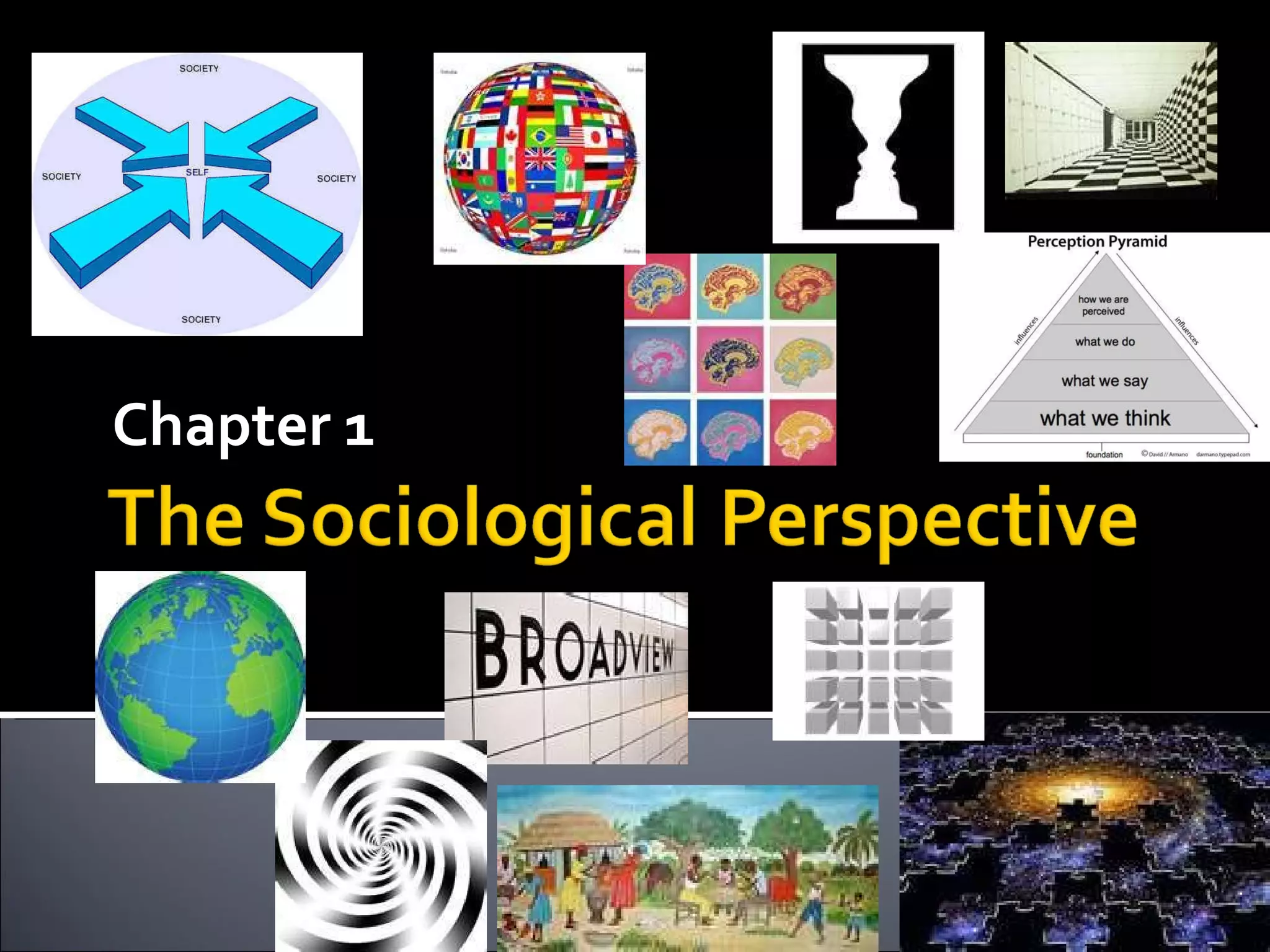
Chapter 1
Sociological Perspective   – Understanding human behavior by placing it within its broader social context Society  – people who share a culture and a territory Social Location   – the group memberships that people have because of their location in history and society
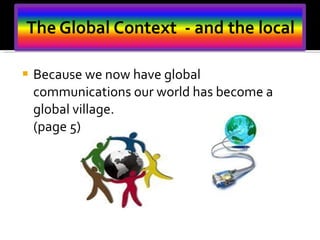
Because we now have global communications our world has become a global village. (page 5)
Science   - The application of systematic methods to obtain knowledge and the knowledge obtained by those methods Natural Sciences   – the intellectual and academic disciplines designed t explain and predict events in our natural environments Social Sciences   – the intellectual and academic disciplines designed to understand the social world objectively by means of controlled and repeated observations
Anthropology …the study of humanity  Economics …studies the production and distribution of the material goods and services of a society Political Science …examine how governments are formed, how they operate, and how they are related to other institutions of society Psychology …the study of human behavior Sociology …the study of societies and the behavior of societies (cultures, group structures, belief systems)
To make  Generalizations  – statements that go beyond the indivual case and are applied to a broader group r situation To look for  Patterns  – recurring characteristics or events To  predict  or specify what will happen in the future Common sense   – those things “everyone knows” are true (look at pages 8-Down-to-Earth box)
Scientific method   – using objective, systematic observations to test theories Positivism   - the application of the scientific approach to the social world  Sociology  – the study of society and human behavior
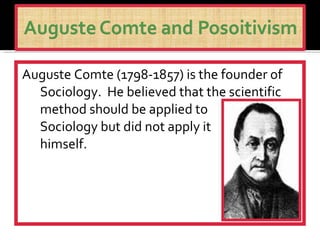
Auguste Comte (1798-1857) is the founder of Sociology.  He believed that the scientific method should be applied to  Sociology but did not apply it  himself.
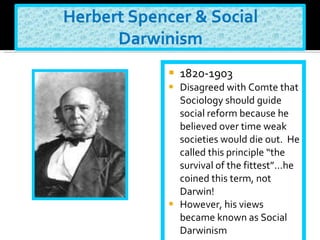
1820-1903 Disagreed with Comte that Sociology should guide social reform because he believed over time weak societies would die out.  He called this principle “the survival of the fittest”…he coined this term, not Darwin! However, his views became known as Social Darwinism
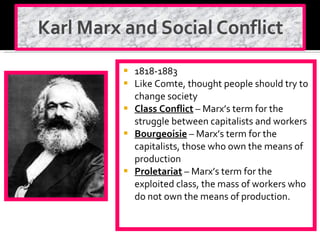
1818-1883 Like Comte, thought people should try to change society Class Conflict  – Marx’s term for the struggle between capitalists and workers Bourgeoisie  – Marx’s term for the capitalists, those who own the means of production Proletariat  – Marx’s term for the exploited class, the mass of workers who do not own the means of production.
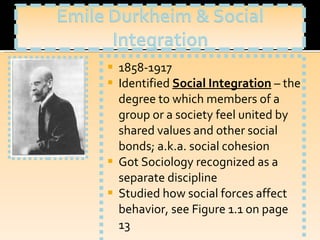
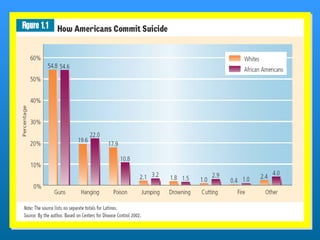
1858-1917 Identified  Social Integration   – the degree to which members of a group or a society feel united by shared values and other social bonds; a.k.a. social cohesion Got Sociology recognized as a separate discipline Studied how social forces affect behavior, see Figure 1.1 on page 13
 
1864-1920 Believed religion is the central force in social change Origin of capitalism came from the Protestants of the Calvinist tradition wanting signs they were on the path to Heaven Called the readiness to invest into capital the “ Protestant Ethic ” He called the readiness to invest in capital to make money the “ spirit of capitalism ”
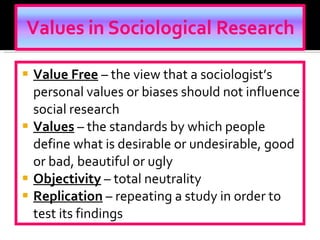
Value Free   – the view that a sociologist’s personal values or biases should not influence social research Values  – the standards by which people define what is desirable or undesirable, good or bad, beautiful or ugly Objectivity  – total neutrality Replication  – repeating a study in order to test its findings
 
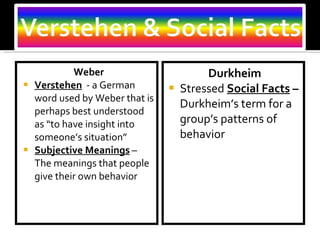
Weber Verstehen   - a German word used by Weber that is perhaps best understood as “to have insight into someone’s situation” Subjective Meanings  – The meanings that people give their own behavior Durkheim Stressed   Social Facts  –  Durkheim’s term for a group’s patterns of behavior
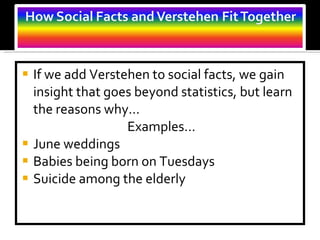
If we add Verstehen to social facts, we gain insight that goes beyond statistics, but learn the reasons why… Examples… June weddings  Babies being born on Tuesdays Suicide among the elderly
1800s Attitudes of the time were that women were wives and mothers Women were expected to devoted themselves to the 4 Ks:  Kirche ,  Kuchen ,  Kinder , and  Kleider  (church, cooking, children, and clothes) Few people at all were educated beyond the basics
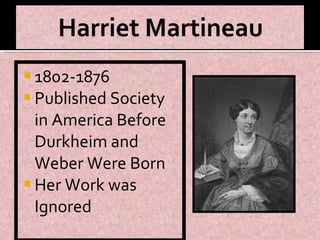
1802-1876 Published Society in America Before Durkheim and Weber Were Born Her Work was Ignored
University of Kansas  develops  first Sociology dept.  in North America in  1890  followed by University of Chicago in 1892, Atlanta University in 1897, McGill University in Canada in 1922, Harvard in 1930 and Berkeley in the 1950s!
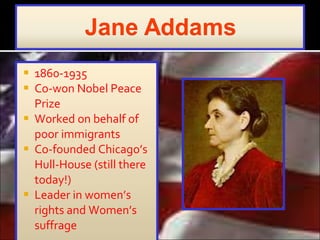
1860-1935 Co-won Nobel Peace Prize  Worked on behalf of poor immigrants Co-founded Chicago’s Hull-House (still there today!) Leader in women’s rights and Women’s suffrage
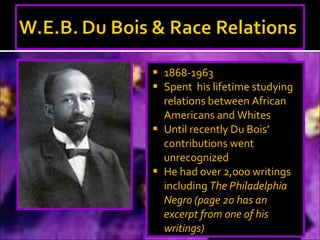
1868-1963 Spent  his lifetime studying relations between African Americans and Whites Until recently Du Bois’ contributions went unrecognized He had over 2,000 writings  including  The Philadelphia Negro (page 20 has an excerpt from one of his writings)
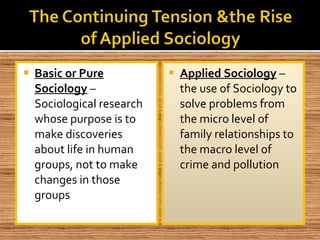
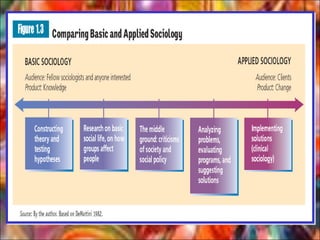
Basic or Pure Sociology  – Sociological research whose purpose is to make discoveries about life in human groups, not to make changes in those groups Applied Sociology  – the use of Sociology to solve problems from the micro level of family relationships to the macro level of crime and pollution
 
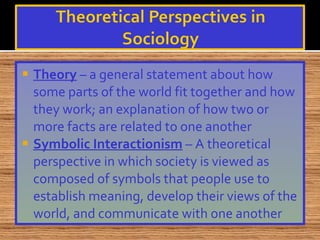
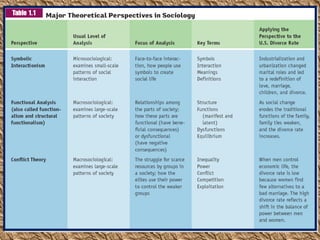
Theory  – a general statement about how some parts of the world fit together and how they work; an explanation of how two or more facts are related to one another Symbolic Interactionism  – A theoretical perspective in which society is viewed as composed of symbols that people use to establish meaning, develop their views of the world, and communicate with one another
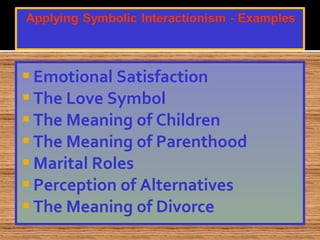
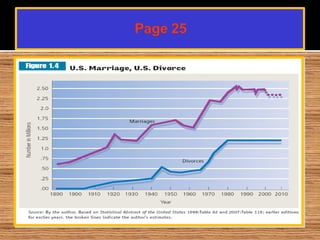
Emotional Satisfaction The Love Symbol The Meaning of Children The Meaning of Parenthood Marital Roles Perception of Alternatives The Meaning of Divorce
 
Functional Analysis  – a theoretical framework in which society is viewed as composed of various parts, each with a function that, when fulfilled, contributes to a society’s equilibrium; a.k.a. functionalism and structural functionalism (Society is a Whole Unit Made Up of Interrelated Parts that Work Together) Comte and Spencer viewed society as a living organism
Conflict Theory   - a theoretical framework in which society is viewed as composed as groups that are competing for scarce resources Founded by Karl Marx who thought the key to human history was class conflict
Macro-level Analysis  – an examination of large-scale patterns of society Micro-level Analysis  – an examination of small scale patterns of society Social Interaction  – what people do when they are in one another’s presence Nonverbal Interaction  – communication without words through gestures, use of space, silence, and so on
 
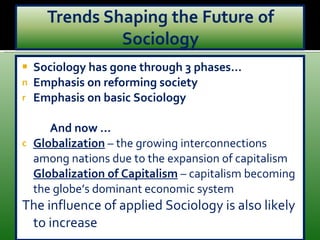
Sociology has gone through 3 phases… Emphasis on reforming society Emphasis on basic Sociology And now … Globalization  – the growing interconnections among nations due to the expansion of capitalism Globalization of Capitalism   – capitalism becoming the globe’s dominant economic system The influence of applied Sociology is also likely to increase

Chapter 1 The Sociological Perspective

  • 1.
  • 2.
    Sociological Perspective – Understanding human behavior by placing it within its broader social context Society – people who share a culture and a territory Social Location – the group memberships that people have because of their location in history and society
  • 3.
    Because we nowhave global communications our world has become a global village. (page 5)
  • 4.
    Science - The application of systematic methods to obtain knowledge and the knowledge obtained by those methods Natural Sciences – the intellectual and academic disciplines designed t explain and predict events in our natural environments Social Sciences – the intellectual and academic disciplines designed to understand the social world objectively by means of controlled and repeated observations
  • 5.
    Anthropology …the studyof humanity Economics …studies the production and distribution of the material goods and services of a society Political Science …examine how governments are formed, how they operate, and how they are related to other institutions of society Psychology …the study of human behavior Sociology …the study of societies and the behavior of societies (cultures, group structures, belief systems)
  • 6.
    To make Generalizations – statements that go beyond the indivual case and are applied to a broader group r situation To look for Patterns – recurring characteristics or events To predict or specify what will happen in the future Common sense – those things “everyone knows” are true (look at pages 8-Down-to-Earth box)
  • 7.
    Scientific method – using objective, systematic observations to test theories Positivism - the application of the scientific approach to the social world Sociology – the study of society and human behavior
  • 8.
    Auguste Comte (1798-1857)is the founder of Sociology. He believed that the scientific method should be applied to Sociology but did not apply it himself.
  • 9.
    1820-1903 Disagreed withComte that Sociology should guide social reform because he believed over time weak societies would die out. He called this principle “the survival of the fittest”…he coined this term, not Darwin! However, his views became known as Social Darwinism
  • 10.
    1818-1883 Like Comte,thought people should try to change society Class Conflict – Marx’s term for the struggle between capitalists and workers Bourgeoisie – Marx’s term for the capitalists, those who own the means of production Proletariat – Marx’s term for the exploited class, the mass of workers who do not own the means of production.
  • 11.
    1858-1917 Identified Social Integration – the degree to which members of a group or a society feel united by shared values and other social bonds; a.k.a. social cohesion Got Sociology recognized as a separate discipline Studied how social forces affect behavior, see Figure 1.1 on page 13
  • 12.
  • 13.
    1864-1920 Believed religionis the central force in social change Origin of capitalism came from the Protestants of the Calvinist tradition wanting signs they were on the path to Heaven Called the readiness to invest into capital the “ Protestant Ethic ” He called the readiness to invest in capital to make money the “ spirit of capitalism ”
  • 14.
    Value Free – the view that a sociologist’s personal values or biases should not influence social research Values – the standards by which people define what is desirable or undesirable, good or bad, beautiful or ugly Objectivity – total neutrality Replication – repeating a study in order to test its findings
  • 15.
  • 16.
    Weber Verstehen - a German word used by Weber that is perhaps best understood as “to have insight into someone’s situation” Subjective Meanings – The meanings that people give their own behavior Durkheim Stressed Social Facts – Durkheim’s term for a group’s patterns of behavior
  • 17.
    If we addVerstehen to social facts, we gain insight that goes beyond statistics, but learn the reasons why… Examples… June weddings Babies being born on Tuesdays Suicide among the elderly
  • 18.
    1800s Attitudes ofthe time were that women were wives and mothers Women were expected to devoted themselves to the 4 Ks: Kirche , Kuchen , Kinder , and Kleider (church, cooking, children, and clothes) Few people at all were educated beyond the basics
  • 19.
    1802-1876 Published Societyin America Before Durkheim and Weber Were Born Her Work was Ignored
  • 20.
    University of Kansas develops first Sociology dept. in North America in 1890 followed by University of Chicago in 1892, Atlanta University in 1897, McGill University in Canada in 1922, Harvard in 1930 and Berkeley in the 1950s!
  • 21.
    1860-1935 Co-won NobelPeace Prize Worked on behalf of poor immigrants Co-founded Chicago’s Hull-House (still there today!) Leader in women’s rights and Women’s suffrage
  • 22.
    1868-1963 Spent his lifetime studying relations between African Americans and Whites Until recently Du Bois’ contributions went unrecognized He had over 2,000 writings including The Philadelphia Negro (page 20 has an excerpt from one of his writings)
  • 23.
    Basic or PureSociology – Sociological research whose purpose is to make discoveries about life in human groups, not to make changes in those groups Applied Sociology – the use of Sociology to solve problems from the micro level of family relationships to the macro level of crime and pollution
  • 24.
  • 25.
    Theory –a general statement about how some parts of the world fit together and how they work; an explanation of how two or more facts are related to one another Symbolic Interactionism – A theoretical perspective in which society is viewed as composed of symbols that people use to establish meaning, develop their views of the world, and communicate with one another
  • 26.
    Emotional Satisfaction TheLove Symbol The Meaning of Children The Meaning of Parenthood Marital Roles Perception of Alternatives The Meaning of Divorce
  • 27.
  • 28.
    Functional Analysis – a theoretical framework in which society is viewed as composed of various parts, each with a function that, when fulfilled, contributes to a society’s equilibrium; a.k.a. functionalism and structural functionalism (Society is a Whole Unit Made Up of Interrelated Parts that Work Together) Comte and Spencer viewed society as a living organism
  • 29.
    Conflict Theory - a theoretical framework in which society is viewed as composed as groups that are competing for scarce resources Founded by Karl Marx who thought the key to human history was class conflict
  • 30.
    Macro-level Analysis – an examination of large-scale patterns of society Micro-level Analysis – an examination of small scale patterns of society Social Interaction – what people do when they are in one another’s presence Nonverbal Interaction – communication without words through gestures, use of space, silence, and so on
  • 31.
  • 32.
    Sociology has gonethrough 3 phases… Emphasis on reforming society Emphasis on basic Sociology And now … Globalization – the growing interconnections among nations due to the expansion of capitalism Globalization of Capitalism – capitalism becoming the globe’s dominant economic system The influence of applied Sociology is also likely to increase