Edit this text to create aa 16:9 media
      This slide has Heading
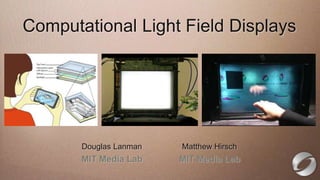
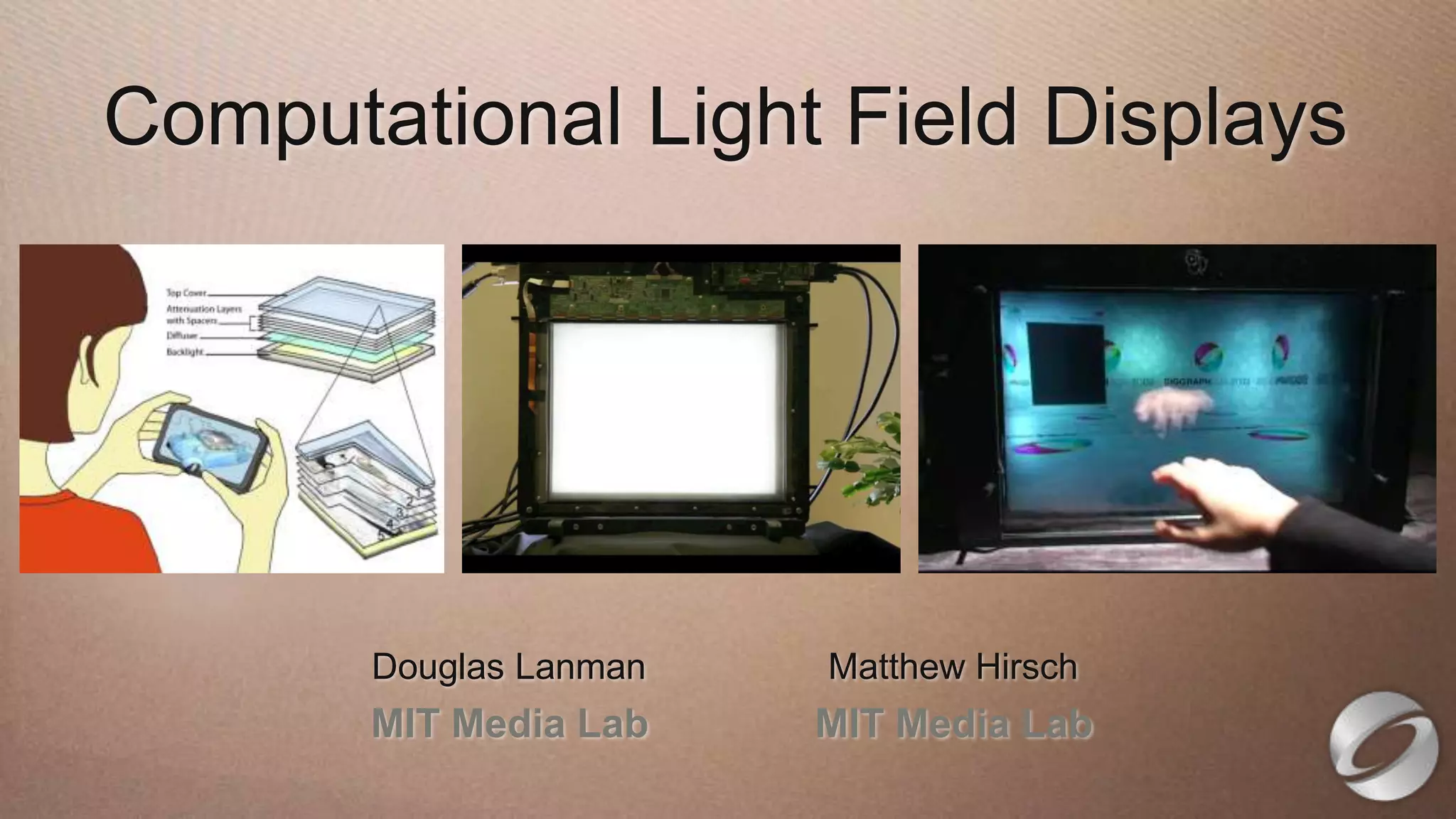
    Computational Light Field window
                              Displays
   This subtitle is 20 points
   Bullets are blue
   They have 110% line spacing, 2 points before & after
   Longer bullets in the form of a paragraph are harder to
    read if there is insufficient line spacing. This is the
    maximum recommended number of lines per slide
    (seven).
                Douglas Lanman      Matthew Hirsch
     Sub bulletsMIT Media Lab
                  look like this   MIT Media Lab
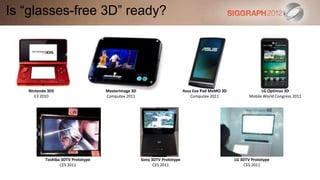
Is “glasses-free 3D” ready?


   Nintendo 3DS                    MasterImage 3D                         Asus Eee Pad MeMO 3D                LG Optimus 3D
      E3 2010                      Computex 2011                              Computex 2011             Mobile World Congress 2011


          Toshiba 3DTV Prototype                    Sony 3DTV Prototype                          LG 3DTV Prototype
                 CES 2011                                 CES 2011                                   CES 2011
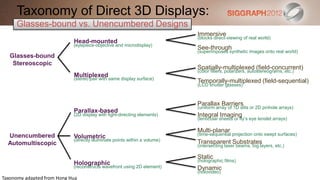
Taxonomy of Direct 3D Displays:
     Glasses-bound vs. Unencumbered Designs
                                                                           Immersive
                                                                           (blocks direct-viewing of real world)
                            Head-mounted
                            (eyepiece-objective and microdisplay)
                                                                           See-through
                                                                           (superimposes synthetic images onto real world)
   Glasses-bound
    Stereoscopic
                                                                           Spatially-multiplexed (field-concurrent)
                                                                           (color filters, polarizers, autostereograms, etc.)
                            Multiplexed
                            (stereo pair with same display surface)
                                                                           Temporally-multiplexed (field-sequential)
                                                                           (LCD shutter glasses)


                                                                           Parallax Barriers
                                                                           (uniform array of 1D slits or 2D pinhole arrays)
                            Parallax-based
                            (2D display with light-directing elements)     Integral Imaging
                                                                           (lenticular sheets or fly’s eye lenslet arrays)

                                                                           Multi-planar
  Unencumbered                                                             (time-sequential projection onto swept surfaces)
                            Volumetric
                            (directly illuminate points within a volume)   Transparent Substrates
  Automultiscopic                                                          (intersecting laser beams, fog layers, etc.)

                                                                           Static
                                                                           (holographic films)
                            Holographic
                            (reconstructs wavefront using 2D element)      Dynamic
                                                                           (holovideo)
Taxonomy adapted from Hong Hua
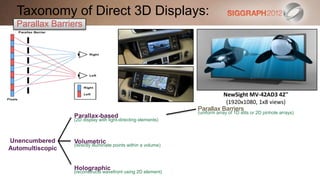
Taxonomy of Direct 3D Displays:
  Parallax Barriers


                                                                          NewSight MV-42AD3 42''
                                                                           (1920x1080, 1x8 views)
                                                                 Parallax Barriers
                                                                 (uniform array of 1D slits or 2D pinhole arrays)
                  Parallax-based
                  (2D display with light-directing elements)


Unencumbered      Volumetric
                  (directly illuminate points within a volume)
Automultiscopic


                  Holographic
                  (reconstructs wavefront using 2D element)
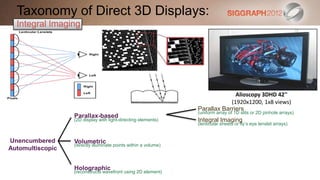
Taxonomy of Direct 3D Displays:
  Integral Imaging


                                                                               Alioscopy 3DHD 42''
                                                                             (1920x1200, 1x8 views)
                                                                 Parallax Barriers
                                                                 (uniform array of 1D slits or 2D pinhole arrays)
                  Parallax-based
                  (2D display with light-directing elements)     Integral Imaging
                                                                 (lenticular sheets or fly’s eye lenslet arrays)


Unencumbered      Volumetric
                  (directly illuminate points within a volume)
Automultiscopic


                  Holographic
                  (reconstructs wavefront using 2D element)
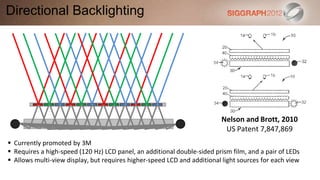
Directional Backlighting


                                                                         Nelson and Brott, 2010
                                                                          US Patent 7,847,869
 Currently promoted by 3M
 Requires a high-speed (120 Hz) LCD panel, an additional double-sided prism film, and a pair of LEDs
 Allows multi-view display, but requires higher-speed LCD and additional light sources for each view
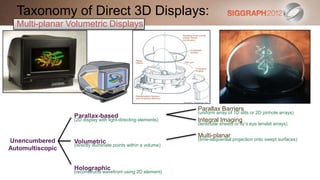
Taxonomy of Direct 3D Displays:
  Multi-planar Volumetric Displays


                                                                 Parallax Barriers
                                                                 (uniform array of 1D slits or 2D pinhole arrays)
                  Parallax-based
                  (2D display with light-directing elements)     Integral Imaging
                                                                 (lenticular sheets or fly’s eye lenslet arrays)

                                                                 Multi-planar
Unencumbered                                                     (time-sequential projection onto swept surfaces)
                  Volumetric
                  (directly illuminate points within a volume)
Automultiscopic


                  Holographic
                  (reconstructs wavefront using 2D element)
Taxonomy of Direct 3D Displays:
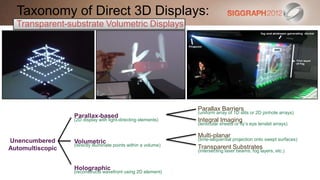
  Transparent-substrate Volumetric Displays


                                                                 Parallax Barriers
                                                                 (uniform array of 1D slits or 2D pinhole arrays)
                  Parallax-based
                  (2D display with light-directing elements)     Integral Imaging
                                                                 (lenticular sheets or fly’s eye lenslet arrays)

                                                                 Multi-planar
Unencumbered                                                     (time-sequential projection onto swept surfaces)
                  Volumetric
                  (directly illuminate points within a volume)   Transparent Substrates
Automultiscopic                                                  (intersecting laser beams, fog layers, etc.)


                  Holographic
                  (reconstructs wavefront using 2D element)
Taxonomy of Direct 3D Displays:
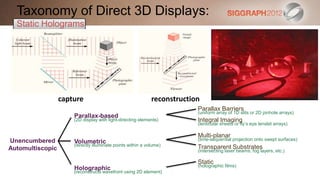
  Static Holograms


                  capture                                    reconstruction
                                                                          Parallax Barriers
                                                                          (uniform array of 1D slits or 2D pinhole arrays)
                      Parallax-based
                      (2D display with light-directing elements)          Integral Imaging
                                                                          (lenticular sheets or fly’s eye lenslet arrays)

                                                                          Multi-planar
Unencumbered                                                              (time-sequential projection onto swept surfaces)
                      Volumetric
                      (directly illuminate points within a volume)        Transparent Substrates
Automultiscopic                                                           (intersecting laser beams, fog layers, etc.)

                                                                          Static
                                                                          (holographic films)
                      Holographic
                      (reconstructs wavefront using 2D element)
Taxonomy of Direct 3D Displays:
  Dynamic Holograms (Holovideo)


      Tay et al.                                            MIT Media Lab Spatial Imaging Group
    [Nature, 2008]                                                  [Holovideo, 1989 – present]
                                                                                Parallax Barriers
                                                                                (uniform array of 1D slits or 2D pinhole arrays)
                     Parallax-based
                     (2D display with light-directing elements)                 Integral Imaging
                                                                                (lenticular sheets or fly’s eye lenslet arrays)

                                                                                Multi-planar
Unencumbered                                                                    (time-sequential projection onto swept surfaces)
                     Volumetric
                     (directly illuminate points within a volume)               Transparent Substrates
Automultiscopic                                                                 (intersecting laser beams, fog layers, etc.)

                                                                                Static
                                                                                (holographic films)
                     Holographic
                     (reconstructs wavefront using 2D element)                  Dynamic
                                                                                (holovideo)
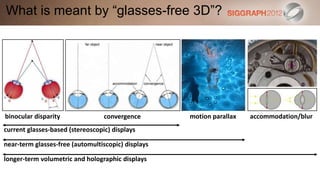
What is meant by “glasses-free 3D”?


binocular disparity               convergence       motion parallax   accommodation/blur
current glasses-based (stereoscopic) displays

near-term glasses-free (automultiscopic) displays

longer-term volumetric and holographic displays
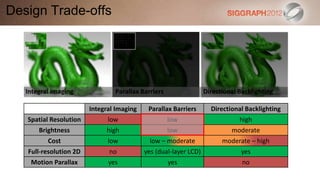
Design Trade-offs


   Integral Imaging             Parallax Barriers                 Directional Backlighting

                        Integral Imaging    Parallax Barriers       Directional Backlighting
   Spatial Resolution         low                   low                       high
       Brightness            high                   low                    moderate
          Cost                low            low – moderate             moderate – high
   Full-resolution 2D         no           yes (dual-layer LCD)                yes
    Motion Parallax           yes                   yes                        no
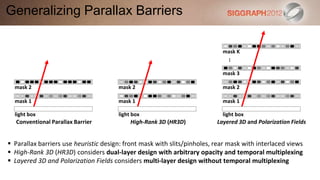
Generalizing Parallax Barriers

                                                                            mask K


                                                                              …
                                                                            mask 3

  mask 2                               mask 2                               mask 2

  mask 1                               mask 1                               mask 1

  light box                            light box                            light box
   Conventional Parallax Barrier            High-Rank 3D (HR3D)           Layered 3D and Polarization Fields


 Parallax barriers use heuristic design: front mask with slits/pinholes, rear mask with interlaced views
 High-Rank 3D (HR3D) considers dual-layer design with arbitrary opacity and temporal multiplexing
 Layered 3D and Polarization Fields considers multi-layer design without temporal multiplexing
Outline
 Automultiscopic Displays
    Multi-Layer Displays
       Layered 3D
      - Polarization Fields
    Dual-Layer Displays
      - High-Rank 3D (HR3D)
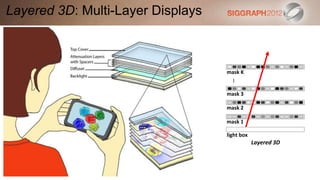
Layered 3D: Multi-Layer Displays


                                   mask K


                                     …
                                   mask 3

                                   mask 2

                                   mask 1

                                   light box
                                               Layered 3D
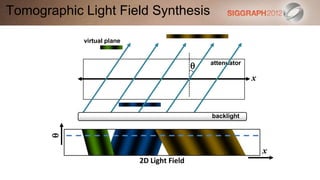
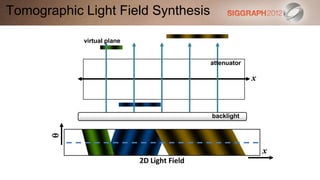
Tomographic Light Field Synthesis

            virtual plane


                                             q   attenuator

                                                              x


                                                 backlight
       q


                                                                  x
                            2D Light Field
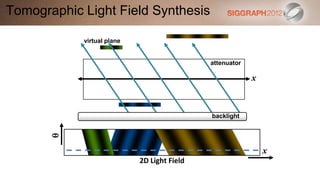
Tomographic Light Field Synthesis

            virtual plane


                                             attenuator

                                                          x


                                             backlight
       q


                                                              x
                            2D Light Field
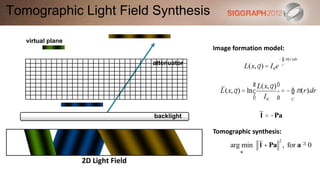
Tomographic Light Field Synthesis

            virtual plane


                                             attenuator

                                                          x


                                             backlight
       q


                                                              x
                            2D Light Field
Tomographic Light Field Synthesis

   virtual plane
                                                 Image formation model:
                                                                                      ò
                                                                                  - m (r )dr
                                    attenuator
                                                               L(x, q ) = I 0 e       C


                                                                 æ L(x, q ) ö
                                                   L(x, q ) = ln ç          ÷ = - ò m (r)dr
                                                                 è I0 ø           C


                                    backlight                         l = -Pa

                                                 Tomographic synthesis:
                                                                                  2
                                                       arg min l + Pa , for a ³ 0
                                                           a

                   2D Light Field
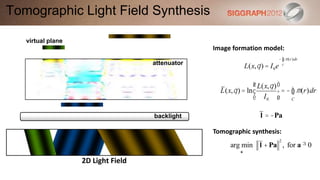
Tomographic Light Field Synthesis

   virtual plane
                                                 Image formation model:
                                                                                      ò
                                                                                  - m (r )dr
                                    attenuator
                                                               L(x, q ) = I 0 e       C


                                                                 æ L(x, q ) ö
                                                   L(x, q ) = ln ç          ÷ = - ò m (r)dr
                                                                 è I0 ø           C


                                    backlight                         l = -Pa

                                                 Tomographic synthesis:
                                                                                  2
                                                       arg min l + Pa , for a ³ 0
                                                           a

                   2D Light Field
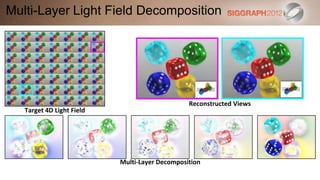
Multi-Layer Light Field Decomposition


                                                Reconstructed Views
   Target 4D Light Field


                           Multi-Layer Decomposition
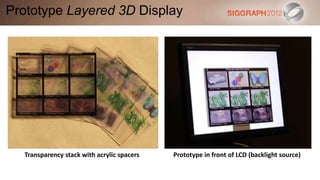
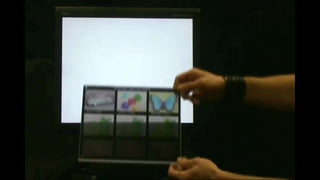
Prototype Layered 3D Display


  Transparency stack with acrylic spacers   Prototype in front of LCD (backlight source)
Outline
 Automultiscopic Displays
    Multi-Layer Displays
      - Layered 3D
       Polarization Fields
    Dual-Layer Displays
      - High-Rank 3D (HR3D)
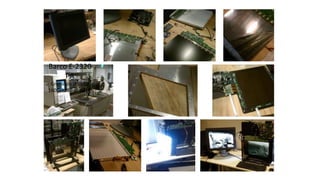
Barco E-2320
     PA
 Grayscale IPS LCD
1600x1200 @ 60 Hz
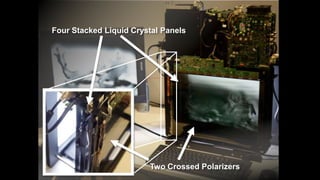
Four Stacked Liquid Crystal Panels


                        Two Crossed Polarizers
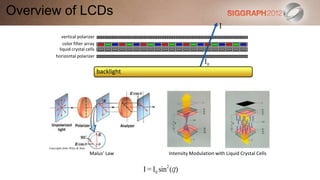
Overview of LCDs
                                                                             I
          vertical polarizer
          color filter array
        liquid crystal cells
       horizontal polarizer
                                                                      I0
                               backlight


                         Malus’ Law                   Intensity Modulation with Liquid Crystal Cells


                                           I = I0 sin2 (q )
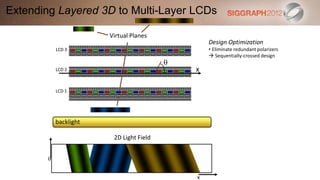
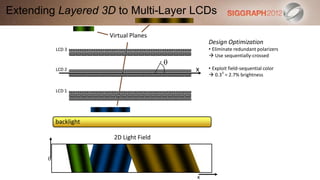
Extending Layered 3D to Multi-Layer LCDs

                       Virtual Planes
                                                 Design Optimization
           LCD 3                                 • Eliminate redundant polarizers
                                                  Sequentially-crossed design
                                         q
           LCD 2                             x

           LCD 1


           backlight

                        2D Light Field


       q


                                             x
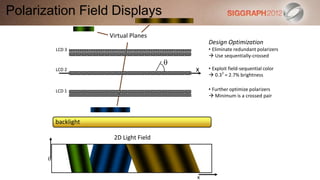
Extending Layered 3D to Multi-Layer LCDs

                       Virtual Planes
                                                 Design Optimization
           LCD 3                                 • Eliminate redundant polarizers
                                                  Use sequentially-crossed
                                         q
           LCD 2                             x   • Exploit field-sequential color
                                                  0.33 = 2.7% brightness

           LCD 1


           backlight

                        2D Light Field


       q


                                             x
Polarization Field Displays
                       Virtual Planes
                                                 Design Optimization
           LCD 3                                 • Eliminate redundant polarizers
                                                  Use sequentially-crossed
                                         q
           LCD 2                             x   • Exploit field-sequential color
                                                  0.33 = 2.7% brightness

           LCD 1                                 • Further optimize polarizers
                                                  Minimum is a crossed pair


           backlight

                        2D Light Field


       q


                                             x
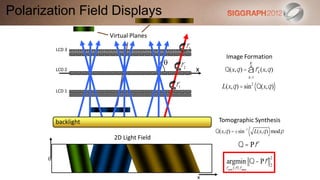
Polarization Field Displays
                       Virtual Planes

           LCD 3
                                                   f3
                                                                 Image Formation
                                         q    f2                                 K
           LCD 2                                        x       Q(x, q ) = åfk (x, q )
                                                                                 k=1

                                             f1                L(x, q ) = sin 2 (Q(x,q ))
           LCD 1


           backlight                                         Tomographic Synthesis

                        2D Light Field
                                                            Q(x,q ) = ±sin-1     (           )
                                                                                       L(x, q ) mod p

                                                                        Q = Pf
       q                                                         argmin Q - Pf
                                                                                                 2
                                                                                                 2
                                                                 fmin £f £fmax

                                                        x
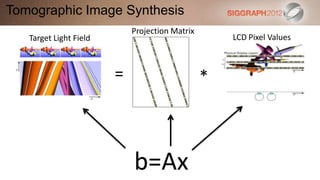
Tomographic Image Synthesis
                            Projection Matrix
   Target Light Field                               LCD Pixel Values


                        =                       *


                            b=Ax
SART [Simultaneous Algebraic Reconstruction Technique]

                                                            b=Ax
                                          pre-compute some weights

                                         initial guess
                          ATv          Ax                update
                                                         clamp
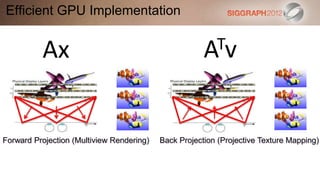
Efficient GPU Implementation


          Ax                                           ATv


Forward Projection (Multiview Rendering)   Back Projection (Projective Texture Mapping)
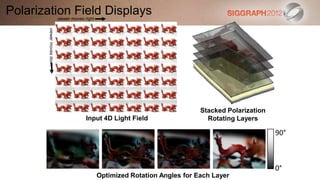
Polarization Field Displaysviewer moves right


       viewer moves down


                                                                               Stacked Polarization
                                         Input 4D Light Field                    Rotating Layers

                                                                                                      90°


                                                                                                      0°
                                                Optimized Rotation Angles for Each Layer
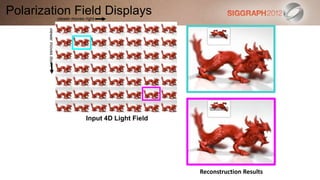
Polarization Field Displaysviewer moves right


       viewer moves down


                                         Input 4D Light Field


                                                                Reconstruction Results
Outline
 Automultiscopic Displays
    Multi-Layer Displays
      - Layered 3D
      - Polarization Fields
    Dual-Layer Displays
       High-Rank 3D (HR3D)
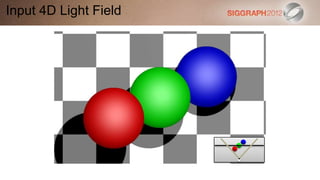
Input 4D Light Field
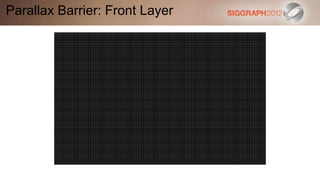
Parallax Barrier: Front Layer
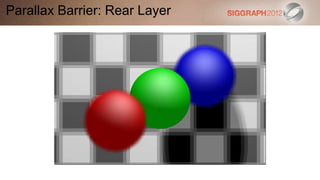
Parallax Barrier: Rear Layer
Analysis of Parallax Barriers

                                        k
                 L[i,k]
                                    i
        k
g[k]
 f[i]
        i
                                               L[i,k]
                                                    `


                 light box
            L[i, k] = f [i]× g[k]       L[i, k ]  f [i]  g[k ]
Analysis of Parallax Barriers

                                      L[i,k]

                 k
    g[k]
                  i
     f[i]                                                                                    `


                                     light box
                                                                         T
Ken Perlin et al. An Autosteroscopic Display. 2000.            L[i, k] = å ft [i] Ä gt [k]
Yunhee Kim et al. Electrically Movable Pinhole Arrays. 2007.
                                                                         t=1
Content-Adaptive Parallax Barriers

            L[i,k]
                                     G

        k
g[k]
        i                            ~`
 f[i]                       F        L

            light box
                        ~
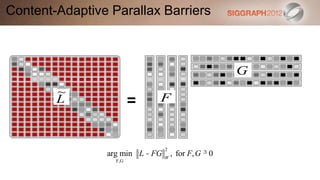
                        L  FG
Content-Adaptive Parallax Barriers


                                                  G
        ~`
        L               =      F


                arg min L - FG W , for F, G ³ 0
                                2

                  F,G
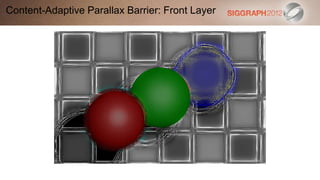
Content-Adaptive Parallax Barrier: Front Layer
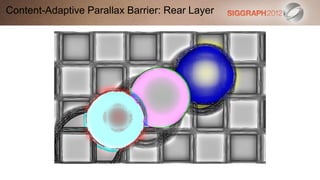
Content-Adaptive Parallax Barrier: Rear Layer
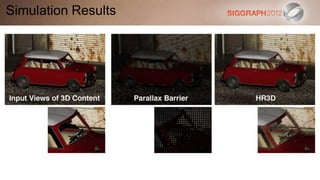
Simulation Results
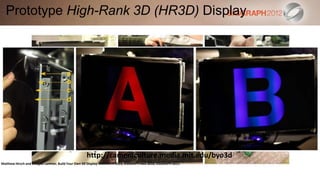
Prototype High-Rank 3D (HR3D) Display


                                                    http://cameraculture.media.mit.edu/byo3d
Matthew Hirsch and Douglas Lanman. Build Your Own 3D Display. SIGGRAPH 2010, SIGGRAPH Asia 2010, SIGGRAPH 2011.
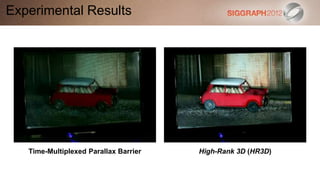
Experimental Results


   Time-Multiplexed Parallax Barrier   High-Rank 3D (HR3D)
Outline
 Automultiscopic Displays
    Multi-Layer Displays
      - Layered 3D
      - Polarization Fields
    Dual-Layer Displays
      - High-Rank 3D (HR3D)
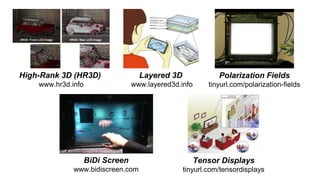
High-Rank 3D (HR3D)                 Layered 3D               Polarization Fields
    www.hr3d.info                 www.layered3d.info      tinyurl.com/polarization-fields


                    BiDi Screen                        Tensor Displays
              www.bidiscreen.com                 tinyurl.com/tensordisplays

SIGGRAPH 2012 Computational Display Course - 3 Computational Light Field Displays

  • 1.
    Edit this textto create aa 16:9 media This slide has Heading Computational Light Field window Displays  This subtitle is 20 points  Bullets are blue  They have 110% line spacing, 2 points before & after  Longer bullets in the form of a paragraph are harder to read if there is insufficient line spacing. This is the maximum recommended number of lines per slide (seven). Douglas Lanman Matthew Hirsch  Sub bulletsMIT Media Lab look like this MIT Media Lab
  • 2.
    Is “glasses-free 3D”ready? Nintendo 3DS MasterImage 3D Asus Eee Pad MeMO 3D LG Optimus 3D E3 2010 Computex 2011 Computex 2011 Mobile World Congress 2011 Toshiba 3DTV Prototype Sony 3DTV Prototype LG 3DTV Prototype CES 2011 CES 2011 CES 2011
  • 3.
    Taxonomy of Direct3D Displays: Glasses-bound vs. Unencumbered Designs Immersive (blocks direct-viewing of real world) Head-mounted (eyepiece-objective and microdisplay) See-through (superimposes synthetic images onto real world) Glasses-bound Stereoscopic Spatially-multiplexed (field-concurrent) (color filters, polarizers, autostereograms, etc.) Multiplexed (stereo pair with same display surface) Temporally-multiplexed (field-sequential) (LCD shutter glasses) Parallax Barriers (uniform array of 1D slits or 2D pinhole arrays) Parallax-based (2D display with light-directing elements) Integral Imaging (lenticular sheets or fly’s eye lenslet arrays) Multi-planar Unencumbered (time-sequential projection onto swept surfaces) Volumetric (directly illuminate points within a volume) Transparent Substrates Automultiscopic (intersecting laser beams, fog layers, etc.) Static (holographic films) Holographic (reconstructs wavefront using 2D element) Dynamic (holovideo) Taxonomy adapted from Hong Hua
  • 4.
    Taxonomy of Direct3D Displays: Parallax Barriers NewSight MV-42AD3 42'' (1920x1080, 1x8 views) Parallax Barriers (uniform array of 1D slits or 2D pinhole arrays) Parallax-based (2D display with light-directing elements) Unencumbered Volumetric (directly illuminate points within a volume) Automultiscopic Holographic (reconstructs wavefront using 2D element)
  • 5.
    Taxonomy of Direct3D Displays: Integral Imaging Alioscopy 3DHD 42'' (1920x1200, 1x8 views) Parallax Barriers (uniform array of 1D slits or 2D pinhole arrays) Parallax-based (2D display with light-directing elements) Integral Imaging (lenticular sheets or fly’s eye lenslet arrays) Unencumbered Volumetric (directly illuminate points within a volume) Automultiscopic Holographic (reconstructs wavefront using 2D element)
  • 6.
    Directional Backlighting Nelson and Brott, 2010 US Patent 7,847,869  Currently promoted by 3M  Requires a high-speed (120 Hz) LCD panel, an additional double-sided prism film, and a pair of LEDs  Allows multi-view display, but requires higher-speed LCD and additional light sources for each view
  • 7.
    Taxonomy of Direct3D Displays: Multi-planar Volumetric Displays Parallax Barriers (uniform array of 1D slits or 2D pinhole arrays) Parallax-based (2D display with light-directing elements) Integral Imaging (lenticular sheets or fly’s eye lenslet arrays) Multi-planar Unencumbered (time-sequential projection onto swept surfaces) Volumetric (directly illuminate points within a volume) Automultiscopic Holographic (reconstructs wavefront using 2D element)
  • 8.
    Taxonomy of Direct3D Displays: Transparent-substrate Volumetric Displays Parallax Barriers (uniform array of 1D slits or 2D pinhole arrays) Parallax-based (2D display with light-directing elements) Integral Imaging (lenticular sheets or fly’s eye lenslet arrays) Multi-planar Unencumbered (time-sequential projection onto swept surfaces) Volumetric (directly illuminate points within a volume) Transparent Substrates Automultiscopic (intersecting laser beams, fog layers, etc.) Holographic (reconstructs wavefront using 2D element)
  • 9.
    Taxonomy of Direct3D Displays: Static Holograms capture reconstruction Parallax Barriers (uniform array of 1D slits or 2D pinhole arrays) Parallax-based (2D display with light-directing elements) Integral Imaging (lenticular sheets or fly’s eye lenslet arrays) Multi-planar Unencumbered (time-sequential projection onto swept surfaces) Volumetric (directly illuminate points within a volume) Transparent Substrates Automultiscopic (intersecting laser beams, fog layers, etc.) Static (holographic films) Holographic (reconstructs wavefront using 2D element)
  • 10.
    Taxonomy of Direct3D Displays: Dynamic Holograms (Holovideo) Tay et al. MIT Media Lab Spatial Imaging Group [Nature, 2008] [Holovideo, 1989 – present] Parallax Barriers (uniform array of 1D slits or 2D pinhole arrays) Parallax-based (2D display with light-directing elements) Integral Imaging (lenticular sheets or fly’s eye lenslet arrays) Multi-planar Unencumbered (time-sequential projection onto swept surfaces) Volumetric (directly illuminate points within a volume) Transparent Substrates Automultiscopic (intersecting laser beams, fog layers, etc.) Static (holographic films) Holographic (reconstructs wavefront using 2D element) Dynamic (holovideo)
  • 11.
    What is meantby “glasses-free 3D”? binocular disparity convergence motion parallax accommodation/blur current glasses-based (stereoscopic) displays near-term glasses-free (automultiscopic) displays longer-term volumetric and holographic displays
  • 12.
    Design Trade-offs Integral Imaging Parallax Barriers Directional Backlighting Integral Imaging Parallax Barriers Directional Backlighting Spatial Resolution low low high Brightness high low moderate Cost low low – moderate moderate – high Full-resolution 2D no yes (dual-layer LCD) yes Motion Parallax yes yes no
  • 13.
    Generalizing Parallax Barriers mask K … mask 3 mask 2 mask 2 mask 2 mask 1 mask 1 mask 1 light box light box light box Conventional Parallax Barrier High-Rank 3D (HR3D) Layered 3D and Polarization Fields  Parallax barriers use heuristic design: front mask with slits/pinholes, rear mask with interlaced views  High-Rank 3D (HR3D) considers dual-layer design with arbitrary opacity and temporal multiplexing  Layered 3D and Polarization Fields considers multi-layer design without temporal multiplexing
  • 14.
    Outline  Automultiscopic Displays  Multi-Layer Displays  Layered 3D - Polarization Fields  Dual-Layer Displays - High-Rank 3D (HR3D)
  • 15.
    Layered 3D: Multi-LayerDisplays mask K … mask 3 mask 2 mask 1 light box Layered 3D
  • 16.
    Tomographic Light FieldSynthesis virtual plane q attenuator x backlight q x 2D Light Field
  • 17.
    Tomographic Light FieldSynthesis virtual plane attenuator x backlight q x 2D Light Field
  • 18.
    Tomographic Light FieldSynthesis virtual plane attenuator x backlight q x 2D Light Field
  • 19.
    Tomographic Light FieldSynthesis virtual plane Image formation model: ò - m (r )dr attenuator L(x, q ) = I 0 e C æ L(x, q ) ö L(x, q ) = ln ç ÷ = - ò m (r)dr è I0 ø C backlight l = -Pa Tomographic synthesis: 2 arg min l + Pa , for a ³ 0 a 2D Light Field
  • 20.
    Tomographic Light FieldSynthesis virtual plane Image formation model: ò - m (r )dr attenuator L(x, q ) = I 0 e C æ L(x, q ) ö L(x, q ) = ln ç ÷ = - ò m (r)dr è I0 ø C backlight l = -Pa Tomographic synthesis: 2 arg min l + Pa , for a ³ 0 a 2D Light Field
  • 21.
    Multi-Layer Light FieldDecomposition Reconstructed Views Target 4D Light Field Multi-Layer Decomposition
  • 22.
    Prototype Layered 3DDisplay Transparency stack with acrylic spacers Prototype in front of LCD (backlight source)
  • 24.
    Outline  Automultiscopic Displays  Multi-Layer Displays - Layered 3D  Polarization Fields  Dual-Layer Displays - High-Rank 3D (HR3D)
  • 25.
    Barco E-2320 PA Grayscale IPS LCD 1600x1200 @ 60 Hz
  • 26.
    Four Stacked LiquidCrystal Panels Two Crossed Polarizers
  • 27.
    Overview of LCDs I vertical polarizer color filter array liquid crystal cells horizontal polarizer I0 backlight Malus’ Law Intensity Modulation with Liquid Crystal Cells I = I0 sin2 (q )
  • 28.
    Extending Layered 3Dto Multi-Layer LCDs Virtual Planes Design Optimization LCD 3 • Eliminate redundant polarizers  Sequentially-crossed design q LCD 2 x LCD 1 backlight 2D Light Field q x
  • 29.
    Extending Layered 3Dto Multi-Layer LCDs Virtual Planes Design Optimization LCD 3 • Eliminate redundant polarizers  Use sequentially-crossed q LCD 2 x • Exploit field-sequential color  0.33 = 2.7% brightness LCD 1 backlight 2D Light Field q x
  • 30.
    Polarization Field Displays Virtual Planes Design Optimization LCD 3 • Eliminate redundant polarizers  Use sequentially-crossed q LCD 2 x • Exploit field-sequential color  0.33 = 2.7% brightness LCD 1 • Further optimize polarizers  Minimum is a crossed pair backlight 2D Light Field q x
  • 31.
    Polarization Field Displays Virtual Planes LCD 3 f3 Image Formation q f2 K LCD 2 x Q(x, q ) = åfk (x, q ) k=1 f1 L(x, q ) = sin 2 (Q(x,q )) LCD 1 backlight Tomographic Synthesis 2D Light Field Q(x,q ) = ±sin-1 ( ) L(x, q ) mod p Q = Pf q argmin Q - Pf 2 2 fmin £f £fmax x
  • 32.
    Tomographic Image Synthesis Projection Matrix Target Light Field LCD Pixel Values = * b=Ax
  • 33.
    SART [Simultaneous AlgebraicReconstruction Technique] b=Ax pre-compute some weights initial guess ATv Ax update clamp
  • 34.
    Efficient GPU Implementation Ax ATv Forward Projection (Multiview Rendering) Back Projection (Projective Texture Mapping)
  • 35.
    Polarization Field Displaysviewermoves right viewer moves down Stacked Polarization Input 4D Light Field Rotating Layers 90° 0° Optimized Rotation Angles for Each Layer
  • 36.
    Polarization Field Displaysviewermoves right viewer moves down Input 4D Light Field Reconstruction Results
  • 38.
    Outline  Automultiscopic Displays  Multi-Layer Displays - Layered 3D - Polarization Fields  Dual-Layer Displays  High-Rank 3D (HR3D)
  • 39.
  • 40.
  • 41.
  • 42.
    Analysis of ParallaxBarriers k L[i,k] i k g[k] f[i] i L[i,k] ` light box L[i, k] = f [i]× g[k] L[i, k ]  f [i]  g[k ]
  • 43.
    Analysis of ParallaxBarriers L[i,k] k g[k] i f[i] ` light box T Ken Perlin et al. An Autosteroscopic Display. 2000. L[i, k] = å ft [i] Ä gt [k] Yunhee Kim et al. Electrically Movable Pinhole Arrays. 2007. t=1
  • 44.
    Content-Adaptive Parallax Barriers L[i,k] G k g[k] i ~` f[i] F L light box ~ L  FG
  • 45.
    Content-Adaptive Parallax Barriers G ~` L = F arg min L - FG W , for F, G ³ 0 2 F,G
  • 46.
  • 47.
  • 48.
  • 49.
    Prototype High-Rank 3D(HR3D) Display http://cameraculture.media.mit.edu/byo3d Matthew Hirsch and Douglas Lanman. Build Your Own 3D Display. SIGGRAPH 2010, SIGGRAPH Asia 2010, SIGGRAPH 2011.
  • 50.
    Experimental Results Time-Multiplexed Parallax Barrier High-Rank 3D (HR3D)
  • 51.
    Outline  Automultiscopic Displays  Multi-Layer Displays - Layered 3D - Polarization Fields  Dual-Layer Displays - High-Rank 3D (HR3D)
  • 52.
    High-Rank 3D (HR3D) Layered 3D Polarization Fields www.hr3d.info www.layered3d.info tinyurl.com/polarization-fields BiDi Screen Tensor Displays www.bidiscreen.com tinyurl.com/tensordisplays

Editor's Notes

  • #42 Basically, the tomographic light field synthesis then boils down to solving a linear equation system of the form Ax=b. b is the target light field, A the projection matrix, and the unknowns x are the LCD pixel values
  • #43 This equation system can be solved with SART – a technique developed, tested, and refined over decades in the medical imaging community.Algorithm is very simple:Initialize some data and find an initial guess of the pixel valuesIteratively update and clamp the solutionUpdate rules require two important operations: a function computing the matrix-vector multiplication Ax, and a function computing the transpose matrix-vector multiplication ATv