HOLOGRAPHY

              Chew Guang Wei           HT093271W
              Ho Seow Yan              HT093116E
              Lim Su Ru                HT093278B
              Ong Lip Sin              HT093131U
              Wee Chong Liang Justin   HT093290B


MT5009
Content
2


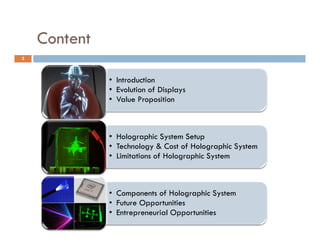
              • Introduction
              • Evolution of Displays
              • Value Proposition


              • Holographic System Setup
              • Technology & Cost of Holographic System
              • Limitations of Holographic System


              • Components of Holographic System
              • F t
                Future Opportunities
                       O     t iti
              • Entrepreneurial Opportunities
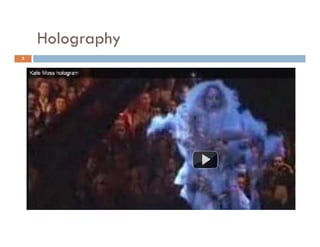
Holography
        g p y
3
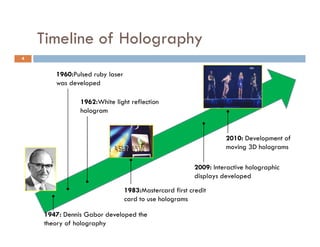
Timeline of Holography
                    g p y
4


       1960:Pulsed ruby laser
                      y
       was developed

               1962:White light reflection
               hologram


                                                                  2010: Development of
                                                                  moving 3D holograms

                                                        2009: Interactive holographic
                                                                              g p
                                                        displays developed
                                1983:Mastercard first credit
                                                g
                                card to use holograms

    1947: Dennis Gabor developed the
    theory of holography
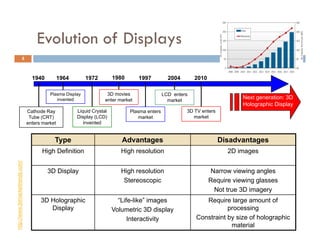
Evolution of Displays
                                                     p y
                           5


                                   1940          1964       1972         1980       1997          2004       2010

                                           Plasma Display             3D movies                 LCD enters
                                              invented               enter market                 market
                                                                                                                               Next generation: 3D
                                                                                                                               Holographic Display
                                 Cathode Ray            Liquid Crystal          Plasma enters            3D TV enters
                                  Tube (CRT)            Display (LCD)              market                   market
                                 enters market             invented


                                             Type                           Advantages                                  Disadvantages
                                       High Definition                      High resolution                               2D images
                          com/


                                          3D Display                        High resolution                          Narrow viewing angles
            dmarkettrends.c


                                                                             Stereoscopic                           Require viewing glasses
                                                                                                                      Not true 3D imagery
                                       3D Holographic                      “Life-like” images
                                                                            Life like                           Require large amount of
http://www.3d


                                          Display                        Volumetric 3D display                          processing
                                                                               Interactivity                 Constraint by size of holographic
                                                                                                                         material
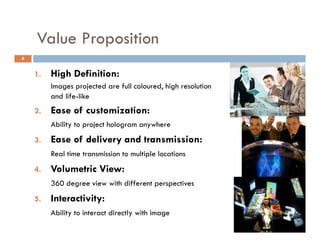
Value Proposition
             p
6


    1.
     .   High Definition:
           g e        o :
         Images projected are full coloured, high resolution
         and life-like
    2.   Ease of customization:
         E     f    t i ti
         Ability to project hologram anywhere
    3.
    3    Ease of delivery and transmission:
         Real time transmission to multiple locations
    4.
    4    Volumetric View:
         360 degree view with different perspectives
    5.   Interactivity:
         Ability to interact directly with image
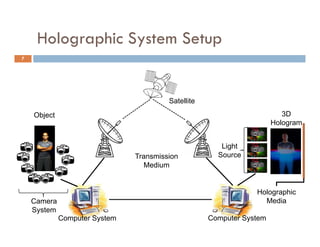
Holographic System Setup
         g p      y         p
7


                                        Satellite
    Object                                                               3D
                                                                      Hologram


                                                       Light
                               Transmission           Source
                                 Medium


                                                                Holographic
    Camera                                                        Media
    System
             Computer System                        Computer System
Technology for Holographic System
              gy         g p      y
8


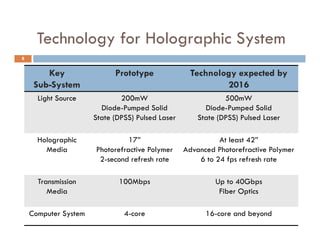
        Keyy                Prototype
                                  yp                Technology expected by
                                                            gy p         y
     Sub-System                                             2016
      Light Source            200mW                           500mW
                        Diode-Pumped
                        Diode Pumped Solid              Diode-Pumped
                                                        Diode Pumped Solid
                      State (DPSS) Pulsed Laser       State (DPSS) Pulsed Laser

      Holographic               17”                         At least 42”
        Media         Photorefractive Polymer     Advanced Photorefractive Polymer
                       2-second refresh rate          6 to 24 fps refresh rate

      Transmission           100Mbps                       Up to 40Gbps
         Media                                              Fiber Optics

    Computer System            4-core                   16-core and beyond
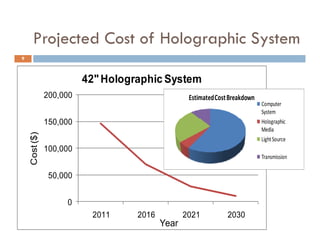
Projected Cost of Holographic System
          j                  g p      y
9


                         42" Holographic System
                                         S stem
               200,000                            Estimated Cost Breakdown
                                                                             Computer 
                                                                             System
               150,000                                                       Holographic 
                                                                             Media
          $)
    Cost ($


                                                                             Light Source
                                                                             Light Source
               100,000
                                                                             Transmission

                50,000


                    0
                          2011     2016          2021           2030
                                          Year
Limitations of Holographic System
                        g p      y
10


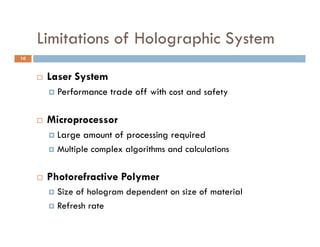
        Laser System
            Performance trade off with cost and safety

        Microprocessor
          Large amount of processing required
              g             p        g q
          Multiple complex algorithms and calculations


        Photorefractive Polymer
          Size of hologram dependent on size of material
          Refresh rate
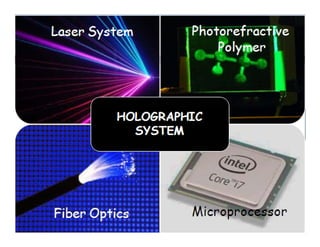
Photorefractive
                        Polymer
11


     Fiber Optics
Light Source: Evolution
           g
 12


              Mercury               Solid-state           Semiconductor
              arc lamp                 laser
                                       l                   laser di d
                                                           l     diodes
                (1948)                 (1960s)                  (1980s)


                                  Dr. Theodore                                                  [1]
                                  Maiman
                                  studies a ruby
                                  crystal in the
                                  shape of a
                                  cube in a laser.


[1] http://www.britannica.com/EBchecked/topic/269607/holography/92904/Pulsed-laser-holography
Laser System: Performance
                  y
 13


      1)   The lower the laser power the longer the exposure time
                               power,
                A second to few minutes for CW lasers vs. “nanoseconds” for Pulsed lasers

      2)   Laser power requirement
           i)    Increases with Size of holograms
                  Typical
                   T i l power l l H N l
                                   levels: HeNe lasers: 1 20 W Di d lasers: 5-50mW,
                                                        1-20mW, Diode l        5 50 W
                   DPSS lasers: 20-200mW, Ar lasers with etalon: 100-500mW
                  For large holograms, on the order of 10-sq m, laser powers on the order
                   of 1 W i preferred if cost i not an issue [1]  solid-state or A i gas
                     f 1-W is    f     d      t is t     i           lid t t      Ar ion
                   lasers as candidates


           ii)   Increases with Distance of hologram set-up
                    Min. power output for laser light shows: ~400mW
[1] http://www.loreti.it/chaptersPDF/Ch11_Non-Laser_Illum.pdf
[3] h //          i ll      i      /P d   /D         /CVIMG H l   h   Whi   df
Laser System: Performance vs. Cost
                  y
 14


      3)   Higher laser power systems translate to higher costs
           (several thousand to tens of thousand dollars) [1]
                                                        Laser System Costing
                                   35000             CW
                                                     Pulsed
                                   30000

                                   25000

                                   20000
                        Cost ($)


                                   15000

                                   10000

                                    5000

                                      0
                                           0   200     400    600   800   1000 1200 1400
                                                              Power (mW)       * Modulator & optic system costs not included [1]

[1] Diode pumped SSL Costs: http://www.amazing1.com, 2011
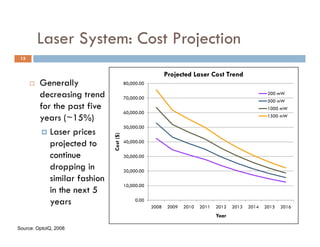
Laser System: Cost Projection
                 y              j
 15


                                                             Projected Laser Cost Trend
                                                                j
         Generally                       80,000.00

          decreasing trend                70,000.00
                                                                                                         200 mW
                                                                                                         500 mW
          for the past five                                                                              1000 mW
                                                                                                               W
                                          60,000.00
          years (~15%)                                                                                   1500 mW

                                          50,000.00
            Laser prices
                               Cost ($)


             projected to                 40,000.00


             continue                     30,000.00

             dropping in
                 pp g                     20,000.00
                                          20 000 00
             similar fashion
                                          10,000.00
             in the next 5
             years                             0.00
                                                      2008    2009   2010   2011   2012   2013   2014   2015   2016
                                                                                   Year

Source: OptoIQ, 2008
Holographic Media
                                     g p
 16

                                                                Comparison in Key Performance Metrics in Holographic Recording
                                                                                        Materials [1,2]
                                                                                        M t i l [1 2]
                                120%                                                                                                                                                                                  30,000

                                                                                                                                                                                                                                                         Recording medium
                                100%                                                                                                                                                                                  25,000                              should have
                                                                                                                                                                                                                                                               High diffraction
   Diffraction Efficiency (%)
                            )


                                                                                                                                                                                                                                                          1)


                                                                                                                                                                                                                               Resolution Limi (um)
                                80%                                                                                                                                                                                   20,000
                                                                                                                                                                                                                                                               efficiency
                                60%                                                                                                                                                                                   15,000                              2)   Wide resolution
                                                                                                                                                                                                                                                               range
                                                                                                                                                                                                                                                                  g


                                                                                                                                                                                                                                             it
                                40%                                                                                                                                                                                   10,000
                                                                                                                                                                                                                                                           Max. Resolution limit [um]
                                                                                                                                                                                                                                                           Max. Resolution limit [mm−1]

                                20%                                                                                                                                                                                   5,000                                Min. Resolution limit [um]
                                                                                                                                                                                                                                                           Min. Resolution limit [mm−1]

                                                                                                                                                                                                                                                           Max. efficiency Effi i
                                                                                                                                                                                                                                                           Max. Diff
                                                                                                                                                                                                                                                           M     Diffraction Efficiency
                                                                                                                                                                                                                                                                         i
                                 0%                                                                                                                                                                                   0
                                                                                           Dichromated gelatin


                                                                                                                                                      Photopolymers


                                                                                                                                                                                                         Elastomers
                                       Photographic emulsions


                                                                  Photographic emulsions


                                                                                                                                Photothermoplastics


                                                                                                                                                                      Photochromics


                                                                                                                                                                                        otorefractives
                                                                                                                 Photoresists
                                                                    (Phase bleached)
                                              mplitude)


                                                                                                                                                                      P


                                                                                                                                                                                      Pho
                                                                         e,


                                                                                                                                                      P
                                            (Am


[1] Lecture Holography and optical phase conjugation held at ETH Zürich by Prof. G. Montemezzani in 2002
[2] Ablation of nanoparticles for holographic recordings in elastomers: http://pubs.acs.org/doi/full/10.1021/la102693m
Holographic Media
             g p
17

        1)     Silver Halide Emulsion
                  High exposure sensitivity over a wide range of spectral regions
                  High resolving power
                  Suitable for transmission/reflection holograms (amplitude and phase type)
                                            /               g     ( p            p      yp )
        2)
        5)     Dichromated Gelatin Material
               Photorefractive polymer [1]
              
                  Record multicolour reflection holograms the 3D telepresence
                   Used for 3D dynamic holograms, enables
              
                   Suitable f veryi highl efficiency and low noise holograms
                   No     d for
                   N need for special glasses
                                      l
        3)    Photorefractive Crystals seconds; quasi real-time
                 Refreshes images every 2
                  Good for large-area and holography
                   Material use for real-time dynamically updatable holographic recording media
                  Recyclable! Photothermoplastics can also b recycled several h d d times and are
                         l bl h       h      l            l be     l d       l hundred       d
                   most suitable for holographic interferometry
        4)     Photoresist Material
                  Suitable for producing surface relief holograms
                  Most sensitive to ultraviolet/blue light only.
[1] P.-A. Blanche et al, Holographic three-dimensional telepresence using large-area photorefractive polymer, Nature Volume:
    468, Pages: 80–83, 04 November 2010, DOI 10.1038/nature09521
Photorefractive Polymer: Performance
                            y
 18


   1)     Refresh Rate
            University of Arizona (UA) took 2 s to write & erase a full-colour dynamic holographic
             image in 2010 vs. 4 mins in 2008 [1,2]
                   marked improvement of ~100x in 2 years!
            Quoting UA lead author of the study Blanche,
             “In two years we improved the speed by a factor of 100. If we can improve the speed by
             the same factor, we will be over video rate. It will be done.” [2]
            Next step: 6 fps (~0.2s); to progress towards a refresh rate of 24-30 fps


   2)
    )     Display Size
             p y
            17” (current largest)
            Have to scale up the display size to 85” for outdoor billboard advertising & 6–8 ft
             (
             (life-size) for telepresencing to be truly p
                       )         p        g           y possible


[1] http://news.inventhelp.com/Articles/Electronics/Inventions/three-dimensional-dynamic-holography-12521.aspx
[2] http://www.wired.com/wiredscience/2010/11/holographic-video/
Photorefractive Polymer: Cost Projection
                                      y             j
 19

                  Sony's Display Cost based o j eDisplay C o s& o f P h o t o rSony's t i v e P o l y mper Inch based on
                                         P r on c t e d Size t                 e f r a c Display Cost e r
                                                       [1-3]                                                           [1-3]
                        Technology (as of Dec 2010) b a s e d o n S260r e e n S iTechnology (as of Dec 2010)
                                                                         c Display z e
                 5000                                               D y n a m ic p h o t o r e f r a c t i v e p o l y m e r ( P r o je c t e d )
                             XEL-1 OLED TV 0 0
                                       350                 D y n a m ic p h o t o p o l y m e r ( E x t r a p o 240 f r o m Z e b r a I m a g in g )
                                                                                                                la te
                                                                                                                                                                       XEL-1 OLED TV
                             Bravia XBR10 Series LED 3D TV S t a t ic p h o t o p o ly m e r ( Z e b r a I m a g i n g )                                               Bravia XBR10 Series LED 3D TV
                 4500        Bravia XBR9 Series LCD TV                                                          220                                                    Bravia XBR9 Series LCD TV
                                               30000
                                                                                                                                          200
                 4000


                                                                                                                                   nch)
                                               25000                                                                                      180


                                                                                                                     Cost/inch ($/in
                 3500                                                                                                                     160
      Cost ($)


                                               20000
                                    Cost ($)


                                                                                                                                          140
                 3000
                                                                                                                                          120
                                               15000
                 2500                                                                                                                     100
                                               10000                                                                                       80
                 2000
                                                                                                                                           60
                 1500                           5000
                                                                                                                                           40
                        10              20           030        40             50              60                                               10     20         30         40        50        60
                                                        10         20                30                 40                                50      60        70         80
                                               Display Size (inches)                                                                                        Display Size (inches)
                                                                                                    S c r e e n S iz e ( in c h e s )


                       Photorefractive polymer is projected to cost ~4x more than
                                                                      4x
                        static photopolymer
                              $1500 for 12”x18” & $3500 & 2 ft by 3 ft static 3D holograms by Zebra
                               Imaging [4]
                               I   i
[1] Sony XEL-1 OLED TV pricing: http://reviews.cnet.com/oled/sony-xel-1-oled/4505-13948_7-32815284.html
[2] Sony Bravia XBR10 Series LED 3D TV pricing: http://www.best-led-tv.net/46%E2%80%B3-sony-bravia-xbr10.html
[3] Sony Bravia XBR9 Series LCD TV pricing: http://www.practical-home-theater-guide.com/sony-lcd-tv-1.html
[4] Zebra Imaging Print Cost: http://www.3d-display-info.com/zebra-imaging-prints-large-3d-holograms
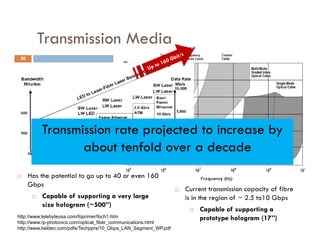
Transmission Media
 20


           Transmission rate projected to increase by
                  about tenfold over a decade
     Has the potential to go up to 40 or even 160
      Gbps
                                                                    Current transmission capacity of fibre
          Capable of supporting a very large                        is in the region of ~ 2.5 to10 Gbps
           size hologram (~500”)
                                                                         Capable of supporting a
http://www.telebyteusa.com/foprimer/foch1.htm                             prototype hologram (17”)
http://www.rp-photonics.com/optical_fiber_communications.html
http://www.belden.com/pdfs/Techpprs/10_Gbps_LAN_Segment_WP.pdf
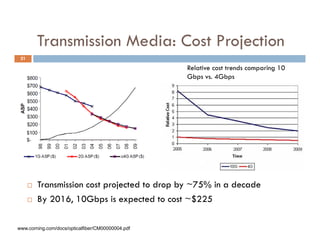
Transmission Media: Cost Projection
 21

                                                   Relative cost trends comparing 10
                                                   Gbps vs 4Gbps
                                                          vs.


         Transmission cost projected to drop by ~75% in a decade
         By 2016, 10Gbps is expected to cost ~$225
                                                  $225

www.corning.com/docs/opticalfiber/CM00000004.pdf
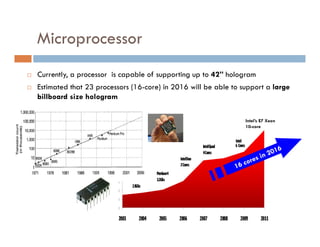
Microprocessor
         p
   Currently, a processor is capable of supporting up to 42” hologram
                                                          42
   Estimated that 23 processors (16-core) in 2016 will be able to support a large
    billboard size hologram

                                                                    Intel’s E7 Xeon
                                                                    10-core
Microprocessor: Cost Projection
             p                  j
 23


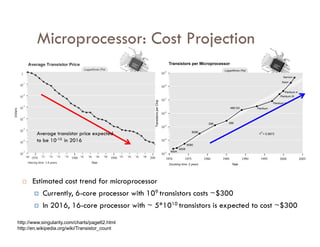
        Average transistor price expected
        to be 10-10 i 2016
           b     10 in


     Estimated cost trend for microprocessor
          Currently, 6-core processor with 109 transistors costs ~$300
          In 2016, 16-core processor with ~ 5*1010 transistors is expected to cost ~$300

http://www.singularity.com/charts/page62.html
http://en.wikipedia.org/wiki/Transistor_count
FUTURE OPPORTUNITIES
Future Opportunities
             pp
25


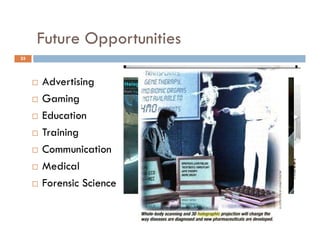
        Advertising
        Gaming
        Education
        Training           Richard Branson Hologram – Virgin Digital Launch


        Communication
        Medical
        Forensic Science
Entrepreneurial Opportunities
          p           pp
26


      Lasers or alternative light sources
      Optics

       (e.g. diffusers, filters, diffraction gratings)
      Software developer  p
       (e.g. algorithms)
      Photorefractive materials

      Silicon photonics
Conclusion
27


        With a trend of moving towards 3D and virtual
         reality, Holographic System will dominate the
         display, advertising and entertainment industries
            p y,            g

        This is largely attributed to:
          Lowering of cost of key components

          Advancement in holographic technology

          Advancement in technologies of key components
THANK YOU
  (Q&A)

3D Holography: When Might it become Economically Feasible?

  • 1.
    HOLOGRAPHY Chew Guang Wei HT093271W Ho Seow Yan HT093116E Lim Su Ru HT093278B Ong Lip Sin HT093131U Wee Chong Liang Justin HT093290B MT5009
  • 2.
    Content 2 • Introduction • Evolution of Displays • Value Proposition • Holographic System Setup • Technology & Cost of Holographic System • Limitations of Holographic System • Components of Holographic System • F t Future Opportunities O t iti • Entrepreneurial Opportunities
  • 3.
    Holography g p y 3
  • 4.
    Timeline of Holography g p y 4 1960:Pulsed ruby laser y was developed 1962:White light reflection hologram 2010: Development of moving 3D holograms 2009: Interactive holographic g p displays developed 1983:Mastercard first credit g card to use holograms 1947: Dennis Gabor developed the theory of holography
  • 5.
    Evolution of Displays p y 5 1940 1964 1972 1980 1997 2004 2010 Plasma Display 3D movies LCD enters invented enter market market Next generation: 3D Holographic Display Cathode Ray Liquid Crystal Plasma enters 3D TV enters Tube (CRT) Display (LCD) market market enters market invented Type Advantages Disadvantages High Definition High resolution 2D images com/ 3D Display High resolution Narrow viewing angles dmarkettrends.c Stereoscopic Require viewing glasses Not true 3D imagery 3D Holographic “Life-like” images Life like Require large amount of http://www.3d Display Volumetric 3D display processing Interactivity Constraint by size of holographic material
  • 6.
    Value Proposition p 6 1. . High Definition: g e o : Images projected are full coloured, high resolution and life-like 2. Ease of customization: E f t i ti Ability to project hologram anywhere 3. 3 Ease of delivery and transmission: Real time transmission to multiple locations 4. 4 Volumetric View: 360 degree view with different perspectives 5. Interactivity: Ability to interact directly with image
  • 7.
    Holographic System Setup g p y p 7 Satellite Object 3D Hologram Light Transmission Source Medium Holographic Camera Media System Computer System Computer System
  • 8.
    Technology for HolographicSystem gy g p y 8 Keyy Prototype yp Technology expected by gy p y Sub-System 2016 Light Source 200mW 500mW Diode-Pumped Diode Pumped Solid Diode-Pumped Diode Pumped Solid State (DPSS) Pulsed Laser State (DPSS) Pulsed Laser Holographic 17” At least 42” Media Photorefractive Polymer Advanced Photorefractive Polymer 2-second refresh rate 6 to 24 fps refresh rate Transmission 100Mbps Up to 40Gbps Media Fiber Optics Computer System 4-core 16-core and beyond
  • 9.
    Projected Cost ofHolographic System j g p y 9 42" Holographic System S stem 200,000 Estimated Cost Breakdown Computer  System 150,000 Holographic  Media $) Cost ($ Light Source Light Source 100,000 Transmission 50,000 0 2011 2016 2021 2030 Year
  • 10.
    Limitations of HolographicSystem g p y 10  Laser System  Performance trade off with cost and safety  Microprocessor  Large amount of processing required g p g q  Multiple complex algorithms and calculations  Photorefractive Polymer  Size of hologram dependent on size of material  Refresh rate
  • 11.
    Photorefractive Polymer 11 Fiber Optics
  • 12.
    Light Source: Evolution g 12 Mercury Solid-state Semiconductor arc lamp laser l laser di d l diodes (1948) (1960s) (1980s) Dr. Theodore [1] Maiman studies a ruby crystal in the shape of a cube in a laser. [1] http://www.britannica.com/EBchecked/topic/269607/holography/92904/Pulsed-laser-holography
  • 13.
    Laser System: Performance y 13 1) The lower the laser power the longer the exposure time power,  A second to few minutes for CW lasers vs. “nanoseconds” for Pulsed lasers 2) Laser power requirement i) Increases with Size of holograms  Typical T i l power l l H N l levels: HeNe lasers: 1 20 W Di d lasers: 5-50mW, 1-20mW, Diode l 5 50 W DPSS lasers: 20-200mW, Ar lasers with etalon: 100-500mW  For large holograms, on the order of 10-sq m, laser powers on the order of 1 W i preferred if cost i not an issue [1]  solid-state or A i gas f 1-W is f d t is t i lid t t Ar ion lasers as candidates ii) Increases with Distance of hologram set-up  Min. power output for laser light shows: ~400mW [1] http://www.loreti.it/chaptersPDF/Ch11_Non-Laser_Illum.pdf [3] h // i ll i /P d /D /CVIMG H l h Whi df
  • 14.
    Laser System: Performancevs. Cost y 14 3) Higher laser power systems translate to higher costs (several thousand to tens of thousand dollars) [1] Laser System Costing 35000 CW Pulsed 30000 25000 20000 Cost ($) 15000 10000 5000 0 0 200 400 600 800 1000 1200 1400 Power (mW) * Modulator & optic system costs not included [1] [1] Diode pumped SSL Costs: http://www.amazing1.com, 2011
  • 15.
    Laser System: CostProjection y j 15 Projected Laser Cost Trend j  Generally 80,000.00 decreasing trend 70,000.00 200 mW 500 mW for the past five 1000 mW W 60,000.00 years (~15%) 1500 mW 50,000.00  Laser prices Cost ($) projected to 40,000.00 continue 30,000.00 dropping in pp g 20,000.00 20 000 00 similar fashion 10,000.00 in the next 5 years 0.00 2008 2009 2010 2011 2012 2013 2014 2015 2016 Year Source: OptoIQ, 2008
  • 16.
    Holographic Media g p 16 Comparison in Key Performance Metrics in Holographic Recording Materials [1,2] M t i l [1 2] 120% 30,000  Recording medium 100% 25,000 should have High diffraction Diffraction Efficiency (%) ) 1) Resolution Limi (um) 80% 20,000 efficiency 60% 15,000 2) Wide resolution range g it 40% 10,000 Max. Resolution limit [um] Max. Resolution limit [mm−1] 20% 5,000 Min. Resolution limit [um] Min. Resolution limit [mm−1] Max. efficiency Effi i Max. Diff M Diffraction Efficiency i 0% 0 Dichromated gelatin Photopolymers Elastomers Photographic emulsions Photographic emulsions Photothermoplastics Photochromics otorefractives Photoresists (Phase bleached) mplitude) P Pho e, P (Am [1] Lecture Holography and optical phase conjugation held at ETH Zürich by Prof. G. Montemezzani in 2002 [2] Ablation of nanoparticles for holographic recordings in elastomers: http://pubs.acs.org/doi/full/10.1021/la102693m
  • 17.
    Holographic Media g p 17 1) Silver Halide Emulsion  High exposure sensitivity over a wide range of spectral regions  High resolving power  Suitable for transmission/reflection holograms (amplitude and phase type) / g ( p p yp ) 2) 5) Dichromated Gelatin Material Photorefractive polymer [1]   Record multicolour reflection holograms the 3D telepresence Used for 3D dynamic holograms, enables   Suitable f veryi highl efficiency and low noise holograms No d for N need for special glasses l 3) Photorefractive Crystals seconds; quasi real-time Refreshes images every 2  Good for large-area and holography Material use for real-time dynamically updatable holographic recording media  Recyclable! Photothermoplastics can also b recycled several h d d times and are l bl h h l l be l d l hundred d most suitable for holographic interferometry 4) Photoresist Material  Suitable for producing surface relief holograms  Most sensitive to ultraviolet/blue light only. [1] P.-A. Blanche et al, Holographic three-dimensional telepresence using large-area photorefractive polymer, Nature Volume: 468, Pages: 80–83, 04 November 2010, DOI 10.1038/nature09521
  • 18.
    Photorefractive Polymer: Performance y 18 1) Refresh Rate  University of Arizona (UA) took 2 s to write & erase a full-colour dynamic holographic image in 2010 vs. 4 mins in 2008 [1,2]  marked improvement of ~100x in 2 years!  Quoting UA lead author of the study Blanche, “In two years we improved the speed by a factor of 100. If we can improve the speed by the same factor, we will be over video rate. It will be done.” [2]  Next step: 6 fps (~0.2s); to progress towards a refresh rate of 24-30 fps 2) ) Display Size p y  17” (current largest)  Have to scale up the display size to 85” for outdoor billboard advertising & 6–8 ft ( (life-size) for telepresencing to be truly p ) p g y possible [1] http://news.inventhelp.com/Articles/Electronics/Inventions/three-dimensional-dynamic-holography-12521.aspx [2] http://www.wired.com/wiredscience/2010/11/holographic-video/
  • 19.
    Photorefractive Polymer: CostProjection y j 19 Sony's Display Cost based o j eDisplay C o s& o f P h o t o rSony's t i v e P o l y mper Inch based on P r on c t e d Size t e f r a c Display Cost e r [1-3] [1-3] Technology (as of Dec 2010) b a s e d o n S260r e e n S iTechnology (as of Dec 2010) c Display z e 5000 D y n a m ic p h o t o r e f r a c t i v e p o l y m e r ( P r o je c t e d ) XEL-1 OLED TV 0 0 350 D y n a m ic p h o t o p o l y m e r ( E x t r a p o 240 f r o m Z e b r a I m a g in g ) la te XEL-1 OLED TV Bravia XBR10 Series LED 3D TV S t a t ic p h o t o p o ly m e r ( Z e b r a I m a g i n g ) Bravia XBR10 Series LED 3D TV 4500 Bravia XBR9 Series LCD TV 220 Bravia XBR9 Series LCD TV 30000 200 4000 nch) 25000 180 Cost/inch ($/in 3500 160 Cost ($) 20000 Cost ($) 140 3000 120 15000 2500 100 10000 80 2000 60 1500 5000 40 10 20 030 40 50 60 10 20 30 40 50 60 10 20 30 40 50 60 70 80 Display Size (inches) Display Size (inches) S c r e e n S iz e ( in c h e s )  Photorefractive polymer is projected to cost ~4x more than 4x static photopolymer  $1500 for 12”x18” & $3500 & 2 ft by 3 ft static 3D holograms by Zebra Imaging [4] I i [1] Sony XEL-1 OLED TV pricing: http://reviews.cnet.com/oled/sony-xel-1-oled/4505-13948_7-32815284.html [2] Sony Bravia XBR10 Series LED 3D TV pricing: http://www.best-led-tv.net/46%E2%80%B3-sony-bravia-xbr10.html [3] Sony Bravia XBR9 Series LCD TV pricing: http://www.practical-home-theater-guide.com/sony-lcd-tv-1.html [4] Zebra Imaging Print Cost: http://www.3d-display-info.com/zebra-imaging-prints-large-3d-holograms
  • 20.
    Transmission Media 20 Transmission rate projected to increase by about tenfold over a decade  Has the potential to go up to 40 or even 160 Gbps  Current transmission capacity of fibre  Capable of supporting a very large is in the region of ~ 2.5 to10 Gbps size hologram (~500”)  Capable of supporting a http://www.telebyteusa.com/foprimer/foch1.htm prototype hologram (17”) http://www.rp-photonics.com/optical_fiber_communications.html http://www.belden.com/pdfs/Techpprs/10_Gbps_LAN_Segment_WP.pdf
  • 21.
    Transmission Media: CostProjection 21 Relative cost trends comparing 10 Gbps vs 4Gbps vs.  Transmission cost projected to drop by ~75% in a decade  By 2016, 10Gbps is expected to cost ~$225 $225 www.corning.com/docs/opticalfiber/CM00000004.pdf
  • 22.
    Microprocessor p  Currently, a processor is capable of supporting up to 42” hologram 42  Estimated that 23 processors (16-core) in 2016 will be able to support a large billboard size hologram Intel’s E7 Xeon 10-core
  • 23.
    Microprocessor: Cost Projection p j 23 Average transistor price expected to be 10-10 i 2016 b 10 in  Estimated cost trend for microprocessor  Currently, 6-core processor with 109 transistors costs ~$300  In 2016, 16-core processor with ~ 5*1010 transistors is expected to cost ~$300 http://www.singularity.com/charts/page62.html http://en.wikipedia.org/wiki/Transistor_count
  • 24.
  • 25.
    Future Opportunities pp 25  Advertising  Gaming  Education  Training Richard Branson Hologram – Virgin Digital Launch  Communication  Medical  Forensic Science
  • 26.
    Entrepreneurial Opportunities p pp 26  Lasers or alternative light sources  Optics (e.g. diffusers, filters, diffraction gratings)  Software developer p (e.g. algorithms)  Photorefractive materials  Silicon photonics
  • 27.
    Conclusion 27  With a trend of moving towards 3D and virtual reality, Holographic System will dominate the display, advertising and entertainment industries p y, g  This is largely attributed to:  Lowering of cost of key components  Advancement in holographic technology  Advancement in technologies of key components
  • 28.