Automated Registration of
Synthetic Aperture Radar
    Imagery to LIDAR
        IGARSS 2011, Vancouver, Canada
                July 24-29, 2011

         Mark Pritt, PhD     Kevin LaTourette
          Lockheed Martin    Lockheed Martin
    Gaithersburg, Maryland   Goodyear, Arizona
     mark.pritt@lmco.com     kevin.j.latourette@lmco.com
Problem: SAR Image Registration

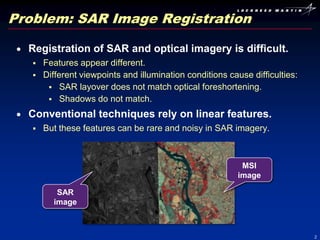
  Registration of SAR and optical imagery is difficult.
      Features appear different.
      Different viewpoints and illumination conditions cause difficulties:
         SAR layover does not match optical foreshortening.
         Shadows do not match.

  Conventional techniques rely on linear features.
      But these features can be rare and noisy in SAR imagery.


                                                            MSI
                                                           image

          SAR
         image


                                                                              2
Solution

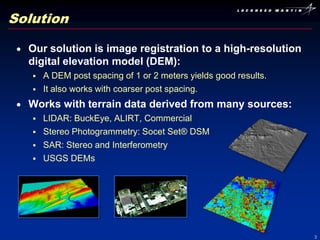
  Our solution is image registration to a high-resolution
  digital elevation model (DEM):
      A DEM post spacing of 1 or 2 meters yields good results.
      It also works with coarser post spacing.
  Works with terrain data derived from many sources:
      LIDAR: BuckEye, ALIRT, Commercial
      Stereo Photogrammetry: Socet Set® DSM
      SAR: Stereo and Interferometry
      USGS DEMs


                                                                  3
Methods

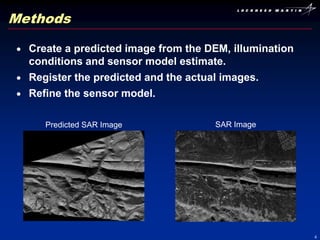
  Create a predicted image from the DEM, illumination
  conditions and sensor model estimate.
  Register the predicted and the actual images.
  Refine the sensor model.

     Predicted SAR Image             SAR Image


                                                        4
Methods (cont)

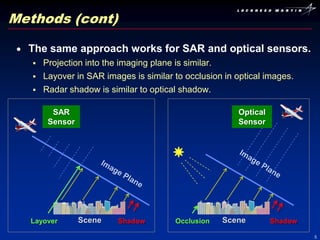
  The same approach works for SAR and optical sensors.
      Projection into the imaging plane is similar.
      Layover in SAR images is similar to occlusion in optical images.
      Radar shadow is similar to optical shadow.

         SAR                                            Optical
        Sensor                                          Sensor


  Layover        Scene    Shadow        Occlusion   Scene         Shadow

                                                                           5
Methods (cont)

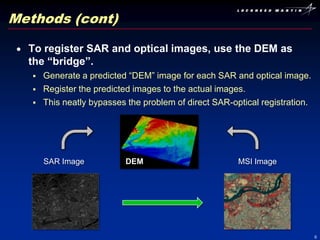
  To register SAR and optical images, use the DEM as
  the “bridge”.
      Generate a predicted “DEM” image for each SAR and optical image.
      Register the predicted images to the actual images.
      This neatly bypasses the problem of direct SAR-optical registration.


       SAR Image           DEM                          MSI Image


                                                                              6
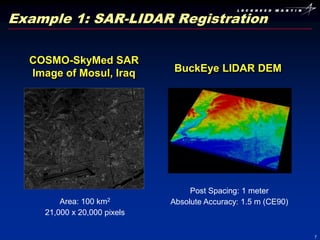
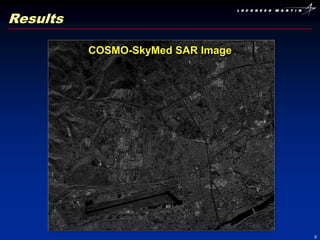
Example 1: SAR-LIDAR Registration

  COSMO-SkyMed SAR
  Image of Mosul, Iraq        BuckEye LIDAR DEM


                                  Post Spacing: 1 meter
        Area: 100 km2        Absolute Accuracy: 1.5 m (CE90)
    21,000 x 20,000 pixels

                                                               7
Results

          COSMO-SkyMed SAR Image


                                   8
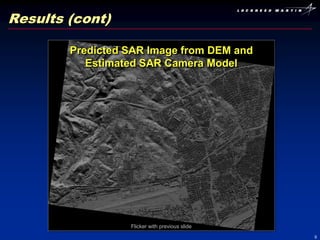
Results (cont)

        Predicted SAR Image from DEM and
           Estimated SAR Camera Model


                  Flicker with previous slide
                                                9
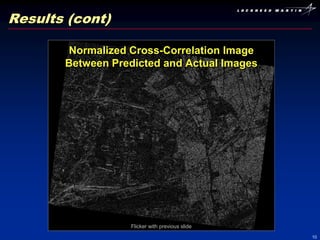
Results (cont)

       Normalized Cross-Correlation Image
       Between Predicted and Actual Images


                  Flicker with previous slide
                                                10
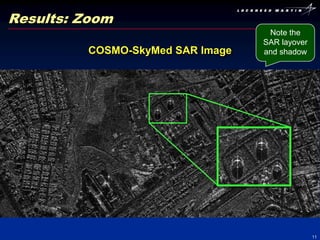
Results: Zoom
                                   Note the
                                  SAR layover
         COSMO-SkyMed SAR Image   and shadow


                                                11
Zoom (cont)
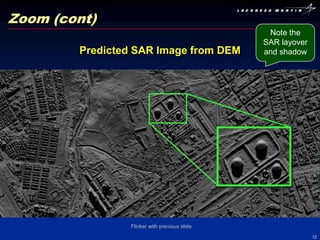
                                               Note the
                                              SAR layover
        Predicted SAR Image from DEM          and shadow


                Flicker with previous slide
                                                            12
Zoom (cont)

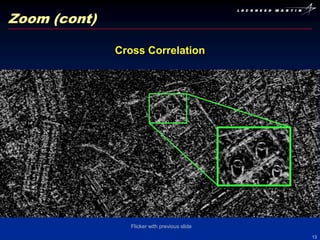
              Cross Correlation


                 Flicker with previous slide
                                               13
Registration Accuracy

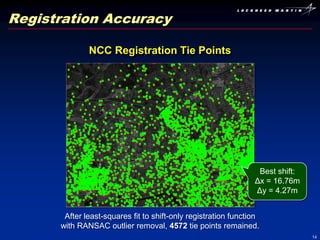
              NCC Registration Tie Points


                                                                 Best shift:
                                                                Δx = 16.76m
                                                                Δy = 4.27m


       After least-squares fit to shift-only registration function
      with RANSAC outlier removal, 4572 tie points remained.
                                                                               14
Registration Accuracy (cont)

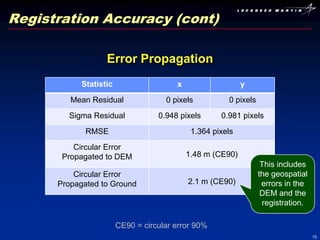
                   Error Propagation
            Statistic                   x                   y
         Mean Residual               0 pixels          0 pixels
        Sigma Residual             0.948 pixels      0.981 pixels
             RMSE                            1.364 pixels
          Circular Error
       Propagated to DEM                    1.48 m (CE90)
                                                                   This includes
          Circular Error                                          the geospatial
      Propagated to Ground                  2.1 m (CE90)           errors in the
                                                                   DEM and the
                                                                   registration.

                        CE90 = circular error 90%
                                                                                   15
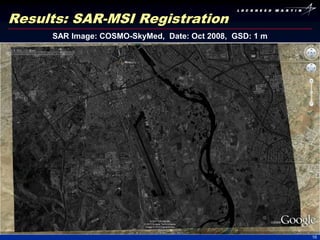
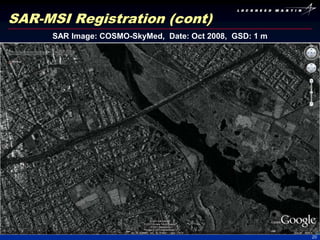
Results: SAR-MSI Registration
     SAR Image: COSMO-SkyMed, Date: Oct 2008, GSD: 1 m


                                                         16
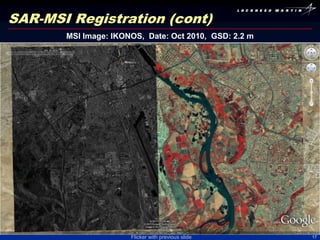
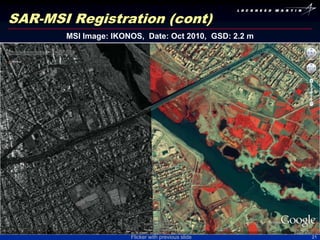
SAR-MSI Registration (cont)
       MSI Image: IKONOS, Date: Oct 2010, GSD: 2.2 m


                      Flicker with previous slide      17
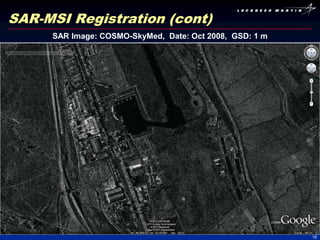
SAR-MSI Registration (cont)
     SAR Image: COSMO-SkyMed, Date: Oct 2008, GSD: 1 m


                                                         18
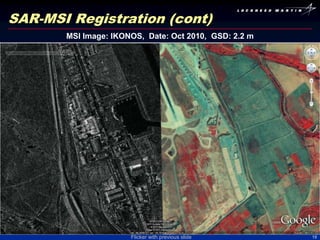
SAR-MSI Registration (cont)
       MSI Image: IKONOS, Date: Oct 2010, GSD: 2.2 m


                      Flicker with previous slide      19
SAR-MSI Registration (cont)
     SAR Image: COSMO-SkyMed, Date: Oct 2008, GSD: 1 m


                                                         20
SAR-MSI Registration (cont)
       MSI Image: IKONOS, Date: Oct 2010, GSD: 2.2 m


                      Flicker with previous slide      21
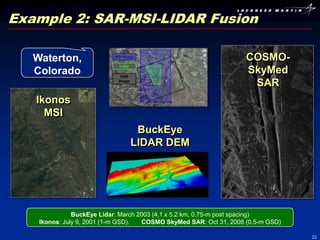
Example 2: SAR-MSI-LIDAR Fusion

   Waterton,                                                        COSMO-
   Colorado                                                         SkyMed
                                                                     SAR
   Ikonos
     MSI
                                 BuckEye
                                LIDAR DEM


               BuckEye Lidar: March 2003 (4.1 x 5.2 km, 0.75-m post spacing)
    Ikonos: July 9, 2001 (1-m GSD).  COSMO SkyMed SAR: Oct 31, 2008 (0.5-m GSD)

                                                                                  22
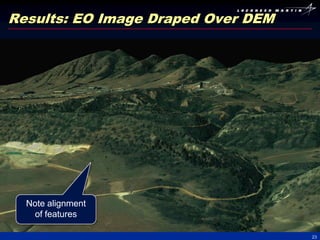
Results: EO Image Draped Over DEM


  Note alignment
   of features

                                    23
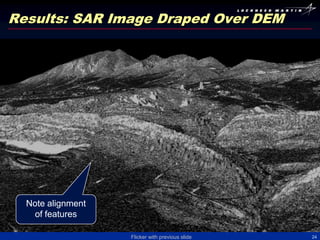
Results: SAR Image Draped Over DEM


  Note alignment
   of features

                   Flicker with previous slide   24
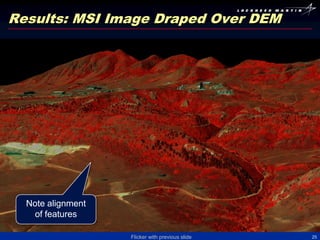
Results: MSI Image Draped Over DEM


  Note alignment
   of features

                   Flicker with previous slide   25
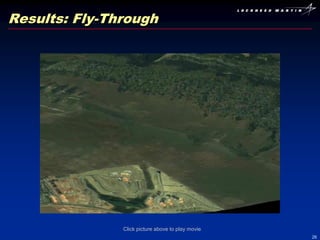
Results: Fly-Through


               Click picture above to play movie
                                                   26
Conclusion

 We have introduced a new method for registering
 SAR images with other sensor data:
     LIDAR, Digital Elevation Models, Optical Images, MSI
 It works by image registration to a high-resolution
 DEM.
     It does this by generating a predicted image from the DEM and
      sensor model estimate.
     It then registers the predicted and actual images and refines the
      sensor model estimate.
 Accuracy: 1-2 m CE90
 Our approach also extends to the case where no DEM
 is available:
     DEM can be generated from stereo EO or interferometric SAR.

                                                                          27
Conclusion (cont.)
  For an extension to Video Geo-registration:
    Pritt, M & LaTourette, K., Stabilization and Georegistration of Aerial Video
     Over Mountain Terrain by Means of LIDAR.
    FR1.T08.4


                                                                                    28

IGARSS-SAR-Pritt.pptx

  • 1.
    Automated Registration of SyntheticAperture Radar Imagery to LIDAR IGARSS 2011, Vancouver, Canada July 24-29, 2011 Mark Pritt, PhD Kevin LaTourette Lockheed Martin Lockheed Martin Gaithersburg, Maryland Goodyear, Arizona mark.pritt@lmco.com kevin.j.latourette@lmco.com
  • 2.
    Problem: SAR ImageRegistration Registration of SAR and optical imagery is difficult.  Features appear different.  Different viewpoints and illumination conditions cause difficulties:  SAR layover does not match optical foreshortening.  Shadows do not match. Conventional techniques rely on linear features.  But these features can be rare and noisy in SAR imagery. MSI image SAR image 2
  • 3.
    Solution Oursolution is image registration to a high-resolution digital elevation model (DEM):  A DEM post spacing of 1 or 2 meters yields good results.  It also works with coarser post spacing. Works with terrain data derived from many sources:  LIDAR: BuckEye, ALIRT, Commercial  Stereo Photogrammetry: Socet Set® DSM  SAR: Stereo and Interferometry  USGS DEMs 3
  • 4.
    Methods Createa predicted image from the DEM, illumination conditions and sensor model estimate. Register the predicted and the actual images. Refine the sensor model. Predicted SAR Image SAR Image 4
  • 5.
    Methods (cont) The same approach works for SAR and optical sensors.  Projection into the imaging plane is similar.  Layover in SAR images is similar to occlusion in optical images.  Radar shadow is similar to optical shadow. SAR Optical Sensor Sensor Layover Scene Shadow Occlusion Scene Shadow 5
  • 6.
    Methods (cont) To register SAR and optical images, use the DEM as the “bridge”.  Generate a predicted “DEM” image for each SAR and optical image.  Register the predicted images to the actual images.  This neatly bypasses the problem of direct SAR-optical registration. SAR Image DEM MSI Image 6
  • 7.
    Example 1: SAR-LIDARRegistration COSMO-SkyMed SAR Image of Mosul, Iraq BuckEye LIDAR DEM Post Spacing: 1 meter Area: 100 km2 Absolute Accuracy: 1.5 m (CE90) 21,000 x 20,000 pixels 7
  • 8.
    Results COSMO-SkyMed SAR Image 8
  • 9.
    Results (cont) Predicted SAR Image from DEM and Estimated SAR Camera Model Flicker with previous slide 9
  • 10.
    Results (cont) Normalized Cross-Correlation Image Between Predicted and Actual Images Flicker with previous slide 10
  • 11.
    Results: Zoom Note the SAR layover COSMO-SkyMed SAR Image and shadow 11
  • 12.
    Zoom (cont) Note the SAR layover Predicted SAR Image from DEM and shadow Flicker with previous slide 12
  • 13.
    Zoom (cont) Cross Correlation Flicker with previous slide 13
  • 14.
    Registration Accuracy NCC Registration Tie Points Best shift: Δx = 16.76m Δy = 4.27m After least-squares fit to shift-only registration function with RANSAC outlier removal, 4572 tie points remained. 14
  • 15.
    Registration Accuracy (cont) Error Propagation Statistic x y Mean Residual 0 pixels 0 pixels Sigma Residual 0.948 pixels 0.981 pixels RMSE 1.364 pixels Circular Error Propagated to DEM 1.48 m (CE90) This includes Circular Error the geospatial Propagated to Ground 2.1 m (CE90) errors in the DEM and the registration. CE90 = circular error 90% 15
  • 16.
    Results: SAR-MSI Registration SAR Image: COSMO-SkyMed, Date: Oct 2008, GSD: 1 m 16
  • 17.
    SAR-MSI Registration (cont) MSI Image: IKONOS, Date: Oct 2010, GSD: 2.2 m Flicker with previous slide 17
  • 18.
    SAR-MSI Registration (cont) SAR Image: COSMO-SkyMed, Date: Oct 2008, GSD: 1 m 18
  • 19.
    SAR-MSI Registration (cont) MSI Image: IKONOS, Date: Oct 2010, GSD: 2.2 m Flicker with previous slide 19
  • 20.
    SAR-MSI Registration (cont) SAR Image: COSMO-SkyMed, Date: Oct 2008, GSD: 1 m 20
  • 21.
    SAR-MSI Registration (cont) MSI Image: IKONOS, Date: Oct 2010, GSD: 2.2 m Flicker with previous slide 21
  • 22.
    Example 2: SAR-MSI-LIDARFusion Waterton, COSMO- Colorado SkyMed SAR Ikonos MSI BuckEye LIDAR DEM BuckEye Lidar: March 2003 (4.1 x 5.2 km, 0.75-m post spacing) Ikonos: July 9, 2001 (1-m GSD). COSMO SkyMed SAR: Oct 31, 2008 (0.5-m GSD) 22
  • 23.
    Results: EO ImageDraped Over DEM Note alignment of features 23
  • 24.
    Results: SAR ImageDraped Over DEM Note alignment of features Flicker with previous slide 24
  • 25.
    Results: MSI ImageDraped Over DEM Note alignment of features Flicker with previous slide 25
  • 26.
    Results: Fly-Through Click picture above to play movie 26
  • 27.
    Conclusion We haveintroduced a new method for registering SAR images with other sensor data:  LIDAR, Digital Elevation Models, Optical Images, MSI It works by image registration to a high-resolution DEM.  It does this by generating a predicted image from the DEM and sensor model estimate.  It then registers the predicted and actual images and refines the sensor model estimate. Accuracy: 1-2 m CE90 Our approach also extends to the case where no DEM is available:  DEM can be generated from stereo EO or interferometric SAR. 27
  • 28.
    Conclusion (cont.) For an extension to Video Geo-registration:  Pritt, M & LaTourette, K., Stabilization and Georegistration of Aerial Video Over Mountain Terrain by Means of LIDAR.  FR1.T08.4 28

Editor's Notes

  • #3 A noted hard problem in a flat area, it is extremely difficult if not impossible over mountainous or urban terrainMany conventional techniques attempt to perform a 2D-2D registration between SAR/EO images, and while this may be sufficient in flat/planar scenes, the techniques will fail in mountainous or urban terrain. Since each image is a 2D representation of a 3D scene, the perspective distortions induced by the terrain must be accounted for.
  • #4 Solves problems ranging from Cross sensor registration, Radar/Optical/Infrared, including over rugged and urban terrain, and true orthorectification of SAR images.
  • #5 Required input: (1) SAR Image to be registered, (2) Estimate of the image collection geometry and Image Formation Processing and (3) A high resolution DEM.From the SAR image metadata, we can create a mapping from the 3D world space of the DEM into the 2D pixel space of the SAR image. To simulate Radar backscatter, we use a weighted average of Lambertian and Specular shading, accounting for Layover and Shadow.Use the Sensormodel to render the SAR-shaded DEM, and register the simulated and actual images together. Since we have accounted for perspective distortions, layover, etc., there is no need for a scale/rotation invariant registration such as SIFT/SURF…instead a Normalized Cross-Correlation based method is ideally suited.The resulting registration function is then used to properly update the Sensor-camera model.
  • #9 0.75 cm COSMO-SkyMed Spotlight-mode SAR image, processed in RMA-INCA (Range Migration Algorithm – Imaging Near Closest Approach)
  • #15 After fitting the tie points to a registration function, we then perform an error propagation analysis by applying the registration function to our tie points, computing the residuals and various other statistics.
  • #16 We first note that the average residuals in x- and y- are both zero, indicating that no bias is present, similarly the fact that our standard deviations in x- and y- are so close indicates that our shift only approach was appropriate. Had an affine or higher order function been necessary, we would expect to see skewed or larger values.The geographic location of each pixel in the image is computed to within 2.1 meters with 90% confidence.