Sickle Cell Anemia
Presented By • Ahsan Kabir Pranto
• Assaduz Jaman Manon
• Dipta Chandra Pal
• Mahbub Arefin Rafi
• Nilotpol Dutta
• Pran Krishno Das
• Rakibul Hasan Sourov
• Dr. Sunjukta Ahsan
:
Submitted To :
Sickle Cell Anemia
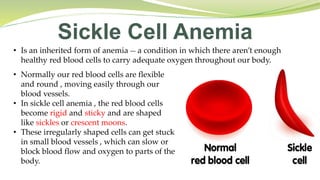
• Is an inherited form of anemia __ a condition in which there aren’t enough
healthy red blood cells to carry adequate oxygen throughout our body.
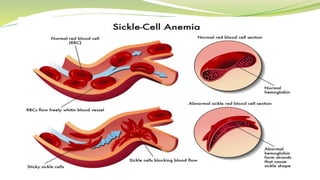
• Normally our red blood cells are flexible
and round , moving easily through our
blood vessels.
• In sickle cell anemia , the red blood cells
become rigid and sticky and are shaped
like sickles or crescent moons.
• These irregularly shaped cells can get stuck
in small blood vessels , which can slow or
block blood flow and oxygen to parts of the
body.
Definition
• Anemia : Anemia is a deficiency in the number or quality of red blood cells
in your body . It means that either the level of red blood cell or the level of
hemoglobin is lower than normal .
• Sickle cell disease : Sickle cell anemia is a genetic diseases where red blood
cells can take shape of a crescent or a sickle . And this allows them to be more
easily destroyed – causing anemia and other complexities .
• It is caused due to an abnormality of the hemoglobin molecules found in the
erythrocytes . These rigid , sticky and irregularly shaped cells can get stuck in
small blood vessels and block blood oxygen flow to parts of the body .
History
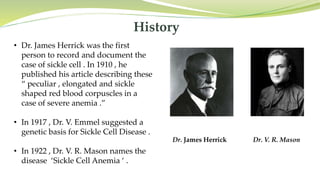
• Dr. James Herrick was the first
person to record and document the
case of sickle cell . In 1910 , he
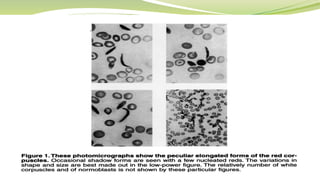
published his article describing these
“ peculiar , elongated and sickle
shaped red blood corpuscles in a
case of severe anemia .”
• In 1917 , Dr. V. Emmel suggested a
genetic basis for Sickle Cell Disease .
• In 1922 , Dr. V. R. Mason names the
disease ‘Sickle Cell Anemia ‘ .
Dr. James Herrick Dr. V. R. Mason
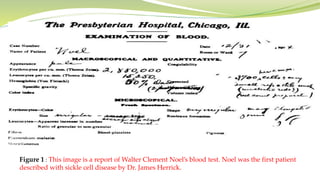
Figure 1 : This image is a report of Walter Clement Noel’s blood test. Noel was the first patient
described with sickle cell disease by Dr. James Herrick.
Causes
• Sickle cell disease is caused by defective hemoglobin which is the oxygen
carrying protein in RBC . Hemoglobin A ( HbA ) is the primary hemoglobin
affected in sickle cell .
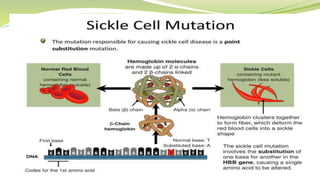
• HbA is made up of two alpha globin and two beta globin peptide chains . The
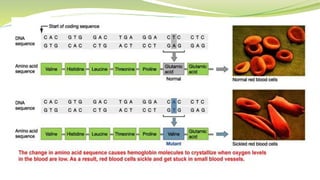
beta globin peptide chains get misshapen due to a mutation in HBB gene .
• Sickle cell mutations is a non-conservative missense mutation , that results in
the sixth amino acid of beta-globin being valine instead of glutamic acid . A
non-conservative substitution means the amino acid valine ( Hydrophobic )
has different properties than the one it replaced , glutamic acid ( Hydrophillic).
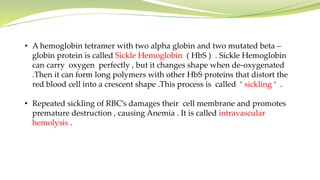
• A hemoglobin tetramer with two alpha globin and two mutated beta –
globin protein is called Sickle Hemoglobin ( HbS ) . Sickle Hemoglobin
can carry oxygen perfectly , but it changes shape when de-oxygenated
.Then it can form long polymers with other HbS proteins that distort the
red blood cell into a crescent shape .This process is called ‘ sickling ‘ .
• Repeated sickling of RBC’s damages their cell membrane and promotes
premature destruction , causing Anemia . It is called intravascular
hemolysis .
Genetics of Sickle Cell Disease
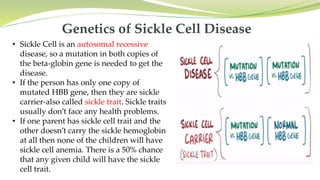
• Sickle Cell is an autosomal recessive
disease, so a mutation in both copies of
the beta-globin gene is needed to get the
disease.
• If the person has only one copy of
mutated HBB gene, then they are sickle
carrier-also called sickle trait. Sickle traits
usually don’t face any health problems.
• If one parent has sickle cell trait and the
other doesn’t carry the sickle hemoglobin
at all then none of the children will have
sickle cell anemia. There is a 50% chance
that any given child will have the sickle
cell trait.
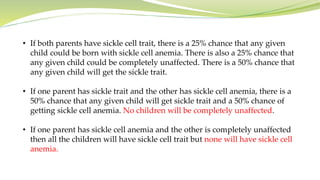
• If both parents have sickle cell trait, there is a 25% chance that any given
child could be born with sickle cell anemia. There is also a 25% chance that
any given child could be completely unaffected. There is a 50% chance that
any given child will get the sickle trait.
• If one parent has sickle trait and the other has sickle cell anemia, there is a
50% chance that any given child will get sickle trait and a 50% chance of
getting sickle cell anemia. No children will be completely unaffected.
• If one parent has sickle cell anemia and the other is completely unaffected
then all the children will have sickle cell trait but none will have sickle cell
anemia.
Inheritance of Sickle Cell Disease
Symptoms
• Anemia : Sickle cells usually die in 10 to 20 days , causing Anemia .Without
enough RBC , our body can’t get enough oxygen , that can cause fatigue .
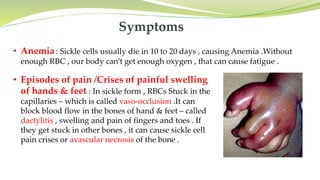
• Episodes of pain /Crises of painful swelling
of hands & feet : In sickle form , RBCs Stuck in the
capillaries – which is called vaso-occlusion .It can
block blood flow in the bones of hand & feet – called
dactylitis , swelling and pain of fingers and toes . If
they get stuck in other bones , it can cause sickle cell
pain crises or avascular necrosis of the bone .
• Complication in growth : A
shortage of healthy red blood cells can
slow growth in infants and children ,
also delay puberty in teenagers .
• Infection : Sickle cells can damage spleen
which is an organ that fights infection . Vaso-
occlusion can lead to having an absence or
non-functional spleen . It can lead to
vulnerability towards infection such as
pneumonia , meningitis , influenza etc.
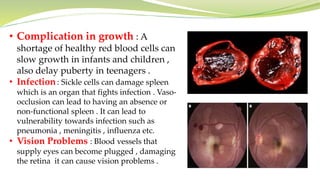
• Vision Problems : Blood vessels that
supply eyes can become plugged , damaging
the retina it can cause vision problems .
Complications
• Gallstones, Jaundice : Intravascular Hemolysis leads to free hemoglobin in
the plasma, which is then recycled by Haptoglobin. This leads to unconjugated
bilirubin. Its high concentration can cause Jaundice, Gallstones etc.
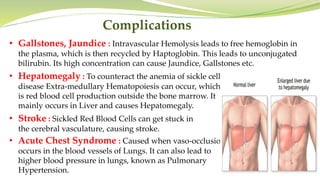
• Hepatomegaly : To counteract the anemia of sickle cell
disease Extra-medullary Hematopoiesis can occur, which
is red blood cell production outside the bone marrow. It
mainly occurs in Liver and causes Hepatomegaly.
• Stroke : Sickled Red Blood Cells can get stuck in
the cerebral vasculature, causing stroke.
• Acute Chest Syndrome : Caused when vaso-occlusion
occurs in the blood vessels of Lungs. It can also lead to
higher blood pressure in lungs, known as Pulmonary
Hypertension.
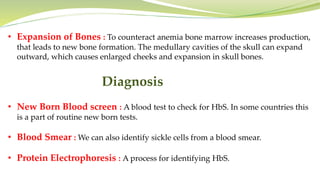
• Expansion of Bones : To counteract anemia bone marrow increases production,
that leads to new bone formation. The medullary cavities of the skull can expand
outward, which causes enlarged cheeks and expansion in skull bones.
Diagnosis
• New Born Blood screen : A blood test to check for HbS. In some countries this
is a part of routine new born tests.
• Blood Smear : We can also identify sickle cells from a blood smear.
• Protein Electrophoresis : A process for identifying HbS.
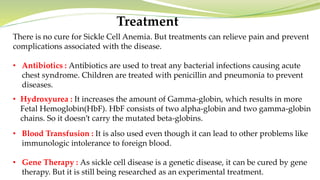
Treatment
There is no cure for Sickle Cell Anemia. But treatments can relieve pain and prevent
complications associated with the disease.
• Antibiotics : Antibiotics are used to treat any bacterial infections causing acute
chest syndrome. Children are treated with penicillin and pneumonia to prevent
diseases.
• Hydroxyurea : It increases the amount of Gamma-globin, which results in more
Fetal Hemoglobin(HbF). HbF consists of two alpha-globin and two gamma-globin
chains. So it doesn’t carry the mutated beta-globins.
• Blood Transfusion : It is also used even though it can lead to other problems like
immunologic intolerance to foreign blood.
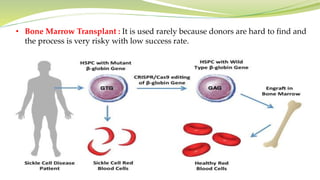
• Gene Therapy : As sickle cell disease is a genetic disease, it can be cured by gene
therapy. But it is still being researched as an experimental treatment.
• Bone Marrow Transplant : It is used rarely because donors are hard to find and
the process is very risky with low success rate.
Presentation about sickle_cell_anemia_

Presentation about sickle_cell_anemia_

  • 1.
    Sickle Cell Anemia PresentedBy • Ahsan Kabir Pranto • Assaduz Jaman Manon • Dipta Chandra Pal • Mahbub Arefin Rafi • Nilotpol Dutta • Pran Krishno Das • Rakibul Hasan Sourov • Dr. Sunjukta Ahsan : Submitted To :
  • 2.
    Sickle Cell Anemia •Is an inherited form of anemia __ a condition in which there aren’t enough healthy red blood cells to carry adequate oxygen throughout our body. • Normally our red blood cells are flexible and round , moving easily through our blood vessels. • In sickle cell anemia , the red blood cells become rigid and sticky and are shaped like sickles or crescent moons. • These irregularly shaped cells can get stuck in small blood vessels , which can slow or block blood flow and oxygen to parts of the body.
  • 3.
    Definition • Anemia :Anemia is a deficiency in the number or quality of red blood cells in your body . It means that either the level of red blood cell or the level of hemoglobin is lower than normal . • Sickle cell disease : Sickle cell anemia is a genetic diseases where red blood cells can take shape of a crescent or a sickle . And this allows them to be more easily destroyed – causing anemia and other complexities . • It is caused due to an abnormality of the hemoglobin molecules found in the erythrocytes . These rigid , sticky and irregularly shaped cells can get stuck in small blood vessels and block blood oxygen flow to parts of the body .
  • 5.
    History • Dr. JamesHerrick was the first person to record and document the case of sickle cell . In 1910 , he published his article describing these “ peculiar , elongated and sickle shaped red blood corpuscles in a case of severe anemia .” • In 1917 , Dr. V. Emmel suggested a genetic basis for Sickle Cell Disease . • In 1922 , Dr. V. R. Mason names the disease ‘Sickle Cell Anemia ‘ . Dr. James Herrick Dr. V. R. Mason
  • 6.
    Figure 1 :This image is a report of Walter Clement Noel’s blood test. Noel was the first patient described with sickle cell disease by Dr. James Herrick.
  • 8.
    Causes • Sickle celldisease is caused by defective hemoglobin which is the oxygen carrying protein in RBC . Hemoglobin A ( HbA ) is the primary hemoglobin affected in sickle cell . • HbA is made up of two alpha globin and two beta globin peptide chains . The beta globin peptide chains get misshapen due to a mutation in HBB gene . • Sickle cell mutations is a non-conservative missense mutation , that results in the sixth amino acid of beta-globin being valine instead of glutamic acid . A non-conservative substitution means the amino acid valine ( Hydrophobic ) has different properties than the one it replaced , glutamic acid ( Hydrophillic).
  • 9.
    • A hemoglobintetramer with two alpha globin and two mutated beta – globin protein is called Sickle Hemoglobin ( HbS ) . Sickle Hemoglobin can carry oxygen perfectly , but it changes shape when de-oxygenated .Then it can form long polymers with other HbS proteins that distort the red blood cell into a crescent shape .This process is called ‘ sickling ‘ . • Repeated sickling of RBC’s damages their cell membrane and promotes premature destruction , causing Anemia . It is called intravascular hemolysis .
  • 12.
    Genetics of SickleCell Disease • Sickle Cell is an autosomal recessive disease, so a mutation in both copies of the beta-globin gene is needed to get the disease. • If the person has only one copy of mutated HBB gene, then they are sickle carrier-also called sickle trait. Sickle traits usually don’t face any health problems. • If one parent has sickle cell trait and the other doesn’t carry the sickle hemoglobin at all then none of the children will have sickle cell anemia. There is a 50% chance that any given child will have the sickle cell trait.
  • 13.
    • If bothparents have sickle cell trait, there is a 25% chance that any given child could be born with sickle cell anemia. There is also a 25% chance that any given child could be completely unaffected. There is a 50% chance that any given child will get the sickle trait. • If one parent has sickle trait and the other has sickle cell anemia, there is a 50% chance that any given child will get sickle trait and a 50% chance of getting sickle cell anemia. No children will be completely unaffected. • If one parent has sickle cell anemia and the other is completely unaffected then all the children will have sickle cell trait but none will have sickle cell anemia.
  • 14.
  • 15.
    Symptoms • Anemia :Sickle cells usually die in 10 to 20 days , causing Anemia .Without enough RBC , our body can’t get enough oxygen , that can cause fatigue . • Episodes of pain /Crises of painful swelling of hands & feet : In sickle form , RBCs Stuck in the capillaries – which is called vaso-occlusion .It can block blood flow in the bones of hand & feet – called dactylitis , swelling and pain of fingers and toes . If they get stuck in other bones , it can cause sickle cell pain crises or avascular necrosis of the bone .
  • 16.
    • Complication ingrowth : A shortage of healthy red blood cells can slow growth in infants and children , also delay puberty in teenagers . • Infection : Sickle cells can damage spleen which is an organ that fights infection . Vaso- occlusion can lead to having an absence or non-functional spleen . It can lead to vulnerability towards infection such as pneumonia , meningitis , influenza etc. • Vision Problems : Blood vessels that supply eyes can become plugged , damaging the retina it can cause vision problems .
  • 17.
    Complications • Gallstones, Jaundice: Intravascular Hemolysis leads to free hemoglobin in the plasma, which is then recycled by Haptoglobin. This leads to unconjugated bilirubin. Its high concentration can cause Jaundice, Gallstones etc. • Hepatomegaly : To counteract the anemia of sickle cell disease Extra-medullary Hematopoiesis can occur, which is red blood cell production outside the bone marrow. It mainly occurs in Liver and causes Hepatomegaly. • Stroke : Sickled Red Blood Cells can get stuck in the cerebral vasculature, causing stroke. • Acute Chest Syndrome : Caused when vaso-occlusion occurs in the blood vessels of Lungs. It can also lead to higher blood pressure in lungs, known as Pulmonary Hypertension.
  • 18.
    • Expansion ofBones : To counteract anemia bone marrow increases production, that leads to new bone formation. The medullary cavities of the skull can expand outward, which causes enlarged cheeks and expansion in skull bones. Diagnosis • New Born Blood screen : A blood test to check for HbS. In some countries this is a part of routine new born tests. • Blood Smear : We can also identify sickle cells from a blood smear. • Protein Electrophoresis : A process for identifying HbS.
  • 19.
    Treatment There is nocure for Sickle Cell Anemia. But treatments can relieve pain and prevent complications associated with the disease. • Antibiotics : Antibiotics are used to treat any bacterial infections causing acute chest syndrome. Children are treated with penicillin and pneumonia to prevent diseases. • Hydroxyurea : It increases the amount of Gamma-globin, which results in more Fetal Hemoglobin(HbF). HbF consists of two alpha-globin and two gamma-globin chains. So it doesn’t carry the mutated beta-globins. • Blood Transfusion : It is also used even though it can lead to other problems like immunologic intolerance to foreign blood. • Gene Therapy : As sickle cell disease is a genetic disease, it can be cured by gene therapy. But it is still being researched as an experimental treatment.
  • 20.
    • Bone MarrowTransplant : It is used rarely because donors are hard to find and the process is very risky with low success rate.