ss
P.R. Jayawickrama
D.S. Kaluwaduge
K.K.G. Kandewaththa
M. Kanchanamala
UNIVERSITY of RUHUNA , FACULTY of MEDICINE.
23.11.2012
1
A four years old boy was brought to the pediatric
hospital with a history of severe back pain and
uncontrolled vomiting since previous night. Further
His mother told that her child was complaining
about some attacks of back pain occurring during
the past months.
On examination patient was pale and spleen was
palpable below the costal margin……!!!!
2
In investigation,
• Haemoglobin level - decreased
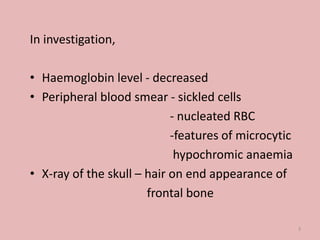
• Peripheral blood smear - sickled cells
- nucleated RBC
-features of microcytic
hypochromic anaemia
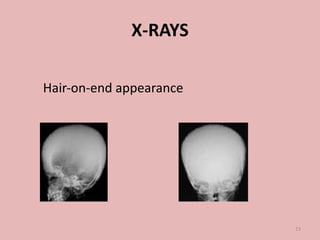
• X-ray of the skull – hair on end appearance of
frontal bone
3
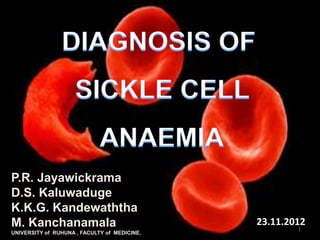
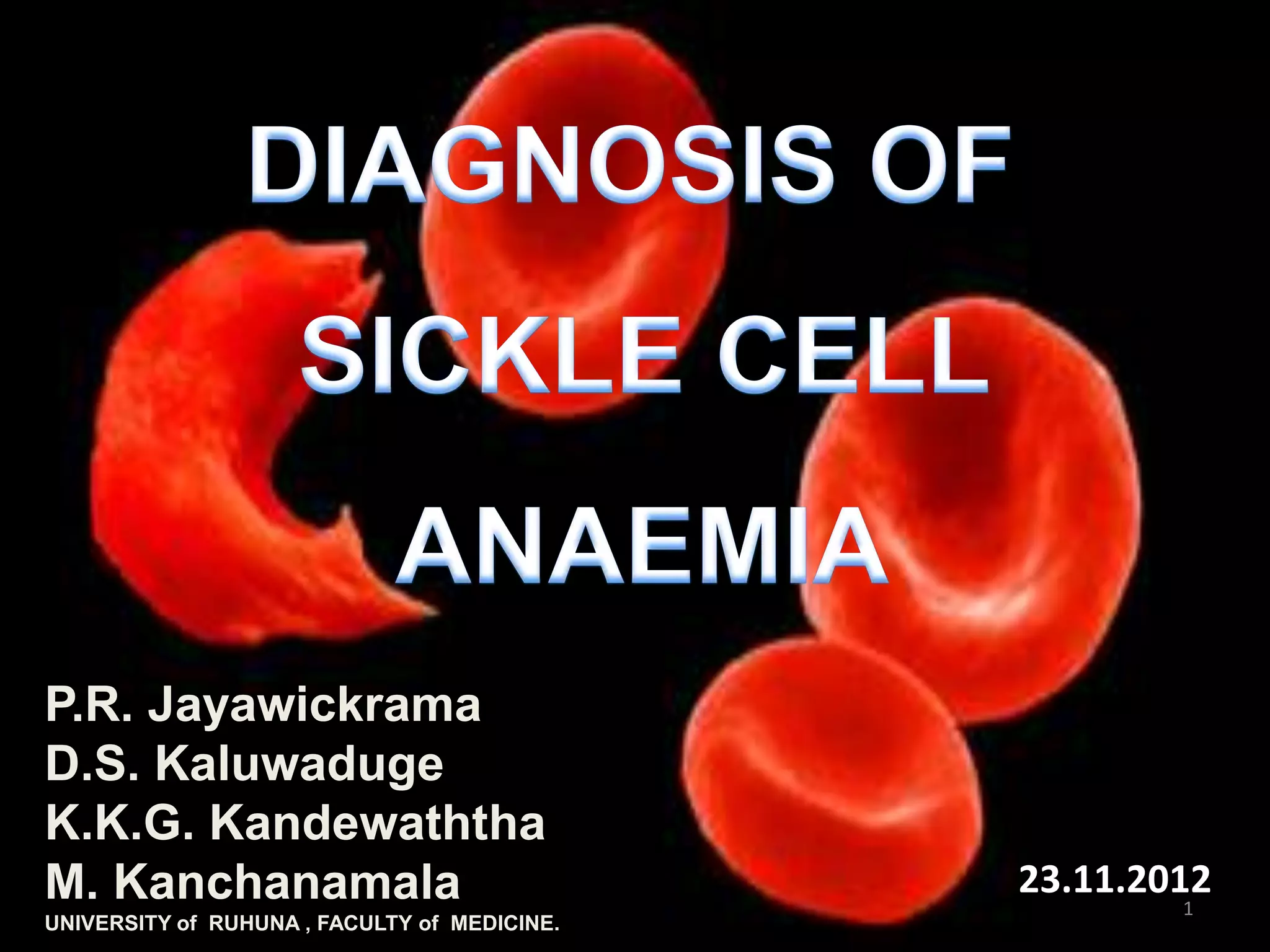
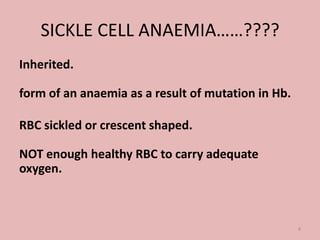
SICKLE CELL ANAEMIA……????
Inherited.
form of an anaemia as a result of mutation in Hb.
RBC sickled or crescent shaped.
NOT enough healthy RBC to carry adequate
oxygen.
4
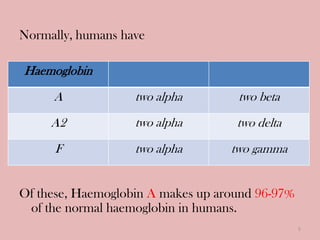
Normally, humans have
Of these, Haemoglobin A makes up around 96-97%
of the normal haemoglobin in humans.
Haemoglobin
A two alpha two beta
A2 two alpha two delta
F two alpha two gamma
5
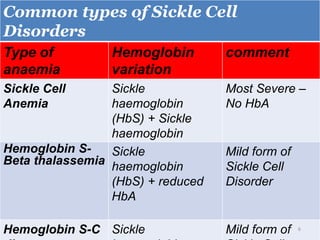
Common types of Sickle Cell
Disorders
Type of
anaemia
Hemoglobin
variation
comment
Sickle Cell
Anemia
Sickle
haemoglobin
(HbS) + Sickle
haemoglobin
Most Severe –
No HbA
Hemoglobin S-
Beta thalassemia
Sickle
haemoglobin
(HbS) + reduced
HbA
Mild form of
Sickle Cell
Disorder
Hemoglobin S-C Sickle Mild form of 6
7
Pathophysiology
Is caused by
• point mutation in the β-globin chain of Hb
glutamic (hydrophobic amino acid)
valine( hydrophilic )
• at the 6th position
Life span
• RBC 90–120 days
• sickle cells 10–20 days.
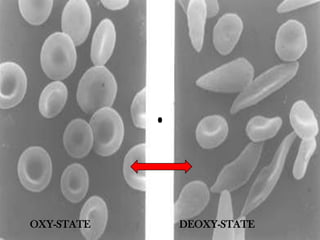
OXY-STATE DEOXY-STATE
• exposure to P O2 < 40 mmHg for 2 to 4 minutes
• polymerization of Hb
• The initiation of polymerization may be
-incomplete and
-reversible , if re-oxygenation occurs early in
the process.
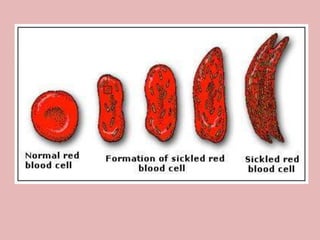
• Repetitive exposure to alternating de-
oxygenated and oxygenated states lead to
-membrane distortion,
-irreversible sickling.
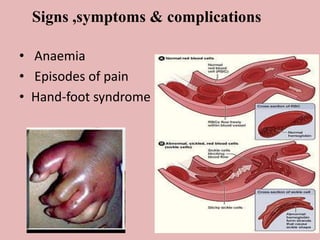
Signs ,symptoms & complications
• Anaemia
• Episodes of pain
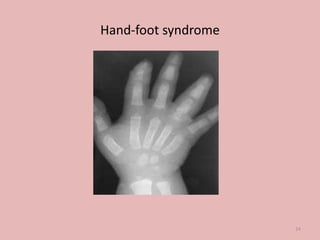
• Hand-foot syndrome
• Frequent infections
• Vision problems
• Delayed growth
• Any signs or symptoms of stroke
• Enlarged heart and systolic murmurs
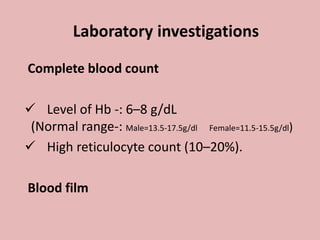
Laboratory investigations
Complete blood count
 Level of Hb -: 6–8 g/dL
(Normal range-: Male=13.5-17.5g/dl Female=11.5-15.5g/dl)
 High reticulocyte count (10–20%).
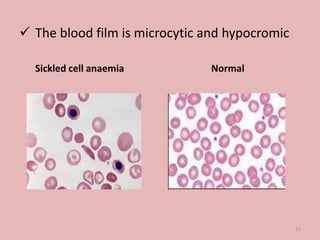
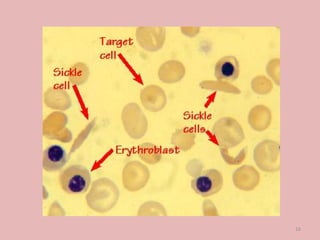
Blood film
 The blood film is microcytic and hypocromic
Sickled cell anaemia Normal
15
16
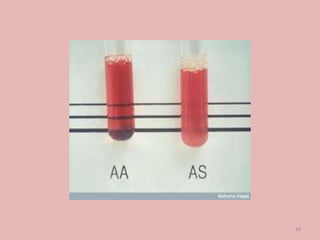
Sickle solubility test
Mixture of Hb S in a reducing solution
Gives a turbid appearance
(Precipitation of Hb S)
 Normal Hb gives a clear solution
17
18
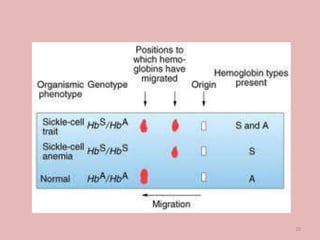
■ Hb electrophoresis
• To confirm the diagnosis.
• There is,
no Hb A
80–95% Hb SS
2–20% Hb F
19
20
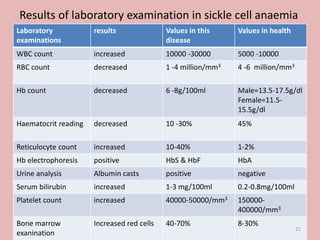
Results of laboratory examination in sickle cell anaemia
Laboratory
examinations
results Values in this
disease
Values in health
WBC count increased 10000 -30000 5000 -10000
RBC count decreased 1 -4 million/mm3 4 -6 million/mm3
Hb count decreased 6 -8g/100ml Male=13.5-17.5g/dl
Female=11.5-
15.5g/dl
Haematocrit reading decreased 10 -30% 45%
Reticulocyte count increased 10-40% 1-2%
Hb electrophoresis positive HbS & HbF HbA
Urine analysis Albumin casts positive negative
Serum bilirubin increased 1-3 mg/100ml 0.2-0.8mg/100ml
Platelet count increased 40000-50000/mm3 150000-
400000/mm3
Bone marrow
exanination
Increased red cells 40-70% 8-30%
21
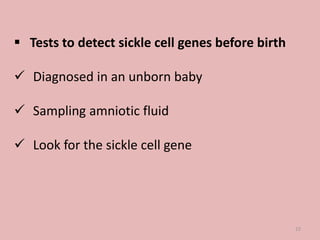
 Tests to detect sickle cell genes before birth
 Diagnosed in an unborn baby
 Sampling amniotic fluid
 Look for the sickle cell gene
22
Hair‐on‐end appearance
X-RAYS
23
Hand-foot syndrome
24
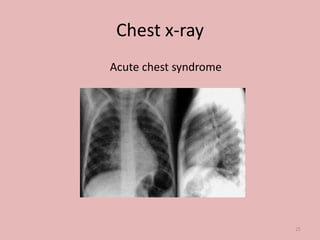
Chest x-ray
Acute chest syndrome
25
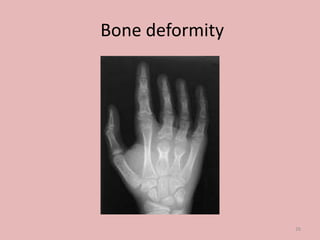
Bone deformity
26
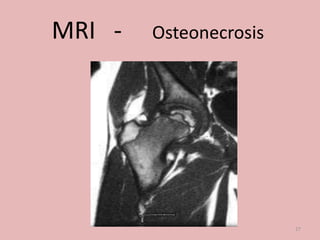
MRI - Osteonecrosis
27
REFFERENCES
• Kumar & Clark’s clinical medicine, 7th eddition
• Ganong’s physiology, 23rd eddition
• Quinn CT, et al.: Minor elective surgical procedures using general
anesthesia in children with sickle cell anemia without pre-operative
blood transfusion. Pediatr Blood Cancer 2005; 45:43–7
• Marchant WA, Walker I: Anaesthetic management of the child with
sickle cell disease. Paediatr Anaesth 2003; 13:473–89.
Anesthesiology Problem-oriented Patient Management, 6th ed.
2008, pp 980–92.
28
ACKNOWLEDGEMENT
we wish to thank our dear sir Dr.Mahinda
Kommalage for all the advices and
his valuable time in completing this
presentation.
29
THANK YOU !!!!!!
30

Diagnosis sickle cell anemia

  • 1.
    ss P.R. Jayawickrama D.S. Kaluwaduge K.K.G.Kandewaththa M. Kanchanamala UNIVERSITY of RUHUNA , FACULTY of MEDICINE. 23.11.2012 1
  • 2.
    A four yearsold boy was brought to the pediatric hospital with a history of severe back pain and uncontrolled vomiting since previous night. Further His mother told that her child was complaining about some attacks of back pain occurring during the past months. On examination patient was pale and spleen was palpable below the costal margin……!!!! 2
  • 3.
    In investigation, • Haemoglobinlevel - decreased • Peripheral blood smear - sickled cells - nucleated RBC -features of microcytic hypochromic anaemia • X-ray of the skull – hair on end appearance of frontal bone 3
  • 4.
    SICKLE CELL ANAEMIA……???? Inherited. formof an anaemia as a result of mutation in Hb. RBC sickled or crescent shaped. NOT enough healthy RBC to carry adequate oxygen. 4
  • 5.
    Normally, humans have Ofthese, Haemoglobin A makes up around 96-97% of the normal haemoglobin in humans. Haemoglobin A two alpha two beta A2 two alpha two delta F two alpha two gamma 5
  • 6.
    Common types ofSickle Cell Disorders Type of anaemia Hemoglobin variation comment Sickle Cell Anemia Sickle haemoglobin (HbS) + Sickle haemoglobin Most Severe – No HbA Hemoglobin S- Beta thalassemia Sickle haemoglobin (HbS) + reduced HbA Mild form of Sickle Cell Disorder Hemoglobin S-C Sickle Mild form of 6
  • 7.
  • 8.
    Pathophysiology Is caused by •point mutation in the β-globin chain of Hb glutamic (hydrophobic amino acid) valine( hydrophilic ) • at the 6th position Life span • RBC 90–120 days • sickle cells 10–20 days.
  • 9.
  • 10.
    • exposure toP O2 < 40 mmHg for 2 to 4 minutes • polymerization of Hb • The initiation of polymerization may be -incomplete and -reversible , if re-oxygenation occurs early in the process. • Repetitive exposure to alternating de- oxygenated and oxygenated states lead to -membrane distortion, -irreversible sickling.
  • 12.
    Signs ,symptoms &complications • Anaemia • Episodes of pain • Hand-foot syndrome
  • 13.
    • Frequent infections •Vision problems • Delayed growth • Any signs or symptoms of stroke • Enlarged heart and systolic murmurs
  • 14.
    Laboratory investigations Complete bloodcount  Level of Hb -: 6–8 g/dL (Normal range-: Male=13.5-17.5g/dl Female=11.5-15.5g/dl)  High reticulocyte count (10–20%). Blood film
  • 15.
     The bloodfilm is microcytic and hypocromic Sickled cell anaemia Normal 15
  • 16.
  • 17.
    Sickle solubility test Mixtureof Hb S in a reducing solution Gives a turbid appearance (Precipitation of Hb S)  Normal Hb gives a clear solution 17
  • 18.
  • 19.
    ■ Hb electrophoresis •To confirm the diagnosis. • There is, no Hb A 80–95% Hb SS 2–20% Hb F 19
  • 20.
  • 21.
    Results of laboratoryexamination in sickle cell anaemia Laboratory examinations results Values in this disease Values in health WBC count increased 10000 -30000 5000 -10000 RBC count decreased 1 -4 million/mm3 4 -6 million/mm3 Hb count decreased 6 -8g/100ml Male=13.5-17.5g/dl Female=11.5- 15.5g/dl Haematocrit reading decreased 10 -30% 45% Reticulocyte count increased 10-40% 1-2% Hb electrophoresis positive HbS & HbF HbA Urine analysis Albumin casts positive negative Serum bilirubin increased 1-3 mg/100ml 0.2-0.8mg/100ml Platelet count increased 40000-50000/mm3 150000- 400000/mm3 Bone marrow exanination Increased red cells 40-70% 8-30% 21
  • 22.
     Tests todetect sickle cell genes before birth  Diagnosed in an unborn baby  Sampling amniotic fluid  Look for the sickle cell gene 22
  • 23.
  • 24.
  • 25.
  • 26.
  • 27.
  • 28.
    REFFERENCES • Kumar &Clark’s clinical medicine, 7th eddition • Ganong’s physiology, 23rd eddition • Quinn CT, et al.: Minor elective surgical procedures using general anesthesia in children with sickle cell anemia without pre-operative blood transfusion. Pediatr Blood Cancer 2005; 45:43–7 • Marchant WA, Walker I: Anaesthetic management of the child with sickle cell disease. Paediatr Anaesth 2003; 13:473–89. Anesthesiology Problem-oriented Patient Management, 6th ed. 2008, pp 980–92. 28
  • 29.
    ACKNOWLEDGEMENT we wish tothank our dear sir Dr.Mahinda Kommalage for all the advices and his valuable time in completing this presentation. 29
  • 30.