NANO BIOREMEDIATION


             Presented by-
             Shreya M. Modi,
             M.Phil/P.hD Student
             in Nanosience
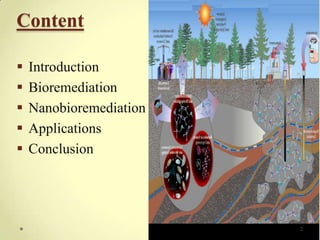
Content

   Introduction
   Bioremediation
   Nanobioremediation
   Applications
   Conclusion


                         2
INTRODUCTION
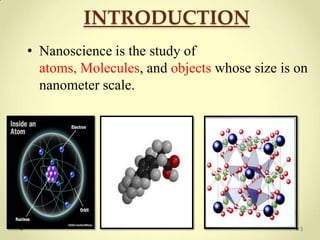
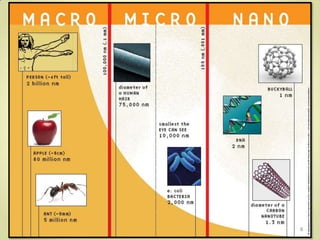
• Nanoscience is the study of
  atoms, Molecules, and objects whose size is on
  nanometer scale.


                                              3
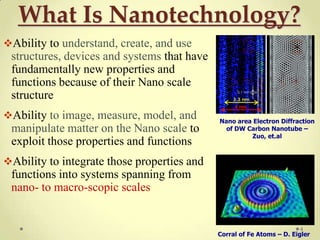
What Is Nanotechnology?
Ability to understand, create, and use
 structures, devices and systems that have
 fundamentally new properties and
 functions because of their Nano scale
 structure
Ability to image, measure, model, and       Nano area Electron Diffraction
 manipulate matter on the Nano scale to        of DW Carbon Nanotube –
                                                      Zuo, et.al
 exploit those properties and functions
Ability to integrate those properties and
 functions into systems spanning from
 nano- to macro-scopic scales


                                                                       4
                                             Corral of Fe Atoms – D. Eigler
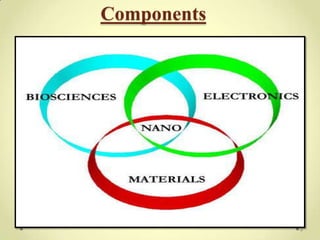
Components


             5
6
7
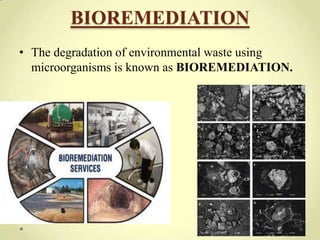
BIOREMEDIATION
• The degradation of environmental waste using
  microorganisms is known as BIOREMEDIATION.


                                                 8
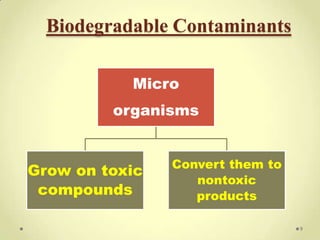
Biodegradable Contaminants

           Micro
         organisms


                Convert them to
Grow on toxic
                   nontoxic
 compounds         products

                                  9
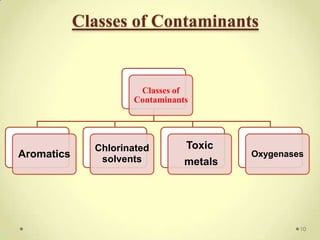
Classes of Contaminants


                      Classes of
                     Contaminants


              Chlorinated       Toxic
Aromatics      solvents
                                         Oxygenases
                                metals


                                                  10
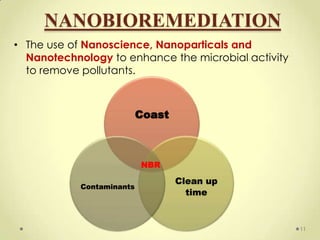
NANOBIOREMEDIATION
• The use of Nanoscience, Nanoparticals and
  Nanotechnology to enhance the microbial activity
  to remove pollutants.


                           Coast


                           NBR

                                   Clean up
            Contaminants
                                     time


                                                     11
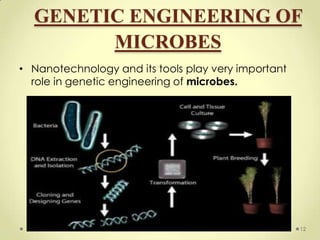
GENETIC ENGINEERING OF
        MICROBES
• Nanotechnology and its tools play very important
  role in genetic engineering of microbes.


                                                     12
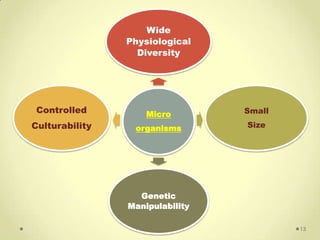
Wide
                Physiological
                  Diversity


 Controlled         Micro        Small
Culturability    organisms       Size


                  Genetic
                Manipulability

                                         13
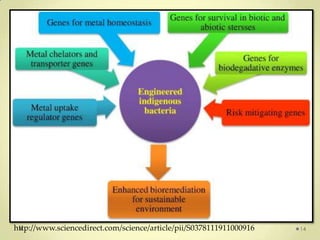
http://www.sciencedirect.com/science/article/pii/S0378111911000916   14
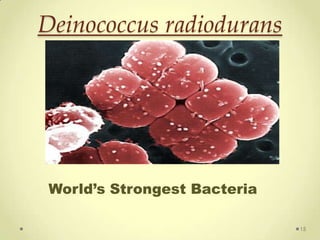
Deinococcus radiodurans


 World’s Strongest Bacteria

                              15
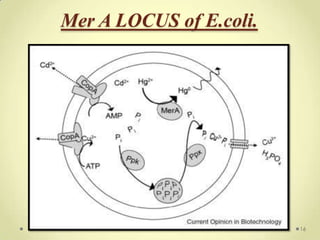
Mer A LOCUS of E.coli.


                         16
Conti………

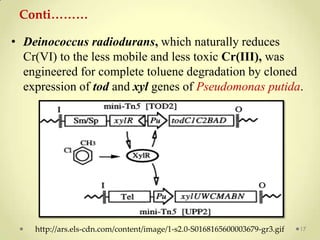
• Deinococcus radiodurans, which naturally reduces
  Cr(VI) to the less mobile and less toxic Cr(III), was
  engineered for complete toluene degradation by cloned
  expression of tod and xyl genes of Pseudomonas putida.


    http://ars.els-cdn.com/content/image/1-s2.0-S0168165600003679-gr3.gif   17
NANOSCALE BIOPOLYMERS

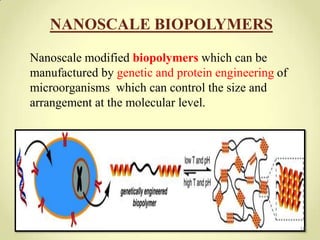
Nanoscale modified biopolymers which can be
manufactured by genetic and protein engineering of
microorganisms which can control the size and
arrangement at the molecular level.


                                                     18
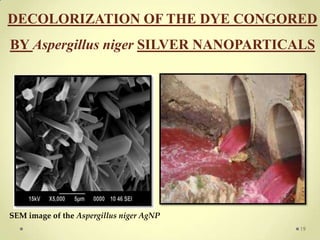
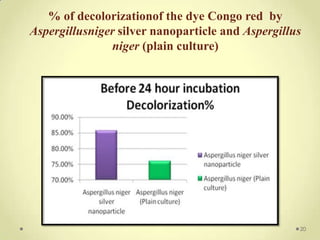
DECOLORIZATION OF THE DYE CONGORED
BY Aspergillus niger SILVER NANOPARTICALS


SEM image of the Aspergillus niger AgNP
                                          19
% of decolorizationof the dye Congo red by
Aspergillusniger silver nanoparticle and Aspergillus
               niger (plain culture)


                                                   20
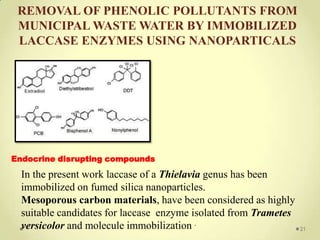
REMOVAL OF PHENOLIC POLLUTANTS FROM
 MUNICIPAL WASTE WATER BY IMMOBILIZED
 LACCASE ENZYMES USING NANOPARTICALS


Endocrine disrupting compounds

  In the present work laccase of a Thielavia genus has been
  immobilized on fumed silica nanoparticles.
  Mesoporous carbon materials, have been considered as highly
  suitable candidates for laccase enzyme isolated from Trametes
  versicolor and molecule immobilization .                        21
Degradation of Hydrophobic Compound
         Enhanced by Nanoparticals

• Polymeric nanoparticals prepared from a
  poly(ethylene) glycol Modified Urethane
  Acrylite(PMUA) precursor was applied to enhance
  the bioavailability of Polynuclear Aeromatic
  Hydrocarbons(PAHs) in soil and aqueus solutions.

• Due to the hydrophobicity of interior regions of
  PMUA there is increased affinity between PAHs and
  released into the aqueous phase and enhances the rate
  of Mineralization.
                                                          22
NANOTECH COATING CAN ENHANCE
  ELECTRICITY OUTPUT FROM
        WASTE WATER
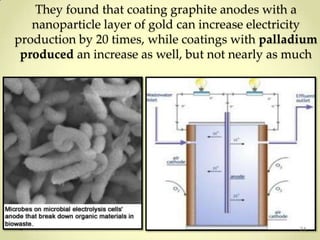
• In this technology, bacteria from biowaste
  such as sewage are placed in an anode
  chamber, where they form a biofilm,
  consume nutrients and grow, in the process
  releasing electrons. In this context, the
  sewage is literally the fuel for electricity
  production.


                                                 23
They found that coating graphite anodes with a
   nanoparticle layer of gold can increase electricity
production by 20 times, while coatings with palladium
 produced an increase as well, but not nearly as much


                                                  24
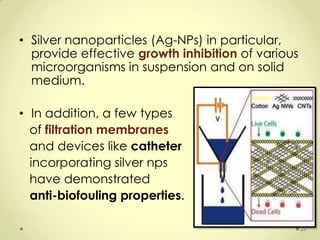
• Silver nanoparticles (Ag-NPs) in particular,
  provide effective growth inhibition of various
  microorganisms in suspension and on solid
  medium.

• In addition, a few types
  of filtration membranes
  and devices like catheter
  incorporating silver nps
  have demonstrated
  anti-biofouling properties.

                                                   25
NANOBIOREMEDIATION TO CLEAN
        UP OIL SPILL


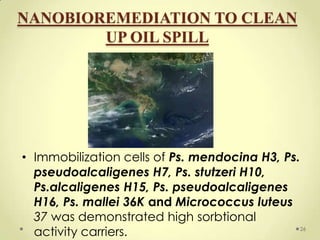
• Immobilization cells of Ps. mendocina H3, Ps.
  pseudoalcaligenes H7, Ps. stutzeri H10,
  Ps.alcaligenes H15, Ps. pseudoalcaligenes
  H16, Ps. mallei 36K and Micrococcus luteus
  37 was demonstrated high sorbtional
  activity carriers.                           26
Conti…..

• Bioremediation of oil contaminated soil is
  important that CARBONIZATED
  SORBENTS itself may sorbs oil drops for
  further oxidation carbohydrates of oil by
  microbial cells, to be source of mineral
  compounds and improve condition of soils.


                                               27
IMMOBILIZATION OF MICROBIAL
 CELLS USING NANOPARTICALS
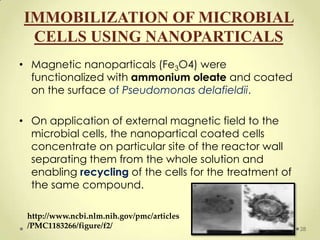
• Magnetic nanoparticals (Fe3O4) were
  functionalized with ammonium oleate and coated
  on the surface of Pseudomonas delafieldii.

• On application of external magnetic field to the
  microbial cells, the nanopartical coated cells
  concentrate on particular site of the reactor wall
  separating them from the whole solution and
  enabling recycling of the cells for the treatment of
  the same compound.

 http://www.ncbi.nlm.nih.gov/pmc/articles
 /PMC1183266/figure/f2/                                  28
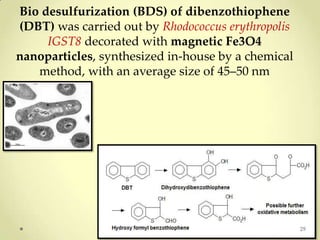
Bio desulfurization (BDS) of dibenzothiophene
(DBT) was carried out by Rhodococcus erythropolis
     IGST8 decorated with magnetic Fe3O4
nanoparticles, synthesized in-house by a chemical
   method, with an average size of 45–50 nm


                                                    29
30
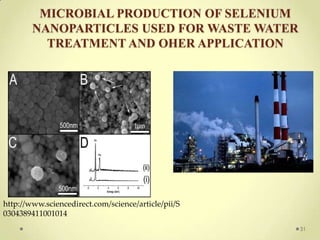
MICROBIAL PRODUCTION OF SELENIUM
        NANOPARTICLES USED FOR WASTE WATER
          TREATMENT AND OHER APPLICATION


http://www.sciencedirect.com/science/article/pii/S
0304389411001014
                                                     31
CONCLUSION

• According to above all application of
  Nanobioremediation it can be definitely
  concluded           that,       Nanoparticals,
  Nanotechnological instrument play efficient
  role in the process of Nanobioremediation. By
  applying       the    nanobioremediation    to
  environment hazards, it can clean them Faster
  and Safer than other methods and technology.
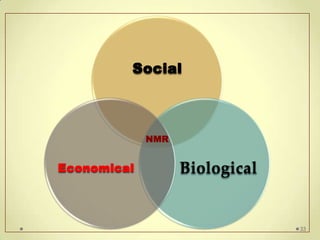
  We can say that, Nanobioremediation Maintain
  all three criteria.
                                               32
Social


             NMR


Economical         Biological


                                33
Thank You
• Thank you.


               34

Shreya ppt

  • 1.
    NANO BIOREMEDIATION Presented by- Shreya M. Modi, M.Phil/P.hD Student in Nanosience
  • 2.
    Content  Introduction  Bioremediation  Nanobioremediation  Applications  Conclusion 2
  • 3.
    INTRODUCTION • Nanoscience isthe study of atoms, Molecules, and objects whose size is on nanometer scale. 3
  • 4.
    What Is Nanotechnology? Abilityto understand, create, and use structures, devices and systems that have fundamentally new properties and functions because of their Nano scale structure Ability to image, measure, model, and Nano area Electron Diffraction manipulate matter on the Nano scale to of DW Carbon Nanotube – Zuo, et.al exploit those properties and functions Ability to integrate those properties and functions into systems spanning from nano- to macro-scopic scales 4 Corral of Fe Atoms – D. Eigler
  • 5.
  • 6.
  • 7.
  • 8.
    BIOREMEDIATION • The degradationof environmental waste using microorganisms is known as BIOREMEDIATION. 8
  • 9.
    Biodegradable Contaminants Micro organisms Convert them to Grow on toxic nontoxic compounds products 9
  • 10.
    Classes of Contaminants Classes of Contaminants Chlorinated Toxic Aromatics solvents Oxygenases metals 10
  • 11.
    NANOBIOREMEDIATION • The useof Nanoscience, Nanoparticals and Nanotechnology to enhance the microbial activity to remove pollutants. Coast NBR Clean up Contaminants time 11
  • 12.
    GENETIC ENGINEERING OF MICROBES • Nanotechnology and its tools play very important role in genetic engineering of microbes. 12
  • 13.
    Wide Physiological Diversity Controlled Micro Small Culturability organisms Size Genetic Manipulability 13
  • 14.
  • 15.
    Deinococcus radiodurans World’sStrongest Bacteria 15
  • 16.
    Mer A LOCUSof E.coli. 16
  • 17.
    Conti……… • Deinococcus radiodurans,which naturally reduces Cr(VI) to the less mobile and less toxic Cr(III), was engineered for complete toluene degradation by cloned expression of tod and xyl genes of Pseudomonas putida. http://ars.els-cdn.com/content/image/1-s2.0-S0168165600003679-gr3.gif 17
  • 18.
    NANOSCALE BIOPOLYMERS Nanoscale modifiedbiopolymers which can be manufactured by genetic and protein engineering of microorganisms which can control the size and arrangement at the molecular level. 18
  • 19.
    DECOLORIZATION OF THEDYE CONGORED BY Aspergillus niger SILVER NANOPARTICALS SEM image of the Aspergillus niger AgNP 19
  • 20.
    % of decolorizationofthe dye Congo red by Aspergillusniger silver nanoparticle and Aspergillus niger (plain culture) 20
  • 21.
    REMOVAL OF PHENOLICPOLLUTANTS FROM MUNICIPAL WASTE WATER BY IMMOBILIZED LACCASE ENZYMES USING NANOPARTICALS Endocrine disrupting compounds In the present work laccase of a Thielavia genus has been immobilized on fumed silica nanoparticles. Mesoporous carbon materials, have been considered as highly suitable candidates for laccase enzyme isolated from Trametes versicolor and molecule immobilization . 21
  • 22.
    Degradation of HydrophobicCompound Enhanced by Nanoparticals • Polymeric nanoparticals prepared from a poly(ethylene) glycol Modified Urethane Acrylite(PMUA) precursor was applied to enhance the bioavailability of Polynuclear Aeromatic Hydrocarbons(PAHs) in soil and aqueus solutions. • Due to the hydrophobicity of interior regions of PMUA there is increased affinity between PAHs and released into the aqueous phase and enhances the rate of Mineralization. 22
  • 23.
    NANOTECH COATING CANENHANCE ELECTRICITY OUTPUT FROM WASTE WATER • In this technology, bacteria from biowaste such as sewage are placed in an anode chamber, where they form a biofilm, consume nutrients and grow, in the process releasing electrons. In this context, the sewage is literally the fuel for electricity production. 23
  • 24.
    They found thatcoating graphite anodes with a nanoparticle layer of gold can increase electricity production by 20 times, while coatings with palladium produced an increase as well, but not nearly as much 24
  • 25.
    • Silver nanoparticles(Ag-NPs) in particular, provide effective growth inhibition of various microorganisms in suspension and on solid medium. • In addition, a few types of filtration membranes and devices like catheter incorporating silver nps have demonstrated anti-biofouling properties. 25
  • 26.
    NANOBIOREMEDIATION TO CLEAN UP OIL SPILL • Immobilization cells of Ps. mendocina H3, Ps. pseudoalcaligenes H7, Ps. stutzeri H10, Ps.alcaligenes H15, Ps. pseudoalcaligenes H16, Ps. mallei 36K and Micrococcus luteus 37 was demonstrated high sorbtional activity carriers. 26
  • 27.
    Conti….. • Bioremediation ofoil contaminated soil is important that CARBONIZATED SORBENTS itself may sorbs oil drops for further oxidation carbohydrates of oil by microbial cells, to be source of mineral compounds and improve condition of soils. 27
  • 28.
    IMMOBILIZATION OF MICROBIAL CELLS USING NANOPARTICALS • Magnetic nanoparticals (Fe3O4) were functionalized with ammonium oleate and coated on the surface of Pseudomonas delafieldii. • On application of external magnetic field to the microbial cells, the nanopartical coated cells concentrate on particular site of the reactor wall separating them from the whole solution and enabling recycling of the cells for the treatment of the same compound. http://www.ncbi.nlm.nih.gov/pmc/articles /PMC1183266/figure/f2/ 28
  • 29.
    Bio desulfurization (BDS)of dibenzothiophene (DBT) was carried out by Rhodococcus erythropolis IGST8 decorated with magnetic Fe3O4 nanoparticles, synthesized in-house by a chemical method, with an average size of 45–50 nm 29
  • 30.
  • 31.
    MICROBIAL PRODUCTION OFSELENIUM NANOPARTICLES USED FOR WASTE WATER TREATMENT AND OHER APPLICATION http://www.sciencedirect.com/science/article/pii/S 0304389411001014 31
  • 32.
    CONCLUSION • According toabove all application of Nanobioremediation it can be definitely concluded that, Nanoparticals, Nanotechnological instrument play efficient role in the process of Nanobioremediation. By applying the nanobioremediation to environment hazards, it can clean them Faster and Safer than other methods and technology. We can say that, Nanobioremediation Maintain all three criteria. 32
  • 33.
    Social NMR Economical Biological 33
  • 34.