RAYAT BAHRA UNIVERSITY,
MOHALI
Presented by: Kuya Kabalo
M.P.H 1st Sem.
Organic pollutants
Introduction
• Persistent organic pollutants (POPs) are organic
chemicals that can persist in the environment for a
longer period due to their non-biodegradability.
• The pervasive and bio-accumulative behavior of
POPs makes them highly toxic to the environmental
species including plants, animals, and humans
Cont.…
• They persist for long periods of time in the
environment and can accumulate and pass from one
species to the next through the food chain
Classification of POPs
• Intentionally
• Un intentionally
Cont.…
• Intentionally produced chemicals currently or once
used in agriculture, disease control, manufacturing,
or industrial processes.
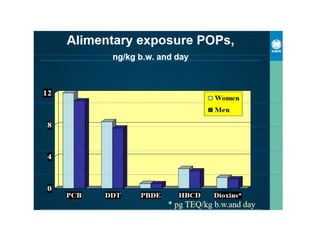
• Examples include PCBs, which have been useful in
a variety of industrial applications (e.g., in electrical
transformers and large capacitors, as hydraulic and
heat exchange fluids, and as additives to paints and
lubricants)
• and DDT, which is still used to control mosquitoes
that carry malaria in some parts of the world
Intentionally produced pops
• Pesticides
• Pharmaceuticals
• chemicals
Cont.…
• Unintentionally produced chemicals, such as
dioxins, that result from some industrial processes
and from combustion (for example, municipal and
medical waste incineration and backyard burning of
trash).
Unintentionally produced pops
• By products
• Transformation and degradation products
• Combustion residual ,gas exhaust
Cont.…
• PCBs
• Hexachlorobenzene
• PAHs
• Brominated dioxins
• Dioxins
Environmental properties
Persistence—POPs are extremely resistant to
physical, chemical, and biological degradation.
They have long half-lives in soil, water, and air.
Bioaccumulation—They accumulate in the
organism to a level which can be harmful to the
human health and environment.
.
Cont.…
• Ability for long range transport—It can
be transported by the environmental media
to far sites where they have never been used
or produced, such as in the Arctic regions.
• Toxicity—POPs are extremely toxic and pose a
threat both to the human health and the
environment
Health effects of POPs
• Exposure to POPs can lead to potential risk of
adverse health effects including cancer, allergies,
reproductive disorder, endocrine and immune
system disruption, obesity, diabetes
References
• L. Fitzgerald, D.S. Wikoff, in Encyclopedia of
Toxicology (Third Edition), 2014
• Roland Kallenborn, ... Eva Brorström-Lundén,
in Comprehensive Analytical Chemistry, 2015

Organic pollutants.pptx

  • 1.
    RAYAT BAHRA UNIVERSITY, MOHALI Presentedby: Kuya Kabalo M.P.H 1st Sem.
  • 2.
  • 3.
    Introduction • Persistent organicpollutants (POPs) are organic chemicals that can persist in the environment for a longer period due to their non-biodegradability. • The pervasive and bio-accumulative behavior of POPs makes them highly toxic to the environmental species including plants, animals, and humans
  • 4.
    Cont.… • They persistfor long periods of time in the environment and can accumulate and pass from one species to the next through the food chain
  • 5.
    Classification of POPs •Intentionally • Un intentionally
  • 6.
    Cont.… • Intentionally producedchemicals currently or once used in agriculture, disease control, manufacturing, or industrial processes. • Examples include PCBs, which have been useful in a variety of industrial applications (e.g., in electrical transformers and large capacitors, as hydraulic and heat exchange fluids, and as additives to paints and lubricants)
  • 7.
    • and DDT,which is still used to control mosquitoes that carry malaria in some parts of the world
  • 8.
    Intentionally produced pops •Pesticides • Pharmaceuticals • chemicals
  • 9.
    Cont.… • Unintentionally producedchemicals, such as dioxins, that result from some industrial processes and from combustion (for example, municipal and medical waste incineration and backyard burning of trash).
  • 10.
    Unintentionally produced pops •By products • Transformation and degradation products • Combustion residual ,gas exhaust
  • 11.
    Cont.… • PCBs • Hexachlorobenzene •PAHs • Brominated dioxins • Dioxins
  • 12.
    Environmental properties Persistence—POPs areextremely resistant to physical, chemical, and biological degradation. They have long half-lives in soil, water, and air. Bioaccumulation—They accumulate in the organism to a level which can be harmful to the human health and environment. .
  • 13.
    Cont.… • Ability forlong range transport—It can be transported by the environmental media to far sites where they have never been used or produced, such as in the Arctic regions. • Toxicity—POPs are extremely toxic and pose a threat both to the human health and the environment
  • 14.
    Health effects ofPOPs • Exposure to POPs can lead to potential risk of adverse health effects including cancer, allergies, reproductive disorder, endocrine and immune system disruption, obesity, diabetes
  • 16.
    References • L. Fitzgerald,D.S. Wikoff, in Encyclopedia of Toxicology (Third Edition), 2014 • Roland Kallenborn, ... Eva Brorström-Lundén, in Comprehensive Analytical Chemistry, 2015