

Yarrakula Mahesh Babu, M.F.Sc
         Ph.D. 1st year
      Dpt. Of Aquaculture
  College of Fishery Science
           Mangalore
O Environment
      Abiotic
      Biotic

O Environmental pollution


O Pollutants
      Chemical
      Biological
      Physical

                            2
O Bio-monitoring


O Biotechnological tools

      Biosensors
      Bioremediation
      Bio-fertilizers
      Bio-fuels
      Genetically modified microorganisms


                                            3
O These are biophysical devices which can detect
  and measure        the    presence    of    specific
  substances.

O Definition: it is an analytical device containing an
  immobilized biological material, which can
  interact with an analyte and produce signals to
  measure.

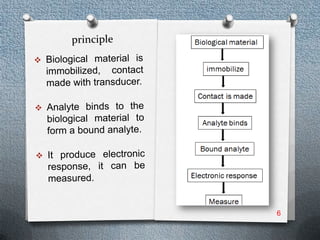
O Biosensors basically involve in the quantitative
  analysis of various substances by converting
                                                    4
  their biological actions into measurable signals.
O Components of biosensor
    Biological component
    Physical component

O Special kits have been designed to identify the
  specific pollutants.
    Gas biosensors
    Immunoassay biosensors
    BOD biosensors


                                                    5
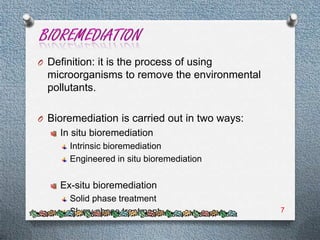
O Definition: it is the process of using
  microorganisms to remove the environmental
  pollutants.

O Bioremediation is carried out in two ways:
     In situ bioremediation
       Intrinsic bioremediation
       Engineered in situ bioremediation

     Ex-situ bioremediation
       Solid phase treatment
       Slurry phase treatment                  7
O It is a direct approach for the microbial degradation
  of xenobiotics at the site of pollution.

O Generally used for cleanup of oil spillage, etc.


Intrinsic bioremediation:
It is the inherent metabolic ability of the
microorganisms to degrade certain pollutants.

There will be no addition of nutrient supply for
accelerating metabolic activity.
                                                      8
Engineered in situ bioremediation:

  Here the bioremediation process is engineered to
  increase the degradation efficiency.

  In this process optimal environment will be
  maintained for the microorganisms to overcome
  the slow and limited bioremediation.


                                                  9
O The waste will be collected from the polluted
  sites and the bioremediation will be carry out at
  designed place by using microorganisms.

O Classification
    Solid phase treatment
    Slurry phase treatment


                                                  10
O Solid phase treatment:
This system includes land treatment soil piles
comprising of organic wastes.

O Slurry phase treatment:
This is a triphasic treatment system involving
three components (water, suspended
particulate matter and air).


                                                 11
Use of genetic engineering for
efficient bioremediation
O In recent years, efforts have been made to create
  genetically engineered microorganisms (GEMs) to
  overcome problems and enhance bioremediation.

O Problems during bioremediation are:
    Growth of microorganisms reduced by the
    xenobiotics.
    Natural one type of microorganism can’t degrade all
    the xenobiotics.
    Slow process.
    Sometimes xenobiotics will become unavailable 12
    form.
O The genetic manipulations of plasmids can lead
 to the creation of new strains of bacteria.

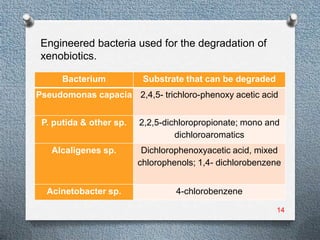
O In 1970s new strain of pseudomonas was
 developed by the scientists named as
 “superbug”.

O This superbug has the capability of degrading
 hydrocarbons of petroleum.


                                                  13
Engineered bacteria used for the degradation of
 xenobiotics.

      Bacterium           Substrate that can be degraded
Pseudomonas capacia 2,4,5- trichloro-phenoxy acetic acid


 P. putida & other sp.   2,2,5-dichloropropionate; mono and
                                  dichloroaromatics
   Alcaligenes sp.        Dichlorophenoxyacetic acid, mixed
                         chlorophenols; 1,4- dichlorobenzene


  Acinetobacter sp.               4-chlorobenzene

                                                           14
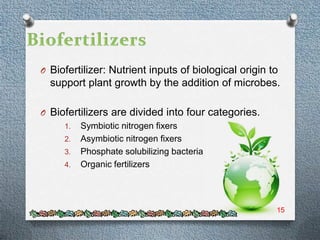
O Biofertilizer: Nutrient inputs of biological origin to
  support plant growth by the addition of microbes.

O Biofertilizers are divided into four categories.
     1. Symbiotic nitrogen fixers
     2. Asymbiotic nitrogen fixers
     3. Phosphate solubilizing bacteria
     4. Organic fertilizers


                                                       15
O Symbiotic nitrogen fixers:
       The diazotrophic microorganisms are the
symbiotic nitrogen fixers that serve as
biofertilizers e.g. Rhizobium sp.,
Bradyrhizopium sp.

O Asymbiotic nitrogen fixers:
The asymbiotic nitrogen fixing bacteria can
directly convert the gaseous nitrogen to nitrogen
rich compounds. e.g. Azobacter sp.,
Azospirillum sp.
                                                 16
O Phosphate solubilizing bacteria:
Thiobacillus, Bacillus are capable of
converting non-available inorganic phosphorus
present in the soil to organic or inorganic form
of phosphate.

O Organic fertilizers:
       Certain types of organic wastes are used
as fertilizers e.g. animal dung, urban garbage,
sewage, crop residues and oil cakes.
       All these wastes can be converted in to
organic manures.                                17
Advantages:

   Improves the tolerance against toxic heavy
   metals.
   Possible to fertile the saline and alkaline
   soils.
   Helps in environmental pollution control.
   Fertility of soil will be increased year after
   year.
   Low cost and easy to produce.
   Increases the physico-chemical properties of
   the soil, soil texture and water holding
   capacity.                                      18
Global warming, industrialization and increasing
price of fossil fuels made search of alternative.

An alternative, biodegradable, domestic fuel
contributes no net CO2 or S2 to the atmosphere.

Mono alkyl esters of long chain fatty acids
derived from a renewable lipid feed stock such
as vegetable oil or animal fat will be used.


                                              19
ADVANTAGES:
O Biodegradable

O Non-toxic fuel

O Not contribute to global warming

O Alternative to petro -based fuels

O Favorable energy balance

O Lower harmful emissions of CO2 & unburned

  hydrocarbons
                                          20
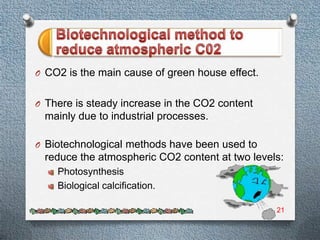
O CO2 is the main cause of green house effect.


O There is steady increase in the CO2 content
 mainly due to industrial processes.

O Biotechnological methods have been used to
 reduce the atmospheric CO2 content at two levels:
    Photosynthesis
    Biological calcification.

                                                 21
O Fast growing plants utilize CO2 more
 efficiently.

O Further, CO2 utilization can be increased by
 enhancing the rate of photosynthesis.

O Ribulosebiphosphate carboxylase is an
 enzyme which can fix the CO2 efficiently.

O Microalgae like chlorella and spirulina can
 utilize CO2 efficiently than higher plants.
                                                 22
O The sewage is treated to get rid of the undesirable
  substances by subjecting the organic matter to
  biodegradation by microorganisms.

O The biodegradation involves the degradation of
  organic matter to smaller molecules and requires
  constant supply of oxygen.

O This problem is overcome by growing microalgae in
  the ponds and tanks where sewage treatment is
  carried out.
                                                     23
Removal of oil by using biotechnology

O Manual and mechanical cleaning is very
  expensive.

O To overcome this oleophilic fertilizers are being
  developed.

O These fertilizers will allow rapid growth and
  multiplication of microorganisms.

O Recently oil utilizing microbes were developed by
  using genetic engineering.                          24
O Some of the oil utilizing microbes can also
  produce surface active compounds that can
  emulsify oil in water and thereby removing the
  oil.

O A strain of Pseudomonas aeruginosa produces
  a glycolipid emulsifier that reduces the surface
  tension of oil-water interface which helps in the
  removal of oil from water.

O This microbial emulsifier is nontoxic and
  biodegradable and has shown promising results
  in the laboratory experiments.
                                                      25
O Use of chemical pesticides, herbicides and
  fertilizers are hazardous.

O They undergo degradation by microorganisms
  and ultraviolet light which releases toxic
  chemicals.

O To overcome this bacterial and viral pesticides are
  being developed by using biotechnology.


                                                   26
O Mutation of the microbes may cause
  diseases to the organisms.

O Cost effective and more shelf life biofertilizers
  should be developed.

O Micro algae like Chlorella, Spirulina should
  be cultured near the industries.

O Protection of coral beds.

                                                  27
O Use of biofertilizers and biofuels should be
  encouraged.

O Recycling of the different products
  should be increase.

O Organic farming has to be develop.


O Continuous biomonitoring of the environment and
  biological control methods should be developed
  rather than chemical methods.

                                                   28
29

Biotechnological tools

  • 1.
    Yarrakula Mahesh Babu,M.F.Sc Ph.D. 1st year Dpt. Of Aquaculture College of Fishery Science Mangalore
  • 2.
    O Environment Abiotic Biotic O Environmental pollution O Pollutants Chemical Biological Physical 2
  • 3.
    O Bio-monitoring O Biotechnologicaltools Biosensors Bioremediation Bio-fertilizers Bio-fuels Genetically modified microorganisms 3
  • 4.
    O These arebiophysical devices which can detect and measure the presence of specific substances. O Definition: it is an analytical device containing an immobilized biological material, which can interact with an analyte and produce signals to measure. O Biosensors basically involve in the quantitative analysis of various substances by converting 4 their biological actions into measurable signals.
  • 5.
    O Components ofbiosensor Biological component Physical component O Special kits have been designed to identify the specific pollutants. Gas biosensors Immunoassay biosensors BOD biosensors 5
  • 7.
    O Definition: itis the process of using microorganisms to remove the environmental pollutants. O Bioremediation is carried out in two ways: In situ bioremediation Intrinsic bioremediation Engineered in situ bioremediation Ex-situ bioremediation Solid phase treatment Slurry phase treatment 7
  • 8.
    O It isa direct approach for the microbial degradation of xenobiotics at the site of pollution. O Generally used for cleanup of oil spillage, etc. Intrinsic bioremediation: It is the inherent metabolic ability of the microorganisms to degrade certain pollutants. There will be no addition of nutrient supply for accelerating metabolic activity. 8
  • 9.
    Engineered in situbioremediation: Here the bioremediation process is engineered to increase the degradation efficiency. In this process optimal environment will be maintained for the microorganisms to overcome the slow and limited bioremediation. 9
  • 10.
    O The wastewill be collected from the polluted sites and the bioremediation will be carry out at designed place by using microorganisms. O Classification Solid phase treatment Slurry phase treatment 10
  • 11.
    O Solid phasetreatment: This system includes land treatment soil piles comprising of organic wastes. O Slurry phase treatment: This is a triphasic treatment system involving three components (water, suspended particulate matter and air). 11
  • 12.
    Use of geneticengineering for efficient bioremediation O In recent years, efforts have been made to create genetically engineered microorganisms (GEMs) to overcome problems and enhance bioremediation. O Problems during bioremediation are: Growth of microorganisms reduced by the xenobiotics. Natural one type of microorganism can’t degrade all the xenobiotics. Slow process. Sometimes xenobiotics will become unavailable 12 form.
  • 13.
    O The geneticmanipulations of plasmids can lead to the creation of new strains of bacteria. O In 1970s new strain of pseudomonas was developed by the scientists named as “superbug”. O This superbug has the capability of degrading hydrocarbons of petroleum. 13
  • 14.
    Engineered bacteria usedfor the degradation of xenobiotics. Bacterium Substrate that can be degraded Pseudomonas capacia 2,4,5- trichloro-phenoxy acetic acid P. putida & other sp. 2,2,5-dichloropropionate; mono and dichloroaromatics Alcaligenes sp. Dichlorophenoxyacetic acid, mixed chlorophenols; 1,4- dichlorobenzene Acinetobacter sp. 4-chlorobenzene 14
  • 15.
    O Biofertilizer: Nutrientinputs of biological origin to support plant growth by the addition of microbes. O Biofertilizers are divided into four categories. 1. Symbiotic nitrogen fixers 2. Asymbiotic nitrogen fixers 3. Phosphate solubilizing bacteria 4. Organic fertilizers 15
  • 16.
    O Symbiotic nitrogenfixers: The diazotrophic microorganisms are the symbiotic nitrogen fixers that serve as biofertilizers e.g. Rhizobium sp., Bradyrhizopium sp. O Asymbiotic nitrogen fixers: The asymbiotic nitrogen fixing bacteria can directly convert the gaseous nitrogen to nitrogen rich compounds. e.g. Azobacter sp., Azospirillum sp. 16
  • 17.
    O Phosphate solubilizingbacteria: Thiobacillus, Bacillus are capable of converting non-available inorganic phosphorus present in the soil to organic or inorganic form of phosphate. O Organic fertilizers: Certain types of organic wastes are used as fertilizers e.g. animal dung, urban garbage, sewage, crop residues and oil cakes. All these wastes can be converted in to organic manures. 17
  • 18.
    Advantages: Improves the tolerance against toxic heavy metals. Possible to fertile the saline and alkaline soils. Helps in environmental pollution control. Fertility of soil will be increased year after year. Low cost and easy to produce. Increases the physico-chemical properties of the soil, soil texture and water holding capacity. 18
  • 19.
    Global warming, industrializationand increasing price of fossil fuels made search of alternative. An alternative, biodegradable, domestic fuel contributes no net CO2 or S2 to the atmosphere. Mono alkyl esters of long chain fatty acids derived from a renewable lipid feed stock such as vegetable oil or animal fat will be used. 19
  • 20.
    ADVANTAGES: O Biodegradable O Non-toxicfuel O Not contribute to global warming O Alternative to petro -based fuels O Favorable energy balance O Lower harmful emissions of CO2 & unburned hydrocarbons 20
  • 21.
    O CO2 isthe main cause of green house effect. O There is steady increase in the CO2 content mainly due to industrial processes. O Biotechnological methods have been used to reduce the atmospheric CO2 content at two levels: Photosynthesis Biological calcification. 21
  • 22.
    O Fast growingplants utilize CO2 more efficiently. O Further, CO2 utilization can be increased by enhancing the rate of photosynthesis. O Ribulosebiphosphate carboxylase is an enzyme which can fix the CO2 efficiently. O Microalgae like chlorella and spirulina can utilize CO2 efficiently than higher plants. 22
  • 23.
    O The sewageis treated to get rid of the undesirable substances by subjecting the organic matter to biodegradation by microorganisms. O The biodegradation involves the degradation of organic matter to smaller molecules and requires constant supply of oxygen. O This problem is overcome by growing microalgae in the ponds and tanks where sewage treatment is carried out. 23
  • 24.
    Removal of oilby using biotechnology O Manual and mechanical cleaning is very expensive. O To overcome this oleophilic fertilizers are being developed. O These fertilizers will allow rapid growth and multiplication of microorganisms. O Recently oil utilizing microbes were developed by using genetic engineering. 24
  • 25.
    O Some ofthe oil utilizing microbes can also produce surface active compounds that can emulsify oil in water and thereby removing the oil. O A strain of Pseudomonas aeruginosa produces a glycolipid emulsifier that reduces the surface tension of oil-water interface which helps in the removal of oil from water. O This microbial emulsifier is nontoxic and biodegradable and has shown promising results in the laboratory experiments. 25
  • 26.
    O Use ofchemical pesticides, herbicides and fertilizers are hazardous. O They undergo degradation by microorganisms and ultraviolet light which releases toxic chemicals. O To overcome this bacterial and viral pesticides are being developed by using biotechnology. 26
  • 27.
    O Mutation ofthe microbes may cause diseases to the organisms. O Cost effective and more shelf life biofertilizers should be developed. O Micro algae like Chlorella, Spirulina should be cultured near the industries. O Protection of coral beds. 27
  • 28.
    O Use ofbiofertilizers and biofuels should be encouraged. O Recycling of the different products should be increase. O Organic farming has to be develop. O Continuous biomonitoring of the environment and biological control methods should be developed rather than chemical methods. 28
  • 29.