POSTGRAD ORTH Deiary Kader
Postgraduate Orthpaedics
FRCS(Tr&Orth) Revision Course
Professor Deiary Kader
Consultant Orthopaedic & Trauma Surgeon
Knee Surgeon
Newcastle Nuffield
POSTGRAD ORTH Deiary Kader
PCL and PLC
Professor Deiary Kader
Consultant Orthopaedic & Trauma Surgeon
Knee Surgeon
Newcastle Nuffield Hospital
POSTGRAD ORTH Deiary Kader
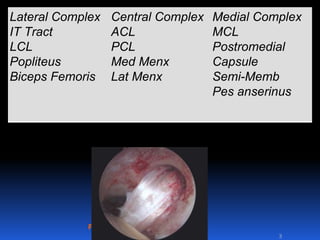
Classification of knee
Stabilizers
3
Lateral Complex
IT Tract
LCL
Popliteus
Biceps Femoris
Central Complex
ACL
PCL
Med Menx
Lat Menx
Medial Complex
MCL
Postromedial
Capsule
Semi-Memb
Pes anserinus
POSTGRAD ORTH Deiary Kader
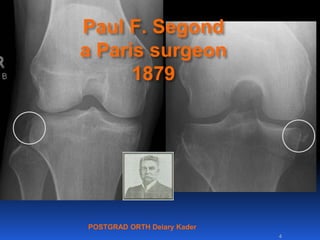
Paul F. Segond
a Paris surgeon
1879
4
POSTGRAD ORTH Deiary Kader
5
POSTGRAD ORTH Deiary Kader
PCL
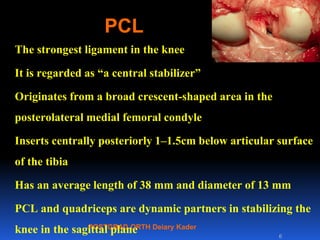
The strongest ligament in the knee
It is regarded as “a central stabilizer”
Originates from a broad crescent-shaped area in the
posterolateral medial femoral condyle
Inserts centrally posteriorly 1–1.5cm below articular surface
of the tibia
Has an average length of 38 mm and diameter of 13 mm
PCL and quadriceps are dynamic partners in stabilizing the
knee in the sagittal plane 6
POSTGRAD ORTH Deiary Kader
PCL
Mechanism of Injury
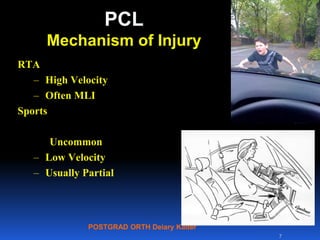
RTA
– High Velocity
– Often MLI
Sports
Uncommon
– Low Velocity
– Usually Partial
7
POSTGRAD ORTH Deiary Kader
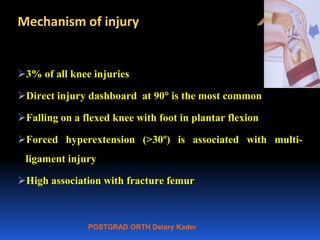
Mechanism of injury
3% of all knee injuries
Direct injury dashboard at 90 is the most common
Falling on a flexed knee with foot in plantar flexion
Forced hyperextension (>30º) is associated with multi-
ligament injury
High association with fracture femur
POSTGRAD ORTH Deiary Kader
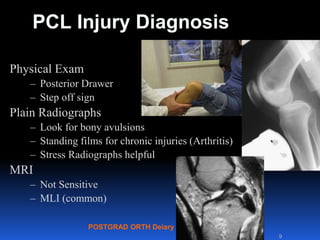
PCL Injury Diagnosis
9
Physical Exam
– Posterior Drawer
– Step off sign
Plain Radiographs
– Look for bony avulsions
– Standing films for chronic injuries (Arthritis)
– Stress Radiographs helpful
MRI
– Not Sensitive
– MLI (common)
POSTGRAD ORTH Deiary Kader
PCL
Three components:
AL: Antero-lateral: long and thick part, twice the size
of the posteromedial bundle; tightens in flexion
PM: Posteromedial: tight in extension
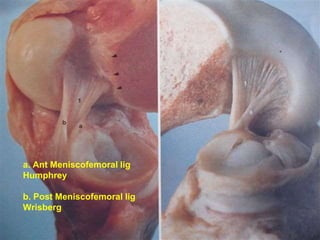
Meniscofemoral ligaments: mechanically very strong
Anterior: Humphrey’s ligament
Posterior: Wrisberg’s ligament
POSTGRAD ORTH Deiary Kader
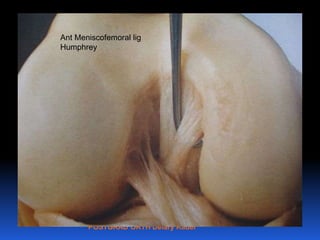
Ant Meniscofemoral lig
Humphrey
POSTGRAD ORTH Deiary Kader
a. Ant Meniscofemoral lig
Humphrey
b. Post Meniscofemoral lig
Wrisberg
POSTGRAD ORTH Deiary Kader
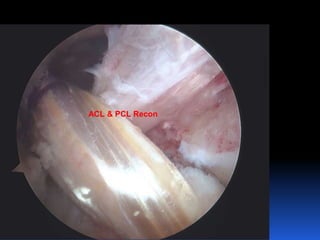
ACL & PCL Recon
POSTGRAD ORTH Deiary Kader
14
POSTGRAD ORTH Deiary Kader
Diagnosis 1
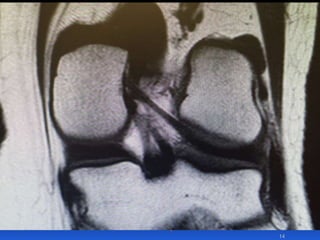
MRI & PCL
Clinical examination is more reliable than MRI
scan
The PCL may be dysfunctional despite normal MRI
Kneeling stress x-ray shows the degree of posterior
translation
POSTGRAD ORTH Deiary Kader
Diagnosis 2
Clinical
Posterior drawer test at 90 and 30
Quadriceps active drawer test. Flex the knee to 60 and
control the foot then ask the patient to contract the
quads. The test is positive when the tibia reduces.
Posterior sag sign (step-off)
Posterolateral rotatory instability (Dial test prone)
External rotation recurvatum test
POSTGRAD ORTH Deiary Kader
Grading of PCL instability
Normal tibia step-off is 10 mm at 90 flexion
Instability could be mild, moderate or severe
Grade I instability is when there is a 5-mm step-off
Grade II instability is when there is no step-off (flush)
Grade III instability is when there is –5 mm step-off
There is a high association between Grade III PCL
injury and posterolateral corner injury.
POSTGRAD ORTH Deiary Kader
Management
In isolation, it often causes little long-term
instability. However, it may lead to medial
or PFJ pain (OA) at a later date.
More troublesome in soccer players due to
difficulty in deceleration.
POSTGRAD ORTH Deiary Kader
Management 2
Presentation
Acute isolated PCL injury is commonly missed
Present with very little pain in the knee without hemarthrosis
There may be only bruising at the popliteal fossa.
Chronic PCL injury on the other hand may present with pain in
the medial compartment or anterior knee pain.
POSTGRAD ORTH Deiary Kader
Treatment
 Treat acute, isolated PCL injury conservatively.
 Extension brace with calf support (Posterior Tibial Support,
PTS Brace) until the pain subsides (4-6 weeks) with quadriceps
rehabilitation
 Start early passive motion only in prone position to maintain
anterior tibia translation.
POSTGRAD ORTH Deiary Kader
21
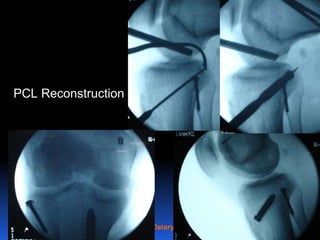
PCL Reconstruction
POSTGRAD ORTH Deiary Kader
Surgical reconstruction
Indications
 Acute combined injuries
 Acute bony avulsion
 Symptomatic chronic PCL injuries that failed rehabilitation.
 There is no difference in clinical outcome between single and
double bundle PCL reconstruction.
POSTGRAD ORTH Deiary Kader
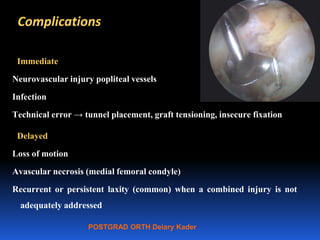
Complications
Immediate
Neurovascular injury popliteal vessels
Infection
Technical error → tunnel placement, graft tensioning, insecure fixation
Delayed
Loss of motion
Avascular necrosis (medial femoral condyle)
Recurrent or persistent laxity (common) when a combined injury is not
adequately addressed
POSTGRAD ORTH Deiary Kader
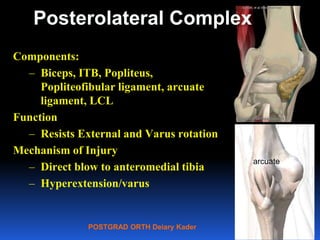
Posterolateral Complex
Components:
– Biceps, ITB, Popliteus,
Popliteofibular ligament, arcuate
ligament, LCL
Function
– Resists External and Varus rotation
Mechanism of Injury
– Direct blow to anteromedial tibia
– Hyperextension/varus
24
arcuate
POSTGRAD ORTH Deiary Kader
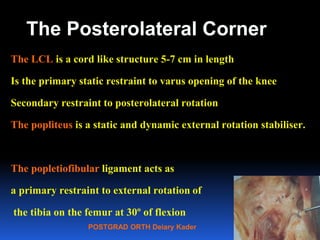
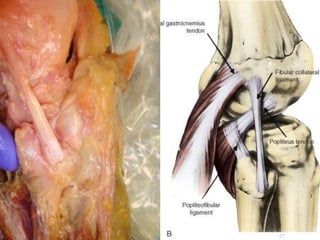
The Posterolateral Corner
The LCL is a cord like structure 5-7 cm in length
Is the primary static restraint to varus opening of the knee
Secondary restraint to posterolateral rotation
The popliteus is a static and dynamic external rotation stabiliser.
The popletiofibular ligament acts as
a primary restraint to external rotation of
the tibia on the femur at 30º of flexion
25
POSTGRAD ORTH Deiary Kader
The Posterolateral Corner
(PLC)
They are the primary stabilisers of external tibial rotation at
all knee flexion angles and the secondary restraints to
anterior and posterior translation
Isolated PLC sectioning produce a maximal average increase of
13° of ER at 30° of knee flexion and only an average increase of
5.3° at 90°.
Isolated PCL sectioning has no effect on external tibial rotation
Combined injury to the PCL and PLC leads to ER of 20.9° at
90° of knee flexion
26
POSTGRAD ORTH Deiary Kader
27
POSTGRAD ORTH Deiary Kader
28
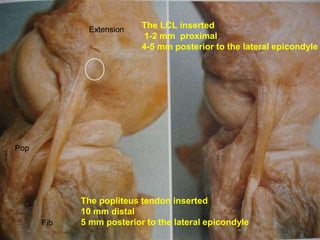
Fib
Pop
Extension
The popliteus tendon inserted
10 mm distal
5 mm posterior to the lateral epicondyle
The LCL inserted
1-2 mm proximal
4-5 mm posterior to the lateral epicondyle
POSTGRAD ORTH Deiary Kader
29
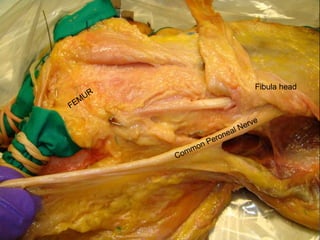
Fibula head
POSTGRAD ORTH Deiary Kader
30
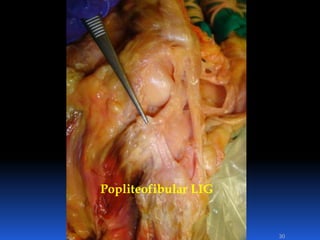
Popliteofibular LIG
POSTGRAD ORTH Deiary Kader
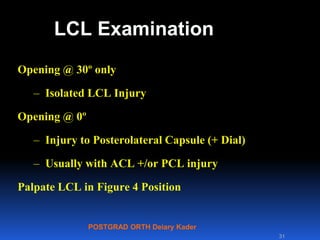
LCL Examination
Opening @ 30º only
– Isolated LCL Injury
Opening @ 0º
– Injury to Posterolateral Capsule (+ Dial)
– Usually with ACL +/or PCL injury
Palpate LCL in Figure 4 Position
31
POSTGRAD ORTH Deiary Kader
Posterolateral Complex
Imaging
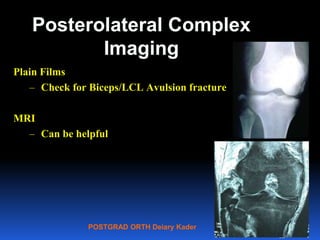
Plain Films
– Check for Biceps/LCL Avulsion fracture
MRI
– Can be helpful
32
POSTGRAD ORTH Deiary Kader
Posterolateral Complex
Injury--Treatment
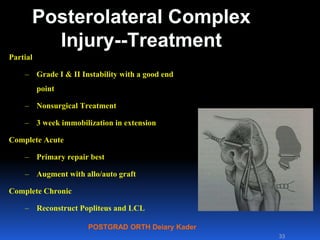
Partial
– Grade I & II Instability with a good end
point
– Nonsurgical Treatment
– 3 week immobilization in extension
Complete Acute
– Primary repair best
– Augment with allo/auto graft
Complete Chronic
– Reconstruct Popliteus and LCL
33
POSTGRAD ORTH Deiary Kader
Posterolateral Complex
Injury
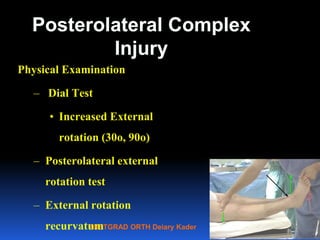
Physical Examination
– Dial Test
• Increased External
rotation (30o, 90o)
– Posterolateral external
rotation test
– External rotation
recurvatum
34
POSTGRAD ORTH Deiary Kader
Posterolateral Complex
Injury--Treatment
Partial
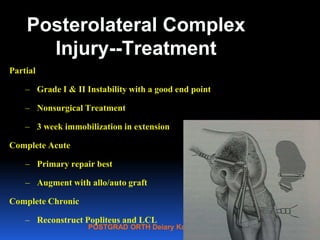
– Grade I & II Instability with a good end point
– Nonsurgical Treatment
– 3 week immobilization in extension
Complete Acute
– Primary repair best
– Augment with allo/auto graft
Complete Chronic
– Reconstruct Popliteus and LCL
35
POSTGRAD ORTH Deiary Kader
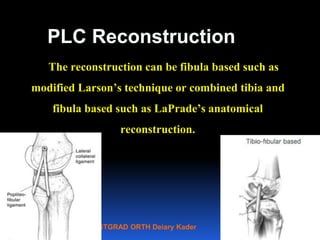
PLC Reconstruction
The reconstruction can be fibula based such as
modified Larson’s technique or combined tibia and
fibula based such as LaPrade’s anatomical
reconstruction.
36
POSTGRAD ORTH Deiary Kader
The principles of surgery
Early repair (within 3 weeks) of torn and detached ligaments,
tendons and capsule in acute injuries. A combination of early
repair and reconstruction has been shown to provide better
results.
Late reconstruction of the two or three of the main stabilisers of
the posterolateral corner of the knee i.e. the lateral collateral
ligament, Popliteus tendon, and popliteofibular ligament in
chronic cases.
Combined ACL/PCL and PLC injury must be treated by
reconstruction of all injured ligaments.
37
POSTGRAD ORTH Deiary Kader
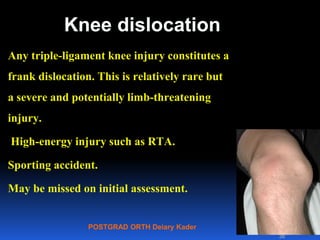
Knee dislocation
Any triple-ligament knee injury constitutes a
frank dislocation. This is relatively rare but
a severe and potentially limb-threatening
injury.
High-energy injury such as RTA.
Sporting accident.
May be missed on initial assessment.
38
POSTGRAD ORTH Deiary Kader
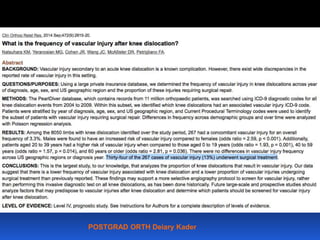
Vascular Injuries
Previously it was thought there was a 50%
incidence of vascular compromise Now 3.3-18%
20%–30% incidence of nerve injury.
Fracture incidence may be as high as 60%.
39
POSTGRAD ORTH Deiary Kader
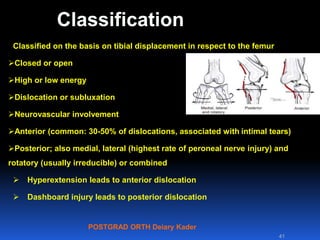
Classification
Classified on the basis on tibial displacement in respect to the femur
Closed or open
High or low energy
Dislocation or subluxation
Neurovascular involvement
Anterior (common: 30-50% of dislocations, associated with intimal tears)
Posterior; also medial, lateral (highest rate of peroneal nerve injury) and
rotatory (usually irreducible) or combined
 Hyperextension leads to anterior dislocation
 Dashboard injury leads to posterior dislocation
41
POSTGRAD ORTH Deiary Kader
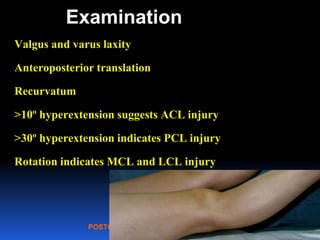
Examination
Valgus and varus laxity
Anteroposterior translation
Recurvatum
>10º hyperextension suggests ACL injury
>30º hyperextension indicates PCL injury
Rotation indicates MCL and LCL injury
42
POSTGRAD ORTH Deiary Kader
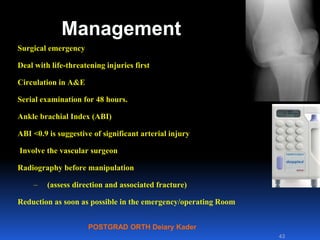
Management
Surgical emergency
Deal with life-threatening injuries first
Circulation in A&E
Serial examination for 48 hours.
Ankle brachial Index (ABI)
ABI <0.9 is suggestive of significant arterial injury
Involve the vascular surgeon
Radiography before manipulation
– (assess direction and associated fracture)
Reduction as soon as possible in the emergency/operating Room
43
POSTGRAD ORTH Deiary Kader
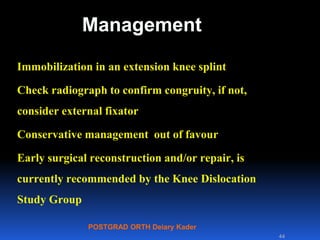
Management
Immobilization in an extension knee splint
Check radiograph to confirm congruity, if not,
consider external fixator
Conservative management out of favour
Early surgical reconstruction and/or repair, is
currently recommended by the Knee Dislocation
Study Group
44
POSTGRAD ORTH Deiary Kader
Management
Surgery as soon as the vascular surgeon allows
Most ACL/PCL/MCL can be treated with bracing the MCL followed by
combined ACL/PCL reconstruction once range of movement is
restarted, usually after 6 weeks.
ACL/PCL/posterolateral corner can be treated by repairing the
posterolateral corner acutely (within three weeks) and delayed ACL/PCL
reconstruction 8 weeks later.
Open dislocation, fracture dislocation and vascular compromise require
staged procedures.
45
POSTGRAD ORTH Deiary Kader
THANK YOU

PCL, PLC, Knee Dislocation

  • 1.
    POSTGRAD ORTH DeiaryKader Postgraduate Orthpaedics FRCS(Tr&Orth) Revision Course Professor Deiary Kader Consultant Orthopaedic & Trauma Surgeon Knee Surgeon Newcastle Nuffield
  • 2.
    POSTGRAD ORTH DeiaryKader PCL and PLC Professor Deiary Kader Consultant Orthopaedic & Trauma Surgeon Knee Surgeon Newcastle Nuffield Hospital
  • 3.
    POSTGRAD ORTH DeiaryKader Classification of knee Stabilizers 3 Lateral Complex IT Tract LCL Popliteus Biceps Femoris Central Complex ACL PCL Med Menx Lat Menx Medial Complex MCL Postromedial Capsule Semi-Memb Pes anserinus
  • 4.
    POSTGRAD ORTH DeiaryKader Paul F. Segond a Paris surgeon 1879 4
  • 5.
  • 6.
    POSTGRAD ORTH DeiaryKader PCL The strongest ligament in the knee It is regarded as “a central stabilizer” Originates from a broad crescent-shaped area in the posterolateral medial femoral condyle Inserts centrally posteriorly 1–1.5cm below articular surface of the tibia Has an average length of 38 mm and diameter of 13 mm PCL and quadriceps are dynamic partners in stabilizing the knee in the sagittal plane 6
  • 7.
    POSTGRAD ORTH DeiaryKader PCL Mechanism of Injury RTA – High Velocity – Often MLI Sports Uncommon – Low Velocity – Usually Partial 7
  • 8.
    POSTGRAD ORTH DeiaryKader Mechanism of injury 3% of all knee injuries Direct injury dashboard at 90 is the most common Falling on a flexed knee with foot in plantar flexion Forced hyperextension (>30º) is associated with multi- ligament injury High association with fracture femur
  • 9.
    POSTGRAD ORTH DeiaryKader PCL Injury Diagnosis 9 Physical Exam – Posterior Drawer – Step off sign Plain Radiographs – Look for bony avulsions – Standing films for chronic injuries (Arthritis) – Stress Radiographs helpful MRI – Not Sensitive – MLI (common)
  • 10.
    POSTGRAD ORTH DeiaryKader PCL Three components: AL: Antero-lateral: long and thick part, twice the size of the posteromedial bundle; tightens in flexion PM: Posteromedial: tight in extension Meniscofemoral ligaments: mechanically very strong Anterior: Humphrey’s ligament Posterior: Wrisberg’s ligament
  • 11.
    POSTGRAD ORTH DeiaryKader Ant Meniscofemoral lig Humphrey
  • 12.
    POSTGRAD ORTH DeiaryKader a. Ant Meniscofemoral lig Humphrey b. Post Meniscofemoral lig Wrisberg
  • 13.
    POSTGRAD ORTH DeiaryKader ACL & PCL Recon
  • 14.
  • 15.
    POSTGRAD ORTH DeiaryKader Diagnosis 1 MRI & PCL Clinical examination is more reliable than MRI scan The PCL may be dysfunctional despite normal MRI Kneeling stress x-ray shows the degree of posterior translation
  • 16.
    POSTGRAD ORTH DeiaryKader Diagnosis 2 Clinical Posterior drawer test at 90 and 30 Quadriceps active drawer test. Flex the knee to 60 and control the foot then ask the patient to contract the quads. The test is positive when the tibia reduces. Posterior sag sign (step-off) Posterolateral rotatory instability (Dial test prone) External rotation recurvatum test
  • 17.
    POSTGRAD ORTH DeiaryKader Grading of PCL instability Normal tibia step-off is 10 mm at 90 flexion Instability could be mild, moderate or severe Grade I instability is when there is a 5-mm step-off Grade II instability is when there is no step-off (flush) Grade III instability is when there is –5 mm step-off There is a high association between Grade III PCL injury and posterolateral corner injury.
  • 18.
    POSTGRAD ORTH DeiaryKader Management In isolation, it often causes little long-term instability. However, it may lead to medial or PFJ pain (OA) at a later date. More troublesome in soccer players due to difficulty in deceleration.
  • 19.
    POSTGRAD ORTH DeiaryKader Management 2 Presentation Acute isolated PCL injury is commonly missed Present with very little pain in the knee without hemarthrosis There may be only bruising at the popliteal fossa. Chronic PCL injury on the other hand may present with pain in the medial compartment or anterior knee pain.
  • 20.
    POSTGRAD ORTH DeiaryKader Treatment  Treat acute, isolated PCL injury conservatively.  Extension brace with calf support (Posterior Tibial Support, PTS Brace) until the pain subsides (4-6 weeks) with quadriceps rehabilitation  Start early passive motion only in prone position to maintain anterior tibia translation.
  • 21.
    POSTGRAD ORTH DeiaryKader 21 PCL Reconstruction
  • 22.
    POSTGRAD ORTH DeiaryKader Surgical reconstruction Indications  Acute combined injuries  Acute bony avulsion  Symptomatic chronic PCL injuries that failed rehabilitation.  There is no difference in clinical outcome between single and double bundle PCL reconstruction.
  • 23.
    POSTGRAD ORTH DeiaryKader Complications Immediate Neurovascular injury popliteal vessels Infection Technical error → tunnel placement, graft tensioning, insecure fixation Delayed Loss of motion Avascular necrosis (medial femoral condyle) Recurrent or persistent laxity (common) when a combined injury is not adequately addressed
  • 24.
    POSTGRAD ORTH DeiaryKader Posterolateral Complex Components: – Biceps, ITB, Popliteus, Popliteofibular ligament, arcuate ligament, LCL Function – Resists External and Varus rotation Mechanism of Injury – Direct blow to anteromedial tibia – Hyperextension/varus 24 arcuate
  • 25.
    POSTGRAD ORTH DeiaryKader The Posterolateral Corner The LCL is a cord like structure 5-7 cm in length Is the primary static restraint to varus opening of the knee Secondary restraint to posterolateral rotation The popliteus is a static and dynamic external rotation stabiliser. The popletiofibular ligament acts as a primary restraint to external rotation of the tibia on the femur at 30º of flexion 25
  • 26.
    POSTGRAD ORTH DeiaryKader The Posterolateral Corner (PLC) They are the primary stabilisers of external tibial rotation at all knee flexion angles and the secondary restraints to anterior and posterior translation Isolated PLC sectioning produce a maximal average increase of 13° of ER at 30° of knee flexion and only an average increase of 5.3° at 90°. Isolated PCL sectioning has no effect on external tibial rotation Combined injury to the PCL and PLC leads to ER of 20.9° at 90° of knee flexion 26
  • 27.
  • 28.
    POSTGRAD ORTH DeiaryKader 28 Fib Pop Extension The popliteus tendon inserted 10 mm distal 5 mm posterior to the lateral epicondyle The LCL inserted 1-2 mm proximal 4-5 mm posterior to the lateral epicondyle
  • 29.
    POSTGRAD ORTH DeiaryKader 29 Fibula head
  • 30.
    POSTGRAD ORTH DeiaryKader 30 Popliteofibular LIG
  • 31.
    POSTGRAD ORTH DeiaryKader LCL Examination Opening @ 30º only – Isolated LCL Injury Opening @ 0º – Injury to Posterolateral Capsule (+ Dial) – Usually with ACL +/or PCL injury Palpate LCL in Figure 4 Position 31
  • 32.
    POSTGRAD ORTH DeiaryKader Posterolateral Complex Imaging Plain Films – Check for Biceps/LCL Avulsion fracture MRI – Can be helpful 32
  • 33.
    POSTGRAD ORTH DeiaryKader Posterolateral Complex Injury--Treatment Partial – Grade I & II Instability with a good end point – Nonsurgical Treatment – 3 week immobilization in extension Complete Acute – Primary repair best – Augment with allo/auto graft Complete Chronic – Reconstruct Popliteus and LCL 33
  • 34.
    POSTGRAD ORTH DeiaryKader Posterolateral Complex Injury Physical Examination – Dial Test • Increased External rotation (30o, 90o) – Posterolateral external rotation test – External rotation recurvatum 34
  • 35.
    POSTGRAD ORTH DeiaryKader Posterolateral Complex Injury--Treatment Partial – Grade I & II Instability with a good end point – Nonsurgical Treatment – 3 week immobilization in extension Complete Acute – Primary repair best – Augment with allo/auto graft Complete Chronic – Reconstruct Popliteus and LCL 35
  • 36.
    POSTGRAD ORTH DeiaryKader PLC Reconstruction The reconstruction can be fibula based such as modified Larson’s technique or combined tibia and fibula based such as LaPrade’s anatomical reconstruction. 36
  • 37.
    POSTGRAD ORTH DeiaryKader The principles of surgery Early repair (within 3 weeks) of torn and detached ligaments, tendons and capsule in acute injuries. A combination of early repair and reconstruction has been shown to provide better results. Late reconstruction of the two or three of the main stabilisers of the posterolateral corner of the knee i.e. the lateral collateral ligament, Popliteus tendon, and popliteofibular ligament in chronic cases. Combined ACL/PCL and PLC injury must be treated by reconstruction of all injured ligaments. 37
  • 38.
    POSTGRAD ORTH DeiaryKader Knee dislocation Any triple-ligament knee injury constitutes a frank dislocation. This is relatively rare but a severe and potentially limb-threatening injury. High-energy injury such as RTA. Sporting accident. May be missed on initial assessment. 38
  • 39.
    POSTGRAD ORTH DeiaryKader Vascular Injuries Previously it was thought there was a 50% incidence of vascular compromise Now 3.3-18% 20%–30% incidence of nerve injury. Fracture incidence may be as high as 60%. 39
  • 40.
  • 41.
    POSTGRAD ORTH DeiaryKader Classification Classified on the basis on tibial displacement in respect to the femur Closed or open High or low energy Dislocation or subluxation Neurovascular involvement Anterior (common: 30-50% of dislocations, associated with intimal tears) Posterior; also medial, lateral (highest rate of peroneal nerve injury) and rotatory (usually irreducible) or combined  Hyperextension leads to anterior dislocation  Dashboard injury leads to posterior dislocation 41
  • 42.
    POSTGRAD ORTH DeiaryKader Examination Valgus and varus laxity Anteroposterior translation Recurvatum >10º hyperextension suggests ACL injury >30º hyperextension indicates PCL injury Rotation indicates MCL and LCL injury 42
  • 43.
    POSTGRAD ORTH DeiaryKader Management Surgical emergency Deal with life-threatening injuries first Circulation in A&E Serial examination for 48 hours. Ankle brachial Index (ABI) ABI <0.9 is suggestive of significant arterial injury Involve the vascular surgeon Radiography before manipulation – (assess direction and associated fracture) Reduction as soon as possible in the emergency/operating Room 43
  • 44.
    POSTGRAD ORTH DeiaryKader Management Immobilization in an extension knee splint Check radiograph to confirm congruity, if not, consider external fixator Conservative management out of favour Early surgical reconstruction and/or repair, is currently recommended by the Knee Dislocation Study Group 44
  • 45.
    POSTGRAD ORTH DeiaryKader Management Surgery as soon as the vascular surgeon allows Most ACL/PCL/MCL can be treated with bracing the MCL followed by combined ACL/PCL reconstruction once range of movement is restarted, usually after 6 weeks. ACL/PCL/posterolateral corner can be treated by repairing the posterolateral corner acutely (within three weeks) and delayed ACL/PCL reconstruction 8 weeks later. Open dislocation, fracture dislocation and vascular compromise require staged procedures. 45
  • 46.
    POSTGRAD ORTH DeiaryKader THANK YOU

Editor's Notes

  • #2 Good after My name is Banaszkiewicz For this first section I will be taking you through examination of the hip I have no disclosures to make