APPLICATIONS OF GRAPHS
GRAPHS
•   Graph theory has turned out to be a vast area with
    innumerable applications in the field of social
    networks , data organization , communication
    network and so on…

•   We have considered here
        1.Dijkstra’s algorithm
        2. Fingerprint classification using graph theory
DIJKSTRA’S
ALGORITHM
DIJKSTRA’S ALGORITHM
•   Djikstra's algorithm (named after its discover, E.W.
    Dijkstra) solves the problem of finding the shortest path
    from a point in a graph (the source) to a destination.

•    It turns out that one can find the shortest paths from a
    given source to all points in a graph in the same time,
    hence this problem is sometimes called the single-
    source shortest paths problem.
•   Given a network of cities and the distances between
    them, the objective of the single-source, shortest-
    path problem is to find the shortest path from a city
    to all other cities connected to it.

•   The network of cities with their distances is
    represented as a weighted graph.
• Let V be a set of N cities (vertices) of the digraph. Here
  the source city is 1.
• The set T is initialized to city 1.
• The DISTANCE vector, DISTANCE [2:N] initially records
  the distances of cities 2 to N connected to the source
  by an edge (not path!)
                             60
                    2                      3


                                       30
               20       40        4


                                               20
                 1


                                      70
                                      110
             SOURCE                        5
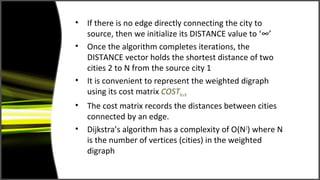
•   If there is no edge directly connecting the city to
    source, then we initialize its DISTANCE value to ‘∞’
•   Once the algorithm completes iterations, the
    DISTANCE vector holds the shortest distance of two
    cities 2 to N from the source city 1
•   It is convenient to represent the weighted digraph
    using its cost matrix COSTN x N
•   The cost matrix records the distances between cities
    connected by an edge.
•   Dijkstra’s algorithm has a complexity of O(N 2) where N
    is the number of vertices (cities) in the weighted
    digraph
DIJKSTRA’S ALGORITHM
Procedure DIJKSTRA_SSSP(N, COST)

/* N is the number of vertices labeled {1,2,3,….,N} of the weighted digraph. If
   there is no edge then COST [I, j] = ∞ */
/* The procedure computes the cost of the shortest path from vertex 1 the
   source, to every other vertex of the weighted digraph */

T = {1};                  /* initialize T to source vertex */
for i = 2 to N do
        DISTANCE [i] = COST [1,i];

/* initialize DISTANCE vector to the cost of the edges connecting vertex I with
   the source vertex 1. If there is no edge then COST[1,i] = ∞ */
for i = 1 to N-1 do
   Choose a vertex u in V – T such that DISTANCE [u] is a
minimum;
   Add u to T;
        for each vertex w in V – T do

   DISTANCE [w] = minimum ( DISTANCE [w] , DISTANCE [u]
             + COST [u ,w]);

       end
   end
 end DIJKSTRA_SSSP
EXAMPLE
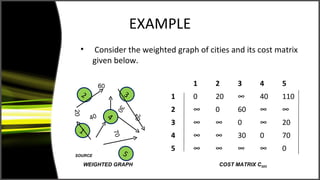
 •       Consider the weighted graph of cities and its cost matrix
         given below.

              60                          1   2     3      4     5
     2                      3        1    0   20    ∞      40    110
                                     2    ∞   0     60     ∞     ∞
                        30
20


         40        4

                                20
                                     3    ∞   ∞     0      ∞     20
 1
                                     4    ∞   ∞     30     0     70
                       70


                                     5    ∞   ∞     ∞      ∞     0
SOURCE
                            5
     WEIGHTED GRAPH                           COST MATRIX C5X5
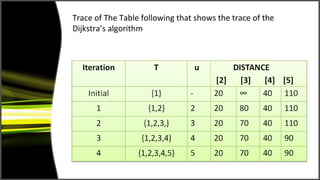
Trace of The Table following that shows the trace of the
Dijkstra’s algorithm
•   The DISTANCE vector in the last iteration records the
    shortest distance of the vertices {2,3,4,5} from the source
    vertex 1.

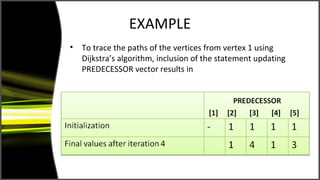
•   To reconstruct the shortest path from the source vertex to
    all other vertices, a vector PREDECESSOR [1:N] where
    PREDECESSOR [v] records the predecessor of vertex v in the
    shortest path, is maintained.

•   PREDECESSOR [1:N] is initialized to source for all v != source
•   PREDECESSOR [1:N] is updated by

       if (( DISTANCE [u] + COST [u, w]) < DISTANCE [w])
          then PREDECESSOR [w] = u

    soon after DISTANCE [w] = minimum ( DISTANCE [w] ,
    DISTANCE [u] + COST [u ,w]) is computed in procedure
    DIJKSTRA_SSS

•   To trace the shortest path we move backwards from the
    destination vertex, hopping on the predecessors recorded by
    the PREDECESSOR vector until the source vertex is reached
EXAMPLE
•   To trace the paths of the vertices from vertex 1 using
    Dijkstra’s algorithm, inclusion of the statement updating
    PREDECESSOR vector results in
• To trace the shortest path from source 1 to vertex 5, we move
  in the reverse direction from vertex 5 hopping on the
  predecessors until the source vertex is reached. The shortest
  path is given by

  PREDECESSOR(5)=3 PREDECESSOR(3)=4 PREDECESSOR(4)=1


   Vertex 5      Vertex 3       Vertex 4       Source Vertex 1

   Thus the shortest path between vertex 1 and vertex 5 is
   1-4-3-5 and the distance is given by DISTANCE [5] is 90
FINGERPRINT
RECOGNITION
USING GRAPH
REPRESENTATIO
N
The three characteristics of FINGER PRINTS are:

1. There are no similar fingerprints in the world.
2. Fingerprints are unchangeable.
3. Fingerprints are one of the unique features for
   identification systems.
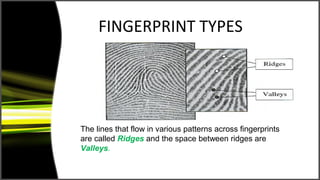
FINGERPRINT TYPES


The lines that flow in various patterns across fingerprints
are called Ridges and the space between ridges are
Valleys.
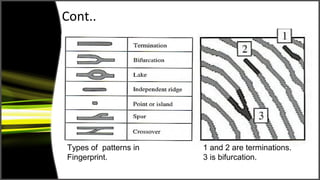
Cont..


Types of patterns in   1 and 2 are terminations.
Fingerprint.           3 is bifurcation.
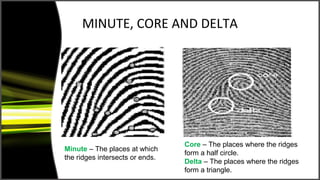
MINUTE, CORE AND DELTA


                                 Core – The places where the ridges
Minute – The places at which
                                 form a half circle.
the ridges intersects or ends.
                                 Delta – The places where the ridges
                                 form a triangle.
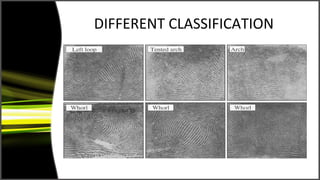
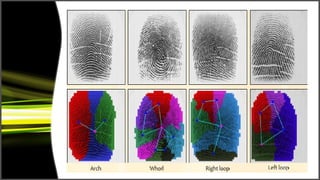
DIFFERENT CLASSIFICATION
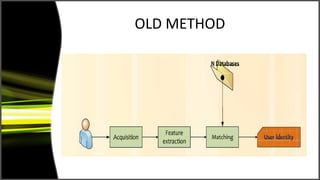
OLD METHOD
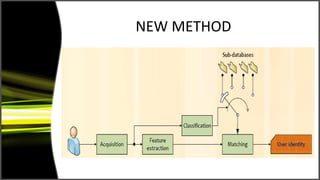
NEW METHOD
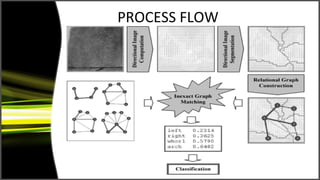
PROCESS FLOW
FINGERPRINT CAPTURE DEVICES
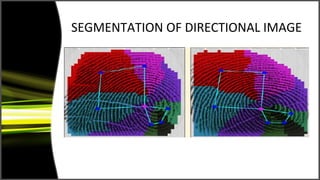
SEGMENTATION OF DIRECTIONAL IMAGE
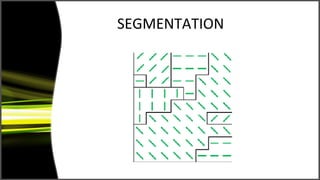
SEGMENTATION
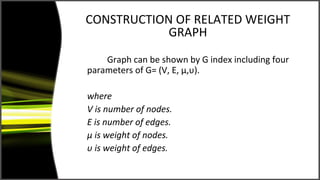
CONSTRUCTION OF RELATED WEIGHT
            GRAPH
    Graph can be shown by G index including four
parameters of G= (V, E, μ,υ).

where
V is number of nodes.
E is number of edges.
μ is weight of nodes.
υ is weight of edges.
Some information can be used in constructing the graph
   related to a finger print like:

• Centre of gravity of regions.
• The direction related to the elements of the various
  regions.
• The area of all the regions.
• The distance between centres of gravity.
• The perimeter of regions.
WEIGHTAGE TO NODES AND EDGES
Wn = Area (Ri)
where
     i = 1,2,3,……,n.
     Wn is the weight of nodes .
      Ri is the specified region in block directional image.


We = (Adj − p) × (Node − d) × (Diff −v)
where
      Adj-p is the boundary of two adjacent regions linking with an edge.
      Node-d is the distance difference between nodes that links by an edge
      Diff-v is the phase difference or direction difference between two
regions of block directional image.
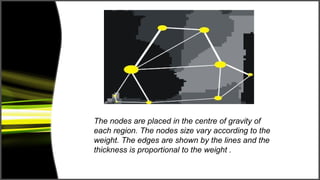
The nodes are placed in the centre of gravity of
each region. The nodes size vary according to the
weight. The edges are shown by the lines and the
thickness is proportional to the weight .
CONSTRUCTING SUPER GRAPH
    We combine the properties of the Graph and model of the
    Super Graph to form,

•   A node for region with similar directions.
•   Its co-ordinates is the centre of gravity related to those
    regions of the graph.
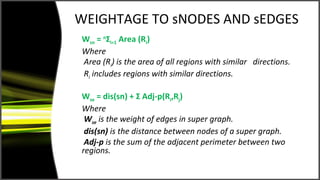
WEIGHTAGE TO sNODES AND sEDGES
Wsn = nΣi=1 Area (Ri)
Where
Area (Ri) is the area of all regions with similar directions.
Ri includes regions with similar directions.

Wse = dis(sn) + Σ Adj-p(Ri,Rj)
Where
 Wse is the weight of edges in super graph.
 dis(sn) is the distance between nodes of a super graph.
 Adj-p is the sum of the adjacent perimeter between two
regions.
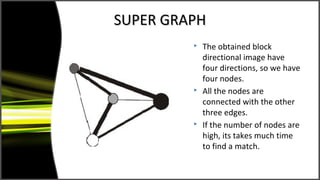
SUPER GRAPH
            The obtained block
             directional image have
             four directions, so we have
             four nodes.
            All the nodes are
             connected with the other
             three edges.
            If the number of nodes are
             high, its takes much time
             to find a match.
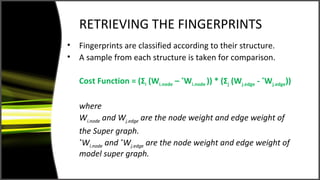
RETRIEVING THE FINGERPRINTS
•   Fingerprints are classified according to their structure.
•   A sample from each structure is taken for comparison.

    Cost Function = (Σi (Wi.node – *Wi.node )) * (Σj (Wj.edge - *Wj.edge))

    where
    Wi.node and Wj.edge are the node weight and edge weight of
    the Super graph.
    *
     Wi.node and *Wj.edge are the node weight and edge weight of
    model super graph.
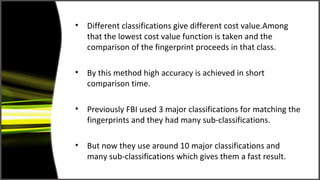
• Different classifications give different cost value.Among
  that the lowest cost value function is taken and the
  comparison of the fingerprint proceeds in that class.

• By this method high accuracy is achieved in short
  comparison time.

• Previously FBI used 3 major classifications for matching the
  fingerprints and they had many sub-classifications.

• But now they use around 10 major classifications and
  many sub-classifications which gives them a fast result.
SOME MORE INTERESTING
   APPLICATIONS…..
EPIDEMOLOGY
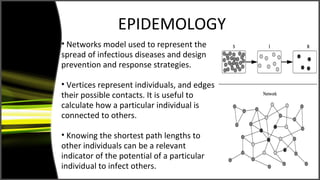
• Networks model used to represent the
spread of infectious diseases and design
prevention and response strategies.

• Vertices represent individuals, and edges
their possible contacts. It is useful to
calculate how a particular individual is
connected to others.

• Knowing the shortest path lengths to
other individuals can be a relevant
indicator of the potential of a particular
individual to infect others.
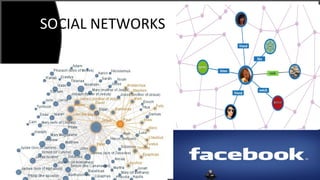
SOCIAL NETWORKS
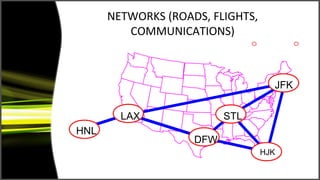
NETWORKS (ROADS, FLIGHTS,
         COMMUNICATIONS)


                                    JFK

        LAX               STL
HNL
                    DFW
                                  HJK
THANK YOU!!!

Applications of graphs

  • 1.
  • 2.
    GRAPHS • Graph theory has turned out to be a vast area with innumerable applications in the field of social networks , data organization , communication network and so on… • We have considered here 1.Dijkstra’s algorithm 2. Fingerprint classification using graph theory
  • 3.
  • 4.
    DIJKSTRA’S ALGORITHM • Djikstra's algorithm (named after its discover, E.W. Dijkstra) solves the problem of finding the shortest path from a point in a graph (the source) to a destination. • It turns out that one can find the shortest paths from a given source to all points in a graph in the same time, hence this problem is sometimes called the single- source shortest paths problem.
  • 5.
    Given a network of cities and the distances between them, the objective of the single-source, shortest- path problem is to find the shortest path from a city to all other cities connected to it. • The network of cities with their distances is represented as a weighted graph.
  • 6.
    • Let Vbe a set of N cities (vertices) of the digraph. Here the source city is 1. • The set T is initialized to city 1. • The DISTANCE vector, DISTANCE [2:N] initially records the distances of cities 2 to N connected to the source by an edge (not path!) 60 2 3 30 20 40 4 20 1 70 110 SOURCE 5
  • 7.
    If there is no edge directly connecting the city to source, then we initialize its DISTANCE value to ‘∞’ • Once the algorithm completes iterations, the DISTANCE vector holds the shortest distance of two cities 2 to N from the source city 1 • It is convenient to represent the weighted digraph using its cost matrix COSTN x N • The cost matrix records the distances between cities connected by an edge. • Dijkstra’s algorithm has a complexity of O(N 2) where N is the number of vertices (cities) in the weighted digraph
  • 8.
    DIJKSTRA’S ALGORITHM Procedure DIJKSTRA_SSSP(N,COST) /* N is the number of vertices labeled {1,2,3,….,N} of the weighted digraph. If there is no edge then COST [I, j] = ∞ */ /* The procedure computes the cost of the shortest path from vertex 1 the source, to every other vertex of the weighted digraph */ T = {1}; /* initialize T to source vertex */ for i = 2 to N do DISTANCE [i] = COST [1,i]; /* initialize DISTANCE vector to the cost of the edges connecting vertex I with the source vertex 1. If there is no edge then COST[1,i] = ∞ */
  • 9.
    for i =1 to N-1 do Choose a vertex u in V – T such that DISTANCE [u] is a minimum; Add u to T; for each vertex w in V – T do DISTANCE [w] = minimum ( DISTANCE [w] , DISTANCE [u] + COST [u ,w]); end end end DIJKSTRA_SSSP
  • 10.
    EXAMPLE • Consider the weighted graph of cities and its cost matrix given below. 60 1 2 3 4 5 2 3 1 0 20 ∞ 40 110 2 ∞ 0 60 ∞ ∞ 30 20 40 4 20 3 ∞ ∞ 0 ∞ 20 1 4 ∞ ∞ 30 0 70 70 5 ∞ ∞ ∞ ∞ 0 SOURCE 5 WEIGHTED GRAPH COST MATRIX C5X5
  • 11.
    Trace of TheTable following that shows the trace of the Dijkstra’s algorithm
  • 12.
    The DISTANCE vector in the last iteration records the shortest distance of the vertices {2,3,4,5} from the source vertex 1. • To reconstruct the shortest path from the source vertex to all other vertices, a vector PREDECESSOR [1:N] where PREDECESSOR [v] records the predecessor of vertex v in the shortest path, is maintained. • PREDECESSOR [1:N] is initialized to source for all v != source
  • 13.
    PREDECESSOR [1:N] is updated by if (( DISTANCE [u] + COST [u, w]) < DISTANCE [w]) then PREDECESSOR [w] = u soon after DISTANCE [w] = minimum ( DISTANCE [w] , DISTANCE [u] + COST [u ,w]) is computed in procedure DIJKSTRA_SSS • To trace the shortest path we move backwards from the destination vertex, hopping on the predecessors recorded by the PREDECESSOR vector until the source vertex is reached
  • 14.
    EXAMPLE • To trace the paths of the vertices from vertex 1 using Dijkstra’s algorithm, inclusion of the statement updating PREDECESSOR vector results in
  • 15.
    • To tracethe shortest path from source 1 to vertex 5, we move in the reverse direction from vertex 5 hopping on the predecessors until the source vertex is reached. The shortest path is given by PREDECESSOR(5)=3 PREDECESSOR(3)=4 PREDECESSOR(4)=1 Vertex 5 Vertex 3 Vertex 4 Source Vertex 1 Thus the shortest path between vertex 1 and vertex 5 is 1-4-3-5 and the distance is given by DISTANCE [5] is 90
  • 16.
  • 17.
    The three characteristicsof FINGER PRINTS are: 1. There are no similar fingerprints in the world. 2. Fingerprints are unchangeable. 3. Fingerprints are one of the unique features for identification systems.
  • 18.
    FINGERPRINT TYPES The linesthat flow in various patterns across fingerprints are called Ridges and the space between ridges are Valleys.
  • 19.
    Cont.. Types of patternsin 1 and 2 are terminations. Fingerprint. 3 is bifurcation.
  • 20.
    MINUTE, CORE ANDDELTA Core – The places where the ridges Minute – The places at which form a half circle. the ridges intersects or ends. Delta – The places where the ridges form a triangle.
  • 21.
  • 22.
  • 23.
  • 24.
  • 25.
  • 26.
  • 28.
  • 29.
    CONSTRUCTION OF RELATEDWEIGHT GRAPH Graph can be shown by G index including four parameters of G= (V, E, μ,υ). where V is number of nodes. E is number of edges. μ is weight of nodes. υ is weight of edges.
  • 30.
    Some information canbe used in constructing the graph related to a finger print like: • Centre of gravity of regions. • The direction related to the elements of the various regions. • The area of all the regions. • The distance between centres of gravity. • The perimeter of regions.
  • 31.
    WEIGHTAGE TO NODESAND EDGES Wn = Area (Ri) where  i = 1,2,3,……,n.  Wn is the weight of nodes .  Ri is the specified region in block directional image. We = (Adj − p) × (Node − d) × (Diff −v) where  Adj-p is the boundary of two adjacent regions linking with an edge.  Node-d is the distance difference between nodes that links by an edge  Diff-v is the phase difference or direction difference between two regions of block directional image.
  • 32.
    The nodes areplaced in the centre of gravity of each region. The nodes size vary according to the weight. The edges are shown by the lines and the thickness is proportional to the weight .
  • 33.
    CONSTRUCTING SUPER GRAPH We combine the properties of the Graph and model of the Super Graph to form, • A node for region with similar directions. • Its co-ordinates is the centre of gravity related to those regions of the graph.
  • 34.
    WEIGHTAGE TO sNODESAND sEDGES Wsn = nΣi=1 Area (Ri) Where Area (Ri) is the area of all regions with similar directions. Ri includes regions with similar directions. Wse = dis(sn) + Σ Adj-p(Ri,Rj) Where Wse is the weight of edges in super graph. dis(sn) is the distance between nodes of a super graph. Adj-p is the sum of the adjacent perimeter between two regions.
  • 35.
    SUPER GRAPH  The obtained block directional image have four directions, so we have four nodes.  All the nodes are connected with the other three edges.  If the number of nodes are high, its takes much time to find a match.
  • 36.
    RETRIEVING THE FINGERPRINTS • Fingerprints are classified according to their structure. • A sample from each structure is taken for comparison. Cost Function = (Σi (Wi.node – *Wi.node )) * (Σj (Wj.edge - *Wj.edge)) where Wi.node and Wj.edge are the node weight and edge weight of the Super graph. * Wi.node and *Wj.edge are the node weight and edge weight of model super graph.
  • 37.
    • Different classificationsgive different cost value.Among that the lowest cost value function is taken and the comparison of the fingerprint proceeds in that class. • By this method high accuracy is achieved in short comparison time. • Previously FBI used 3 major classifications for matching the fingerprints and they had many sub-classifications. • But now they use around 10 major classifications and many sub-classifications which gives them a fast result.
  • 38.
    SOME MORE INTERESTING APPLICATIONS…..
  • 39.
    EPIDEMOLOGY • Networks modelused to represent the spread of infectious diseases and design prevention and response strategies. • Vertices represent individuals, and edges their possible contacts. It is useful to calculate how a particular individual is connected to others. • Knowing the shortest path lengths to other individuals can be a relevant indicator of the potential of a particular individual to infect others.
  • 40.
  • 41.
    NETWORKS (ROADS, FLIGHTS, COMMUNICATIONS) JFK LAX STL HNL DFW HJK
  • 42.