Travelling Salesman Problem using
branch and bound
•Find a tour of minimum cost starting from a node S going
through other nodes only once and returning to the
starting point S.
• Let G=(V,E) be a directed graph defining an instances of
TSP.
• Let Cij cost of edge <i, j>
• Cij =∞ if <i, j> E∉
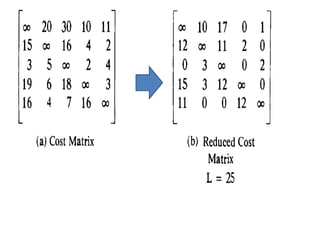
• A row (column) is said to be reduced iff it contains at
least one zero & remaining entries are non negative.
• A matrix is reduced iff every row & column is reduced.
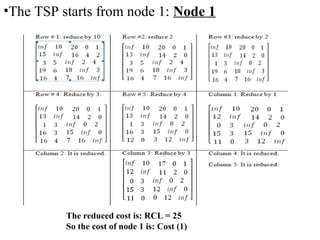
•The TSP starts from node 1: Node 1
The reduced cost is: RCL = 25
So the cost of node 1 is: Cost (1)
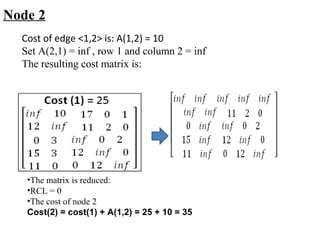
Node 2
Cost of edge <1,2> is: A(1,2) = 10
Set A(2,1) = inf , row 1 and column 2 = inf
The resulting cost matrix is:
•The matrix is reduced:
•RCL = 0
•The cost of node 2
Cost(2) = cost(1) + A(1,2) = 25 + 10 = 35
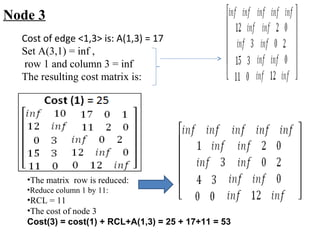
Node 3
Cost of edge <1,3> is: A(1,3) = 17
Set A(3,1) = inf ,
row 1 and column 3 = inf
The resulting cost matrix is:
•The matrix row is reduced:
•Reduce column 1 by 11:
•RCL = 11
•The cost of node 3
Cost(3) = cost(1) + RCL+A(1,3) = 25 + 17+11 = 53
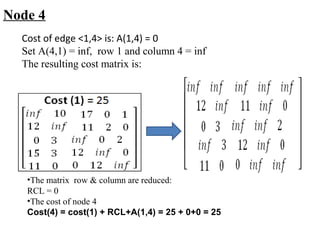
Node 4
Cost of edge <1,4> is: A(1,4) = 0
Set A(4,1) = inf, row 1 and column 4 = inf
The resulting cost matrix is:
•The matrix row & column are reduced:
RCL = 0
•The cost of node 4
Cost(4) = cost(1) + RCL+A(1,4) = 25 + 0+0 = 25
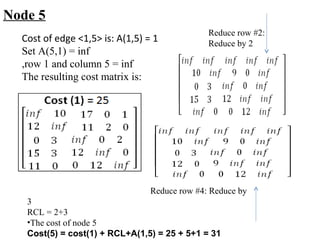
Node 5
Cost of edge <1,5> is: A(1,5) = 1
Set A(5,1) = inf
,row 1 and column 5 = inf
The resulting cost matrix is:
Reduce row #4: Reduce by
3
RCL = 2+3
•The cost of node 5
Cost(5) = cost(1) + RCL+A(1,5) = 25 + 5+1 = 31
Reduce row #2:
Reduce by 2
In summary:
So the live nodes we have so far are:
2: cost(2) = 35, path: 1->2
3: cost(3) = 53, path: 1->3
4: cost(4) = 25, path: 1->4
5: cost(5) = 31, path: 1->5
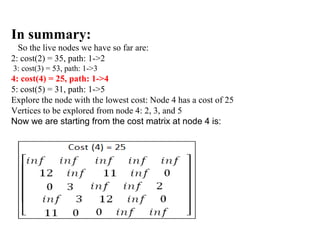
Explore the node with the lowest cost: Node 4 has a cost of 25
Vertices to be explored from node 4: 2, 3, and 5
Now we are starting from the cost matrix at node 4 is:
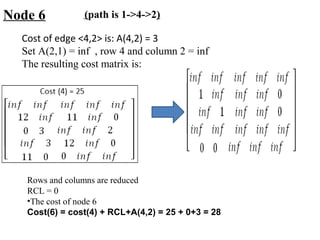
Node 6
Cost of edge <4,2> is: A(4,2) = 3
Set A(2,1) = inf , row 4 and column 2 = inf
The resulting cost matrix is:
Rows and columns are reduced
RCL = 0
•The cost of node 6
Cost(6) = cost(4) + RCL+A(4,2) = 25 + 0+3 = 28
(path is 1->4->2)
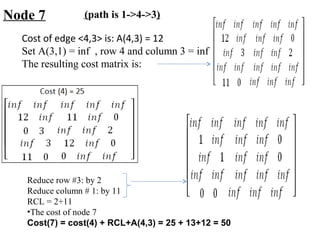
Node 7
Cost of edge <4,3> is: A(4,3) = 12
Set A(3,1) = inf , row 4 and column 3 = inf
The resulting cost matrix is:
Reduce row #3: by 2
Reduce column # 1: by 11
RCL = 2+11
•The cost of node 7
Cost(7) = cost(4) + RCL+A(4,3) = 25 + 13+12 = 50
(path is 1->4->3)
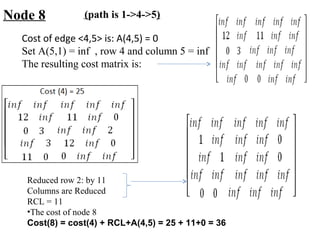
Node 8
Cost of edge <4,5> is: A(4,5) = 0
Set A(5,1) = inf , row 4 and column 5 = inf
The resulting cost matrix is:
Reduced row 2: by 11
Columns are Reduced
RCL = 11
•The cost of node 8
Cost(8) = cost(4) + RCL+A(4,5) = 25 + 11+0 = 36
(path is 1->4->5)
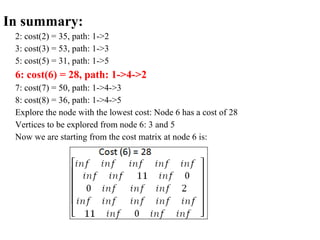
In summary:
2: cost(2) = 35, path: 1->2
3: cost(3) = 53, path: 1->3
5: cost(5) = 31, path: 1->5
6: cost(6) = 28, path: 1->4->2
7: cost(7) = 50, path: 1->4->3
8: cost(8) = 36, path: 1->4->5
Explore the node with the lowest cost: Node 6 has a cost of 28
Vertices to be explored from node 6: 3 and 5
Now we are starting from the cost matrix at node 6 is:
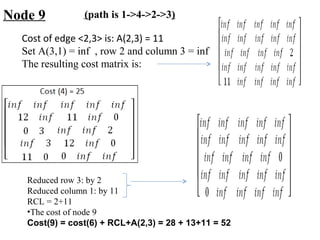
Node 9
Cost of edge <2,3> is: A(2,3) = 11
Set A(3,1) = inf , row 2 and column 3 = inf
The resulting cost matrix is:
Reduced row 3: by 2
Reduced column 1: by 11
RCL = 2+11
•The cost of node 9
Cost(9) = cost(6) + RCL+A(2,3) = 28 + 13+11 = 52
(path is 1->4->2->3)
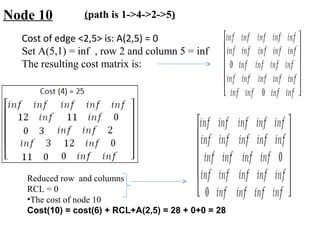
Node 10
Cost of edge <2,5> is: A(2,5) = 0
Set A(5,1) = inf , row 2 and column 5 = inf
The resulting cost matrix is:
Reduced row and columns
RCL = 0
•The cost of node 10
Cost(10) = cost(6) + RCL+A(2,5) = 28 + 0+0 = 28
(path is 1->4->2->5)
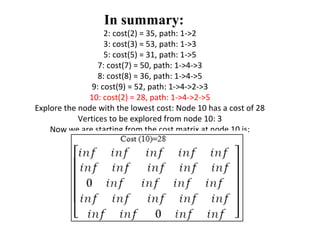
In summary:
2: cost(2) = 35, path: 1->2
3: cost(3) = 53, path: 1->3
5: cost(5) = 31, path: 1->5
7: cost(7) = 50, path: 1->4->3
8: cost(8) = 36, path: 1->4->5
9: cost(9) = 52, path: 1->4->2->3
10: cost(2) = 28, path: 1->4->2->5
Explore the node with the lowest cost: Node 10 has a cost of 28
Vertices to be explored from node 10: 3
Now we are starting from the cost matrix at node 10 is:
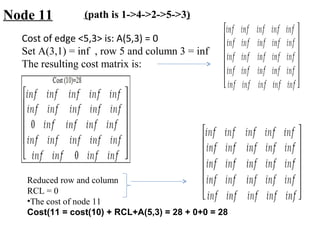
Node 11
Cost of edge <5,3> is: A(5,3) = 0
Set A(3,1) = inf , row 5 and column 3 = inf
The resulting cost matrix is:
Reduced row and column
RCL = 0
•The cost of node 11
Cost(11 = cost(10) + RCL+A(5,3) = 28 + 0+0 = 28
(path is 1->4->2->5->3)
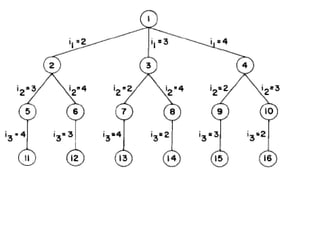
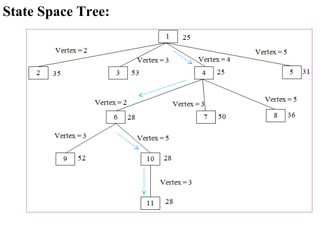
State Space Tree:

Tsp branch and bound

  • 1.
    Travelling Salesman Problemusing branch and bound •Find a tour of minimum cost starting from a node S going through other nodes only once and returning to the starting point S. • Let G=(V,E) be a directed graph defining an instances of TSP. • Let Cij cost of edge <i, j> • Cij =∞ if <i, j> E∉ • A row (column) is said to be reduced iff it contains at least one zero & remaining entries are non negative. • A matrix is reduced iff every row & column is reduced.
  • 4.
    •The TSP startsfrom node 1: Node 1 The reduced cost is: RCL = 25 So the cost of node 1 is: Cost (1)
  • 5.
    Node 2 Cost ofedge <1,2> is: A(1,2) = 10 Set A(2,1) = inf , row 1 and column 2 = inf The resulting cost matrix is: •The matrix is reduced: •RCL = 0 •The cost of node 2 Cost(2) = cost(1) + A(1,2) = 25 + 10 = 35
  • 6.
    Node 3 Cost ofedge <1,3> is: A(1,3) = 17 Set A(3,1) = inf , row 1 and column 3 = inf The resulting cost matrix is: •The matrix row is reduced: •Reduce column 1 by 11: •RCL = 11 •The cost of node 3 Cost(3) = cost(1) + RCL+A(1,3) = 25 + 17+11 = 53
  • 7.
    Node 4 Cost ofedge <1,4> is: A(1,4) = 0 Set A(4,1) = inf, row 1 and column 4 = inf The resulting cost matrix is: •The matrix row & column are reduced: RCL = 0 •The cost of node 4 Cost(4) = cost(1) + RCL+A(1,4) = 25 + 0+0 = 25
  • 8.
    Node 5 Cost ofedge <1,5> is: A(1,5) = 1 Set A(5,1) = inf ,row 1 and column 5 = inf The resulting cost matrix is: Reduce row #4: Reduce by 3 RCL = 2+3 •The cost of node 5 Cost(5) = cost(1) + RCL+A(1,5) = 25 + 5+1 = 31 Reduce row #2: Reduce by 2
  • 9.
    In summary: So thelive nodes we have so far are: 2: cost(2) = 35, path: 1->2 3: cost(3) = 53, path: 1->3 4: cost(4) = 25, path: 1->4 5: cost(5) = 31, path: 1->5 Explore the node with the lowest cost: Node 4 has a cost of 25 Vertices to be explored from node 4: 2, 3, and 5 Now we are starting from the cost matrix at node 4 is:
  • 10.
    Node 6 Cost ofedge <4,2> is: A(4,2) = 3 Set A(2,1) = inf , row 4 and column 2 = inf The resulting cost matrix is: Rows and columns are reduced RCL = 0 •The cost of node 6 Cost(6) = cost(4) + RCL+A(4,2) = 25 + 0+3 = 28 (path is 1->4->2)
  • 11.
    Node 7 Cost ofedge <4,3> is: A(4,3) = 12 Set A(3,1) = inf , row 4 and column 3 = inf The resulting cost matrix is: Reduce row #3: by 2 Reduce column # 1: by 11 RCL = 2+11 •The cost of node 7 Cost(7) = cost(4) + RCL+A(4,3) = 25 + 13+12 = 50 (path is 1->4->3)
  • 12.
    Node 8 Cost ofedge <4,5> is: A(4,5) = 0 Set A(5,1) = inf , row 4 and column 5 = inf The resulting cost matrix is: Reduced row 2: by 11 Columns are Reduced RCL = 11 •The cost of node 8 Cost(8) = cost(4) + RCL+A(4,5) = 25 + 11+0 = 36 (path is 1->4->5)
  • 13.
    In summary: 2: cost(2)= 35, path: 1->2 3: cost(3) = 53, path: 1->3 5: cost(5) = 31, path: 1->5 6: cost(6) = 28, path: 1->4->2 7: cost(7) = 50, path: 1->4->3 8: cost(8) = 36, path: 1->4->5 Explore the node with the lowest cost: Node 6 has a cost of 28 Vertices to be explored from node 6: 3 and 5 Now we are starting from the cost matrix at node 6 is:
  • 14.
    Node 9 Cost ofedge <2,3> is: A(2,3) = 11 Set A(3,1) = inf , row 2 and column 3 = inf The resulting cost matrix is: Reduced row 3: by 2 Reduced column 1: by 11 RCL = 2+11 •The cost of node 9 Cost(9) = cost(6) + RCL+A(2,3) = 28 + 13+11 = 52 (path is 1->4->2->3)
  • 15.
    Node 10 Cost ofedge <2,5> is: A(2,5) = 0 Set A(5,1) = inf , row 2 and column 5 = inf The resulting cost matrix is: Reduced row and columns RCL = 0 •The cost of node 10 Cost(10) = cost(6) + RCL+A(2,5) = 28 + 0+0 = 28 (path is 1->4->2->5)
  • 16.
    In summary: 2: cost(2)= 35, path: 1->2 3: cost(3) = 53, path: 1->3 5: cost(5) = 31, path: 1->5 7: cost(7) = 50, path: 1->4->3 8: cost(8) = 36, path: 1->4->5 9: cost(9) = 52, path: 1->4->2->3 10: cost(2) = 28, path: 1->4->2->5 Explore the node with the lowest cost: Node 10 has a cost of 28 Vertices to be explored from node 10: 3 Now we are starting from the cost matrix at node 10 is:
  • 17.
    Node 11 Cost ofedge <5,3> is: A(5,3) = 0 Set A(3,1) = inf , row 5 and column 3 = inf The resulting cost matrix is: Reduced row and column RCL = 0 •The cost of node 11 Cost(11 = cost(10) + RCL+A(5,3) = 28 + 0+0 = 28 (path is 1->4->2->5->3)
  • 18.