
SHOCK
Mr.Veerbhadra.B.B
Asst Professor
Medical Surgical Nsg.
SHOCK
 Shock is the life threatening condition.
 It is characterized by inadequate tissue perfusion
that if untreated results in cell death.
 Shock can be defined as a condition in which systemic
blood pressure (SBP) is inadequate to deliver
oxygen and nutrient to supply to vital organs and
cellular functions.
 A failure of circulation to supply adequate oxygen to
the tissues.
CAUSES OF SHOCK
Circulation may fail from:-
 1. Sudden malfunction of heart :
This may occur as a result of:-
 Coronary artery occlusion with acute MI
 Trauma with structural damage to heart.
 Toxemia – viral or bacterial.
 Effects of drugs.
CONT….
2. Deficient oxygenation of blood in lungs: - Amongst
many causes the following are the most important
surgically.
 Post operative : Atelectasis
 Thoracic injuries: Particularly of chest , i.e.
pneumothorax, crushing and laceration of lung
 Obstruction of pulmonary artery by an embolus.
 Disturbances of lung function following surgery and
anesthesia.
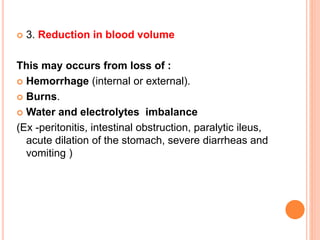
 3. Reduction in blood volume
This may occurs from loss of :
 Hemorrhage (internal or external).
 Burns.
 Water and electrolytes imbalance
(Ex -peritonitis, intestinal obstruction, paralytic ileus,
acute dilation of the stomach, severe diarrheas and
vomiting )
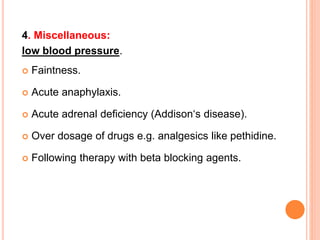
4. Miscellaneous:
low blood pressure.
 Faintness.
 Acute anaphylaxis.
 Acute adrenal deficiency (Addison‘s disease).
 Over dosage of drugs e.g. analgesics like pethidine.
 Following therapy with beta blocking agents.
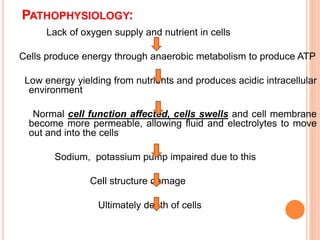
PATHOPHYSIOLOGY:
Lack of oxygen supply and nutrient in cells
Cells produce energy through anaerobic metabolism to produce ATP
Low energy yielding from nutrients and produces acidic intracellular
environment
Normal cell function affected, cells swells and cell membrane
become more permeable, allowing fluid and electrolytes to move
out and into the cells
Sodium, potassium pump impaired due to this
Cell structure damage
Ultimately death of cells
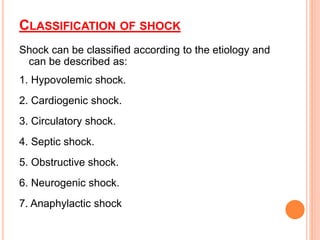
CLASSIFICATION OF SHOCK
Shock can be classified according to the etiology and
can be described as:
1. Hypovolemic shock.
2. Cardiogenic shock.
3. Circulatory shock.
4. Septic shock.
5. Obstructive shock.
6. Neurogenic shock.
7. Anaphylactic shock
Hypovolemic shock:
 HS due to insufficient circulatory blood volume.
 There is loss in the intravascular fluid upto 15% to 25%.
Cardiogenic shock:
 It is caused by the failure of heart to pump an adequate
amount of blood to vital organs.
 It can be the result of myocardial infarction. Other causes
include Arrhythmias, Cardiomyopathy, Congestive heart
failure, and Cardiac valve problems.
Septic shock: Shock result from infection in body
Circulatory shock or distributive shock:
 In this there is no blood loss but the shock is due to the
dilation of the blood vessels
Obstructive shock:
 Obstruction of blood flow results from cardiac arrest. E.g.
Cardiac tapenade, pneumothorax, pulmonary embolism,
and aortic stenosis
Anaphylactic shock:
 Anaphylactic shock is caused by severe reaction to an
allergen, antigen, drug or foreign protein.
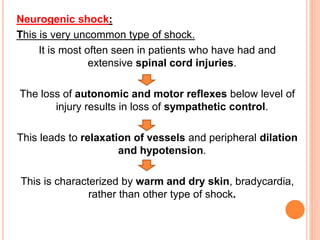
Neurogenic shock:
This is very uncommon type of shock.
It is most often seen in patients who have had and
extensive spinal cord injuries.
The loss of autonomic and motor reflexes below level of
injury results in loss of sympathetic control.
This leads to relaxation of vessels and peripheral dilation
and hypotension.
This is characterized by warm and dry skin, bradycardia,
rather than other type of shock.
.
Stages of shock:
There are three stages of shock that are commonly
identified.
1) Compensatory stage, Non progressive
stage, early stage.
2) Progressive or Intermediate stage.
3) Irreversible or Late stage.
1. COMPENSATORY STAGE:-
In this stage , the patient‘s blood pressure remains within
normal limits.
Stimulation of sympathetic nervous system
Subsequent release of epinephrine and nor epinephrine
Causes Vasoconstriction , increased Heart rate
To maintain the cardiac output.
CONTINUED…
 The body shunts blood from skin, kidneys and
gastrointestinal tract to the brain and heart to
ensure adequate blood supply to these vital
organs.
 As a result the patient‘s
 Skin will be cold and clammy,
 Bowel will be hypoactive and
 Urine output will decrease in response to release of
aldosterone and ADH
SIGNS AND SYMPTOMS :-
 Changes in the level of consciousness,
 Increased depth of respiration,
 Irritability
 Anxiety
 Restless
 Decreased urine output
 Dilated pupils
 Thirst
 Rapid respirations
 Sepsis
 Tachycardia
 Cold skin
 Decreased cardiac output.
2. Progressive stage: -
It is the second stage of shock
Systolic blood pressure (SBP) falls and diastolic pressure
(DBP)rises, decreasing blood flow to myocardium.
Body‘s ability to meet increased oxygen requirement reduced
Leads to ischemia , oxygen deprivation to brain causes the
patient to become confused and disoriented.
Organs especially lungs, heart and kidneys deteriorate.
Signs and symptoms :-
 Decreased response to pain ,
 Dilated and sluggish pupils ,
 Increased thirst,
 Rapid and shallow breathing ,
 Tachycardia,
 Cool moist skin ,
 Possible cyanosis ,
 Lowered body temperature ,
 Muscle weakness and lowered urine output.
Continued…
3) IRREVERSIBLE STAGE:-
 The irreversible stage of shock represents the point
along the shock continum at which organ damage is so
severe that patient does not respond to treatment and
cannot survive.
 Multisystem failure develops.
 It is the end point of shock that is the patient‘s death is
sure.
Signs and symptoms :-
 Unconsciousness,
 Absence of all reflexes ,
 Dilated pupils ,
 Severe thirst ,
 Bradycardia ,
 Cardiac arrhythmias,
 Cold clammy skin,
 Immune system collapse,
 Renal failure,
 Shallow respiration.
Continued…..
Diagnosis of shock: -
An accurate history and assessment of patient symptoms
must be done before commencing treatment.
 Conduct head to toe examination for signs of shock.
 Assess neurological status of the person by assessing the
level of consciousness.
 Assess the cardiovascular status.
 Assess for renal status.
 Assess for integumentary status. Check for skin color, cold
and clammy skin, cyanosis.
 Assess GI status. Hypoactive bowel sounds.
 Assess for the metabolic status.
FIRST AID IN SHOCK:
 Reassure the causality.
 Lay him down on his back comfortably with head low
and turned to one side except in case of head injury.
 Loosen the clothing around the neck, chest and waist.
 Keep the causality warm.
 Give him sips of water if he is thirsty. Never give any
alcoholic drinks.
 Never use hot water bag or massage the limbs.
 Arrest hemorrhage by adequate measures.
 Check pulse, respiration and level of consciousness.
 Transport the causality to the hospital immediately.
TREATMENT OF SHOCK: -
Pharmacological interventions.
1.) Hypovolemic shock:
 Volume expanders
 Desmopression ( in case of diabetes)
 Antidiarrheal agents for diarrhea
2.) Carcinogenic shock:
 Volume expanders
 Positive cardiac inotropics :
 Vasodilators :
 Antiarrythmia medication
3.) Distributive shock:
 Volume expanders
 Positive cardiac inotropics
 Vasoconstrictors
4.) Obstructive shock:
 Volume expanders
5). Septic shock
 Broad spectrum antibiotics
6.) Neurogenic shock:
 Hypoglycemia – glucose is rapidly administered.
MANAGEMENT OF SHOCK:
Administration of intravenous fluids, blood products, and
medication. These include :
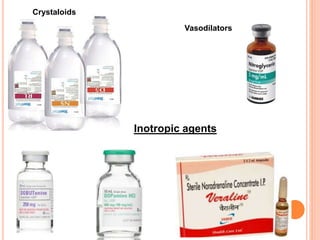
 Crystalloids: These are used for intravenous fluid
replacement in early stages of shock .e.g. Ringer‘s
solution and normal saline most commonly used.
 Inotripoic agents: like Dopamine, Dobutamine and
Epinephrine to improve myocardial contractility.
 Vasodilators: Nitroglycerine, Sodium Nitroprusside
used to dilate the coronary arteries.
Crystaloids
Vasodilators
Inotropic agents
CONT..
 Antibiotics: used to treat septic shock
because they are bactericidal.
 Antihistamines: epinephrine used in
anaphylactic shock.
 Steroids: used to decrease fluid shifts out of
vasculature by stabilizing capillary walls.
CONTINUED…..
 Sodium bicarbonate: it is used to treat metabolic
acidosis that occurs as shock progress.
 Bronchodilators: like atropine, aminophyline, used
to relieve bronco constriction in case of
anaphylactic shock
NURSING DIAGNOSIS IN CASE OF SHOCK:
 Fluid volume deficient related to hemorrhage
 Decreased cardiac output related to ineffective cardiac function.
 Risk for infection related to interruption of skin integrity from
invasive procedures
 Altered nutrition less than body requirement related to decrease
oral intake.
 Altered peripheral tissue perfusion related to edema from stasis
of blood in the capillaries and vasoconstriction
Assignment : Write intervention for above nsg diagnosis,
NURSING MANAGEMENT IN CASE OF
SHOCK:
 Maintain ABC of the patient.
 Provide supplemental oxygen therapy to the patient.
 Monitor for (Arterial blood gas) ABG value to assess the
patient response to oxygen therapy.
 Continuous monitoring of vital signs should be done.
 Check for urine output of the client.
 Maintain nutritional status of the patient. Administer
prescribed medication to the patient.
 Give psychological support to the patient and the
relatives
Thank You.

Shock and Management

  • 1.
  • 2.
    SHOCK  Shock isthe life threatening condition.  It is characterized by inadequate tissue perfusion that if untreated results in cell death.  Shock can be defined as a condition in which systemic blood pressure (SBP) is inadequate to deliver oxygen and nutrient to supply to vital organs and cellular functions.  A failure of circulation to supply adequate oxygen to the tissues.
  • 3.
    CAUSES OF SHOCK Circulationmay fail from:-  1. Sudden malfunction of heart : This may occur as a result of:-  Coronary artery occlusion with acute MI  Trauma with structural damage to heart.  Toxemia – viral or bacterial.  Effects of drugs.
  • 4.
    CONT…. 2. Deficient oxygenationof blood in lungs: - Amongst many causes the following are the most important surgically.  Post operative : Atelectasis  Thoracic injuries: Particularly of chest , i.e. pneumothorax, crushing and laceration of lung  Obstruction of pulmonary artery by an embolus.  Disturbances of lung function following surgery and anesthesia.
  • 5.
     3. Reductionin blood volume This may occurs from loss of :  Hemorrhage (internal or external).  Burns.  Water and electrolytes imbalance (Ex -peritonitis, intestinal obstruction, paralytic ileus, acute dilation of the stomach, severe diarrheas and vomiting )
  • 6.
    4. Miscellaneous: low bloodpressure.  Faintness.  Acute anaphylaxis.  Acute adrenal deficiency (Addison‘s disease).  Over dosage of drugs e.g. analgesics like pethidine.  Following therapy with beta blocking agents.
  • 7.
    PATHOPHYSIOLOGY: Lack of oxygensupply and nutrient in cells Cells produce energy through anaerobic metabolism to produce ATP Low energy yielding from nutrients and produces acidic intracellular environment Normal cell function affected, cells swells and cell membrane become more permeable, allowing fluid and electrolytes to move out and into the cells Sodium, potassium pump impaired due to this Cell structure damage Ultimately death of cells
  • 8.
    CLASSIFICATION OF SHOCK Shockcan be classified according to the etiology and can be described as: 1. Hypovolemic shock. 2. Cardiogenic shock. 3. Circulatory shock. 4. Septic shock. 5. Obstructive shock. 6. Neurogenic shock. 7. Anaphylactic shock
  • 9.
    Hypovolemic shock:  HSdue to insufficient circulatory blood volume.  There is loss in the intravascular fluid upto 15% to 25%. Cardiogenic shock:  It is caused by the failure of heart to pump an adequate amount of blood to vital organs.  It can be the result of myocardial infarction. Other causes include Arrhythmias, Cardiomyopathy, Congestive heart failure, and Cardiac valve problems. Septic shock: Shock result from infection in body
  • 10.
    Circulatory shock ordistributive shock:  In this there is no blood loss but the shock is due to the dilation of the blood vessels Obstructive shock:  Obstruction of blood flow results from cardiac arrest. E.g. Cardiac tapenade, pneumothorax, pulmonary embolism, and aortic stenosis Anaphylactic shock:  Anaphylactic shock is caused by severe reaction to an allergen, antigen, drug or foreign protein.
  • 11.
    Neurogenic shock: This isvery uncommon type of shock. It is most often seen in patients who have had and extensive spinal cord injuries. The loss of autonomic and motor reflexes below level of injury results in loss of sympathetic control. This leads to relaxation of vessels and peripheral dilation and hypotension. This is characterized by warm and dry skin, bradycardia, rather than other type of shock.
  • 12.
    . Stages of shock: Thereare three stages of shock that are commonly identified. 1) Compensatory stage, Non progressive stage, early stage. 2) Progressive or Intermediate stage. 3) Irreversible or Late stage.
  • 13.
    1. COMPENSATORY STAGE:- Inthis stage , the patient‘s blood pressure remains within normal limits. Stimulation of sympathetic nervous system Subsequent release of epinephrine and nor epinephrine Causes Vasoconstriction , increased Heart rate To maintain the cardiac output.
  • 14.
    CONTINUED…  The bodyshunts blood from skin, kidneys and gastrointestinal tract to the brain and heart to ensure adequate blood supply to these vital organs.  As a result the patient‘s  Skin will be cold and clammy,  Bowel will be hypoactive and  Urine output will decrease in response to release of aldosterone and ADH
  • 15.
    SIGNS AND SYMPTOMS:-  Changes in the level of consciousness,  Increased depth of respiration,  Irritability  Anxiety  Restless  Decreased urine output  Dilated pupils  Thirst  Rapid respirations  Sepsis  Tachycardia  Cold skin  Decreased cardiac output.
  • 16.
    2. Progressive stage:- It is the second stage of shock Systolic blood pressure (SBP) falls and diastolic pressure (DBP)rises, decreasing blood flow to myocardium. Body‘s ability to meet increased oxygen requirement reduced Leads to ischemia , oxygen deprivation to brain causes the patient to become confused and disoriented. Organs especially lungs, heart and kidneys deteriorate.
  • 17.
    Signs and symptoms:-  Decreased response to pain ,  Dilated and sluggish pupils ,  Increased thirst,  Rapid and shallow breathing ,  Tachycardia,  Cool moist skin ,  Possible cyanosis ,  Lowered body temperature ,  Muscle weakness and lowered urine output. Continued…
  • 18.
    3) IRREVERSIBLE STAGE:- The irreversible stage of shock represents the point along the shock continum at which organ damage is so severe that patient does not respond to treatment and cannot survive.  Multisystem failure develops.  It is the end point of shock that is the patient‘s death is sure.
  • 19.
    Signs and symptoms:-  Unconsciousness,  Absence of all reflexes ,  Dilated pupils ,  Severe thirst ,  Bradycardia ,  Cardiac arrhythmias,  Cold clammy skin,  Immune system collapse,  Renal failure,  Shallow respiration. Continued…..
  • 20.
    Diagnosis of shock:- An accurate history and assessment of patient symptoms must be done before commencing treatment.  Conduct head to toe examination for signs of shock.  Assess neurological status of the person by assessing the level of consciousness.  Assess the cardiovascular status.  Assess for renal status.  Assess for integumentary status. Check for skin color, cold and clammy skin, cyanosis.  Assess GI status. Hypoactive bowel sounds.  Assess for the metabolic status.
  • 21.
    FIRST AID INSHOCK:  Reassure the causality.  Lay him down on his back comfortably with head low and turned to one side except in case of head injury.  Loosen the clothing around the neck, chest and waist.  Keep the causality warm.  Give him sips of water if he is thirsty. Never give any alcoholic drinks.  Never use hot water bag or massage the limbs.  Arrest hemorrhage by adequate measures.  Check pulse, respiration and level of consciousness.  Transport the causality to the hospital immediately.
  • 22.
    TREATMENT OF SHOCK:- Pharmacological interventions. 1.) Hypovolemic shock:  Volume expanders  Desmopression ( in case of diabetes)  Antidiarrheal agents for diarrhea 2.) Carcinogenic shock:  Volume expanders  Positive cardiac inotropics :  Vasodilators :  Antiarrythmia medication
  • 23.
    3.) Distributive shock: Volume expanders  Positive cardiac inotropics  Vasoconstrictors 4.) Obstructive shock:  Volume expanders 5). Septic shock  Broad spectrum antibiotics 6.) Neurogenic shock:  Hypoglycemia – glucose is rapidly administered.
  • 24.
    MANAGEMENT OF SHOCK: Administrationof intravenous fluids, blood products, and medication. These include :  Crystalloids: These are used for intravenous fluid replacement in early stages of shock .e.g. Ringer‘s solution and normal saline most commonly used.  Inotripoic agents: like Dopamine, Dobutamine and Epinephrine to improve myocardial contractility.  Vasodilators: Nitroglycerine, Sodium Nitroprusside used to dilate the coronary arteries.
  • 25.
  • 26.
    CONT..  Antibiotics: usedto treat septic shock because they are bactericidal.  Antihistamines: epinephrine used in anaphylactic shock.  Steroids: used to decrease fluid shifts out of vasculature by stabilizing capillary walls.
  • 27.
    CONTINUED…..  Sodium bicarbonate:it is used to treat metabolic acidosis that occurs as shock progress.  Bronchodilators: like atropine, aminophyline, used to relieve bronco constriction in case of anaphylactic shock
  • 28.
    NURSING DIAGNOSIS INCASE OF SHOCK:  Fluid volume deficient related to hemorrhage  Decreased cardiac output related to ineffective cardiac function.  Risk for infection related to interruption of skin integrity from invasive procedures  Altered nutrition less than body requirement related to decrease oral intake.  Altered peripheral tissue perfusion related to edema from stasis of blood in the capillaries and vasoconstriction Assignment : Write intervention for above nsg diagnosis,
  • 29.
    NURSING MANAGEMENT INCASE OF SHOCK:  Maintain ABC of the patient.  Provide supplemental oxygen therapy to the patient.  Monitor for (Arterial blood gas) ABG value to assess the patient response to oxygen therapy.  Continuous monitoring of vital signs should be done.  Check for urine output of the client.  Maintain nutritional status of the patient. Administer prescribed medication to the patient.  Give psychological support to the patient and the relatives
  • 30.