4/16/2014 Prof.Dr.R.R.Deshpande 1
Sharir Kriya( Ayurvedic Physiology)
– First BAMS
• PDEA’S College of Ayurved & Research
Center ,Nigdi Pradhikaran ,sector 25,Pune
44
• Instruments for study of Shari kriya
• Teachers & students can be benefited by
this ppt
Instruments – Sharikriya
( Ayurvedic Physiology)
• Presented By –
• Prof.Dr.R.R.Deshpande (M.D in Ayurvdic
Medicine & M.D. in Ayurvedic Physiology)
• www.ayurvedicfriend.com
• Mobile – 922 68 10 630
• Mailme.drrrdeshpande@rediffmail.com
4/16/2014 Prof.Dr.R.R.Deshpande 2
Sharir Kriya Books as per New
Syllabus of CCIM 2012
4/16/2014 3Prof.Dr.R.R.Deshpande
4/16/2014 Prof.Dr.R.R.Deshpande 4
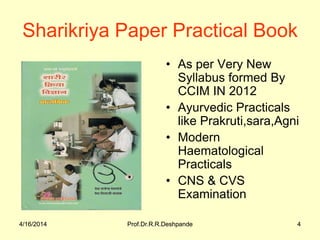
Sharikriya Paper Practical Book
• As per Very New
Syllabus formed By
CCIM IN 2012
• Ayurvedic Practicals
like Prakruti,sara,Agni
• Modern
Haematological
Practicals
• CNS & CVS
Examination
4/16/2014 4Prof.Dr.R.R.Deshpande
4/16/2014 Prof.Dr.R.R.Deshpande 5
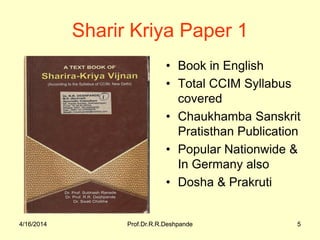
Sharir Kriya Paper 1
• Book in English
• Total CCIM Syllabus
covered
• Chaukhamba Sanskrit
Pratisthan Publication
• Popular Nationwide &
In Germany also
• Dosha & Prakruti
4/16/2014 5Prof.Dr.R.R.Deshpande
4/16/2014 Prof.Dr.R.R.Deshpande 6
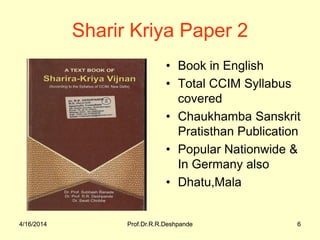
Sharir Kriya Paper 2
• Book in English
• Total CCIM Syllabus
covered
• Chaukhamba Sanskrit
Pratisthan Publication
• Popular Nationwide &
In Germany also
• Dhatu,Mala
4/16/2014 6Prof.Dr.R.R.Deshpande
4/16/2014 Prof.Dr.R.R.Deshpande 74/16/2014 7
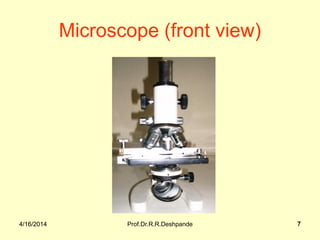
Microscope (front view)
4/16/2014 Prof.Dr.R.R.Deshpande 84/16/2014 8
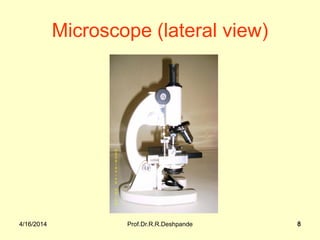
Microscope (lateral view)
4/16/2014 Prof.Dr.R.R.Deshpande 9
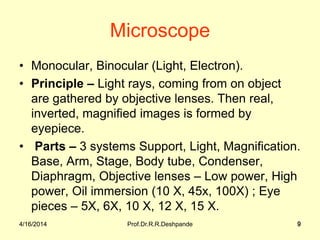
Microscope
• Monocular, Binocular (Light, Electron).
• Principle – Light rays, coming from on object
are gathered by objective lenses. Then real,
inverted, magnified images is formed by
eyepiece.
• Parts – 3 systems Support, Light, Magnification.
Base, Arm, Stage, Body tube, Condenser,
Diaphragm, Objective lenses – Low power, High
power, Oil immersion (10 X, 45x, 100X) ; Eye
pieces – 5X, 6X, 10 X, 12 X, 15 X.
4/16/2014 9
4/16/2014 Prof.Dr.R.R.Deshpande 10
Microscope
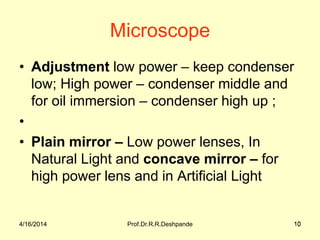
• Adjustment low power – keep condenser
low; High power – condenser middle and
for oil immersion – condenser high up ;
•
• Plain mirror – Low power lenses, In
Natural Light and concave mirror – for
high power lens and in Artificial Light
4/16/2014 10
4/16/2014 Prof.Dr.R.R.Deshpande 11
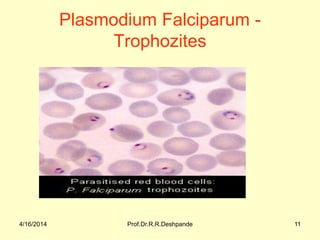
Plasmodium Falciparum -
Trophozites
4/16/2014 Prof.Dr.R.R.Deshpande 12
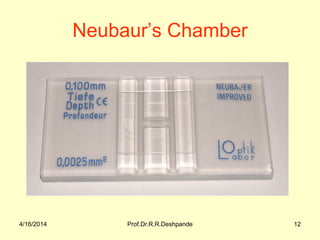
Neubaur’s Chamber
Neubaur’s Chamber
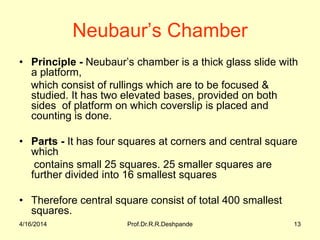
• Principle - Neubaur’s chamber is a thick glass slide with
a platform,
which consist of rullings which are to be focused &
studied. It has two elevated bases, provided on both
sides of platform on which coverslip is placed and
counting is done.
• Parts - It has four squares at corners and central square
which
contains small 25 squares. 25 smaller squares are
further divided into 16 smallest squares
• Therefore central square consist of total 400 smallest
squares.
4/16/2014 13Prof.Dr.R.R.Deshpande
Neubaur’s Chamber
• Uses - 1) Four corner squares are used
for WBC counting.(Total 16 x 4 = 64
squares)
• 2) Central square is used for RBC
counting.(Total 16 x 5 = 80 squares)
• 3) This chamber is also used for sperm
counting.
4/16/2014 14Prof.Dr.R.R.Deshpande
4/16/2014 Prof.Dr.R.R.Deshpande 15
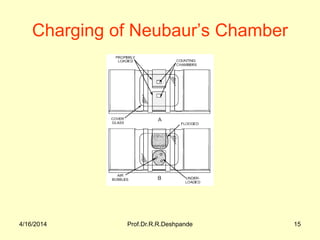
Charging of Neubaur’s Chamber
4/16/2014 Prof.Dr.R.R.Deshpande 164/16/2014 16
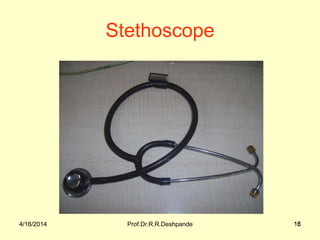
Stethoscope
4/16/2014 Prof.Dr.R.R.Deshpande 17
Stethoscope
• Stetho = chest and scope = To inspect.
Discovered by Lennace in 1816.
• Uses – To hear – Heart sounds, Respiratory
sounds, Peristaltic movements, Foetal heart
sounds, to measure B.P. by Auscultatory
method
• Parts – Chest piece, Diaphragm for low pitch
sound and Bell for high pitch sound, Conducting
tube, Ear frame, Ear piece.
4/16/2014 17
4/16/2014 Prof.Dr.R.R.Deshpande 18
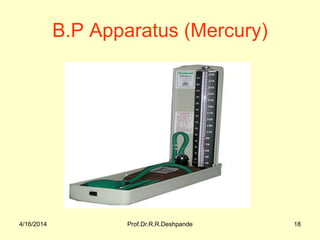
B.P Apparatus (Mercury)
• Principle - The pressure of blood in
brachial artery is balanced against the
pressure in a rubber culf and then it is
measured by Sphygmomanometer.
• Parts - 1) Mercurial manometer
• 2) Mercury well / reservior
• 3) Rubber bag with linen cuff.
• 4) The rubber pump / ballon with valve.
4/16/2014 19Prof.Dr.R.R.Deshpande
4/16/2014 Prof.Dr.R.R.Deshpande 20
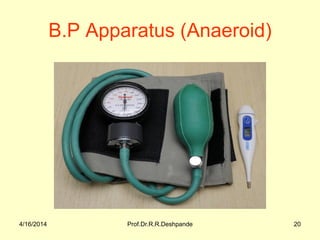
B.P Apparatus (Anaeroid)
4/16/2014 Prof.Dr.R.R.Deshpande 21
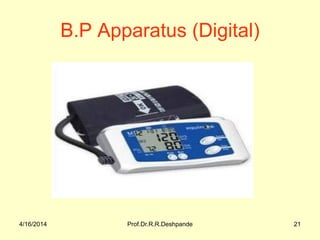
B.P Apparatus (Digital)
• Types - i) Mercurial
ii) Aneroid.
• Uses - To measure arterial B.P. by 3
methods
• a) Palpatory b) Auscultatory c) Oscillatory
4/16/2014 22Prof.Dr.R.R.Deshpande
4/16/2014 Prof.Dr.R.R.Deshpande 234/16/2014 23
Hb tube (1)
4/16/2014 Prof.Dr.R.R.Deshpande 24
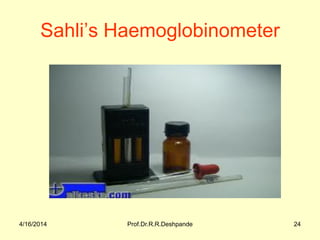
Sahli’s Haemoglobinometer
Prof.Dr.R.R.Deshpande 254/16/2014 25
Hb tube(2)
4/16/2014
4/16/2014 Prof.Dr.R.R.Deshpande 264/16/2014 26
Hb tube
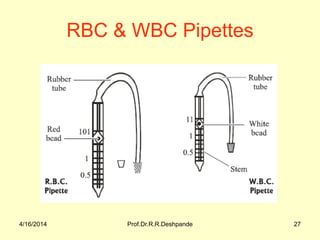
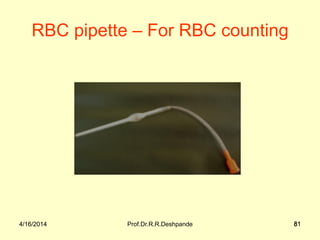
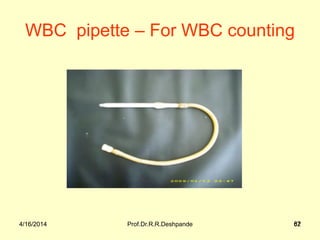
RBC & WBC Pipettes
4/16/2014 27Prof.Dr.R.R.Deshpande
RBC & WBC Pipettes
• Principle - RBC and WBC pipettes have
bulbs with specific volume in which mixing
of blood and diluting fluids is
done,conveniently and accurately. This
mixed solution is used to carry out
counting of RBC and WBC.
4/16/2014 28Prof.Dr.R.R.Deshpande
RBC & WBC Pipettes
• Parts
• 1) Capillary stem with uniform bore.
• 2) Bulb – just above the stem is a bulb which
contain red/white beads (Beads help to mix
blood with RBC/WBC diluting fluid)
• 3) Rubber tube
• Uses - For dilution of blood with RBC or WBC
diluting fluid to count number of RBC’s and
WBC’s in 1mm3 of area.
• Note - RBC pipette marking – 0.5 – 1 – 101
• WBC pipette marking – 0.5 – 1 – 11
4/16/2014 29Prof.Dr.R.R.Deshpande
4/16/2014 Prof.Dr.R.R.Deshpande 304/16/2014 30
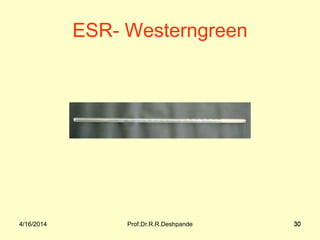
ESR- Westerngreen
4/16/2014 Prof.Dr.R.R.Deshpande 314/16/2014 31
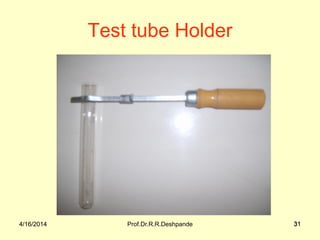
Test tube Holder
4/16/2014 Prof.Dr.R.R.Deshpande 324/16/2014 32
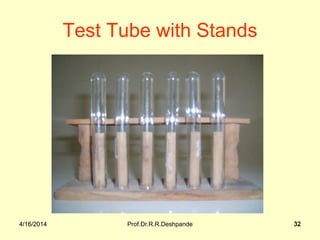
Test Tube with Stands
Test Tubes
• Principle
• 1) Test tubes are made up of special type
of glass which can tolerate
• moderate heat during the chemical
reaction which are taking
• place in contents of test tube.
• 2) As the tubes are made up of glass,
various chemical reactionscan be
observed clearly.
4/16/2014 33Prof.Dr.R.R.Deshpande
Test Tubes
• Parts - 1) Test tubes are with or without rim.
• 2) For explanation of practical parts of test tubes are
• described in terms of bottom and upper part
• Uses
• 1) Test tubes are used to perform various tests in Lab
• eg. In urine practical it is used to detect sugar, albumine
• 2) Small sized tubes are used in serological examination.
• eg. • Widal test for typhoid.
• Kahn / V.D.R.L test for S.T.D (Sexually Transmitted
Diseases)
4/16/2014 34Prof.Dr.R.R.Deshpande
4/16/2014 Prof.Dr.R.R.Deshpande 354/16/2014 35
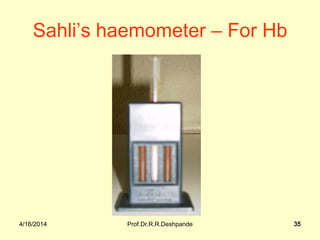
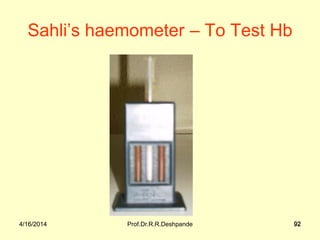
Sahli’s haemometer – For Hb
• Principle - Blood is taken in the Hb tube
and mixed with N/10 HCl.
• Brown coloured acid haematin is formed
which is
• compared with standard colour plates of
the instruments.
4/16/2014 36Prof.Dr.R.R.Deshpande
Sahli’s haemometer – For Hb
• Parts
• 1) Haemoglobinometer with standard
colour tubes
• 2) Hb tube - This tube has a rounded or
square bottom. This graduated tube has
red marking from 0 to 22 on one side to
indicate Hb gm percent and yellow
marking from 0 to 140 to indicate Hb
percentage.
4/16/2014 37Prof.Dr.R.R.Deshpande
Sahli’s haemometer – For Hb
• 3) Hb pipette - has 20 cubic millimeter
marking. Blood is taken
• up to this mark.
• 4) Stirrer 5) Droppers 6) Brush for cleaning
the tube.
4/16/2014 38Prof.Dr.R.R.Deshpande
Sahli’s haemometer – For Hb
• Uses
• 1) Hb tube is used to take N/10 HCl.
• 2) Hb pipette is used to take sample of blood and to mix with
• HCl.
• 3) Stirrer is used to mix blood and HCl.
• 4) Colour plates of the Haemoglobinometer are used to match
• with colour of acid haematin (after reaction of blood and HCl)
• 5) Droppers are used for taking HCl and for adding distilled water
• for diluting mixture
• 6) Brush is used to clean the tube after the experiment
4/16/2014 39Prof.Dr.R.R.Deshpande
4/16/2014 Prof.Dr.R.R.Deshpande 404/16/2014 40
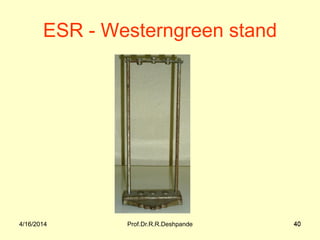
ESR - Westerngreen stand
4/16/2014 Prof.Dr.R.R.Deshpande 414/16/2014 41
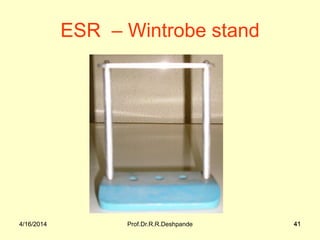
ESR – Wintrobe stand
Stands
• Principle - Various stands are used in the
Lab. The main purpose of
• stand is to keep test tubes or other tubes
vertical and
• fixed according to size and shape.
• Types - 1) Metal stands 2) Wooden
stands
• Parts - 1) Base 2) Sockets to keep the test
tubes
4/16/2014 42Prof.Dr.R.R.Deshpande
Stands
• Uses
• 1) To keep test tubes in vertical position.
• 2) ESR stands are used for holding
Wintrobe of Westerngreen tubes
• in upright position for accurate reading.
• 3) Kahn tubes are kept in specific stands.
• 4) For the Leishman’s staining special type
of stand is used to keep the slide for
staining purpose.
4/16/2014 43Prof.Dr.R.R.Deshpande
4/16/2014 Prof.Dr.R.R.Deshpande 444/16/2014 44
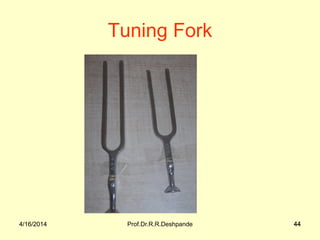
Tuning Fork
4/16/2014 Prof.Dr.R.R.Deshpande 45
Tuning Fork
• Limbs (U shaped two parallel limbs),
Handle (foot plate),
• Numbers – 256, 512 and 1024 Hz.
• Hearing Test
• i) Voice test (Conversation & Whispered)
• ii) Tunning fork test (Rinne, Weber,
Schwabach)
• iii) Audiometry
4/16/2014 45
Tuning Fork
• Principle - Tunning fork is set into
vibration and then it is kept on mastoid
bone and then in front of ear canal and
then the vibration of sound are compared
for Bone Conduction (B.C.) and Air
Conduction. (A.C.)
• Use - To measure hearing capacity, by
comparing air conduction (A.C.) with bone
conduction (B.C.).
4/16/2014 46Prof.Dr.R.R.Deshpande
4/16/2014 Prof.Dr.R.R.Deshpande 474/16/2014 47
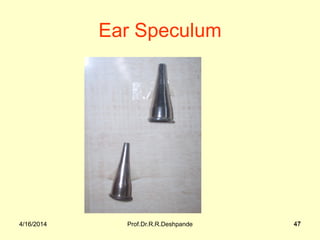
Ear Speculum
4/16/2014 Prof.Dr.R.R.Deshpande 48
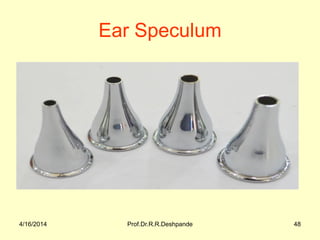
Ear Speculum
Ear Speculum
• Principle - Due to specific shape of
speculum and hollow cavity one can
examine – external auditory canal, ear
drum (tympanic membrane)
• Parts - This is cone shaped instrument. It
has base (broad) and end part is tapering.
4/16/2014 49Prof.Dr.R.R.Deshpande
4/16/2014 Prof.Dr.R.R.Deshpande 50
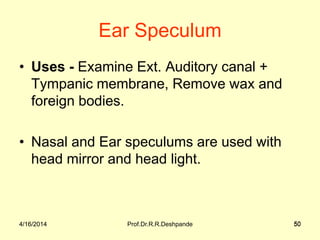
Ear Speculum
• Uses - Examine Ext. Auditory canal +
Tympanic membrane, Remove wax and
foreign bodies.
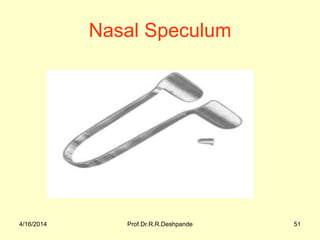
• Nasal and Ear speculums are used with
head mirror and head light.
4/16/2014 50
4/16/2014 Prof.Dr.R.R.Deshpande 51
Nasal Speculum
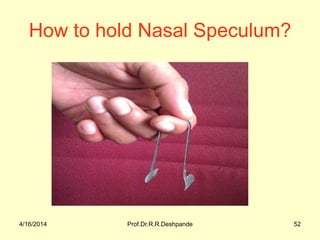
4/16/2014 Prof.Dr.R.R.Deshpande 52
How to hold Nasal Speculum?
4/16/2014 Prof.Dr.R.R.Deshpande 534/16/2014 53
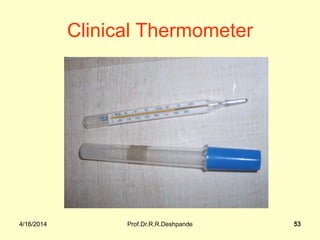
Clinical Thermometer
4/16/2014 Prof.Dr.R.R.Deshpande 54
Clinical Thermometer
• Normal Body Temp. 97 – 98.5 F or 36 C to
37.5 C;
• C = F – 32 x 5 / 9
• Sites – Axilla, Mouth, Rectum, vagina;
• Parts – Bulb, constricted part, Index
• Curved surface acts as lens and magnifies
level of mercury,
• Flat surface Graduated Index
4/16/2014 54
4/16/2014 Prof.Dr.R.R.Deshpande 55
Clinical Thermometer
• Principle
• Mercury expands, when it comes in contact with body
heat and so temperature can be recorded.
• Temperature depends upon – Time of the day
(Evening > Early morning)
• Sex (In female, temperature on the day of ovulation,
during M.C) Organ – In liver, max. heat is produced;
clothes – Temperature of organs covered with clothes,
is more, Exercise – After exercise temperature
4/16/2014 55
4/16/2014 Prof.Dr.R.R.Deshpande 56
Clinical Thermometer
• Body temperature types
• Core Temperature (Inside) > Shell
temperature (external skin).
•
• Temperature regulating center ---
Hypothalamus
4/16/2014 56
Prof.Dr.R.R.Deshpande 574/16/2014 57
Ryle’s Tube
4/16/2014
4/16/2014 Prof.Dr.R.R.Deshpande 58
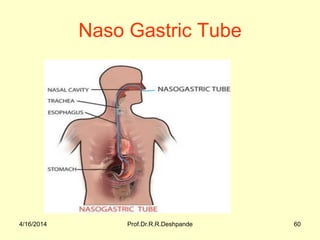
Ryle’s Tube
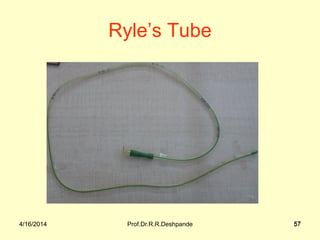
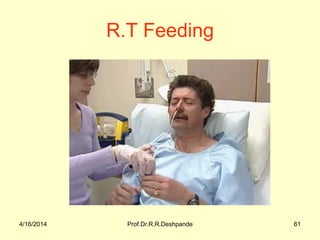
• Uses – To collect Gastric contents ,for
Gastric Analysis
• To give Stomach wash in Poisoning
• For Artificial Feeding
• Parts – Flexible Polythene tube ,diameter
8 mm
4/16/2014 58
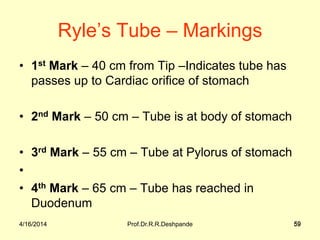
4/16/2014 Prof.Dr.R.R.Deshpande 59
Ryle’s Tube – Markings
• 1st Mark – 40 cm from Tip –Indicates tube has
passes up to Cardiac orifice of stomach
• 2nd Mark – 50 cm – Tube is at body of stomach
• 3rd Mark – 55 cm – Tube at Pylorus of stomach
•
• 4th Mark – 65 cm – Tube has reached in
Duodenum
4/16/2014 59
4/16/2014 Prof.Dr.R.R.Deshpande 60
Naso Gastric Tube
4/16/2014 Prof.Dr.R.R.Deshpande 61
R.T Feeding
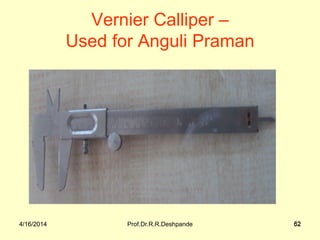
4/16/2014 Prof.Dr.R.R.Deshpande 624/16/2014 62
Vernier Calliper –
Used for Anguli Praman
Vernier Calliper
• Principle - To measure length or diameter of an
object accurately upto 0.01 cm / 0.1 mm
• Parts - 1) Jaws (To hold the object) 2) Ears
• 3) Right angled steel plate, graduated in mm
and marked in cm.
• 4) A small vernier scale, consists of N divisions
on one side of vernier.
4/16/2014 63Prof.Dr.R.R.Deshpande
Vernier Calliper
• Uses
• 1) Vernier calliper is used to measure
individual finger unit.(Anguli Praman)
• Finger unit is useful to check whether the
whole body or body organ are
proportionate or not.
• 2) Finger unit is also useful for study of
Marma (Vital points)
4/16/2014 64Prof.Dr.R.R.Deshpande
4/16/2014 Prof.Dr.R.R.Deshpande 654/16/2014 65
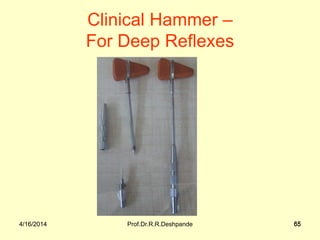
Clinical Hammer –
For Deep Reflexes
4/16/2014 Prof.Dr.R.R.Deshpande 66
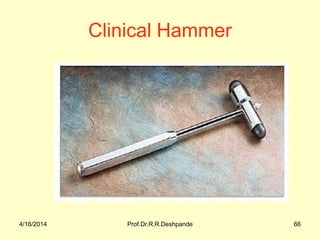
Clinical Hammer
4/16/2014 Prof.Dr.R.R.Deshpande 67
Clinical Hammer
• Parts - Rubber pad, handle, brush;
• Principle
• By applying external stimulus to joints,
bones, tendons, skin –response in the
form of Reflex can be observed and
Neuromuscular co-ordination and reflex
arc can be examined;
4/16/2014 Prof.Dr.R.R.Deshpande 68
Clinical Hammer
• Reflex types – Superficial, Deep, Visceral
• Superficial – Plantar, corneal, pupillary,
cremasteric, abdominal
• Deep – Bicep, Triceps, wrist, knee, Ankle
• Note - To divert the mind of the patient,
while taking reflexes, Jendrasik's manure
is applied (i.e.- asking the patient to clinch
• his teeth or tight locking of fingers of both
the hands.)
4/16/2014 Prof.Dr.R.R.Deshpande 69
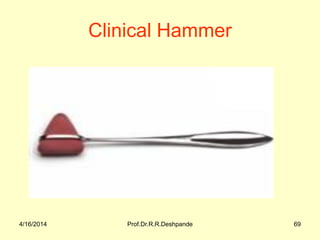
Clinical Hammer
Clinical Hammer
• Parts - 1) Rubber pad 2) Handle 3) Pointed end
4) Brush
• • Rubber pad is made up of soft rubber, having
triangular shape.This part is used to give
stimulus for eliciting reflexes.
• Metallic handle is used to hold a hammer.
• Pointed end, which is usually covered, is used
to elicit pain sensation (sensory tract). Pointed or
blunt end is used to take Babinski’s sign.
• • Brush is used to elicit touch sensation (sensory
tract).
4/16/2014 70Prof.Dr.R.R.Deshpande
Clinical Hammer
• Uses - To study reflexes and make
diagnosis about
• Upper motor neuron (UMN) lesion –
Exaggerated
• Lower motor neuron (LMN) lesion –
diminished.
4/16/2014 71Prof.Dr.R.R.Deshpande
4/16/2014 Prof.Dr.R.R.Deshpande 72
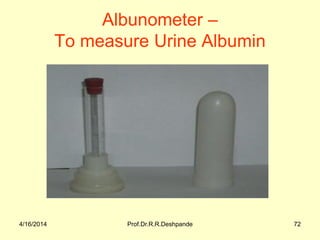
Albunometer –
To measure Urine Albumin
4/16/2014 Prof.Dr.R.R.Deshpande 734/16/2014 73
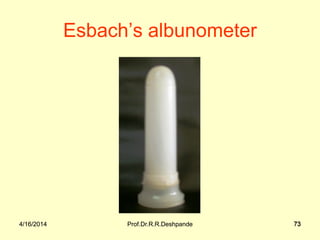
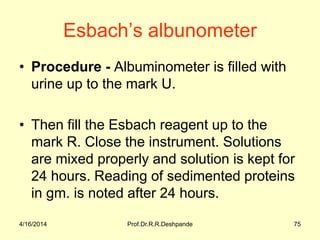
Esbach’s albunometer
4/16/2014 73Prof.Dr.R.R.Deshpande
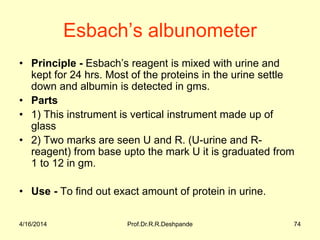
Esbach’s albunometer
• Principle - Esbach’s reagent is mixed with urine and
kept for 24 hrs. Most of the proteins in the urine settle
down and albumin is detected in gms.
• Parts
• 1) This instrument is vertical instrument made up of
glass
• 2) Two marks are seen U and R. (U-urine and R-
reagent) from base upto the mark U it is graduated from
1 to 12 in gm.
• Use - To find out exact amount of protein in urine.
4/16/2014 74Prof.Dr.R.R.Deshpande
Esbach’s albunometer
• Procedure - Albuminometer is filled with
urine up to the mark U.
• Then fill the Esbach reagent up to the
mark R. Close the instrument. Solutions
are mixed properly and solution is kept for
24 hours. Reading of sedimented proteins
in gm. is noted after 24 hours.
4/16/2014 75Prof.Dr.R.R.Deshpande
4/16/2014 Prof.Dr.R.R.Deshpande 764/16/2014 76
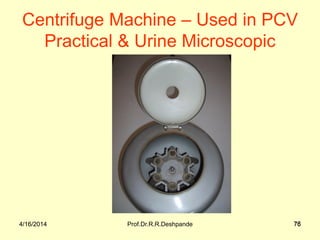
Centrifuge Machine – Used in PCV
Practical & Urine Microscopic
4/16/2014 Prof.Dr.R.R.Deshpande 774/16/2014 77
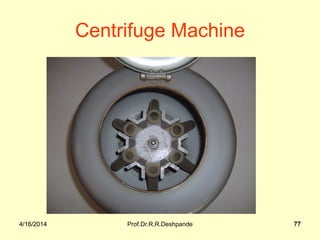
Centrifuge Machine
Centrifuge Machine
• Principle - To separate solid particles from liquid in
solution, with the help of high spinning speed of the
centrifuge machine.
• Parts - 1) The central shaft (Rotating part, connected to
motor)
• 2) The head (carries 4 - 6 sockets to keep test tubes)
• 3) Chamber
• 4) Lid
• 5) Centrifuge tubes (glass or plastics) - placed in
opposite sockets to counter balance.
• Types of machine - 1) Manual 2) Electric
4/16/2014 78Prof.Dr.R.R.Deshpande
4/16/2014 Prof.Dr.R.R.Deshpande 79
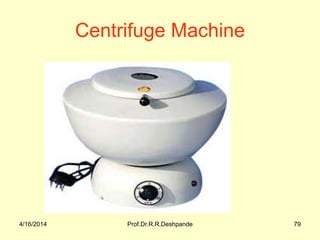
Centrifuge Machine
Centrifuge Machine
• Uses
• 1) To separate serum from blood, for
serological tests like LFT.
• 2) To separate plasma from blood
• 3) To measure packed cell volume (PCV)
• 4) To collect sediment of urine
• (specially for microscopic examination of
urine)
4/16/2014 80Prof.Dr.R.R.Deshpande
4/16/2014 Prof.Dr.R.R.Deshpande 814/16/2014 81
RBC pipette – For RBC counting
4/16/2014 Prof.Dr.R.R.Deshpande 824/16/2014 67
WBC pipette – For WBC counting
4/16/2014 Prof.Dr.R.R.Deshpande 83
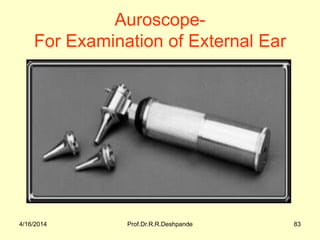
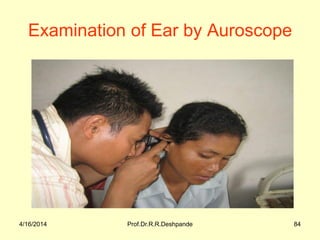
Auroscope-
For Examination of External Ear
4/16/2014 Prof.Dr.R.R.Deshpande 84
Examination of Ear by Auroscope
4/16/2014 Prof.Dr.R.R.Deshpande 85
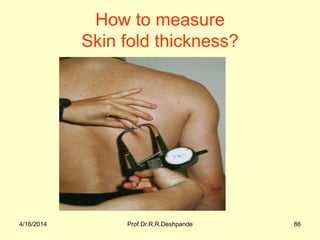
Herpende’s Caliper for measuring
skin fold thickness
4/16/2014 Prof.Dr.R.R.Deshpande 86
How to measure
Skin fold thickness?
4/16/2014 Prof.Dr.R.R.Deshpande 87
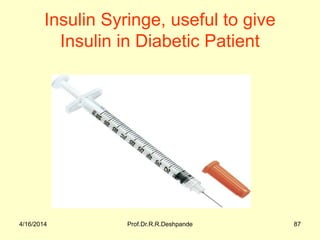
Insulin Syringe, useful to give
Insulin in Diabetic Patient
4/16/2014 Prof.Dr.R.R.Deshpande 88
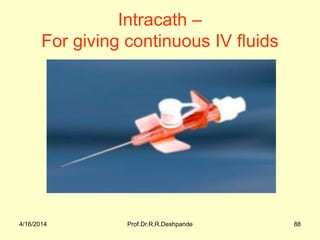
Intracath –
For giving continuous IV fluids
4/16/2014 Prof.Dr.R.R.Deshpande 89
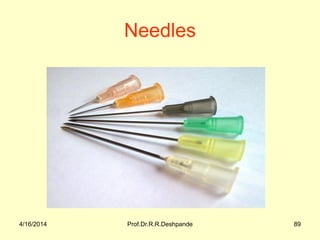
Needles
4/16/2014 Prof.Dr.R.R.Deshpande 904/16/2014 90
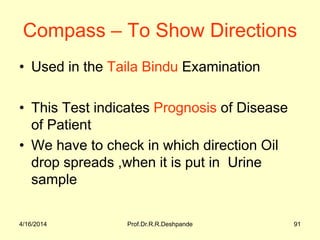
Compass – To Show Directions – Used
in Taila Bindu Pariksha of Urine
4/16/2014 Prof.Dr.R.R.Deshpande 91
Compass – To Show Directions
• Used in the Taila Bindu Examination
• This Test indicates Prognosis of Disease
of Patient
• We have to check in which direction Oil
drop spreads ,when it is put in Urine
sample
4/16/2014 Prof.Dr.R.R.Deshpande 924/16/2014 92
Sahli’s haemometer – To Test Hb
4/16/2014 Prof.Dr.R.R.Deshpande 934/16/2014 93
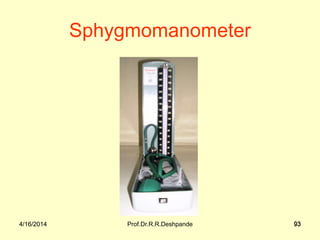
Sphygmomanometer
4/16/2014 Prof.Dr.R.R.Deshpande 94
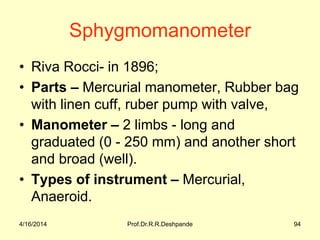
Sphygmomanometer
• Riva Rocci- in 1896;
• Parts – Mercurial manometer, Rubber bag
with linen cuff, ruber pump with valve,
• Manometer – 2 limbs - long and
graduated (0 - 250 mm) and another short
and broad (well).
• Types of instrument – Mercurial,
Anaeroid.
4/16/2014 Prof.Dr.R.R.Deshpande 954/16/2014 95
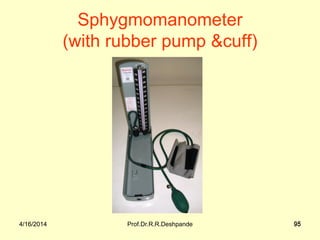
Sphygmomanometer
(with rubber pump &cuff)
4/16/2014 Prof.Dr.R.R.Deshpande 964/16/2014 96
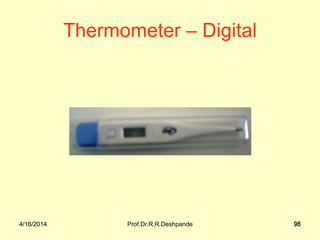
Thermometer – Digital
4/16/2014 Prof.Dr.R.R.Deshpande 974/16/2014 97
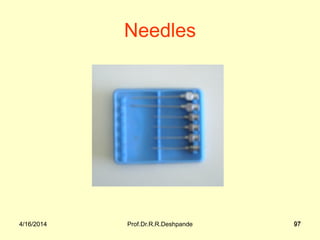
Needles
4/16/2014 Prof.Dr.R.R.Deshpande 984/16/2014 98
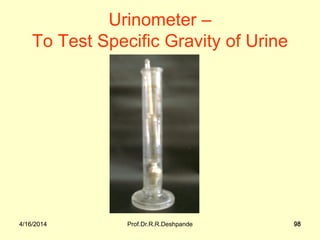
Urinometer –
To Test Specific Gravity of Urine
4/16/2014 Prof.Dr.R.R.Deshpande 99
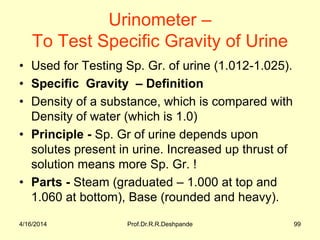
Urinometer –
To Test Specific Gravity of Urine
• Used for Testing Sp. Gr. of urine (1.012-1.025).
• Specific Gravity – Definition
• Density of a substance, which is compared with
Density of water (which is 1.0)
• Principle - Sp. Gr of urine depends upon
solutes present in urine. Increased up thrust of
solution means more Sp. Gr. !
• Parts - Steam (graduated – 1.000 at top and
1.060 at bottom), Base (rounded and heavy).
4/16/2014 Prof.Dr.R.R.Deshpande 1004/16/2014 100
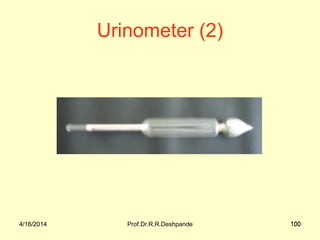
Urinometer (2)
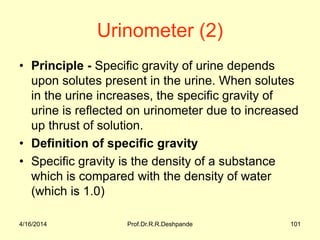
Urinometer (2)
• Principle - Specific gravity of urine depends
upon solutes present in the urine. When solutes
in the urine increases, the specific gravity of
urine is reflected on urinometer due to increased
up thrust of solution.
• Definition of specific gravity
• Specific gravity is the density of a substance
which is compared with the density of water
(which is 1.0)
4/16/2014 101Prof.Dr.R.R.Deshpande
4/16/2014 Prof.Dr.R.R.Deshpande 1024/16/2014 102
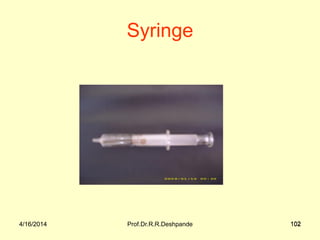
Syringe
4/16/2014 Prof.Dr.R.R.Deshpande 1034/16/2014 103
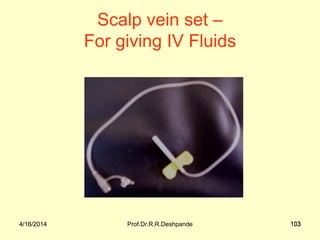
Scalp vein set –
For giving IV Fluids
Scalp vein set
• Principle - At the time of giving
intravenous fluid (DNS, Ringer lactate, 5
% glucose) it is necessary to keep needle
in the vein for longer time. Scalp vein set
is used for this purpose.
• Parts - 1) Needle 2) Wing 3) Tube
4/16/2014 104Prof.Dr.R.R.Deshpande
Scalp vein set
• Scalp vein needles have the bore of size
18 to 25. 18 to 20 numbers are for adults
and 24 number is for children. BT is given
with 20 number.
• • Scalp vein needle is introduced in the
vein with rough surface of the wings facing
the body surface of the patient. Wings are
having material of soft rubber
4/16/2014 105Prof.Dr.R.R.Deshpande
Scalp vein set
• Tube is 30 cm long and made up of flexible
polythene. One funnel like broad end of this tube
has a lid. This lid is opened and attached to I/V
set. One end of I/V set is connected to scalp
vein set and other end to I/V fluid bottle (D.N.S.
etc).
• After discontinuing I/V fluids, scalp vein tube
again can be closed with lid. Wings are fixed on
the skin with adhesive tape.
• Scalp vein sets are available in sterile pack.
4/16/2014 106Prof.Dr.R.R.Deshpande
Scalp vein set
• I/V fluids like saline or Dextrose; but
sometimes due to the movements of
hands of the patient, I/V can go out. To
avoid this problem, many a times
Intracath is used.
• I/V set has outlet, chamber, and pointed
end with rubber tubing and valve with
screw.
4/16/2014 107Prof.Dr.R.R.Deshpande
Scalp vein set
• Uses
• 1) For blood transfusion 20 or 21 no.
needle is used.
• 2) Intra venous set (I.V set is used to give
I.V. fluids)
• common sites – i) cubital fossa,ii) dorsum
of hand
4/16/2014 108Prof.Dr.R.R.Deshpande
4/16/2014 Prof.Dr.R.R.Deshpande 1094/16/2014 109
Stop watch – Used For BT,CT
Stop watch
• Principle - Because of the ability to show the
timings at the level of seconds and fraction of
seconds, the stop watch is used to know exact
period or time required to perform any test.
• Parts - 1) Circular dial, showing time 2) Knob (to
control start and stop movements)
• Now a days, digital stop watch is a better
alternative.
4/16/2014 110Prof.Dr.R.R.Deshpande
Stop watch
• Uses - 1) To calculate bleeding time.
(B.T.)
• 2) To calculate clotting time. (C.T.)
• 3) To conduct test in given timing.
• Eg. - Harward step test.
4/16/2014 111Prof.Dr.R.R.Deshpande
4/16/2014 Prof.Dr.R.R.Deshpande 1124/16/2014 112
Wintrobe bulb–
Collecting Blood for Haemogram
4/16/2014 Prof.Dr.R.R.Deshpande 1134/16/2014 113
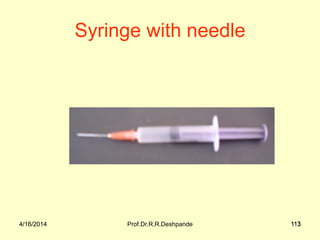
Syringe with needle
4/16/2014 Prof.Dr.R.R.Deshpande 114
Syringe with needle
• Syringe – Barrel, plunger;
• Needle – Bevel, shaft, hub,
• Uses – To give I.M. or I. V. Injections OR to
take out the Blood,
• Number of Needles and uses – No. 18, 19 – To
take out blood or to give thick injections like Inj
Penidure LA 12, 24 for syphilis, No. 21 Oily Inj.
No 22, 23 – Watery Inj, No-24 – For children ;
Syringes – 2 CC, 5CC, 10 CC, 20 CC, 50 cc.
4/16/2014 Prof.Dr.R.R.Deshpande 115
Syringe with needle
• Types
• Disposable syringes and needles, scalp
vein set (IV set), Insulin syringe and
needle, Glycerine syringe (for giving
Glycerine ),Lumber puncture Needle
• Sites for giving injection Triceps muscle,
Gluteus muscle, Ant. abdominal wall –
Subcutaneous (Rabies), Lt. arm – Origin
of Deltoid muscle (BCG)
4/16/2014 Prof.Dr.R.R.Deshpande 116
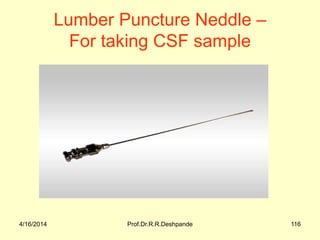
Lumber Puncture Neddle –
For taking CSF sample
4/16/2014 Prof.Dr.R.R.Deshpande 117
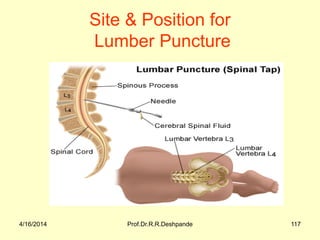
Site & Position for
Lumber Puncture
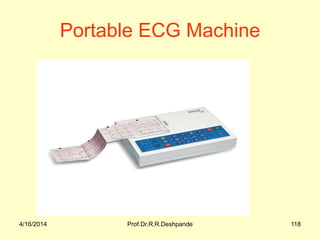
4/16/2014 Prof.Dr.R.R.Deshpande 118
Portable ECG Machine
4/16/2014 Prof.Dr.R.R.Deshpande 119
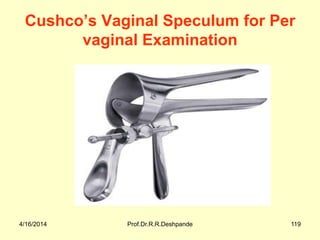
Cushco’s Vaginal Speculum for Per
vaginal Examination
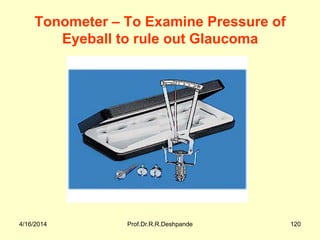
Tonometer – To Examine Pressure of
Eyeball to rule out Glaucoma
4/16/2014 Prof.Dr.R.R.Deshpande 120
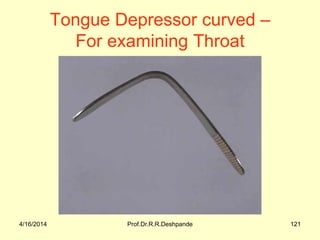
Tongue Depressor curved –
For examining Throat
4/16/2014 Prof.Dr.R.R.Deshpande 121
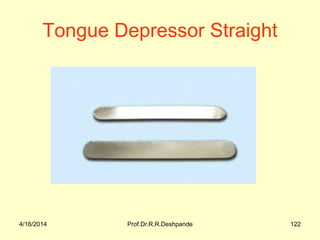
Tongue Depressor Straight
4/16/2014 Prof.Dr.R.R.Deshpande 122
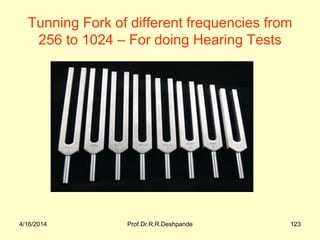
Tunning Fork of different frequencies from
256 to 1024 – For doing Hearing Tests
4/16/2014 Prof.Dr.R.R.Deshpande 123
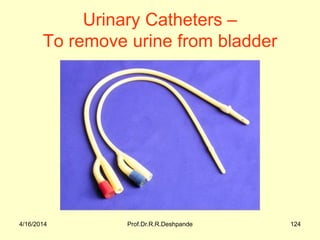
Urinary Catheters –
To remove urine from bladder
4/16/2014 Prof.Dr.R.R.Deshpande 124
4/16/2014 Prof.Dr.R.R.Deshpande 125
Prof.Dr.R.R.Deshpande
• Prof.Dr.R.R.Deshpande
• www.ayurvedicfriend.com
• Mobile – 922 68 10 630
• Mail ID –
mailme.drrrdeshpande@rediffmail.com
• professordeshpande@gmail.com
4/16/2014 Prof.Dr.R.R.Deshpande 126
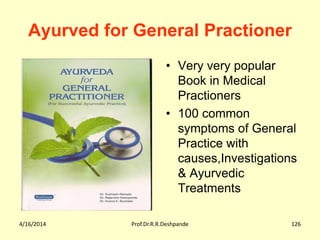
Ayurved for General Practioner
• Very very popular
Book in Medical
Practioners
• 100 common
symptoms of General
Practice with
causes,Investigations
& Ayurvedic
Treatments
4/16/2014 Prof.Dr.R.R.Deshpande 127
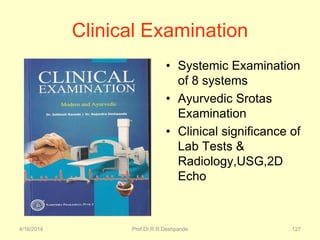
Clinical Examination
• Systemic Examination
of 8 systems
• Ayurvedic Srotas
Examination
• Clinical significance of
Lab Tests &
Radiology,USG,2D
Echo
4/16/2014 Prof.Dr.R.R.Deshpande 128
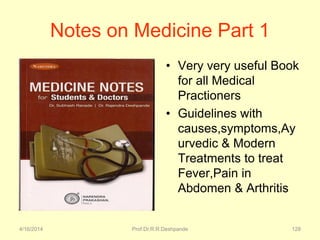
Notes on Medicine Part 1
• Very very useful Book
for all Medical
Practioners
• Guidelines with
causes,symptoms,Ay
urvedic & Modern
Treatments to treat
Fever,Pain in
Abdomen & Arthritis
4/16/2014 Prof.Dr.R.R.Deshpande 129
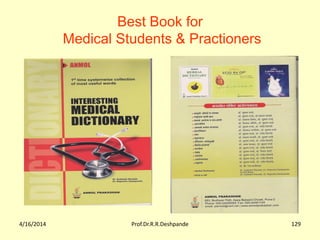
Best Book for
Medical Students & Practioners
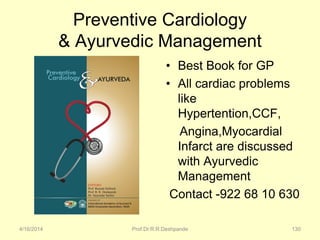
Preventive Cardiology
& Ayurvedic Management
• Best Book for GP
• All cardiac problems
like
Hypertention,CCF,
Angina,Myocardial
Infarct are discussed
with Ayurvedic
Management
Contact -922 68 10 630
4/16/2014 Prof.Dr.R.R.Deshpande 130
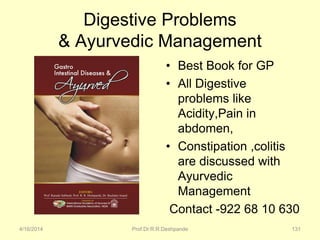
Digestive Problems
& Ayurvedic Management
• Best Book for GP
• All Digestive
problems like
Acidity,Pain in
abdomen,
• Constipation ,colitis
are discussed with
Ayurvedic
Management
Contact -922 68 10 630
4/16/2014 Prof.Dr.R.R.Deshpande 131
Gynaecological Problems &
Ayurvedic Management
• Best Book for GP
• All Gynaecological
problems like Heavy
bleeding,White
discharge,Infertility,ca
ncer are discussed
with Ayurvedic
Management
Contact -922 68 10 630
4/16/2014 Prof.Dr.R.R.Deshpande 132
Arthritis,Backache &
Ayurvedic Management
• Best Book for GP
• All Joint problems
like Rheumatoid
Arthritis,Osteoarthritis
,Backache are
discussed with
Ayurvedic
Management
Contact -922 68 10 630
4/16/2014 Prof.Dr.R.R.Deshpande 133
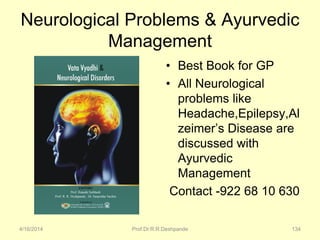
Neurological Problems & Ayurvedic
Management
• Best Book for GP
• All Neurological
problems like
Headache,Epilepsy,Al
zeimer’s Disease are
discussed with
Ayurvedic
Management
Contact -922 68 10 630
4/16/2014 Prof.Dr.R.R.Deshpande 134
Ayurvedic Concept of Diet
& Nutrition
• Best Book for GP
• Dietary Advice
according to Prakruti
,Dietary prescriptions
for many diseases are
given
• Contact -922 68 10
630
4/16/2014 Prof.Dr.R.R.Deshpande 135
Prof.Dr.Deshpande’s
Popular Links on Internet
• Just Start Internet on Desk top or Lap top
or on your mobile . Copy Following Link &
Paste as Web address –URL
• http://www.youtube.com/user/deshpande1
959
• http://www.slideshare.net/rajendra9a/
• http://www.mixcloud.com/jamdadey/
4/16/2014 Prof.Dr.R.R.Deshpande 136
Prof.Dr.Deshpande’s
Popular Links on Internet
• Just Start Internet on Desk top or Lap top
or on your mobile . Copy Following Link &
Paste as Web address –URL
• http://professordeshpande.blogspot.in
• http://professordrdeshpande.blogspot.in/
• http://www.mixcloud.com/rajendra-
deshpande
• https://soundcloud.com/professor-
deshpande
4/16/2014 Prof.Dr.R.R.Deshpande 137

Sharir kriya ( ayurvedic physiology) instruments

  • 1.
    4/16/2014 Prof.Dr.R.R.Deshpande 1 SharirKriya( Ayurvedic Physiology) – First BAMS • PDEA’S College of Ayurved & Research Center ,Nigdi Pradhikaran ,sector 25,Pune 44 • Instruments for study of Shari kriya • Teachers & students can be benefited by this ppt
  • 2.
    Instruments – Sharikriya (Ayurvedic Physiology) • Presented By – • Prof.Dr.R.R.Deshpande (M.D in Ayurvdic Medicine & M.D. in Ayurvedic Physiology) • www.ayurvedicfriend.com • Mobile – 922 68 10 630 • Mailme.drrrdeshpande@rediffmail.com 4/16/2014 Prof.Dr.R.R.Deshpande 2
  • 3.
    Sharir Kriya Booksas per New Syllabus of CCIM 2012 4/16/2014 3Prof.Dr.R.R.Deshpande
  • 4.
    4/16/2014 Prof.Dr.R.R.Deshpande 4 SharikriyaPaper Practical Book • As per Very New Syllabus formed By CCIM IN 2012 • Ayurvedic Practicals like Prakruti,sara,Agni • Modern Haematological Practicals • CNS & CVS Examination 4/16/2014 4Prof.Dr.R.R.Deshpande
  • 5.
    4/16/2014 Prof.Dr.R.R.Deshpande 5 SharirKriya Paper 1 • Book in English • Total CCIM Syllabus covered • Chaukhamba Sanskrit Pratisthan Publication • Popular Nationwide & In Germany also • Dosha & Prakruti 4/16/2014 5Prof.Dr.R.R.Deshpande
  • 6.
    4/16/2014 Prof.Dr.R.R.Deshpande 6 SharirKriya Paper 2 • Book in English • Total CCIM Syllabus covered • Chaukhamba Sanskrit Pratisthan Publication • Popular Nationwide & In Germany also • Dhatu,Mala 4/16/2014 6Prof.Dr.R.R.Deshpande
  • 7.
  • 8.
    4/16/2014 Prof.Dr.R.R.Deshpande 84/16/20148 Microscope (lateral view)
  • 9.
    4/16/2014 Prof.Dr.R.R.Deshpande 9 Microscope •Monocular, Binocular (Light, Electron). • Principle – Light rays, coming from on object are gathered by objective lenses. Then real, inverted, magnified images is formed by eyepiece. • Parts – 3 systems Support, Light, Magnification. Base, Arm, Stage, Body tube, Condenser, Diaphragm, Objective lenses – Low power, High power, Oil immersion (10 X, 45x, 100X) ; Eye pieces – 5X, 6X, 10 X, 12 X, 15 X. 4/16/2014 9
  • 10.
    4/16/2014 Prof.Dr.R.R.Deshpande 10 Microscope •Adjustment low power – keep condenser low; High power – condenser middle and for oil immersion – condenser high up ; • • Plain mirror – Low power lenses, In Natural Light and concave mirror – for high power lens and in Artificial Light 4/16/2014 10
  • 11.
  • 12.
  • 13.
    Neubaur’s Chamber • Principle- Neubaur’s chamber is a thick glass slide with a platform, which consist of rullings which are to be focused & studied. It has two elevated bases, provided on both sides of platform on which coverslip is placed and counting is done. • Parts - It has four squares at corners and central square which contains small 25 squares. 25 smaller squares are further divided into 16 smallest squares • Therefore central square consist of total 400 smallest squares. 4/16/2014 13Prof.Dr.R.R.Deshpande
  • 14.
    Neubaur’s Chamber • Uses- 1) Four corner squares are used for WBC counting.(Total 16 x 4 = 64 squares) • 2) Central square is used for RBC counting.(Total 16 x 5 = 80 squares) • 3) This chamber is also used for sperm counting. 4/16/2014 14Prof.Dr.R.R.Deshpande
  • 15.
  • 16.
  • 17.
    4/16/2014 Prof.Dr.R.R.Deshpande 17 Stethoscope •Stetho = chest and scope = To inspect. Discovered by Lennace in 1816. • Uses – To hear – Heart sounds, Respiratory sounds, Peristaltic movements, Foetal heart sounds, to measure B.P. by Auscultatory method • Parts – Chest piece, Diaphragm for low pitch sound and Bell for high pitch sound, Conducting tube, Ear frame, Ear piece. 4/16/2014 17
  • 18.
  • 19.
    B.P Apparatus (Mercury) •Principle - The pressure of blood in brachial artery is balanced against the pressure in a rubber culf and then it is measured by Sphygmomanometer. • Parts - 1) Mercurial manometer • 2) Mercury well / reservior • 3) Rubber bag with linen cuff. • 4) The rubber pump / ballon with valve. 4/16/2014 19Prof.Dr.R.R.Deshpande
  • 20.
  • 21.
  • 22.
    B.P Apparatus (Digital) •Types - i) Mercurial ii) Aneroid. • Uses - To measure arterial B.P. by 3 methods • a) Palpatory b) Auscultatory c) Oscillatory 4/16/2014 22Prof.Dr.R.R.Deshpande
  • 23.
  • 24.
  • 25.
  • 26.
  • 27.
    RBC & WBCPipettes 4/16/2014 27Prof.Dr.R.R.Deshpande
  • 28.
    RBC & WBCPipettes • Principle - RBC and WBC pipettes have bulbs with specific volume in which mixing of blood and diluting fluids is done,conveniently and accurately. This mixed solution is used to carry out counting of RBC and WBC. 4/16/2014 28Prof.Dr.R.R.Deshpande
  • 29.
    RBC & WBCPipettes • Parts • 1) Capillary stem with uniform bore. • 2) Bulb – just above the stem is a bulb which contain red/white beads (Beads help to mix blood with RBC/WBC diluting fluid) • 3) Rubber tube • Uses - For dilution of blood with RBC or WBC diluting fluid to count number of RBC’s and WBC’s in 1mm3 of area. • Note - RBC pipette marking – 0.5 – 1 – 101 • WBC pipette marking – 0.5 – 1 – 11 4/16/2014 29Prof.Dr.R.R.Deshpande
  • 30.
  • 31.
  • 32.
  • 33.
    Test Tubes • Principle •1) Test tubes are made up of special type of glass which can tolerate • moderate heat during the chemical reaction which are taking • place in contents of test tube. • 2) As the tubes are made up of glass, various chemical reactionscan be observed clearly. 4/16/2014 33Prof.Dr.R.R.Deshpande
  • 34.
    Test Tubes • Parts- 1) Test tubes are with or without rim. • 2) For explanation of practical parts of test tubes are • described in terms of bottom and upper part • Uses • 1) Test tubes are used to perform various tests in Lab • eg. In urine practical it is used to detect sugar, albumine • 2) Small sized tubes are used in serological examination. • eg. • Widal test for typhoid. • Kahn / V.D.R.L test for S.T.D (Sexually Transmitted Diseases) 4/16/2014 34Prof.Dr.R.R.Deshpande
  • 35.
    4/16/2014 Prof.Dr.R.R.Deshpande 354/16/201435 Sahli’s haemometer – For Hb
  • 36.
    Sahli’s haemometer –For Hb • Principle - Blood is taken in the Hb tube and mixed with N/10 HCl. • Brown coloured acid haematin is formed which is • compared with standard colour plates of the instruments. 4/16/2014 36Prof.Dr.R.R.Deshpande
  • 37.
    Sahli’s haemometer –For Hb • Parts • 1) Haemoglobinometer with standard colour tubes • 2) Hb tube - This tube has a rounded or square bottom. This graduated tube has red marking from 0 to 22 on one side to indicate Hb gm percent and yellow marking from 0 to 140 to indicate Hb percentage. 4/16/2014 37Prof.Dr.R.R.Deshpande
  • 38.
    Sahli’s haemometer –For Hb • 3) Hb pipette - has 20 cubic millimeter marking. Blood is taken • up to this mark. • 4) Stirrer 5) Droppers 6) Brush for cleaning the tube. 4/16/2014 38Prof.Dr.R.R.Deshpande
  • 39.
    Sahli’s haemometer –For Hb • Uses • 1) Hb tube is used to take N/10 HCl. • 2) Hb pipette is used to take sample of blood and to mix with • HCl. • 3) Stirrer is used to mix blood and HCl. • 4) Colour plates of the Haemoglobinometer are used to match • with colour of acid haematin (after reaction of blood and HCl) • 5) Droppers are used for taking HCl and for adding distilled water • for diluting mixture • 6) Brush is used to clean the tube after the experiment 4/16/2014 39Prof.Dr.R.R.Deshpande
  • 40.
  • 41.
  • 42.
    Stands • Principle -Various stands are used in the Lab. The main purpose of • stand is to keep test tubes or other tubes vertical and • fixed according to size and shape. • Types - 1) Metal stands 2) Wooden stands • Parts - 1) Base 2) Sockets to keep the test tubes 4/16/2014 42Prof.Dr.R.R.Deshpande
  • 43.
    Stands • Uses • 1)To keep test tubes in vertical position. • 2) ESR stands are used for holding Wintrobe of Westerngreen tubes • in upright position for accurate reading. • 3) Kahn tubes are kept in specific stands. • 4) For the Leishman’s staining special type of stand is used to keep the slide for staining purpose. 4/16/2014 43Prof.Dr.R.R.Deshpande
  • 44.
  • 45.
    4/16/2014 Prof.Dr.R.R.Deshpande 45 TuningFork • Limbs (U shaped two parallel limbs), Handle (foot plate), • Numbers – 256, 512 and 1024 Hz. • Hearing Test • i) Voice test (Conversation & Whispered) • ii) Tunning fork test (Rinne, Weber, Schwabach) • iii) Audiometry 4/16/2014 45
  • 46.
    Tuning Fork • Principle- Tunning fork is set into vibration and then it is kept on mastoid bone and then in front of ear canal and then the vibration of sound are compared for Bone Conduction (B.C.) and Air Conduction. (A.C.) • Use - To measure hearing capacity, by comparing air conduction (A.C.) with bone conduction (B.C.). 4/16/2014 46Prof.Dr.R.R.Deshpande
  • 47.
  • 48.
  • 49.
    Ear Speculum • Principle- Due to specific shape of speculum and hollow cavity one can examine – external auditory canal, ear drum (tympanic membrane) • Parts - This is cone shaped instrument. It has base (broad) and end part is tapering. 4/16/2014 49Prof.Dr.R.R.Deshpande
  • 50.
    4/16/2014 Prof.Dr.R.R.Deshpande 50 EarSpeculum • Uses - Examine Ext. Auditory canal + Tympanic membrane, Remove wax and foreign bodies. • Nasal and Ear speculums are used with head mirror and head light. 4/16/2014 50
  • 51.
  • 52.
  • 53.
  • 54.
    4/16/2014 Prof.Dr.R.R.Deshpande 54 ClinicalThermometer • Normal Body Temp. 97 – 98.5 F or 36 C to 37.5 C; • C = F – 32 x 5 / 9 • Sites – Axilla, Mouth, Rectum, vagina; • Parts – Bulb, constricted part, Index • Curved surface acts as lens and magnifies level of mercury, • Flat surface Graduated Index 4/16/2014 54
  • 55.
    4/16/2014 Prof.Dr.R.R.Deshpande 55 ClinicalThermometer • Principle • Mercury expands, when it comes in contact with body heat and so temperature can be recorded. • Temperature depends upon – Time of the day (Evening > Early morning) • Sex (In female, temperature on the day of ovulation, during M.C) Organ – In liver, max. heat is produced; clothes – Temperature of organs covered with clothes, is more, Exercise – After exercise temperature 4/16/2014 55
  • 56.
    4/16/2014 Prof.Dr.R.R.Deshpande 56 ClinicalThermometer • Body temperature types • Core Temperature (Inside) > Shell temperature (external skin). • • Temperature regulating center --- Hypothalamus 4/16/2014 56
  • 57.
  • 58.
    4/16/2014 Prof.Dr.R.R.Deshpande 58 Ryle’sTube • Uses – To collect Gastric contents ,for Gastric Analysis • To give Stomach wash in Poisoning • For Artificial Feeding • Parts – Flexible Polythene tube ,diameter 8 mm 4/16/2014 58
  • 59.
    4/16/2014 Prof.Dr.R.R.Deshpande 59 Ryle’sTube – Markings • 1st Mark – 40 cm from Tip –Indicates tube has passes up to Cardiac orifice of stomach • 2nd Mark – 50 cm – Tube is at body of stomach • 3rd Mark – 55 cm – Tube at Pylorus of stomach • • 4th Mark – 65 cm – Tube has reached in Duodenum 4/16/2014 59
  • 60.
  • 61.
  • 62.
    4/16/2014 Prof.Dr.R.R.Deshpande 624/16/201462 Vernier Calliper – Used for Anguli Praman
  • 63.
    Vernier Calliper • Principle- To measure length or diameter of an object accurately upto 0.01 cm / 0.1 mm • Parts - 1) Jaws (To hold the object) 2) Ears • 3) Right angled steel plate, graduated in mm and marked in cm. • 4) A small vernier scale, consists of N divisions on one side of vernier. 4/16/2014 63Prof.Dr.R.R.Deshpande
  • 64.
    Vernier Calliper • Uses •1) Vernier calliper is used to measure individual finger unit.(Anguli Praman) • Finger unit is useful to check whether the whole body or body organ are proportionate or not. • 2) Finger unit is also useful for study of Marma (Vital points) 4/16/2014 64Prof.Dr.R.R.Deshpande
  • 65.
    4/16/2014 Prof.Dr.R.R.Deshpande 654/16/201465 Clinical Hammer – For Deep Reflexes
  • 66.
  • 67.
    4/16/2014 Prof.Dr.R.R.Deshpande 67 ClinicalHammer • Parts - Rubber pad, handle, brush; • Principle • By applying external stimulus to joints, bones, tendons, skin –response in the form of Reflex can be observed and Neuromuscular co-ordination and reflex arc can be examined;
  • 68.
    4/16/2014 Prof.Dr.R.R.Deshpande 68 ClinicalHammer • Reflex types – Superficial, Deep, Visceral • Superficial – Plantar, corneal, pupillary, cremasteric, abdominal • Deep – Bicep, Triceps, wrist, knee, Ankle • Note - To divert the mind of the patient, while taking reflexes, Jendrasik's manure is applied (i.e.- asking the patient to clinch • his teeth or tight locking of fingers of both the hands.)
  • 69.
  • 70.
    Clinical Hammer • Parts- 1) Rubber pad 2) Handle 3) Pointed end 4) Brush • • Rubber pad is made up of soft rubber, having triangular shape.This part is used to give stimulus for eliciting reflexes. • Metallic handle is used to hold a hammer. • Pointed end, which is usually covered, is used to elicit pain sensation (sensory tract). Pointed or blunt end is used to take Babinski’s sign. • • Brush is used to elicit touch sensation (sensory tract). 4/16/2014 70Prof.Dr.R.R.Deshpande
  • 71.
    Clinical Hammer • Uses- To study reflexes and make diagnosis about • Upper motor neuron (UMN) lesion – Exaggerated • Lower motor neuron (LMN) lesion – diminished. 4/16/2014 71Prof.Dr.R.R.Deshpande
  • 72.
  • 73.
    4/16/2014 Prof.Dr.R.R.Deshpande 734/16/201473 Esbach’s albunometer 4/16/2014 73Prof.Dr.R.R.Deshpande
  • 74.
    Esbach’s albunometer • Principle- Esbach’s reagent is mixed with urine and kept for 24 hrs. Most of the proteins in the urine settle down and albumin is detected in gms. • Parts • 1) This instrument is vertical instrument made up of glass • 2) Two marks are seen U and R. (U-urine and R- reagent) from base upto the mark U it is graduated from 1 to 12 in gm. • Use - To find out exact amount of protein in urine. 4/16/2014 74Prof.Dr.R.R.Deshpande
  • 75.
    Esbach’s albunometer • Procedure- Albuminometer is filled with urine up to the mark U. • Then fill the Esbach reagent up to the mark R. Close the instrument. Solutions are mixed properly and solution is kept for 24 hours. Reading of sedimented proteins in gm. is noted after 24 hours. 4/16/2014 75Prof.Dr.R.R.Deshpande
  • 76.
    4/16/2014 Prof.Dr.R.R.Deshpande 764/16/201476 Centrifuge Machine – Used in PCV Practical & Urine Microscopic
  • 77.
  • 78.
    Centrifuge Machine • Principle- To separate solid particles from liquid in solution, with the help of high spinning speed of the centrifuge machine. • Parts - 1) The central shaft (Rotating part, connected to motor) • 2) The head (carries 4 - 6 sockets to keep test tubes) • 3) Chamber • 4) Lid • 5) Centrifuge tubes (glass or plastics) - placed in opposite sockets to counter balance. • Types of machine - 1) Manual 2) Electric 4/16/2014 78Prof.Dr.R.R.Deshpande
  • 79.
  • 80.
    Centrifuge Machine • Uses •1) To separate serum from blood, for serological tests like LFT. • 2) To separate plasma from blood • 3) To measure packed cell volume (PCV) • 4) To collect sediment of urine • (specially for microscopic examination of urine) 4/16/2014 80Prof.Dr.R.R.Deshpande
  • 81.
    4/16/2014 Prof.Dr.R.R.Deshpande 814/16/201481 RBC pipette – For RBC counting
  • 82.
    4/16/2014 Prof.Dr.R.R.Deshpande 824/16/201467 WBC pipette – For WBC counting
  • 83.
  • 84.
  • 85.
    4/16/2014 Prof.Dr.R.R.Deshpande 85 Herpende’sCaliper for measuring skin fold thickness
  • 86.
    4/16/2014 Prof.Dr.R.R.Deshpande 86 Howto measure Skin fold thickness?
  • 87.
    4/16/2014 Prof.Dr.R.R.Deshpande 87 InsulinSyringe, useful to give Insulin in Diabetic Patient
  • 88.
    4/16/2014 Prof.Dr.R.R.Deshpande 88 Intracath– For giving continuous IV fluids
  • 89.
  • 90.
    4/16/2014 Prof.Dr.R.R.Deshpande 904/16/201490 Compass – To Show Directions – Used in Taila Bindu Pariksha of Urine
  • 91.
    4/16/2014 Prof.Dr.R.R.Deshpande 91 Compass– To Show Directions • Used in the Taila Bindu Examination • This Test indicates Prognosis of Disease of Patient • We have to check in which direction Oil drop spreads ,when it is put in Urine sample
  • 92.
    4/16/2014 Prof.Dr.R.R.Deshpande 924/16/201492 Sahli’s haemometer – To Test Hb
  • 93.
  • 94.
    4/16/2014 Prof.Dr.R.R.Deshpande 94 Sphygmomanometer •Riva Rocci- in 1896; • Parts – Mercurial manometer, Rubber bag with linen cuff, ruber pump with valve, • Manometer – 2 limbs - long and graduated (0 - 250 mm) and another short and broad (well). • Types of instrument – Mercurial, Anaeroid.
  • 95.
    4/16/2014 Prof.Dr.R.R.Deshpande 954/16/201495 Sphygmomanometer (with rubber pump &cuff)
  • 96.
  • 97.
  • 98.
    4/16/2014 Prof.Dr.R.R.Deshpande 984/16/201498 Urinometer – To Test Specific Gravity of Urine
  • 99.
    4/16/2014 Prof.Dr.R.R.Deshpande 99 Urinometer– To Test Specific Gravity of Urine • Used for Testing Sp. Gr. of urine (1.012-1.025). • Specific Gravity – Definition • Density of a substance, which is compared with Density of water (which is 1.0) • Principle - Sp. Gr of urine depends upon solutes present in urine. Increased up thrust of solution means more Sp. Gr. ! • Parts - Steam (graduated – 1.000 at top and 1.060 at bottom), Base (rounded and heavy).
  • 100.
  • 101.
    Urinometer (2) • Principle- Specific gravity of urine depends upon solutes present in the urine. When solutes in the urine increases, the specific gravity of urine is reflected on urinometer due to increased up thrust of solution. • Definition of specific gravity • Specific gravity is the density of a substance which is compared with the density of water (which is 1.0) 4/16/2014 101Prof.Dr.R.R.Deshpande
  • 102.
  • 103.
    4/16/2014 Prof.Dr.R.R.Deshpande 1034/16/2014103 Scalp vein set – For giving IV Fluids
  • 104.
    Scalp vein set •Principle - At the time of giving intravenous fluid (DNS, Ringer lactate, 5 % glucose) it is necessary to keep needle in the vein for longer time. Scalp vein set is used for this purpose. • Parts - 1) Needle 2) Wing 3) Tube 4/16/2014 104Prof.Dr.R.R.Deshpande
  • 105.
    Scalp vein set •Scalp vein needles have the bore of size 18 to 25. 18 to 20 numbers are for adults and 24 number is for children. BT is given with 20 number. • • Scalp vein needle is introduced in the vein with rough surface of the wings facing the body surface of the patient. Wings are having material of soft rubber 4/16/2014 105Prof.Dr.R.R.Deshpande
  • 106.
    Scalp vein set •Tube is 30 cm long and made up of flexible polythene. One funnel like broad end of this tube has a lid. This lid is opened and attached to I/V set. One end of I/V set is connected to scalp vein set and other end to I/V fluid bottle (D.N.S. etc). • After discontinuing I/V fluids, scalp vein tube again can be closed with lid. Wings are fixed on the skin with adhesive tape. • Scalp vein sets are available in sterile pack. 4/16/2014 106Prof.Dr.R.R.Deshpande
  • 107.
    Scalp vein set •I/V fluids like saline or Dextrose; but sometimes due to the movements of hands of the patient, I/V can go out. To avoid this problem, many a times Intracath is used. • I/V set has outlet, chamber, and pointed end with rubber tubing and valve with screw. 4/16/2014 107Prof.Dr.R.R.Deshpande
  • 108.
    Scalp vein set •Uses • 1) For blood transfusion 20 or 21 no. needle is used. • 2) Intra venous set (I.V set is used to give I.V. fluids) • common sites – i) cubital fossa,ii) dorsum of hand 4/16/2014 108Prof.Dr.R.R.Deshpande
  • 109.
    4/16/2014 Prof.Dr.R.R.Deshpande 1094/16/2014109 Stop watch – Used For BT,CT
  • 110.
    Stop watch • Principle- Because of the ability to show the timings at the level of seconds and fraction of seconds, the stop watch is used to know exact period or time required to perform any test. • Parts - 1) Circular dial, showing time 2) Knob (to control start and stop movements) • Now a days, digital stop watch is a better alternative. 4/16/2014 110Prof.Dr.R.R.Deshpande
  • 111.
    Stop watch • Uses- 1) To calculate bleeding time. (B.T.) • 2) To calculate clotting time. (C.T.) • 3) To conduct test in given timing. • Eg. - Harward step test. 4/16/2014 111Prof.Dr.R.R.Deshpande
  • 112.
    4/16/2014 Prof.Dr.R.R.Deshpande 1124/16/2014112 Wintrobe bulb– Collecting Blood for Haemogram
  • 113.
  • 114.
    4/16/2014 Prof.Dr.R.R.Deshpande 114 Syringewith needle • Syringe – Barrel, plunger; • Needle – Bevel, shaft, hub, • Uses – To give I.M. or I. V. Injections OR to take out the Blood, • Number of Needles and uses – No. 18, 19 – To take out blood or to give thick injections like Inj Penidure LA 12, 24 for syphilis, No. 21 Oily Inj. No 22, 23 – Watery Inj, No-24 – For children ; Syringes – 2 CC, 5CC, 10 CC, 20 CC, 50 cc.
  • 115.
    4/16/2014 Prof.Dr.R.R.Deshpande 115 Syringewith needle • Types • Disposable syringes and needles, scalp vein set (IV set), Insulin syringe and needle, Glycerine syringe (for giving Glycerine ),Lumber puncture Needle • Sites for giving injection Triceps muscle, Gluteus muscle, Ant. abdominal wall – Subcutaneous (Rabies), Lt. arm – Origin of Deltoid muscle (BCG)
  • 116.
    4/16/2014 Prof.Dr.R.R.Deshpande 116 LumberPuncture Neddle – For taking CSF sample
  • 117.
    4/16/2014 Prof.Dr.R.R.Deshpande 117 Site& Position for Lumber Puncture
  • 118.
  • 119.
    4/16/2014 Prof.Dr.R.R.Deshpande 119 Cushco’sVaginal Speculum for Per vaginal Examination
  • 120.
    Tonometer – ToExamine Pressure of Eyeball to rule out Glaucoma 4/16/2014 Prof.Dr.R.R.Deshpande 120
  • 121.
    Tongue Depressor curved– For examining Throat 4/16/2014 Prof.Dr.R.R.Deshpande 121
  • 122.
    Tongue Depressor Straight 4/16/2014Prof.Dr.R.R.Deshpande 122
  • 123.
    Tunning Fork ofdifferent frequencies from 256 to 1024 – For doing Hearing Tests 4/16/2014 Prof.Dr.R.R.Deshpande 123
  • 124.
    Urinary Catheters – Toremove urine from bladder 4/16/2014 Prof.Dr.R.R.Deshpande 124
  • 125.
    4/16/2014 Prof.Dr.R.R.Deshpande 125 Prof.Dr.R.R.Deshpande •Prof.Dr.R.R.Deshpande • www.ayurvedicfriend.com • Mobile – 922 68 10 630 • Mail ID – mailme.drrrdeshpande@rediffmail.com • professordeshpande@gmail.com
  • 126.
    4/16/2014 Prof.Dr.R.R.Deshpande 126 Ayurvedfor General Practioner • Very very popular Book in Medical Practioners • 100 common symptoms of General Practice with causes,Investigations & Ayurvedic Treatments
  • 127.
    4/16/2014 Prof.Dr.R.R.Deshpande 127 ClinicalExamination • Systemic Examination of 8 systems • Ayurvedic Srotas Examination • Clinical significance of Lab Tests & Radiology,USG,2D Echo
  • 128.
    4/16/2014 Prof.Dr.R.R.Deshpande 128 Noteson Medicine Part 1 • Very very useful Book for all Medical Practioners • Guidelines with causes,symptoms,Ay urvedic & Modern Treatments to treat Fever,Pain in Abdomen & Arthritis
  • 129.
    4/16/2014 Prof.Dr.R.R.Deshpande 129 BestBook for Medical Students & Practioners
  • 130.
    Preventive Cardiology & AyurvedicManagement • Best Book for GP • All cardiac problems like Hypertention,CCF, Angina,Myocardial Infarct are discussed with Ayurvedic Management Contact -922 68 10 630 4/16/2014 Prof.Dr.R.R.Deshpande 130
  • 131.
    Digestive Problems & AyurvedicManagement • Best Book for GP • All Digestive problems like Acidity,Pain in abdomen, • Constipation ,colitis are discussed with Ayurvedic Management Contact -922 68 10 630 4/16/2014 Prof.Dr.R.R.Deshpande 131
  • 132.
    Gynaecological Problems & AyurvedicManagement • Best Book for GP • All Gynaecological problems like Heavy bleeding,White discharge,Infertility,ca ncer are discussed with Ayurvedic Management Contact -922 68 10 630 4/16/2014 Prof.Dr.R.R.Deshpande 132
  • 133.
    Arthritis,Backache & Ayurvedic Management •Best Book for GP • All Joint problems like Rheumatoid Arthritis,Osteoarthritis ,Backache are discussed with Ayurvedic Management Contact -922 68 10 630 4/16/2014 Prof.Dr.R.R.Deshpande 133
  • 134.
    Neurological Problems &Ayurvedic Management • Best Book for GP • All Neurological problems like Headache,Epilepsy,Al zeimer’s Disease are discussed with Ayurvedic Management Contact -922 68 10 630 4/16/2014 Prof.Dr.R.R.Deshpande 134
  • 135.
    Ayurvedic Concept ofDiet & Nutrition • Best Book for GP • Dietary Advice according to Prakruti ,Dietary prescriptions for many diseases are given • Contact -922 68 10 630 4/16/2014 Prof.Dr.R.R.Deshpande 135
  • 136.
    Prof.Dr.Deshpande’s Popular Links onInternet • Just Start Internet on Desk top or Lap top or on your mobile . Copy Following Link & Paste as Web address –URL • http://www.youtube.com/user/deshpande1 959 • http://www.slideshare.net/rajendra9a/ • http://www.mixcloud.com/jamdadey/ 4/16/2014 Prof.Dr.R.R.Deshpande 136
  • 137.
    Prof.Dr.Deshpande’s Popular Links onInternet • Just Start Internet on Desk top or Lap top or on your mobile . Copy Following Link & Paste as Web address –URL • http://professordeshpande.blogspot.in • http://professordrdeshpande.blogspot.in/ • http://www.mixcloud.com/rajendra- deshpande • https://soundcloud.com/professor- deshpande 4/16/2014 Prof.Dr.R.R.Deshpande 137