HEMOCYTOMETER
Objectives
• What is hemocytometer?
• What are the uses of hemocytometer?
• Principle of cell counting.
• What are the differences between WBC and RBC
pipette?
• What are the common source of error during cell
counting?
HEMOCYTOMETER
Hemo: blood
Cyto: cell
Meter: measurement
Thus, it is an instrument used to count the
blood cells.
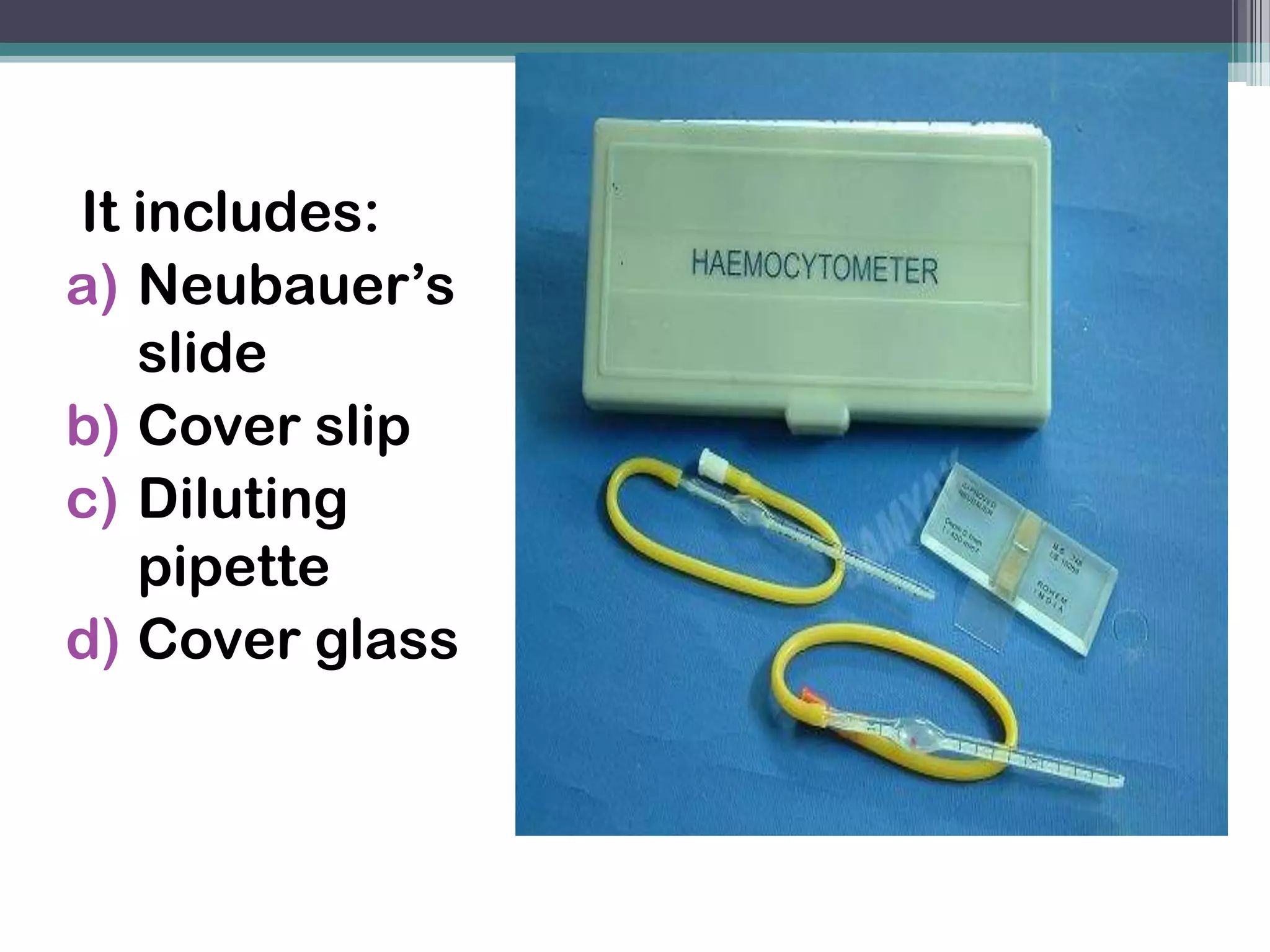
It includes:
a) Neubauer’s
slide
b) Cover slip
c) Diluting
pipette
d) Cover glass
Different types Counting chamber
• Ordinary Neubauer counting chamber
• Improved Neubauer counting chamber
• Levy’s counting chamber
• Fuch’s Rosenthal chamber
NEUBAUER’S SLIDE
• Thick glass slide with two ruling area on
centre
• Ruled area are separated by H-shaped
gutter/trough
• Beyond the two vertical arm of trough
there are two raised shoulder(ridge)
which support cover glass
• lining is coated by shining metal or
rhodium
• Each scale is 3mm wide and 3mm long.
• Depth of the chamber is 0.1mm
• The whole scale is divided into 9 big
squares.
• Each square is 1mm long and 1mm wide.
Hemocytometer
Chamber
The four corner squares are further
divided into sixteen smaller squares and
are used for WBC counting.
Four
corner
squares
are
meant
for WBC
counting.
Total =
64 small
squares
W
W
W
W
• Central square is divided into 25 medium
sized square and are separated by triple
line
• The medium sized square are further
divided into 16 small square(tiny)
• The four corner and central square are
used for platelet and RBC count.
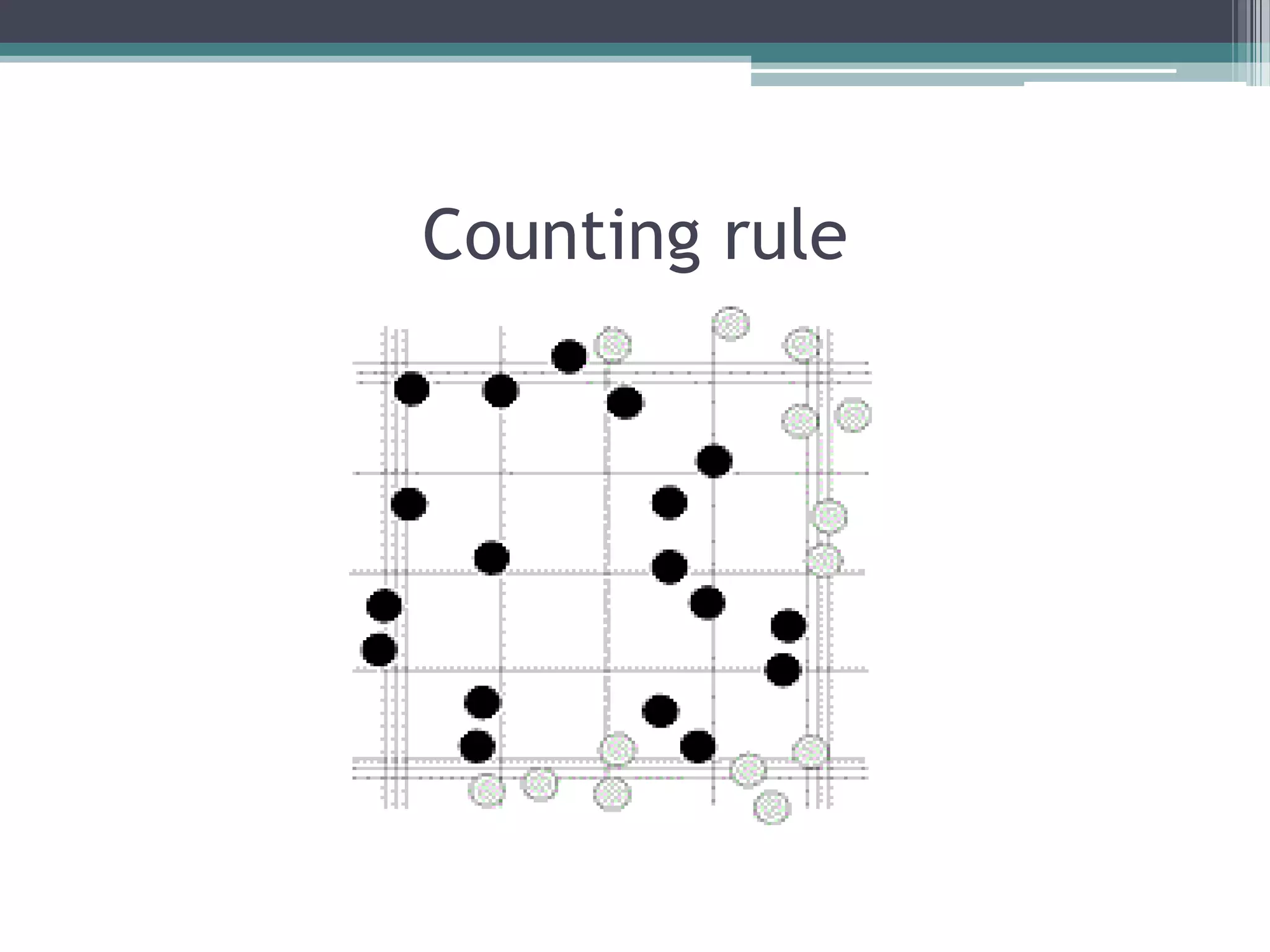
Counting Rule
• Do not count cells
touching
▫ Bottom line
▫ Right line
 This is to avoid
double counting.
Counting rule
Thomas pipette
• Consist of graduated capillary tube, mixing bulb
with glass bead and aspirating tube
• Parts: stem, bulb, rubber tube
• Thomas pipette are: WBC pipette and RBC
pipette
DIFFERENCES BETWEEN RBC AND
WBC PIPETTE
RBC pipette WBC pipette
1) It has a red bead It has a white
bead
2) It has
graduations upto
mark 101
It has
graduations upto
mark 11
3) Size of bulb is
larger
Size of bulb is
smaller
4) Size of lumen is
smaller
Size of lumen is
larger
RBC PIPETTE
WBC PIPETTE
Cover slip
• Special cover glass with smooth surface and even
thickness
• Thickness= 0.3, 0.4, 0.5 mm
• Length= 16x22mm, 22x23mm
For WBC counting
0.5 part of blood is mixed in 10 parts of
fluid
So, 1 part of blood is in 20 parts of fluid
Thus, dilution factor for WBC counting is
20.
Principle
• Dilution of blood
• Sampling of diluted suspension into measured
volume
• Counting of cell in that volume
FOCUSING
• 4X to see the general
formation of slide.
• 10X for WBC counting
• 40X for RBC/Plt. counting
Calculation
Cell count=N x dilution factor x depth factor/area
counted
Source of error
False high count False low count
• Improper mixing
• Uneven distribution of cell
• Error in pipetting
• Error in calculation
• Blood taken from area of hemo
concentration
• Yeast, dirt and leucocyte are
counted as RBC
• Blood diluted with tissue fluid
• Undue delay in counting of cell
• Clumping of cell(AIHA)
• Uneven distribution of cell
• Faulty technique of counting
• Improperly standarized
counting chamber
Thank you

Hemocytometer

  • 1.
  • 2.
    Objectives • What ishemocytometer? • What are the uses of hemocytometer? • Principle of cell counting. • What are the differences between WBC and RBC pipette? • What are the common source of error during cell counting?
  • 3.
    HEMOCYTOMETER Hemo: blood Cyto: cell Meter:measurement Thus, it is an instrument used to count the blood cells.
  • 4.
    It includes: a) Neubauer’s slide b)Cover slip c) Diluting pipette d) Cover glass
  • 5.
    Different types Countingchamber • Ordinary Neubauer counting chamber • Improved Neubauer counting chamber • Levy’s counting chamber • Fuch’s Rosenthal chamber
  • 6.
    NEUBAUER’S SLIDE • Thickglass slide with two ruling area on centre • Ruled area are separated by H-shaped gutter/trough • Beyond the two vertical arm of trough there are two raised shoulder(ridge) which support cover glass • lining is coated by shining metal or rhodium
  • 8.
    • Each scaleis 3mm wide and 3mm long. • Depth of the chamber is 0.1mm • The whole scale is divided into 9 big squares. • Each square is 1mm long and 1mm wide.
  • 10.
  • 11.
    The four cornersquares are further divided into sixteen smaller squares and are used for WBC counting.
  • 12.
  • 15.
    • Central squareis divided into 25 medium sized square and are separated by triple line • The medium sized square are further divided into 16 small square(tiny) • The four corner and central square are used for platelet and RBC count.
  • 16.
    Counting Rule • Donot count cells touching ▫ Bottom line ▫ Right line  This is to avoid double counting.
  • 18.
  • 19.
    Thomas pipette • Consistof graduated capillary tube, mixing bulb with glass bead and aspirating tube • Parts: stem, bulb, rubber tube • Thomas pipette are: WBC pipette and RBC pipette
  • 20.
    DIFFERENCES BETWEEN RBCAND WBC PIPETTE RBC pipette WBC pipette 1) It has a red bead It has a white bead 2) It has graduations upto mark 101 It has graduations upto mark 11 3) Size of bulb is larger Size of bulb is smaller 4) Size of lumen is smaller Size of lumen is larger
  • 21.
  • 23.
    Cover slip • Specialcover glass with smooth surface and even thickness • Thickness= 0.3, 0.4, 0.5 mm • Length= 16x22mm, 22x23mm
  • 24.
    For WBC counting 0.5part of blood is mixed in 10 parts of fluid So, 1 part of blood is in 20 parts of fluid Thus, dilution factor for WBC counting is 20.
  • 25.
    Principle • Dilution ofblood • Sampling of diluted suspension into measured volume • Counting of cell in that volume
  • 26.
    FOCUSING • 4X tosee the general formation of slide. • 10X for WBC counting • 40X for RBC/Plt. counting
  • 27.
    Calculation Cell count=N xdilution factor x depth factor/area counted
  • 28.
    Source of error Falsehigh count False low count • Improper mixing • Uneven distribution of cell • Error in pipetting • Error in calculation • Blood taken from area of hemo concentration • Yeast, dirt and leucocyte are counted as RBC • Blood diluted with tissue fluid • Undue delay in counting of cell • Clumping of cell(AIHA) • Uneven distribution of cell • Faulty technique of counting • Improperly standarized counting chamber
  • 29.