Laboratory glassware
Václav Mach
Laboratory glassware
• Laboratory glassware is a variety of equipment, made of
glass, used for scientific experiments in chemistry and
biology.
• Some of the equipment is now made of plastic for cost
and convenience reasons, but glass is still
used, because it is relatively inert and transparent.
• Borosilicate glasses such as Pyrex are often used
because they are resistant to heat and chemical
substances.
• Most laboratory glassware is now mass-produced, but
most large laboratories employ a glass blower to
construct specialized pieces.
– transparent – průhledný
– glass blower – sklář
Laboratory glassware
• Laboratory glassware includes
– Test tubes, flasks, beakers, Petri dishes, watch
glasses, graduated cylinders, pippets, burettes,
funnels
• Flasks
– Erlenmayer, volumetric, filtering, boiling, titrating
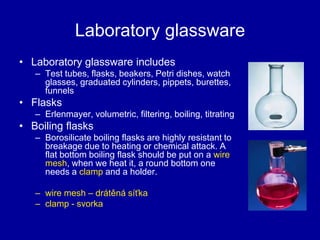
• Boiling flasks
– Borosilicate boiling flasks are highly resistant to
breakage due to heating or chemical attack. A
flat bottom boiling flask should be put on a wire
mesh, when we heat it, a round bottom one
needs a clamp and a holder.
– wire mesh – drátěná síťka
– clamp - svorka
Laboratory glassware
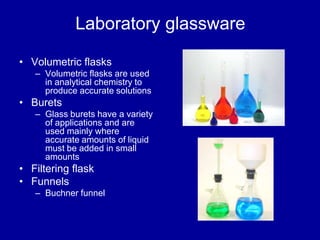
• Volumetric flasks
– Volumetric flasks are used
in analytical chemistry to
produce accurate solutions
• Burets
– Glass burets have a variety
of applications and are
used mainly where
accurate amounts of liquid
must be added in small
amounts
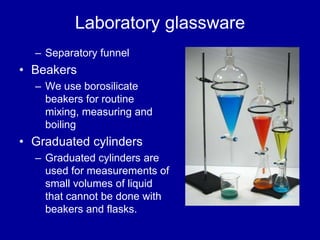
• Filtering flask
• Funnels
– Buchner funnel
Laboratory glassware
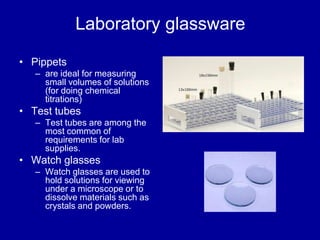
– Separatory funnel
• Beakers
– We use borosilicate
beakers for routine
mixing, measuring and
boiling
• Graduated cylinders
– Graduated cylinders are
used for measurements of
small volumes of liquid
that cannot be done with
beakers and flasks.
Laboratory glassware
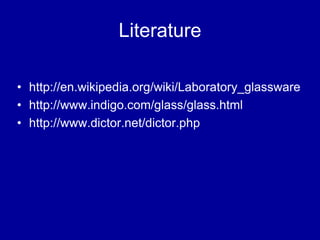
• Pippets
– are ideal for measuring
small volumes of solutions
(for doing chemical
titrations)
• Test tubes
– Test tubes are among the
most common of
requirements for lab
supplies.
• Watch glasses
– Watch glasses are used to
hold solutions for viewing
under a microscope or to
dissolve materials such as
crystals and powders.
Literature
• http://en.wikipedia.org/wiki/Laboratory_glassware
• http://www.indigo.com/glass/glass.html
• http://www.dictor.net/dictor.php

Glass ware

  • 1.
  • 2.
    Laboratory glassware • Laboratoryglassware is a variety of equipment, made of glass, used for scientific experiments in chemistry and biology. • Some of the equipment is now made of plastic for cost and convenience reasons, but glass is still used, because it is relatively inert and transparent. • Borosilicate glasses such as Pyrex are often used because they are resistant to heat and chemical substances. • Most laboratory glassware is now mass-produced, but most large laboratories employ a glass blower to construct specialized pieces. – transparent – průhledný – glass blower – sklář
  • 3.
    Laboratory glassware • Laboratoryglassware includes – Test tubes, flasks, beakers, Petri dishes, watch glasses, graduated cylinders, pippets, burettes, funnels • Flasks – Erlenmayer, volumetric, filtering, boiling, titrating • Boiling flasks – Borosilicate boiling flasks are highly resistant to breakage due to heating or chemical attack. A flat bottom boiling flask should be put on a wire mesh, when we heat it, a round bottom one needs a clamp and a holder. – wire mesh – drátěná síťka – clamp - svorka
  • 4.
    Laboratory glassware • Volumetricflasks – Volumetric flasks are used in analytical chemistry to produce accurate solutions • Burets – Glass burets have a variety of applications and are used mainly where accurate amounts of liquid must be added in small amounts • Filtering flask • Funnels – Buchner funnel
  • 5.
    Laboratory glassware – Separatoryfunnel • Beakers – We use borosilicate beakers for routine mixing, measuring and boiling • Graduated cylinders – Graduated cylinders are used for measurements of small volumes of liquid that cannot be done with beakers and flasks.
  • 6.
    Laboratory glassware • Pippets –are ideal for measuring small volumes of solutions (for doing chemical titrations) • Test tubes – Test tubes are among the most common of requirements for lab supplies. • Watch glasses – Watch glasses are used to hold solutions for viewing under a microscope or to dissolve materials such as crystals and powders.
  • 7.