Prepared By :-
Abu Raihan Shams
Aqsa Khan
Pharm. D , 2nd
Guided By :-
Dr. SHAHID JAMIL
ASST. PROFESSOR
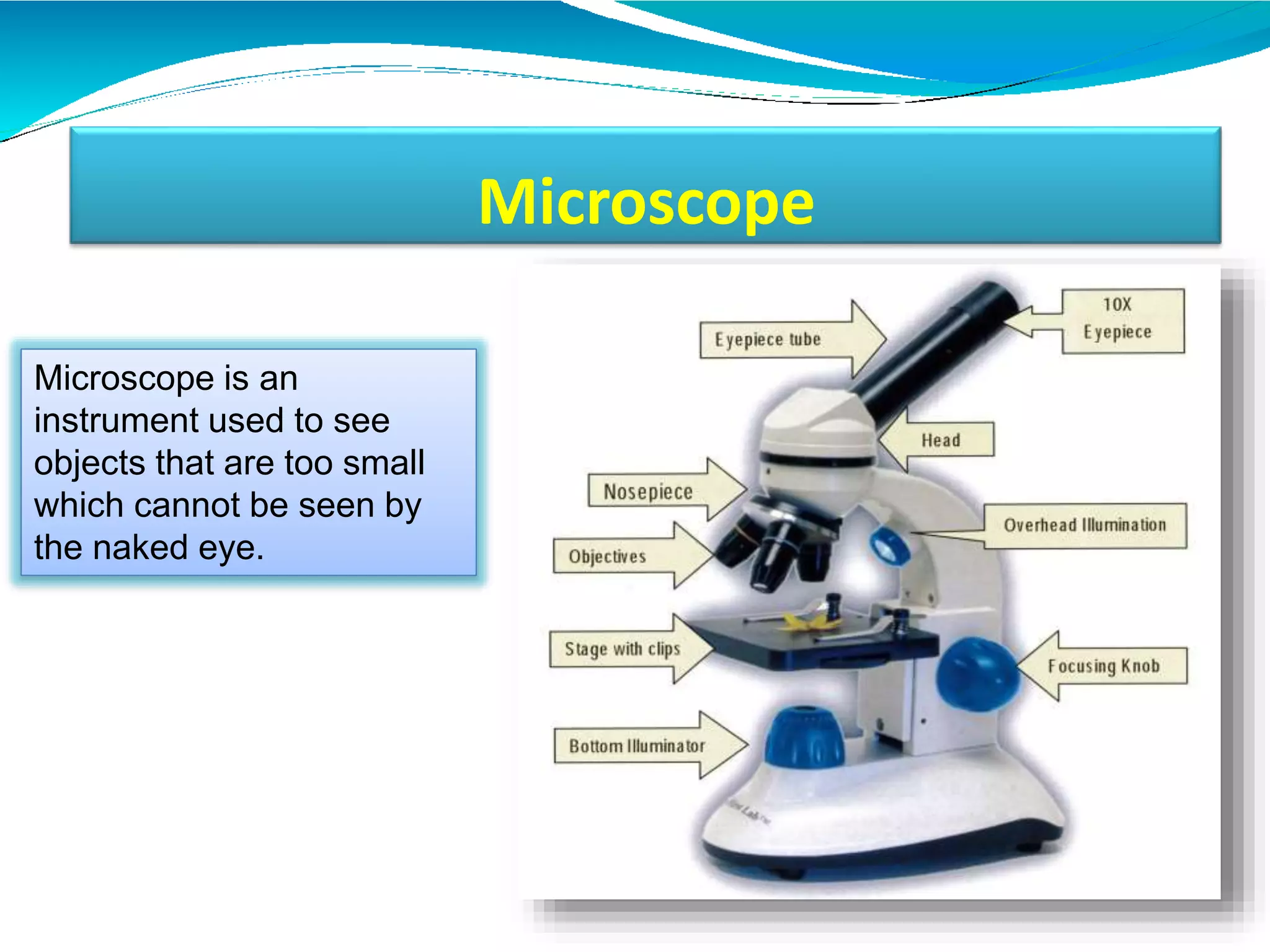
Microscope
Microscope is an
instrument used to see
objects that are too small
which cannot be seen by
the naked eye.
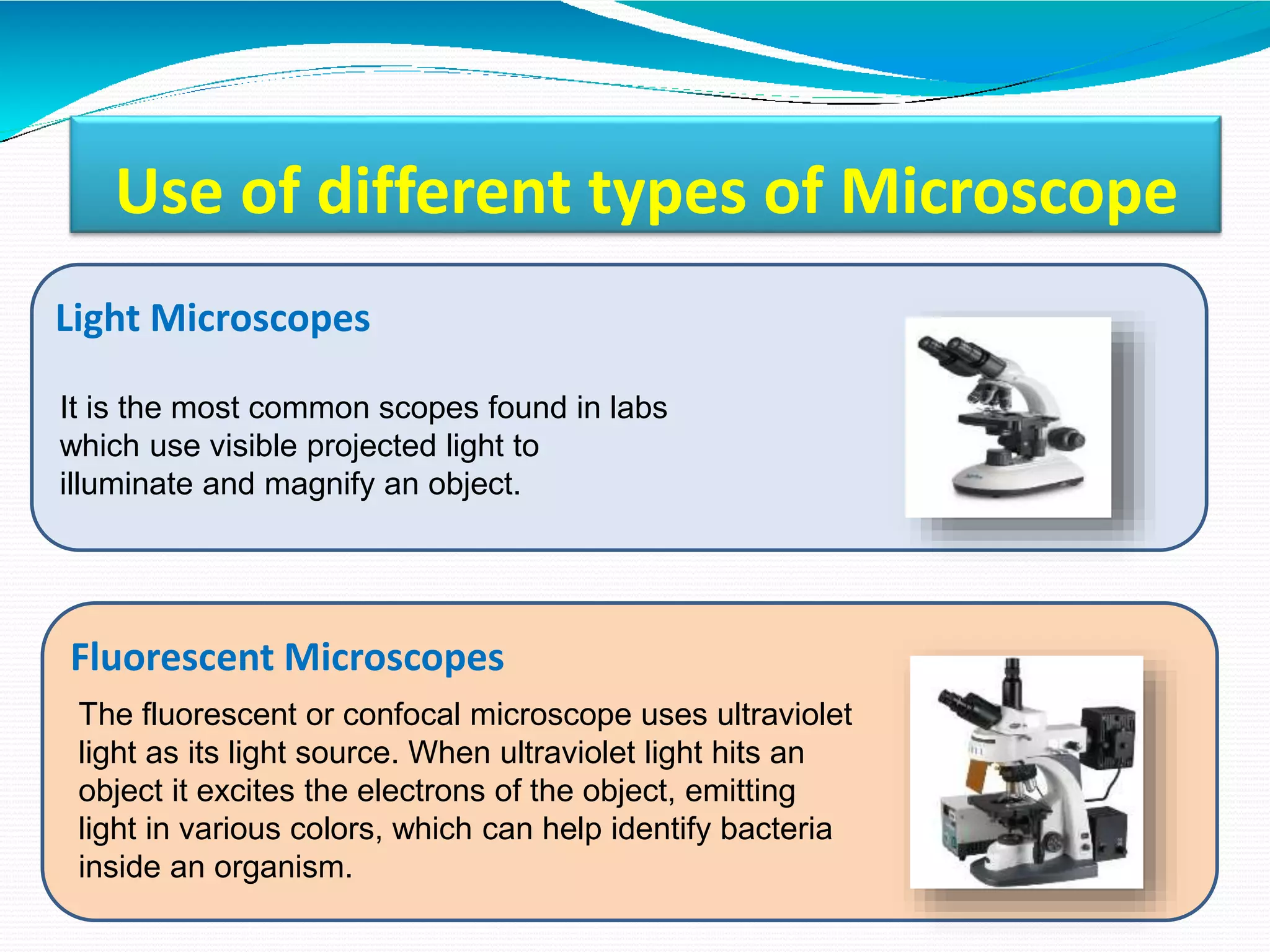
Use of different types of Microscope
Light Microscopes
It is the most common scopes found in labs
which use visible projected light to
illuminate and magnify an object.
Fluorescent Microscopes
The fluorescent or confocal microscope uses ultraviolet
light as its light source. When ultraviolet light hits an
object it excites the electrons of the object, emitting
light in various colors, which can help identify bacteria
inside an organism.
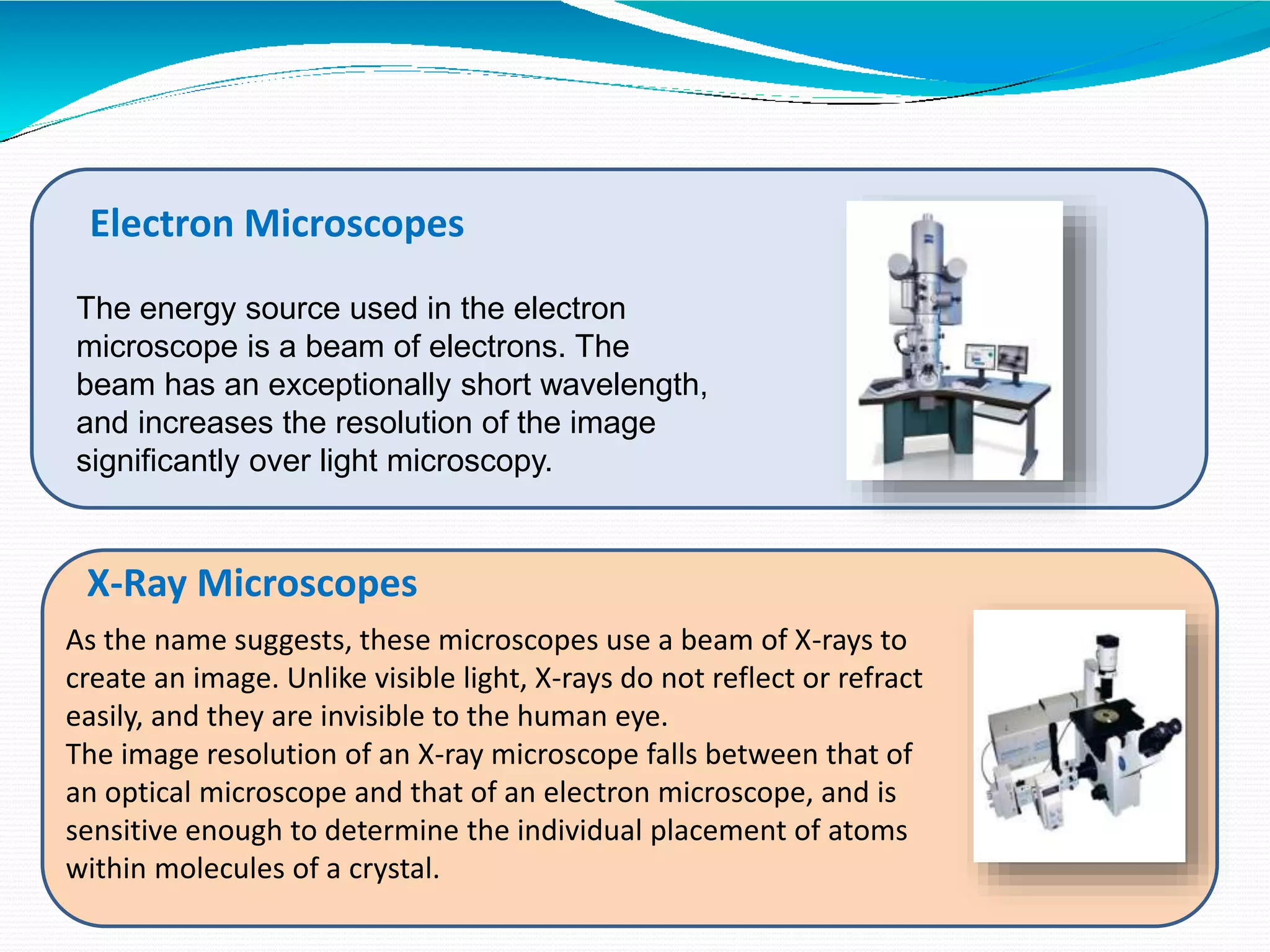
Electron Microscopes
The energy source used in the electron
microscope is a beam of electrons. The
beam has an exceptionally short wavelength,
and increases the resolution of the image
significantly over light microscopy.
X-Ray Microscopes
As the name suggests, these microscopes use a beam of X-rays to
create an image. Unlike visible light, X-rays do not reflect or refract
easily, and they are invisible to the human eye.
The image resolution of an X-ray microscope falls between that of
an optical microscope and that of an electron microscope, and is
sensitive enough to determine the individual placement of atoms
within molecules of a crystal.
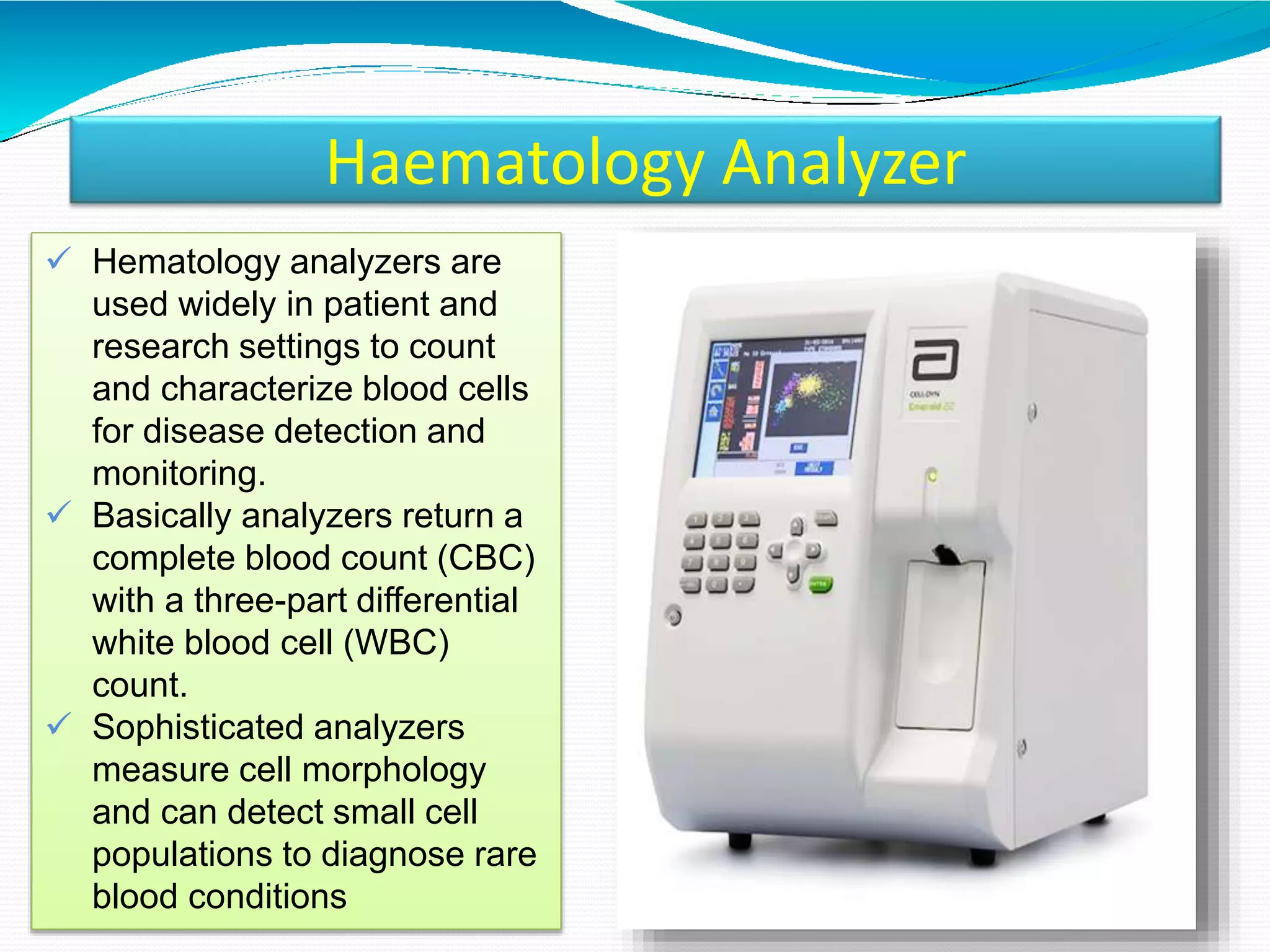
Haematology Analyzer
 Hematology analyzers are
used widely in patient and
research settings to count
and characterize blood cells
for disease detection and
monitoring.
 Basically analyzers return a
complete blood count (CBC)
with a three-part differential
white blood cell (WBC)
count.
 Sophisticated analyzers
measure cell morphology
and can detect small cell
populations to diagnose rare
blood conditions
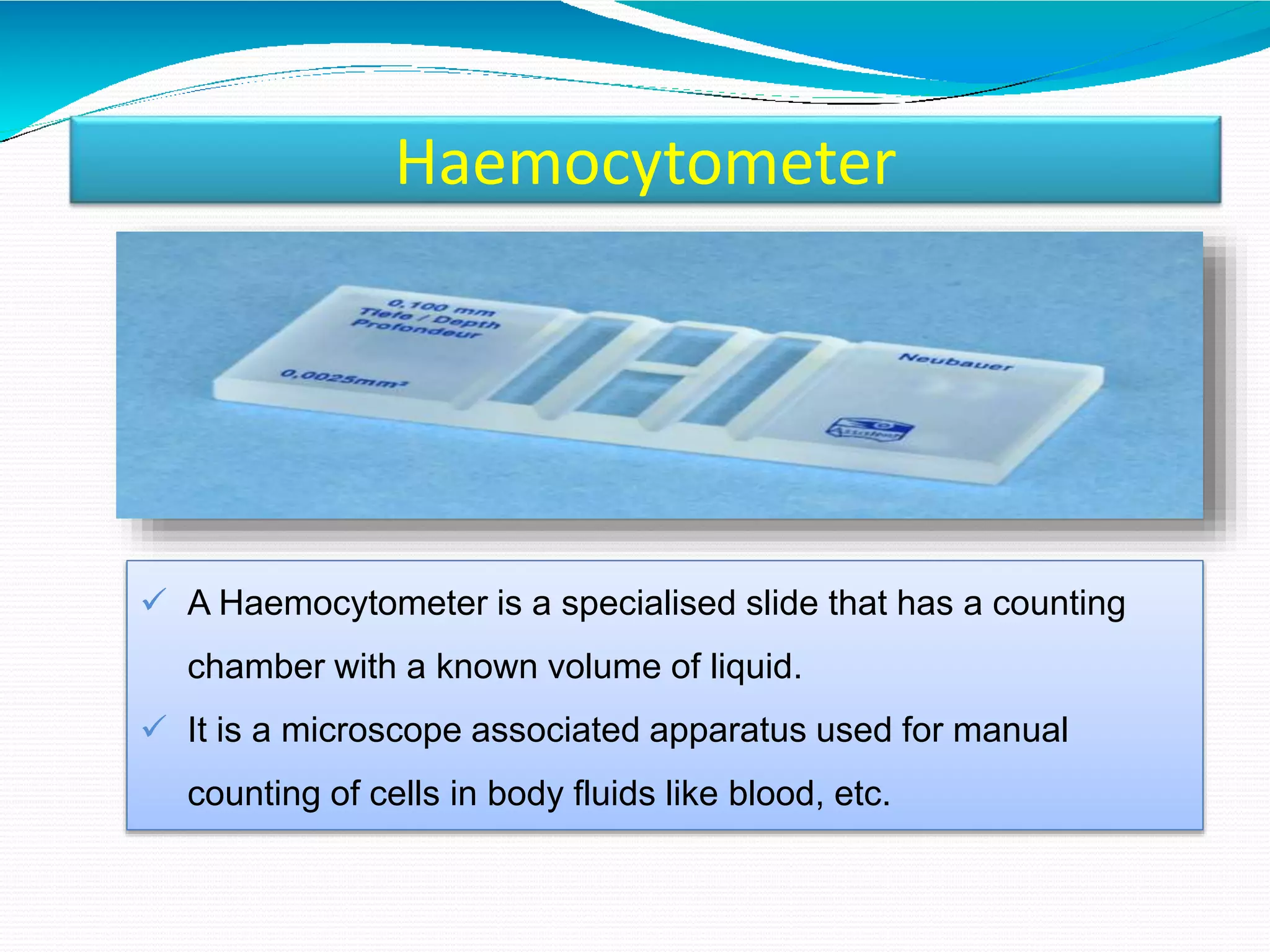
Haemocytometer
 A Haemocytometer is a specialised slide that has a counting
chamber with a known volume of liquid.
 It is a microscope associated apparatus used for manual
counting of cells in body fluids like blood, etc.
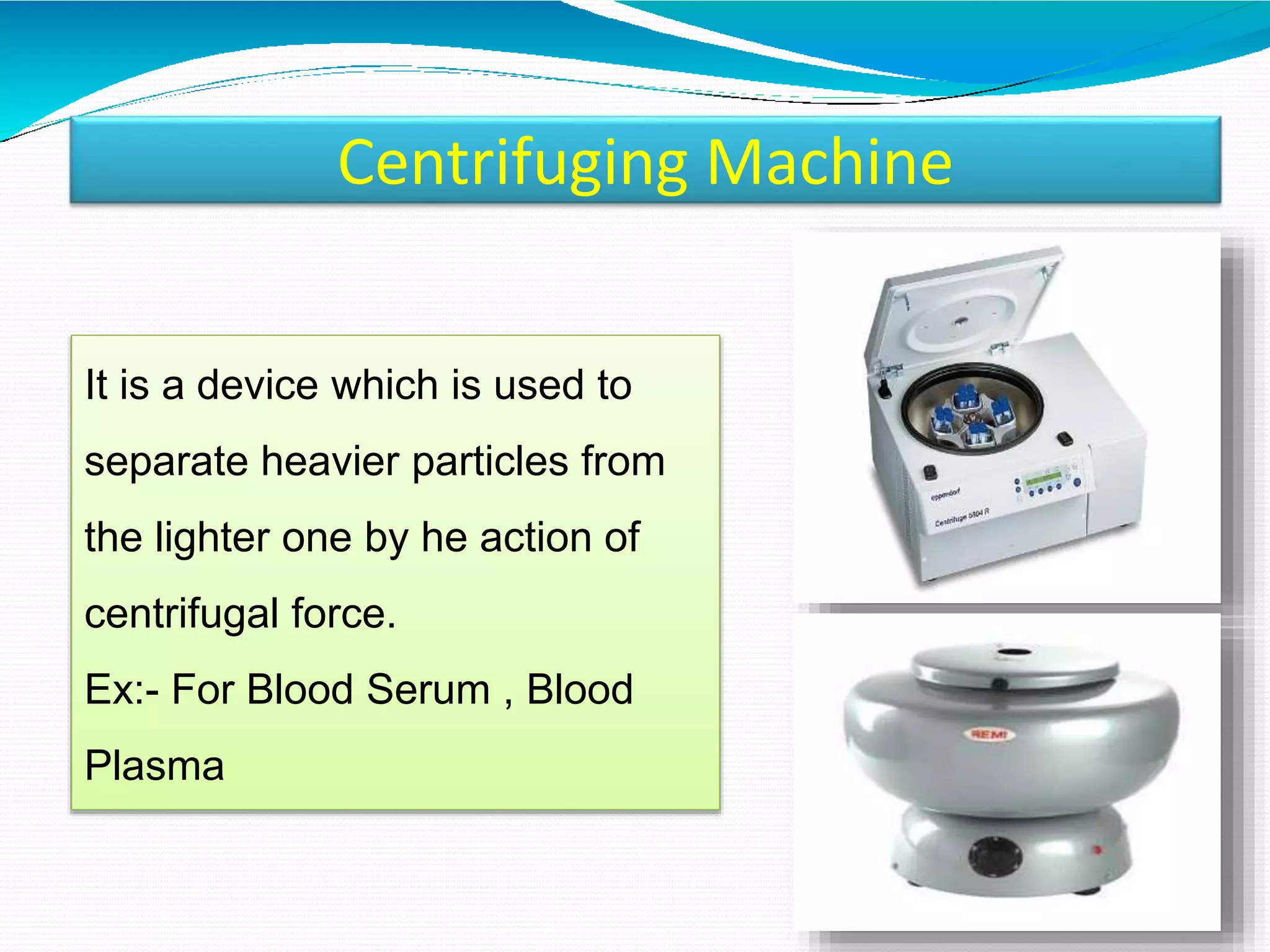
Centrifuging Machine
It is a device which is used to
separate heavier particles from
the lighter one by he action of
centrifugal force.
Ex:- For Blood Serum , Blood
Plasma
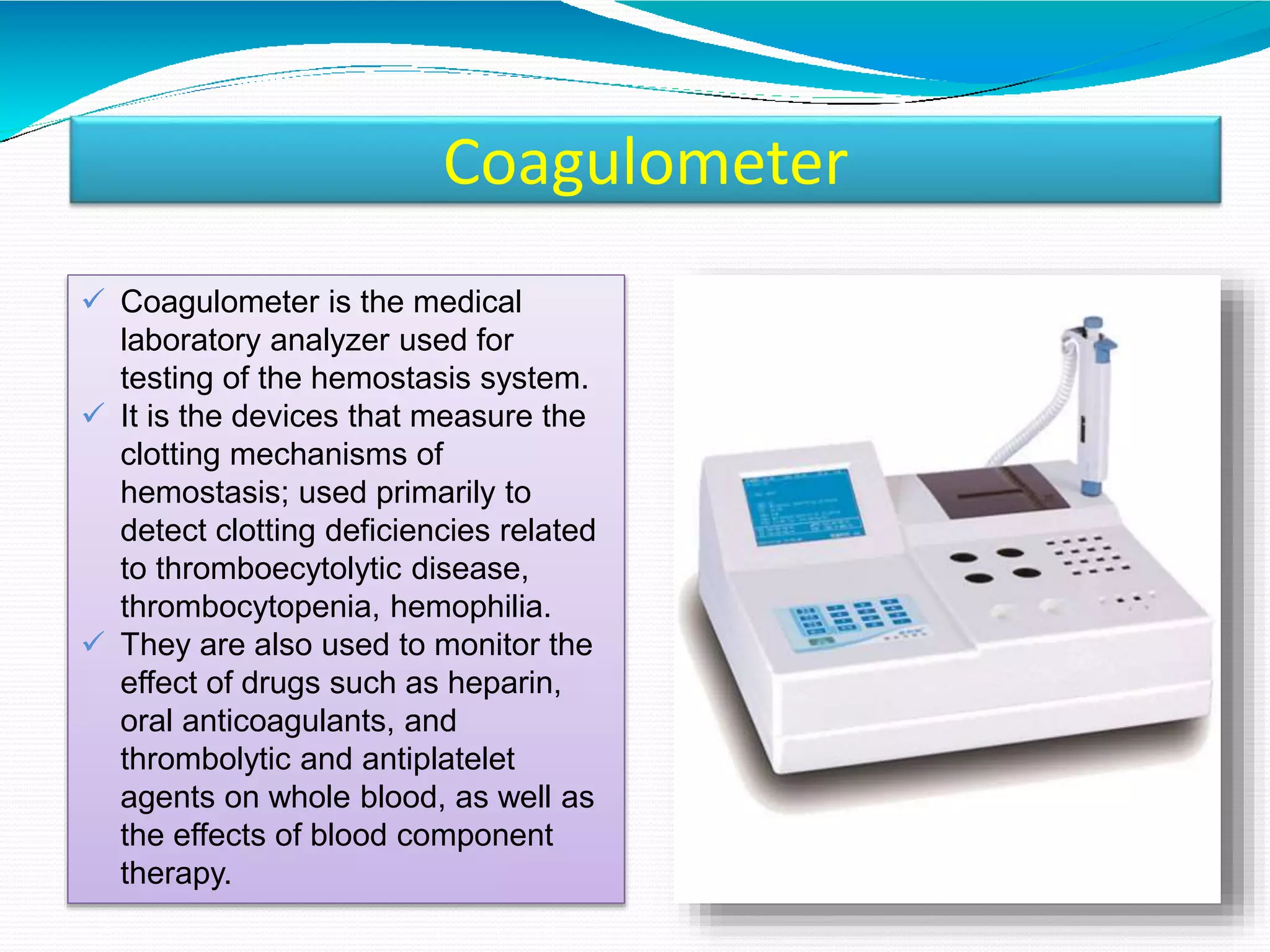
Coagulometer
 Coagulometer is the medical
laboratory analyzer used for
testing of the hemostasis system.
 It is the devices that measure the
clotting mechanisms of
hemostasis; used primarily to
detect clotting deficiencies related
to thromboecytolytic disease,
thrombocytopenia, hemophilia.
 They are also used to monitor the
effect of drugs such as heparin,
oral anticoagulants, and
thrombolytic and antiplatelet
agents on whole blood, as well as
the effects of blood component
therapy.
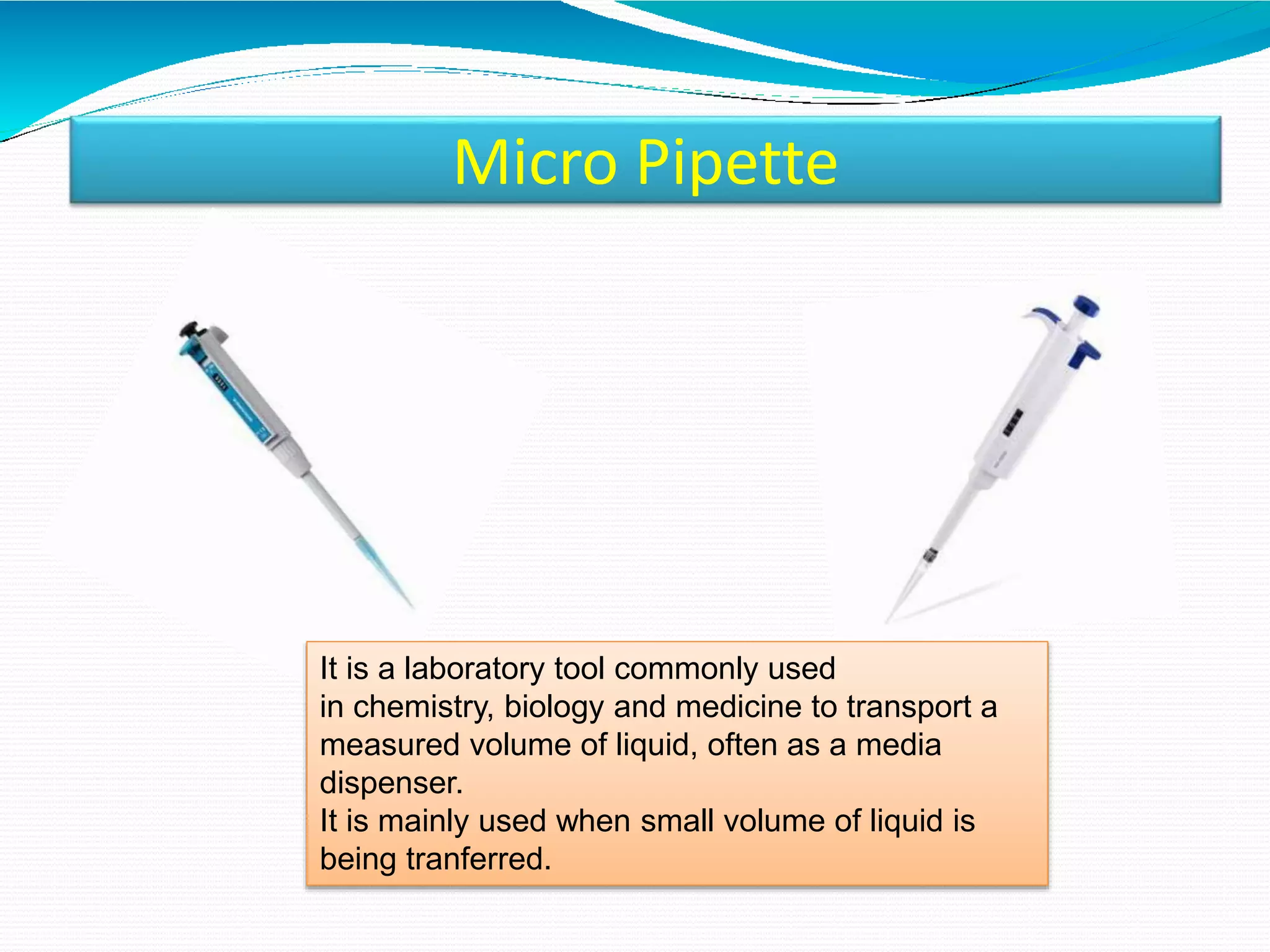
Micro Pipette
It is a laboratory tool commonly used
in chemistry, biology and medicine to transport a
measured volume of liquid, often as a media
dispenser.
It is mainly used when small volume of liquid is
being tranferred.
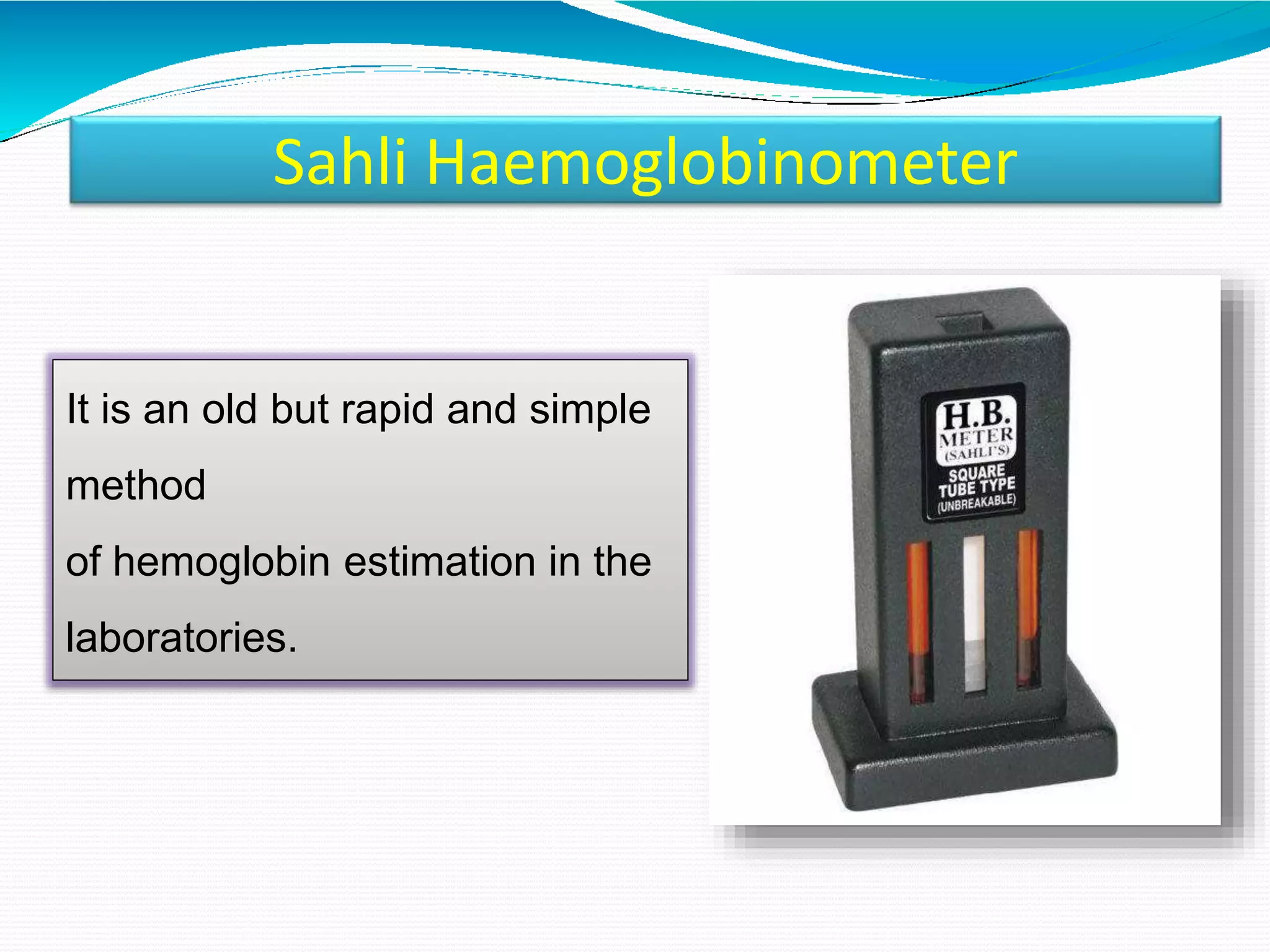
Sahli Haemoglobinometer
It is an old but rapid and simple
method
of hemoglobin estimation in the
laboratories.
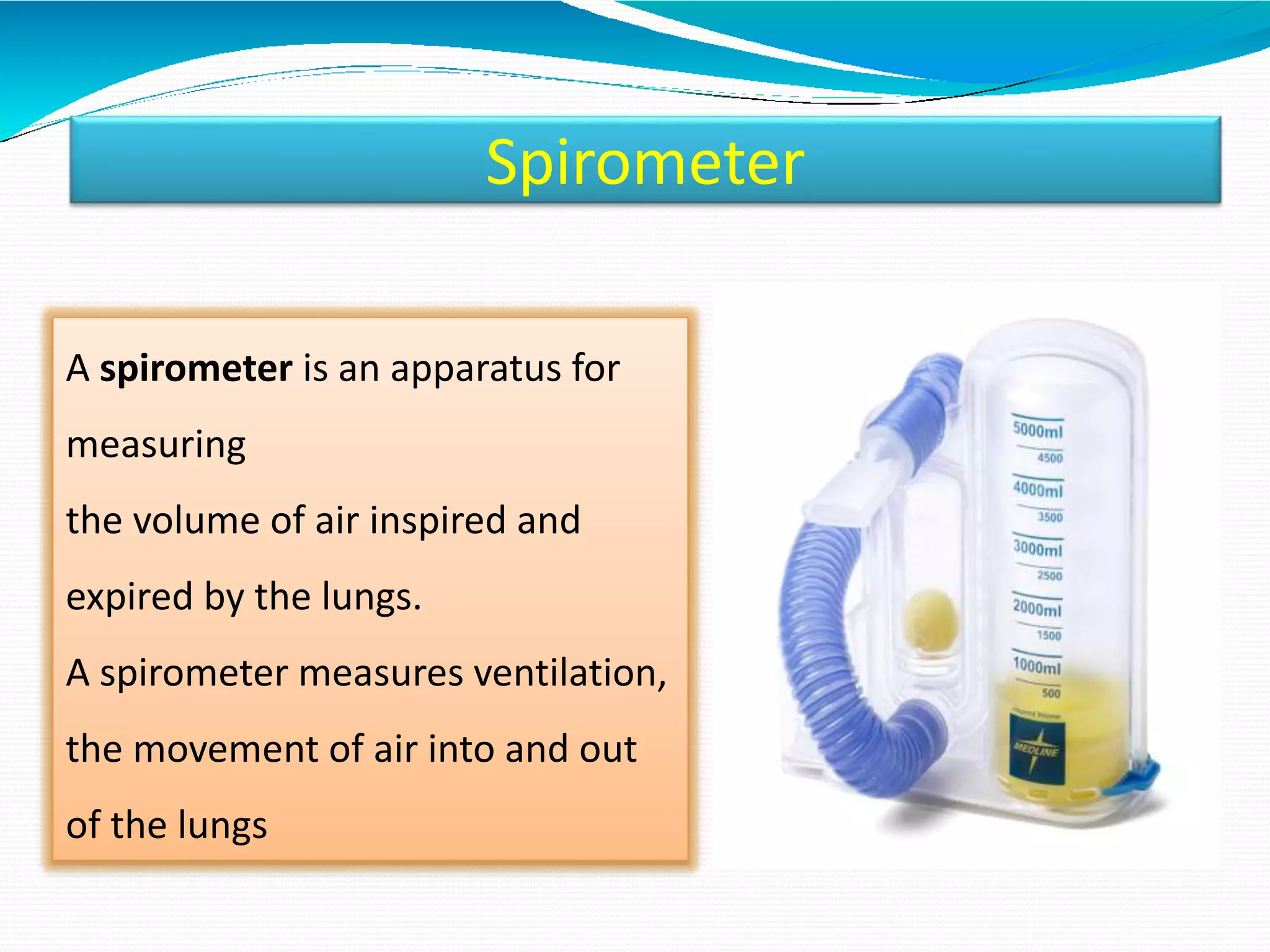
Spirometer
A spirometer is an apparatus for
measuring
the volume of air inspired and
expired by the lungs.
A spirometer measures ventilation,
the movement of air into and out
of the lungs
REFERENCES
https://sciencing.com/different-types-microscopy-
used-microbiology-laboratory-16179.html
https://www.labcompare.com/10-Featured-
Articles/162042-Hematology-Analyzers-From-
Complete-Blood-Counts-to-Cell-Morphology/
https://www.slideshare.net/pankajnaliyapara/centrif
uge-33701880
https://www.who.int/medical_devices/innovation/w
hole_blood_coagulation_analyzer.pdf
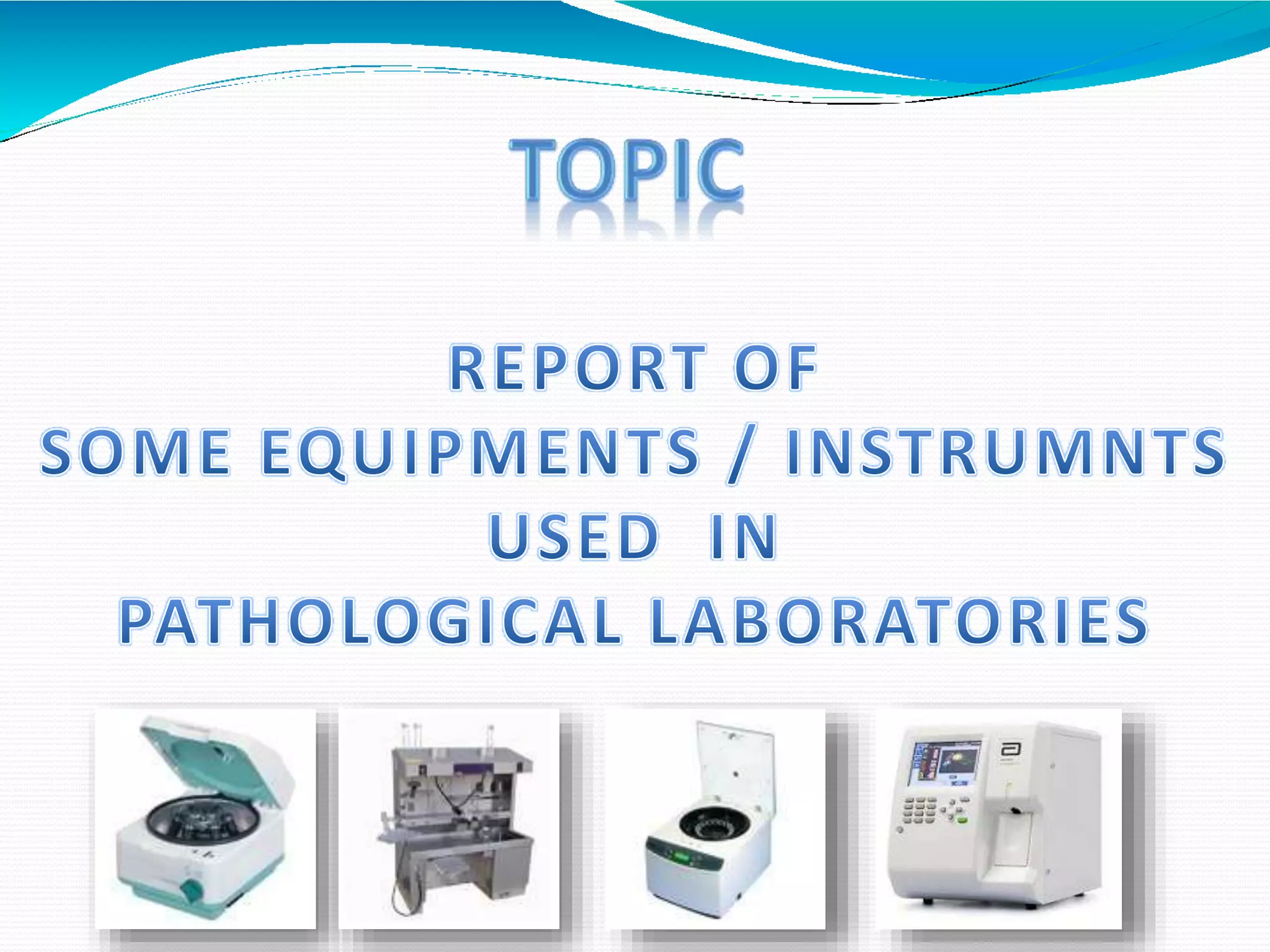
REPORT OF SOME EQUIPMENTS / INSTRUMENTS USED  IN PATHOLOGICAL LABORATORIES

REPORT OF SOME EQUIPMENTS / INSTRUMENTS USED IN PATHOLOGICAL LABORATORIES

  • 1.
    Prepared By :- AbuRaihan Shams Aqsa Khan Pharm. D , 2nd Guided By :- Dr. SHAHID JAMIL ASST. PROFESSOR
  • 3.
    Microscope Microscope is an instrumentused to see objects that are too small which cannot be seen by the naked eye.
  • 4.
    Use of differenttypes of Microscope Light Microscopes It is the most common scopes found in labs which use visible projected light to illuminate and magnify an object. Fluorescent Microscopes The fluorescent or confocal microscope uses ultraviolet light as its light source. When ultraviolet light hits an object it excites the electrons of the object, emitting light in various colors, which can help identify bacteria inside an organism.
  • 5.
    Electron Microscopes The energysource used in the electron microscope is a beam of electrons. The beam has an exceptionally short wavelength, and increases the resolution of the image significantly over light microscopy. X-Ray Microscopes As the name suggests, these microscopes use a beam of X-rays to create an image. Unlike visible light, X-rays do not reflect or refract easily, and they are invisible to the human eye. The image resolution of an X-ray microscope falls between that of an optical microscope and that of an electron microscope, and is sensitive enough to determine the individual placement of atoms within molecules of a crystal.
  • 6.
    Haematology Analyzer  Hematologyanalyzers are used widely in patient and research settings to count and characterize blood cells for disease detection and monitoring.  Basically analyzers return a complete blood count (CBC) with a three-part differential white blood cell (WBC) count.  Sophisticated analyzers measure cell morphology and can detect small cell populations to diagnose rare blood conditions
  • 7.
    Haemocytometer  A Haemocytometeris a specialised slide that has a counting chamber with a known volume of liquid.  It is a microscope associated apparatus used for manual counting of cells in body fluids like blood, etc.
  • 8.
    Centrifuging Machine It isa device which is used to separate heavier particles from the lighter one by he action of centrifugal force. Ex:- For Blood Serum , Blood Plasma
  • 9.
    Coagulometer  Coagulometer isthe medical laboratory analyzer used for testing of the hemostasis system.  It is the devices that measure the clotting mechanisms of hemostasis; used primarily to detect clotting deficiencies related to thromboecytolytic disease, thrombocytopenia, hemophilia.  They are also used to monitor the effect of drugs such as heparin, oral anticoagulants, and thrombolytic and antiplatelet agents on whole blood, as well as the effects of blood component therapy.
  • 10.
    Micro Pipette It isa laboratory tool commonly used in chemistry, biology and medicine to transport a measured volume of liquid, often as a media dispenser. It is mainly used when small volume of liquid is being tranferred.
  • 11.
    Sahli Haemoglobinometer It isan old but rapid and simple method of hemoglobin estimation in the laboratories.
  • 12.
    Spirometer A spirometer isan apparatus for measuring the volume of air inspired and expired by the lungs. A spirometer measures ventilation, the movement of air into and out of the lungs
  • 14.