DENTAL
AVULSION
Dr.MOHAMMED SHALIK
Al-Azhar Dental College
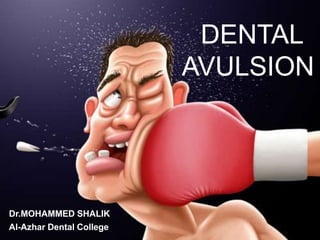
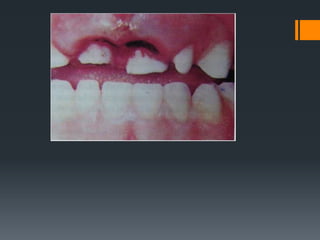
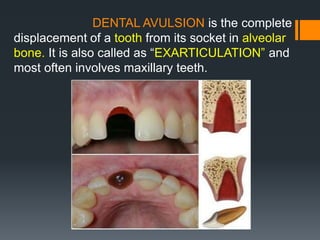
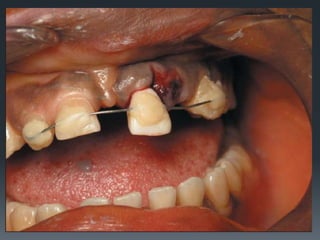
DENTAL AVULSION is the complete
displacement of a tooth from its socket in alveolar
bone. It is also called as “EXARTICULATION” and
most often involves maxillary teeth.
CAUSE
S
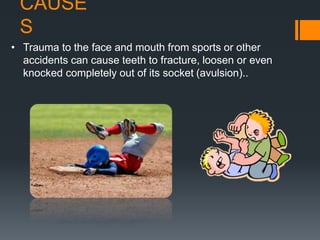
• Trauma to the face and mouth from sports or other
accidents can cause teeth to fracture, loosen or even
knocked completely out of its socket (avulsion)..
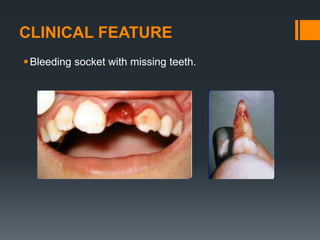
CLINICAL FEATURE
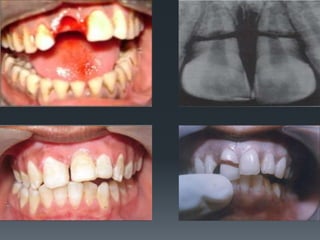
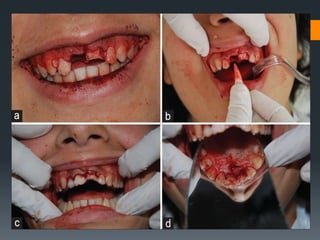
Bleeding socket with missing teeth.
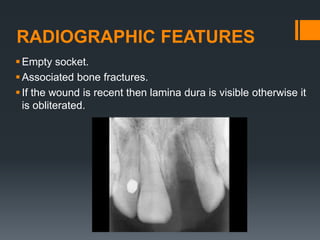
RADIOGRAPHIC FEATURES
Empty socket.
Associated bone fractures.
If the wound is recent then lamina dura is visible otherwise it
is obliterated.
TREATMENT
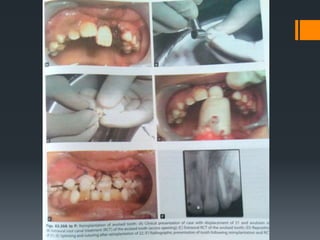
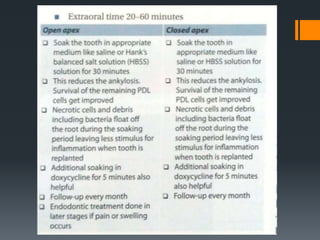
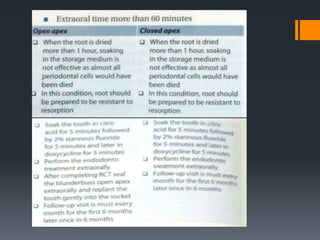
Reimplantation depends on extra oral time.
If apical foramen is not closed – endodontic therapy is
delayed till first signs of apical closure are seen.
If apical foramen is closed – endodontic therapy is done
after 1-2 weeks depending on type of reimplantation.
MANAGEMENT
• A. Management at site of injury.
• B. Management in the dental office.
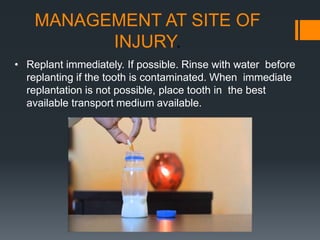
MANAGEMENT AT SITE OF
INJURY.
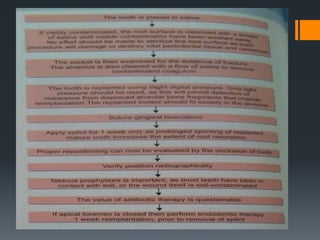
• Replant immediately. If possible. Rinse with water before
replanting if the tooth is contaminated. When immediate
replantation is not possible, place tooth in the best
available transport medium available.
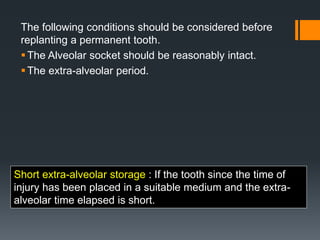
The following conditions should be considered before
replanting a permanent tooth.
The Alveolar socket should be reasonably intact.
The extra-alveolar period.
Short extra-alveolar storage : If the tooth since the time of
injury has been placed in a suitable medium and the extra-
alveolar time elapsed is short.
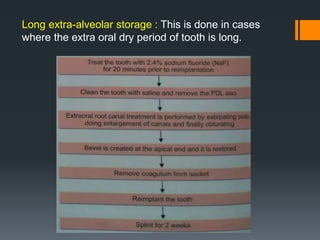
Long extra-alveolar storage : This is done in cases
where the extra oral dry period of tooth is long.
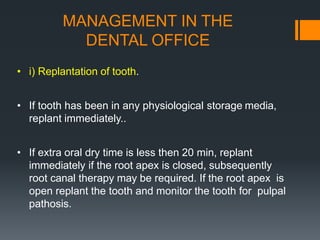
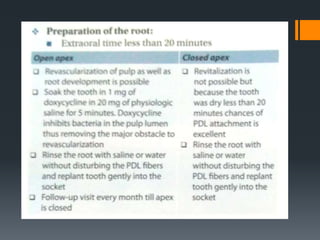
• i) Replantation of tooth.
• If tooth has been in any physiological storage media,
replant immediately..
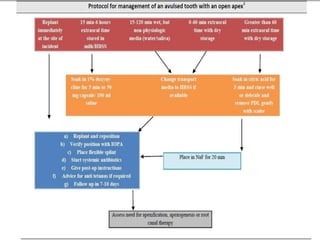
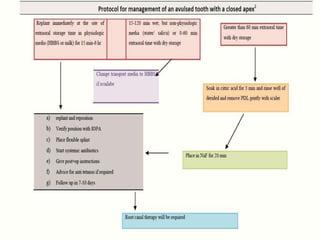
• If extra oral dry time is less then 20 min, replant
immediately if the root apex is closed, subsequently
root canal therapy may be required. If the root apex is
open replant the tooth and monitor the tooth for pulpal
pathosis.
MANAGEMENT IN THE
DENTAL OFFICE
• If extra oral dry time is greater than 20 min rinse with
saline and replant only if the root apex is closed
because replanting the tooth with open apex increases
the risk of ankylosis.
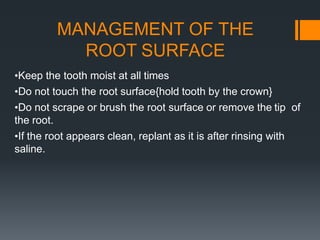
MANAGEMENT OF THE
ROOT SURFACE
•Keep the tooth moist at all times
•Do not touch the root surface{hold tooth by the crown}
•Do not scrape or brush the root surface or remove the tip of
the root.
•If the root appears clean, replant as it is after rinsing with
saline.
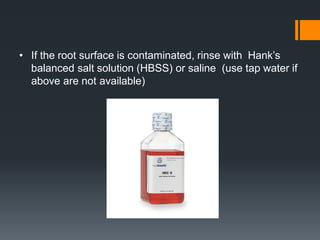
• If the root surface is contaminated, rinse with Hank’s
balanced salt solution (HBSS) or saline (use tap water if
above are not available)
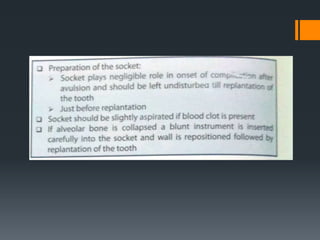
MANAGEMENT OF THE
SOCKET
•Do not curette the socket. If a clot is present, use light
irrigation with saline.
•Do not make a surgical flap unless bony fragments
prevent replantation.
•If the alveolar bone is collapsed and prevents
replantation carefully insert a blunt instrument into the
socket to reposition the bone to its original position. After
replantation manually compress facial and lingual bony
plates .
STORAGE MEDIA FOR AVULSED
TEETH
As dry storage is detrimental to the preservation of the
PDL, the Avulsed tooth must be prevented from drying by
the usage of storage media of correct osmolarity and pH.
EFFECT OF STORAGE MEDIA ON PERIODONTAL
HEALING
It should not produce any antigen antibody reactions
It should reduce the risk of post-implantation root
resorption or ankylosis.
It should have a good shelf life
IDEAL REQUIREMENTS
 It should have antimicrobial characterstics
 It should be able to maintain the viability or the periodontal
fibres.
 It should favour proliferative capacity of the cells.
 It should have the same osmolarity as that of body fluids.
TYPES OF STORAGE MEDIA
1.Saline Solution
2.Tap water
3.Saliva
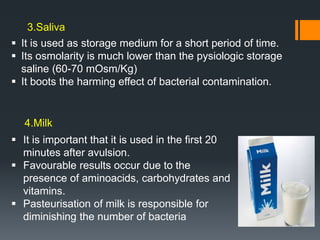
4.Milk
5.Hank’s Balenced salt solution
6.Viaspan
7.Gatarade
8.Propolis
9.Contact lens solution
10.Emdogain
11.Egg white
12.Eagle’s medium
13.L-Dopa
14.Coconut water
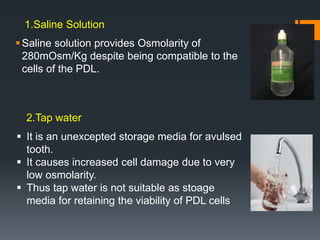
Saline solution provides Osmolarity of
280mOsm/Kg despite being compatible to the
cells of the PDL.
1.Saline Solution
2.Tap water
 It is an unexcepted storage media for avulsed
tooth.
 It causes increased cell damage due to very
low osmolarity.
 Thus tap water is not suitable as stoage
media for retaining the viability of PDL cells
 It is used as storage medium for a short period of time.
 Its osmolarity is much lower than the pysiologic storage
saline (60-70 mOsm/Kg)
 It boots the harming effect of bacterial contamination.
3.Saliva
4.Milk
 It is important that it is used in the first 20
minutes after avulsion.
 Favourable results occur due to the
presence of aminoacids, carbohydrates and
vitamins.
 Pasteurisation of milk is responsible for
diminishing the number of bacteria
 Standard soliution.
 This solution is Non-toxic, Biocompatible with PDL cells, pH
balenced at 7.2, and osmolarity of 320 mOsm/kg
 It does not require refrigerator.
 It can be kept on the shelf for 2 years.
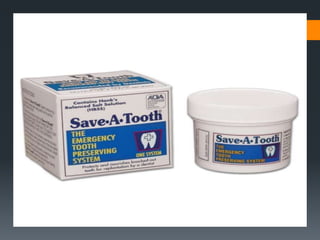
• Recently, an avulsed tooth preserving system called –
‘SAVE A TOOTH’ containing Hank’s balanced salt
solution(HBSS), a pH preserving fluid and trauma
reducing suspension apparatus is available.
• It may be used in serious accidents that relegate
replantation to secondary importance and hence
replanted when crisis is over.
5.Hank’s Balenced salt solution (HBSS)
 Cold Transport organ storage medium
 Osmolarity is 320 mOsm/L, with a pH of 7.4 which is
ideal for cell growth
 Non-carbonated sports drink
 pH of 3 and Osmolarity ranges from 280 mOsm/L to 360
mOsm/L
• It is a sticky resin that seeps from the buds or bark of trees,
chiefly confers.
• It has antiseptic, antibiotic, antibacterial, antifungal,
antiviral, antioxidant, anticarcinogenic properties.
6.Viaspan
7.Gatarade
8.Propolis
• They conatain buffered, isotonic saline solutions with
addition of preservatives that may preserve the viability
of PDL cells
• Emdogain diminishes the percentage of fibroblasts of the
PDL with the capability of forming colonies and that lowers
the capability of fibroblast to repopulate the dental radicular
surface after dental avulsion
• Teeth stored in egg white for 6-10 hours had a better
incidence of repair than those stored in milk for the same
amount of time
9.Contact lens solution
10.Emdogain
11.Egg white
• It conatins L-glutamine,penicillin, streptomycin, nystatin
and calf serum.
• It has high viability, mitogenic and clonogenic capacity
upto 8 hours of stoage at 4 degree C
• Levo dopa is a drug with possibe mitogenic effects.
• It stimulates pituitary to release GH which promotes
healing process.
• It also has local effects in the growth of PDL cells.
• Replenishes the fluids, electrolytes and sugar lost from
the body during heavy physical work
12.Eagle’s medium
13.L-Dopa
14.Coconut water
SPLINTING
 Splint should remain in place for 7-10 days However if
tooth demonstrates excessive mobility splint should be
maintained until mobility reduces
• Oral/systemic antibiotics
• Referral to physician for tetanus prophylaxis within
48 hours.
• Chlorhexidine rinses
• Analgesics
ADJUNCTIVE DRUG THERAPY
Potential complications of replantation are;
• 1) Inflammatory resorption
• 2) Replacement resorption
• 3) Ankylosis
• 4) Tooth submergence
COMPLICATIONS
CONCLUSION
An Avulsed permanent tooth is one of the few real
emergency situations in dentistry. Dentist sholuld always be
prepared to give appropriate advice to the public about first
aid managemnt of avulsed tooth.
REFERENCE
• Textbook of Pediatric Dentistry by Nikhil
Marwah
• Textbook of Pediatric Dentistry by Shobha
Tandon
Dental Avulsion

Dental Avulsion

  • 1.
  • 6.
    DENTAL AVULSION isthe complete displacement of a tooth from its socket in alveolar bone. It is also called as “EXARTICULATION” and most often involves maxillary teeth.
  • 7.
    CAUSE S • Trauma tothe face and mouth from sports or other accidents can cause teeth to fracture, loosen or even knocked completely out of its socket (avulsion)..
  • 8.
  • 9.
    RADIOGRAPHIC FEATURES Empty socket. Associatedbone fractures. If the wound is recent then lamina dura is visible otherwise it is obliterated.
  • 10.
    TREATMENT Reimplantation depends onextra oral time. If apical foramen is not closed – endodontic therapy is delayed till first signs of apical closure are seen. If apical foramen is closed – endodontic therapy is done after 1-2 weeks depending on type of reimplantation.
  • 11.
    MANAGEMENT • A. Managementat site of injury. • B. Management in the dental office.
  • 12.
    MANAGEMENT AT SITEOF INJURY. • Replant immediately. If possible. Rinse with water before replanting if the tooth is contaminated. When immediate replantation is not possible, place tooth in the best available transport medium available.
  • 13.
    The following conditionsshould be considered before replanting a permanent tooth. The Alveolar socket should be reasonably intact. The extra-alveolar period. Short extra-alveolar storage : If the tooth since the time of injury has been placed in a suitable medium and the extra- alveolar time elapsed is short.
  • 15.
    Long extra-alveolar storage: This is done in cases where the extra oral dry period of tooth is long.
  • 17.
    • i) Replantationof tooth. • If tooth has been in any physiological storage media, replant immediately.. • If extra oral dry time is less then 20 min, replant immediately if the root apex is closed, subsequently root canal therapy may be required. If the root apex is open replant the tooth and monitor the tooth for pulpal pathosis. MANAGEMENT IN THE DENTAL OFFICE
  • 20.
    • If extraoral dry time is greater than 20 min rinse with saline and replant only if the root apex is closed because replanting the tooth with open apex increases the risk of ankylosis.
  • 24.
    MANAGEMENT OF THE ROOTSURFACE •Keep the tooth moist at all times •Do not touch the root surface{hold tooth by the crown} •Do not scrape or brush the root surface or remove the tip of the root. •If the root appears clean, replant as it is after rinsing with saline.
  • 25.
    • If theroot surface is contaminated, rinse with Hank’s balanced salt solution (HBSS) or saline (use tap water if above are not available)
  • 28.
    MANAGEMENT OF THE SOCKET •Donot curette the socket. If a clot is present, use light irrigation with saline. •Do not make a surgical flap unless bony fragments prevent replantation. •If the alveolar bone is collapsed and prevents replantation carefully insert a blunt instrument into the socket to reposition the bone to its original position. After replantation manually compress facial and lingual bony plates .
  • 29.
    STORAGE MEDIA FORAVULSED TEETH As dry storage is detrimental to the preservation of the PDL, the Avulsed tooth must be prevented from drying by the usage of storage media of correct osmolarity and pH. EFFECT OF STORAGE MEDIA ON PERIODONTAL HEALING
  • 30.
    It should notproduce any antigen antibody reactions It should reduce the risk of post-implantation root resorption or ankylosis. It should have a good shelf life IDEAL REQUIREMENTS  It should have antimicrobial characterstics  It should be able to maintain the viability or the periodontal fibres.  It should favour proliferative capacity of the cells.  It should have the same osmolarity as that of body fluids.
  • 31.
    TYPES OF STORAGEMEDIA 1.Saline Solution 2.Tap water 3.Saliva 4.Milk 5.Hank’s Balenced salt solution 6.Viaspan 7.Gatarade 8.Propolis 9.Contact lens solution 10.Emdogain 11.Egg white 12.Eagle’s medium 13.L-Dopa 14.Coconut water
  • 32.
    Saline solution providesOsmolarity of 280mOsm/Kg despite being compatible to the cells of the PDL. 1.Saline Solution 2.Tap water  It is an unexcepted storage media for avulsed tooth.  It causes increased cell damage due to very low osmolarity.  Thus tap water is not suitable as stoage media for retaining the viability of PDL cells
  • 33.
     It isused as storage medium for a short period of time.  Its osmolarity is much lower than the pysiologic storage saline (60-70 mOsm/Kg)  It boots the harming effect of bacterial contamination. 3.Saliva 4.Milk  It is important that it is used in the first 20 minutes after avulsion.  Favourable results occur due to the presence of aminoacids, carbohydrates and vitamins.  Pasteurisation of milk is responsible for diminishing the number of bacteria
  • 34.
     Standard soliution. This solution is Non-toxic, Biocompatible with PDL cells, pH balenced at 7.2, and osmolarity of 320 mOsm/kg  It does not require refrigerator.  It can be kept on the shelf for 2 years. • Recently, an avulsed tooth preserving system called – ‘SAVE A TOOTH’ containing Hank’s balanced salt solution(HBSS), a pH preserving fluid and trauma reducing suspension apparatus is available. • It may be used in serious accidents that relegate replantation to secondary importance and hence replanted when crisis is over. 5.Hank’s Balenced salt solution (HBSS)
  • 36.
     Cold Transportorgan storage medium  Osmolarity is 320 mOsm/L, with a pH of 7.4 which is ideal for cell growth  Non-carbonated sports drink  pH of 3 and Osmolarity ranges from 280 mOsm/L to 360 mOsm/L • It is a sticky resin that seeps from the buds or bark of trees, chiefly confers. • It has antiseptic, antibiotic, antibacterial, antifungal, antiviral, antioxidant, anticarcinogenic properties. 6.Viaspan 7.Gatarade 8.Propolis
  • 37.
    • They conatainbuffered, isotonic saline solutions with addition of preservatives that may preserve the viability of PDL cells • Emdogain diminishes the percentage of fibroblasts of the PDL with the capability of forming colonies and that lowers the capability of fibroblast to repopulate the dental radicular surface after dental avulsion • Teeth stored in egg white for 6-10 hours had a better incidence of repair than those stored in milk for the same amount of time 9.Contact lens solution 10.Emdogain 11.Egg white
  • 38.
    • It conatinsL-glutamine,penicillin, streptomycin, nystatin and calf serum. • It has high viability, mitogenic and clonogenic capacity upto 8 hours of stoage at 4 degree C • Levo dopa is a drug with possibe mitogenic effects. • It stimulates pituitary to release GH which promotes healing process. • It also has local effects in the growth of PDL cells. • Replenishes the fluids, electrolytes and sugar lost from the body during heavy physical work 12.Eagle’s medium 13.L-Dopa 14.Coconut water
  • 39.
    SPLINTING  Splint shouldremain in place for 7-10 days However if tooth demonstrates excessive mobility splint should be maintained until mobility reduces
  • 41.
    • Oral/systemic antibiotics •Referral to physician for tetanus prophylaxis within 48 hours. • Chlorhexidine rinses • Analgesics ADJUNCTIVE DRUG THERAPY
  • 42.
    Potential complications ofreplantation are; • 1) Inflammatory resorption • 2) Replacement resorption • 3) Ankylosis • 4) Tooth submergence COMPLICATIONS
  • 43.
    CONCLUSION An Avulsed permanenttooth is one of the few real emergency situations in dentistry. Dentist sholuld always be prepared to give appropriate advice to the public about first aid managemnt of avulsed tooth.
  • 44.
    REFERENCE • Textbook ofPediatric Dentistry by Nikhil Marwah • Textbook of Pediatric Dentistry by Shobha Tandon