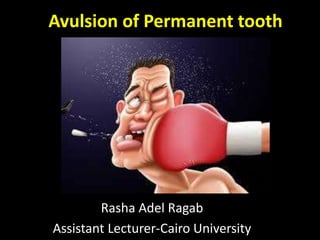
Avulsion of Permanent tooth 
Rasha Adel Ragab 
Assistant Lecturer-Cairo University
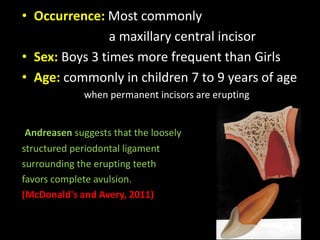
• Occurrence: Most commonly 
a maxillary central incisor 
• Sex: Boys 3 times more frequent than Girls 
• Age: commonly in children 7 to 9 years of age 
when permanent incisors are erupting 
Andreasen suggests that the loosely 
structured periodontal ligament 
surrounding the erupting teeth 
favors complete avulsion. 
(McDonald's and Avery, 2011)
First Aid Advice 
• Parents, 
• Caregivers and 
• Teachers
Information can be given over the telephone
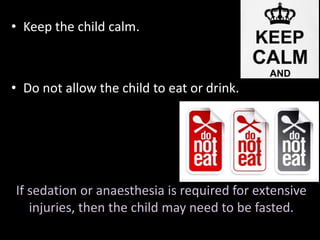
• Keep the child calm. 
• Do not allow the child to eat or drink. 
If sedation or anaesthesia is required for extensive 
injuries, then the child may need to be fasted.
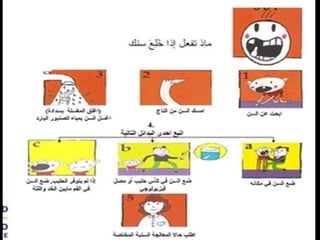
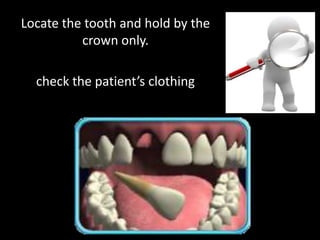
Locate the tooth and hold by the 
crown only. 
check the patient’s clothing
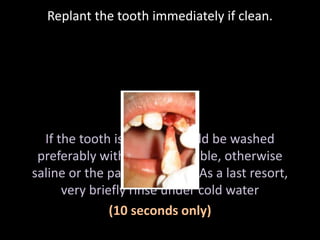
Replant the tooth immediately if clean. 
If the tooth is dirty, it should be washed 
preferably with milk if available, otherwise 
saline or the patient’s saliva. As a last resort, 
very briefly rinse under cold water 
(10 seconds only)
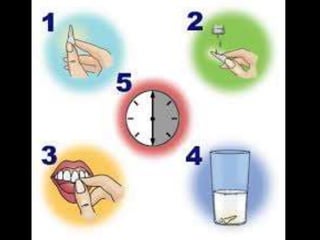
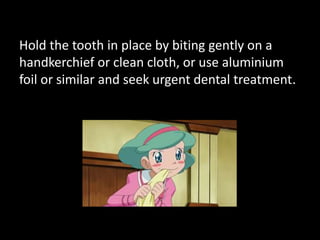
Hold the tooth in place by biting gently on a 
handkerchief or clean cloth, or use aluminium 
foil or similar and seek urgent dental treatment.
If unable to replant the tooth, store it in isotonic 
media to prevent dehydration and death of the 
periodontal ligament cells. Use: 
 Milk (the preferred solution) 
 Saline. 
 Neither Saliva. 
water nor saliva is as good as milk or saline, if the 
tooth must be stored for a long period (more than 30 minutes 
 HBSS 
before replantation). 
Because water is hypotonic, its use leads to rapid cell lysis 
A commercial product designed specifically for storing avulsed teeth is the 
Emergency and Medical increased Treatment inflammation Toothsaver (EMT on Toothsaver; 
replantation. 
SmartPractice, Phoenix, Ariz). The system includes an appropriate 
container for storage and transport of the tooth while immersed in a Ph 
balanced cell culture fluid (similar to Hanks balanced salt solution). This 
product has a 2-year shelf-(McDonald's life without and refrigeration. 
Avery, 2011)
Seek urgent dental treatment
Time is essential! The long-term 
prognosis of the tooth is severely reduced 
after 10 min of being dry and out of the 
mouth. 
Do not waste time searching for an ideal 
storage medium, replant the tooth! 
Every effort should be directed toward 
preserving a viable periodontal ligament. 
(McDonald's and Avery, 2011)
Management in the dental surgery
It is usually still better to replant the tooth 
(Cameron, 2013) 
The replanted tooth serves as a space maintainer 
and often guides adjacent teeth into their proper 
position in the arch, a function that is important 
during the transitional dentition period and has a 
has psychological value. 
(McDonald's and Avery, 2011)
Replantation 
is the technique in which a tooth, usually one in 
the anterior region, is reinserted into the 
alveolus after its loss or displacement by 
accidental means. 
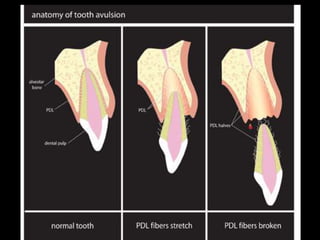
Treatment is directed at avoiding or 
minimizing the resultant inflammation, which 
occurs as a direct result of the two main 
consequences of tooth avulsion: attachment 
damage and pulpal infection.
The sooner a tooth can be replanted in its 
socket after avulsion, the better the prognosis 
will be for retention without root resorption. 
Andreasen and Hjørting-Hansen reported a 
follow-up study of 110 replanted teeth. 
Of those replanted within 30 minutes, 90% 
showed no discernible evidence of resorption 2 
or more years later. However, 95% of the teeth 
replanted more than 2 hours after the injury 
showed root resorption.
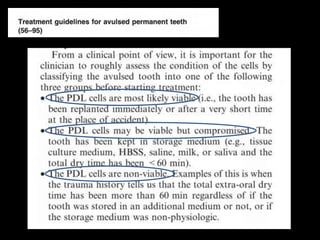
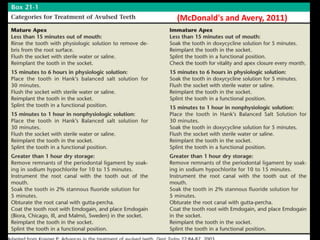
The following are guidelines for replanting avulsed 
permanent teeth. 
Tooth replanted prior to arrival 
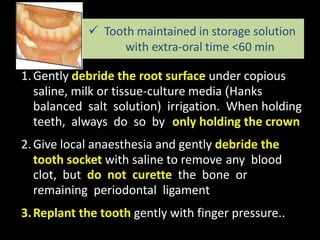
Tooth maintained in storage solution 
with extra-oral time <60 min 
Tooth is dry or extra-oral time is 
>30 min
 Tooth replanted prior to arrival 
Debride the mouth but do not extract the tooth.
 Tooth maintained in storage solution 
with extra-oral time <60 min 
1. Gently debride the root surface under copious 
saline, milk or tissue-culture media )Hanks 
balanced salt solution) irrigation. When holding 
teeth, always do so by only holding the crown 
2. Give local anaesthesia and gently debride the 
tooth socket with saline to remove any blood 
clot, but do not curette the bone or 
remaining periodontal ligament 
3.Replant the tooth gently with finger pressure..
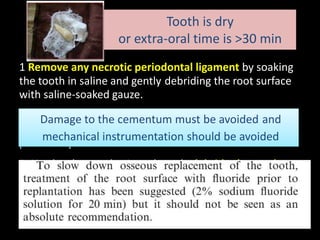
Tooth is dry 
or extra-oral time is >30 min 
1 Remove any necrotic periodontal ligament by soaking 
the tooth in saline and gently debriding the root surface 
with saline-soaked gauze. 
2 The Damage tooth should to the also cementum be soaked must in 2% be avoided sodium fluoride 
and 
for 20 min. It is essential that the tooth be rehydrated 
mechanical instrumentation should be avoided 
prior to replantation. 
3 Give local anaesthesia and gently debride the tooth 
socket with saline to remove the blood clot; do not 
curette the bone or remaining ligament. 
4 Replant the tooth gently with finger pressure.
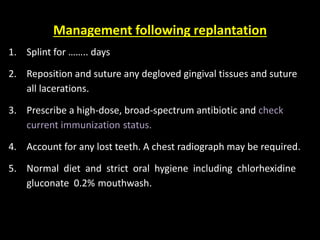
Management following replantation 
1. Splint for …….. days 
2. Reposition and suture any degloved gingival tissues and suture 
all lacerations. 
3. Prescribe a high-dose, broad-spectrum antibiotic and check 
current immunization status. 
4. Account for any lost teeth. A chest radiograph may be required. 
5. Normal diet and strict oral hygiene including chlorhexidine 
gluconate 0.2% mouthwash.
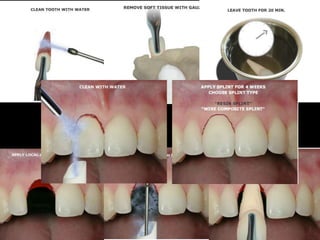
Splinting of Avulsed Teeth 
Splints should be flexible to allow normal 
physiological movement of the tooth; 
Rigid stabilization seems to stimulate 
replacement resorption of the root and is 
This helps to reduce the development of 
ankylosis and replacement resorption. 
detrimental to proper healing of the 
periodontal ligament.
Splint should meet the following 
criteria: 
• It should be easy to fabricate directly in the mouth 
without lengthy laboratory procedures. 
• It should be able to be placed passively without 
causing forces on the teeth. 
• It should not touch the gingival tissues, causing gingival 
irritation. 
• It should not interfere with normal occlusion. 
• It should be easily cleaned and allow for proper oral 
hygiene. 
• It should allow an approach for endodontic therapy. 
• It should be easily removed. 
(McDonald's and Avery, 2011)
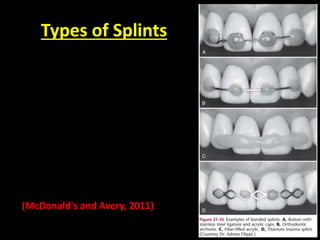
Types of Splints 
(McDonald's and Avery, 2011)
Types of Splints 
• Orthodontic brackets with a light archwire 
(0.014˝). 
1. Easier and quicker to place. 
2. Allows the splint to be readily removed and replaced 
so that the mobility of the teeth can be monitored. 
3. Easier to maintain oral hygiene. 
4. Less time to remove and less chance of damage to 
the teeth following removal of composite resin 
(often used to excess)
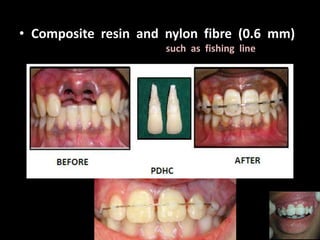
• Composite resin and nylon fibre (0.6 mm) 
such as fishing line
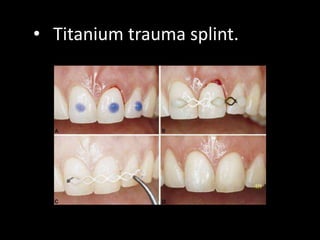
• Titanium trauma splint.
Timing of splinting 
• Splints should generally stay in place for 10–14 
days if there are no complicating factors such 
as alveolar or root fractures. 
• Avulsed teeth that were kept dry more than 
60 min. prior to replantation may require 
splinting for up to 4 weeks.
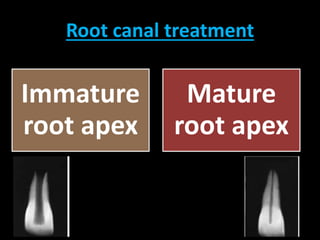
Root canal treatment 
Immature 
root apex 
Mature 
root apex
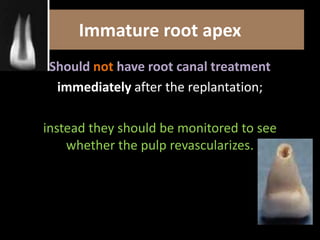
Immature root apex 
Should not have root canal treatment 
immediately after the replantation; 
instead they should be monitored to see 
whether the pulp revascularizes.
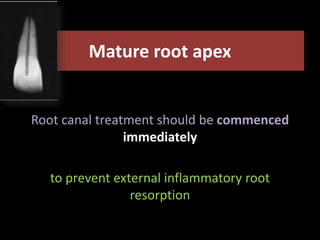
Mature root apex 
Root canal treatment should be commenced 
immediately 
to prevent external inflammatory root 
resorption
Patient instructions 
• Avoid participation in contact sports. 
• Soft food for up to 2 weeks. 
• Brush teeth with a soft toothbrush after each meal. 
• Use a chlorhexidine (0.1 %) mouth rinse twice a day 
for 1 week.
(McDonald's and Avery, 2011)
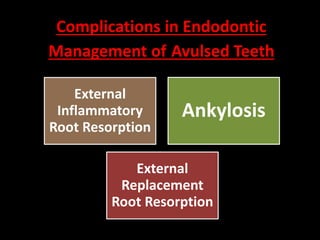
Complications in Endodontic 
Management of Avulsed Teeth 
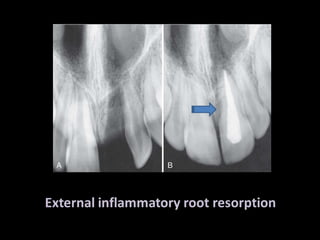
External 
Inflammatory 
Root Resorption 
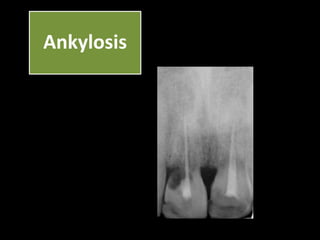
Ankylosis 
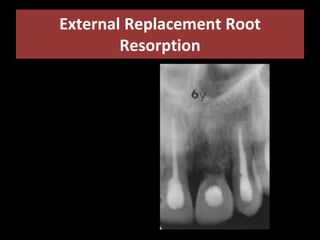
External 
Replacement 
Root Resorption
Ankylosis
External Replacement Root 
Resorption
THANK YOU

Avulsion of permanent teeth

  • 1.
    Avulsion of Permanenttooth Rasha Adel Ragab Assistant Lecturer-Cairo University
  • 2.
    • Occurrence: Mostcommonly a maxillary central incisor • Sex: Boys 3 times more frequent than Girls • Age: commonly in children 7 to 9 years of age when permanent incisors are erupting Andreasen suggests that the loosely structured periodontal ligament surrounding the erupting teeth favors complete avulsion. (McDonald's and Avery, 2011)
  • 4.
    First Aid Advice • Parents, • Caregivers and • Teachers
  • 7.
    Information can begiven over the telephone
  • 8.
    • Keep thechild calm. • Do not allow the child to eat or drink. If sedation or anaesthesia is required for extensive injuries, then the child may need to be fasted.
  • 9.
    Locate the toothand hold by the crown only. check the patient’s clothing
  • 10.
    Replant the toothimmediately if clean. If the tooth is dirty, it should be washed preferably with milk if available, otherwise saline or the patient’s saliva. As a last resort, very briefly rinse under cold water (10 seconds only)
  • 11.
    Hold the toothin place by biting gently on a handkerchief or clean cloth, or use aluminium foil or similar and seek urgent dental treatment.
  • 12.
    If unable toreplant the tooth, store it in isotonic media to prevent dehydration and death of the periodontal ligament cells. Use:  Milk (the preferred solution)  Saline.  Neither Saliva. water nor saliva is as good as milk or saline, if the tooth must be stored for a long period (more than 30 minutes  HBSS before replantation). Because water is hypotonic, its use leads to rapid cell lysis A commercial product designed specifically for storing avulsed teeth is the Emergency and Medical increased Treatment inflammation Toothsaver (EMT on Toothsaver; replantation. SmartPractice, Phoenix, Ariz). The system includes an appropriate container for storage and transport of the tooth while immersed in a Ph balanced cell culture fluid (similar to Hanks balanced salt solution). This product has a 2-year shelf-(McDonald's life without and refrigeration. Avery, 2011)
  • 13.
  • 14.
    Time is essential!The long-term prognosis of the tooth is severely reduced after 10 min of being dry and out of the mouth. Do not waste time searching for an ideal storage medium, replant the tooth! Every effort should be directed toward preserving a viable periodontal ligament. (McDonald's and Avery, 2011)
  • 15.
    Management in thedental surgery
  • 17.
    It is usuallystill better to replant the tooth (Cameron, 2013) The replanted tooth serves as a space maintainer and often guides adjacent teeth into their proper position in the arch, a function that is important during the transitional dentition period and has a has psychological value. (McDonald's and Avery, 2011)
  • 19.
    Replantation is thetechnique in which a tooth, usually one in the anterior region, is reinserted into the alveolus after its loss or displacement by accidental means. Treatment is directed at avoiding or minimizing the resultant inflammation, which occurs as a direct result of the two main consequences of tooth avulsion: attachment damage and pulpal infection.
  • 20.
    The sooner atooth can be replanted in its socket after avulsion, the better the prognosis will be for retention without root resorption. Andreasen and Hjørting-Hansen reported a follow-up study of 110 replanted teeth. Of those replanted within 30 minutes, 90% showed no discernible evidence of resorption 2 or more years later. However, 95% of the teeth replanted more than 2 hours after the injury showed root resorption.
  • 21.
    The following areguidelines for replanting avulsed permanent teeth. Tooth replanted prior to arrival Tooth maintained in storage solution with extra-oral time <60 min Tooth is dry or extra-oral time is >30 min
  • 22.
     Tooth replantedprior to arrival Debride the mouth but do not extract the tooth.
  • 23.
     Tooth maintainedin storage solution with extra-oral time <60 min 1. Gently debride the root surface under copious saline, milk or tissue-culture media )Hanks balanced salt solution) irrigation. When holding teeth, always do so by only holding the crown 2. Give local anaesthesia and gently debride the tooth socket with saline to remove any blood clot, but do not curette the bone or remaining periodontal ligament 3.Replant the tooth gently with finger pressure..
  • 24.
    Tooth is dry or extra-oral time is >30 min 1 Remove any necrotic periodontal ligament by soaking the tooth in saline and gently debriding the root surface with saline-soaked gauze. 2 The Damage tooth should to the also cementum be soaked must in 2% be avoided sodium fluoride and for 20 min. It is essential that the tooth be rehydrated mechanical instrumentation should be avoided prior to replantation. 3 Give local anaesthesia and gently debride the tooth socket with saline to remove the blood clot; do not curette the bone or remaining ligament. 4 Replant the tooth gently with finger pressure.
  • 25.
    Management following replantation 1. Splint for …….. days 2. Reposition and suture any degloved gingival tissues and suture all lacerations. 3. Prescribe a high-dose, broad-spectrum antibiotic and check current immunization status. 4. Account for any lost teeth. A chest radiograph may be required. 5. Normal diet and strict oral hygiene including chlorhexidine gluconate 0.2% mouthwash.
  • 27.
    Splinting of AvulsedTeeth Splints should be flexible to allow normal physiological movement of the tooth; Rigid stabilization seems to stimulate replacement resorption of the root and is This helps to reduce the development of ankylosis and replacement resorption. detrimental to proper healing of the periodontal ligament.
  • 28.
    Splint should meetthe following criteria: • It should be easy to fabricate directly in the mouth without lengthy laboratory procedures. • It should be able to be placed passively without causing forces on the teeth. • It should not touch the gingival tissues, causing gingival irritation. • It should not interfere with normal occlusion. • It should be easily cleaned and allow for proper oral hygiene. • It should allow an approach for endodontic therapy. • It should be easily removed. (McDonald's and Avery, 2011)
  • 29.
    Types of Splints (McDonald's and Avery, 2011)
  • 30.
    Types of Splints • Orthodontic brackets with a light archwire (0.014˝). 1. Easier and quicker to place. 2. Allows the splint to be readily removed and replaced so that the mobility of the teeth can be monitored. 3. Easier to maintain oral hygiene. 4. Less time to remove and less chance of damage to the teeth following removal of composite resin (often used to excess)
  • 31.
    • Composite resinand nylon fibre (0.6 mm) such as fishing line
  • 32.
  • 34.
    Timing of splinting • Splints should generally stay in place for 10–14 days if there are no complicating factors such as alveolar or root fractures. • Avulsed teeth that were kept dry more than 60 min. prior to replantation may require splinting for up to 4 weeks.
  • 35.
    Root canal treatment Immature root apex Mature root apex
  • 36.
    Immature root apex Should not have root canal treatment immediately after the replantation; instead they should be monitored to see whether the pulp revascularizes.
  • 37.
    Mature root apex Root canal treatment should be commenced immediately to prevent external inflammatory root resorption
  • 39.
    Patient instructions •Avoid participation in contact sports. • Soft food for up to 2 weeks. • Brush teeth with a soft toothbrush after each meal. • Use a chlorhexidine (0.1 %) mouth rinse twice a day for 1 week.
  • 40.
  • 41.
    Complications in Endodontic Management of Avulsed Teeth External Inflammatory Root Resorption Ankylosis External Replacement Root Resorption
  • 43.
  • 44.
  • 45.