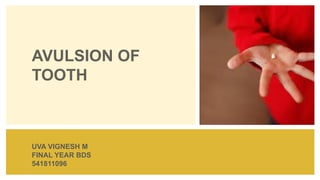
AVULSION OF
TOOTH
UVA VIGNESH M
FINAL YEAR BDS
541811096
Introduction
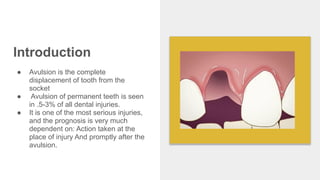
● Avulsion is the complete
displacement of tooth from the
socket
● Avulsion of permanent teeth is seen
in .5-3% of all dental injuries.
● It is one of the most serious injuries,
and the prognosis is very much
dependent on: Action taken at the
place of injury And promptly after the
avulsion.
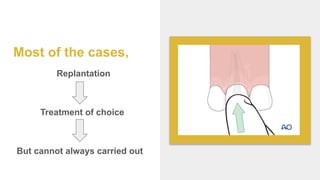
Most of the cases,
Replantation
Treatment of choice
But cannot always carried out
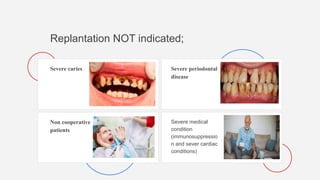
Replantation NOT indicated;
Severe caries Severe periodontal
disease
Non cooperative
patients
Severe medical
condition
(immunosuppressio
n and sever cardiac
conditions)
First aid for avulsed
teeth
● Dentist should be prepared to
give advices about first aid for
avulsed teeth to public.
● Avulsed teeth is on of a REAL
EMERGENCY situation in
dentistry.
● Instruction may be given by
phone to people at the
emergency site.
Instructions
● Make sure that the avulsed tooth is a
permanent tooth.
● Keep the patient calm.
● Fined the tooth and pick it up from the crown
Not the root.
● If the tooth is dirty, wash it briefly (MAX 10 s)
under cold running water and reposition it.
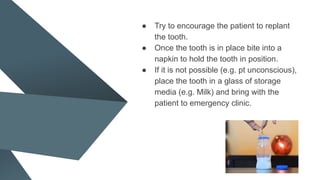
● Try to encourage the patient to replant
the tooth.
● Once the tooth is in place bite into a
napkin to hold the tooth in position.
● If it is not possible (e.g. pt unconscious),
place the tooth in a glass of storage
media (e.g. Milk) and bring with the
patient to emergency clinic.
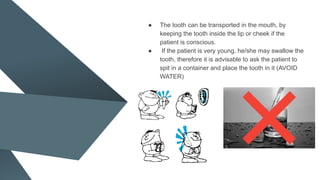
● The tooth can be transported in the mouth, by
keeping the tooth inside the lip or cheek if the
patient is conscious.
● If the patient is very young, he/she may swallow the
tooth, therefore it is advisable to ask the patient to
spit in a container and place the tooth in it (AVOID
WATER)
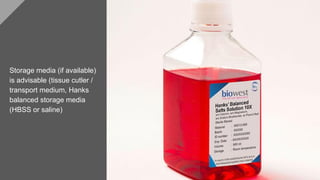
Storage media (if available)
is advisable (tissue cutler /
transport medium, Hanks
balanced storage media
(HBSS or saline)
Storage media
Natural
media
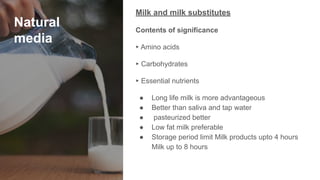
Milk and milk substitutes
Contents of significance
▸ Amino acids
▸ Carbohydrates
▸ Essential nutrients
● Long life milk is more advantageous
● Better than saliva and tap water
● pasteurized better
● Low fat milk preferable
● Storage period limit Milk products upto 4 hours
Milk up to 8 hours
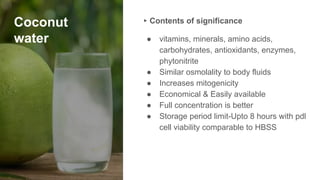
Coconut
water
▸ Contents of significance
● vitamins, minerals, amino acids,
carbohydrates, antioxidants, enzymes,
phytonitrite
● Similar osmolality to body fluids
● Increases mitogenicity
● Economical & Easily available
● Full concentration is better
● Storage period limit-Upto 8 hours with pdl
cell viability comparable to HBSS
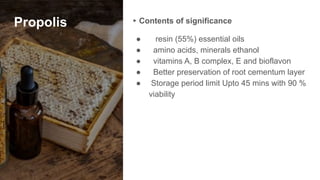
Propolis ▸ Contents of significance
● resin (55%) essential oils
● amino acids, minerals ethanol
● vitamins A, B complex, E and bioflavon
● Better preservation of root cementum layer
● Storage period limit Upto 45 mins with 90 %
viability
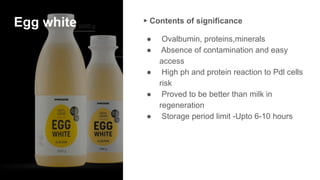
Egg white ▸ Contents of significance
● Ovalbumin, proteins,minerals
● Absence of contamination and easy
access
● High ph and protein reaction to Pdl cells
risk
● Proved to be better than milk in
regeneration
● Storage period limit -Upto 6-10 hours
Tap water ● Hypotonic and rapid lysis of cells
● Final choice when no alternative is
available Storage period limit
● Only for a very shorter period of time
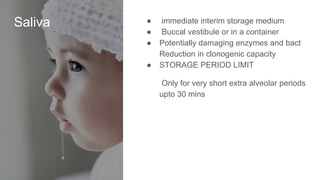
Saliva ● immediate interim storage medium
● Buccal vestibule or in a container
● Potentially damaging enzymes and bact
Reduction in clonogenic capacity
● STORAGE PERIOD LIMIT
Only for very short extra alveolar periods
upto 30 mins
Artificial
storage
media
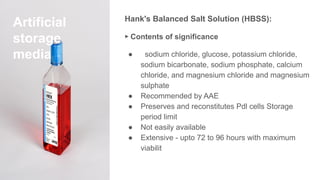
Hank's Balanced Salt Solution (HBSS):
▸ Contents of significance
● sodium chloride, glucose, potassium chloride,
sodium bicarbonate, sodium phosphate, calcium
chloride, and magnesium chloride and magnesium
sulphate
● Recommended by AAE
● Preserves and reconstitutes Pdl cells Storage
period limit
● Not easily available
● Extensive - upto 72 to 96 hours with maximum
viabilit
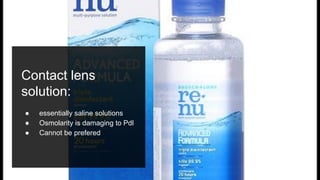
Contact lens
solution:
● essentially saline solutions
● Osmolarity is damaging to Pdl
● Cannot be prefered
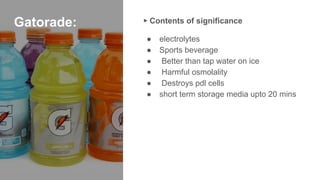
Gatorade: ▸ Contents of significance
● electrolytes
● Sports beverage
● Better than tap water on ice
● Harmful osmolality
● Destroys pdl cells
● short term storage media upto 20 mins
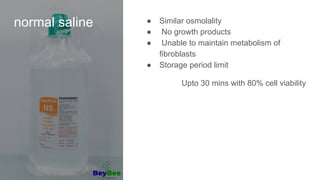
normal saline ● Similar osmolality
● No growth products
● Unable to maintain metabolism of
fibroblasts
● Storage period limit
Upto 30 mins with 80% cell viability
Organic
storage
media
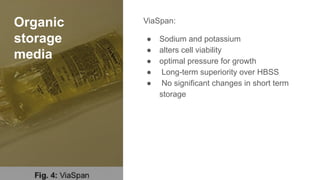
ViaSpan:
● Sodium and potassium
● alters cell viability
● optimal pressure for growth
● Long-term superiority over HBSS
● No significant changes in short term
storage
Special
culture
media
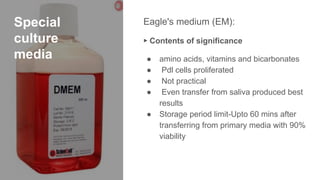
Eagle's medium (EM):
▸ Contents of significance
● amino acids, vitamins and bicarbonates
● Pdl cells proliferated
● Not practical
● Even transfer from saliva produced best
results
● Storage period limit-Upto 60 mins after
transferring from primary media with 90%
viability
Additives Emdogain
● Enamel matrix proteins
● diminishes the percentage of fibroblasts
of the periodontal ligament with capability
of forming colonies
● Deyals replacement resorption
● Alone is not sufficient
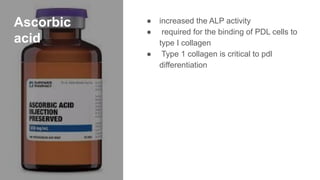
Ascorbic
acid
● increased the ALP activity
● required for the binding of PDL cells to
type I collagen
● Type 1 collagen is critical to pdl
differentiation
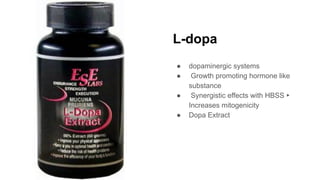
L-dopa
● dopaminergic systems
● Growth promoting hormone like
substance
● Synergistic effects with HBSS ▸
Increases mitogenicity
● Dopa Extract
Protocol for
management of avulsed
teeth with open apex
The tooth
has been
replanted
before the
patient's
arrival at the
clinic:
● Leave the tooth in place.
● Clean the area with water spray, saline, or
chlorhexidine.
● Soak the tooth in 1 mg of Doxycycline of physiologic
saline for 5 mins ( doxycycline inhibits bacteria in the
plup lumen thus removing major obstacle to
revascularization
● Suture gingival lacerations, if present.
● Verify normal position of the replanted tooth clinically
and radiographically.
● flexible splint for up to 2 weeks.

● Antibiotic and anti tetanus therapy
● Give patient instructions.
● The goal for replanting still-developing (immature) teeth
in children is to allow for possible revascularization
(apexogenesis) of the pulp space. If that does not occur,
root canal treatment may be recommended
The tooth has
been kept in a
physiologic
storage medium
and/or stored
dry, the extra-oral
dry time has
been <60 min
● Clean the root surface and apical foramen with a
stream of saline.
● Soak the tooth in appropriate medium like saline or
HBBS solution for 30 mins.This reduces the
ankylosis.Survival of the remaining PDL cells get
improved
● LA
● Examine the alveolar socket. If fractured, reposition it
with a suitable instrument.
● Remove the coagulum in the socket and replant the
tooth slowly with slight digital pressure.
● Suture gingival lacerations, especially in the cervical
area.
● Verify normal position of the replanted tooth clinically
and radiographically.
● Apply a flexible splint for up to 2 weeks
● Antibiotic and anti tetanus therapy.
● Give patient instructions.
● The goal for replanting (immature)
teeth in children is to allow for
possible revascularization
(apexogenesis) of the pulp space. If
that does not occur, root canal
treatment may be recommended.
Dry time >60 min or other
reasons suggesting
non-viable
cells
● Remove attached non-viable soft tissue
carefully
● When the root is dried more than 1 hr
,soaking in the storage medium is not
effective as almost all periodontal cells would
have dried
● Administer local anesthesia. Remove the
coagulum from the socket with a stream of
saline.
● Examine the alveolar socket. If there is a
fracture of the socket wall, reposition it with a
suitable instrument.
5.In this condition,root should be prepared to resistant to
resorption
6.Soak the tooth in citric acid for 5 mins followed by 2%
stannous fluoride for 5 mins
7.Root canal treatment to the tooth can be carried out prior
to replantation or later.
8.After completing RCT seal the blunderbuss open apex
extraorally
9. Replant the tooth slowly with slight digital pressure.
10. Suture gingival laceration.if needed
11.Verify normal position of the replanted tooth clinically
and radiographically.
12.Stabilize the tooth for 4 weeks using a flexible splint.
13.Antibiotic and anti tetanus therapy
14. Give patient instructions.
15. To slow down osseous replacement of the tooth, treatment
of the root surface with fluoride prior to replantation (2%
sodium fluoride solution for 20 min)
Patient instructions
● Avoid participation in contact
sports.
● Soft diet for up to 2 weeks.
Thereafter normal function as soon
as possible.
● Brush teeth with a soft toothbrush
after each meal.
● Use a chlorhexidine (0.1%) mouth
rinse twice a day for 1 week.
In children and adolescent ankylosis is frequently
associated with infra position
Careful follow up is required
Good communication to insecure the patient and
the guardians with this possible outcome
Decoronation may be necessary later when
infraposition is seen(> 1mm)
Avulsion.pdf

Avulsion.pdf

  • 1.
    AVULSION OF TOOTH UVA VIGNESHM FINAL YEAR BDS 541811096
  • 2.
    Introduction ● Avulsion isthe complete displacement of tooth from the socket ● Avulsion of permanent teeth is seen in .5-3% of all dental injuries. ● It is one of the most serious injuries, and the prognosis is very much dependent on: Action taken at the place of injury And promptly after the avulsion.
  • 3.
    Most of thecases, Replantation Treatment of choice But cannot always carried out
  • 4.
    Replantation NOT indicated; Severecaries Severe periodontal disease Non cooperative patients Severe medical condition (immunosuppressio n and sever cardiac conditions)
  • 5.
    First aid foravulsed teeth
  • 6.
    ● Dentist shouldbe prepared to give advices about first aid for avulsed teeth to public. ● Avulsed teeth is on of a REAL EMERGENCY situation in dentistry. ● Instruction may be given by phone to people at the emergency site.
  • 7.
    Instructions ● Make surethat the avulsed tooth is a permanent tooth. ● Keep the patient calm. ● Fined the tooth and pick it up from the crown Not the root. ● If the tooth is dirty, wash it briefly (MAX 10 s) under cold running water and reposition it.
  • 8.
    ● Try toencourage the patient to replant the tooth. ● Once the tooth is in place bite into a napkin to hold the tooth in position. ● If it is not possible (e.g. pt unconscious), place the tooth in a glass of storage media (e.g. Milk) and bring with the patient to emergency clinic.
  • 9.
    ● The toothcan be transported in the mouth, by keeping the tooth inside the lip or cheek if the patient is conscious. ● If the patient is very young, he/she may swallow the tooth, therefore it is advisable to ask the patient to spit in a container and place the tooth in it (AVOID WATER)
  • 10.
    Storage media (ifavailable) is advisable (tissue cutler / transport medium, Hanks balanced storage media (HBSS or saline)
  • 11.
  • 12.
    Natural media Milk and milksubstitutes Contents of significance ▸ Amino acids ▸ Carbohydrates ▸ Essential nutrients ● Long life milk is more advantageous ● Better than saliva and tap water ● pasteurized better ● Low fat milk preferable ● Storage period limit Milk products upto 4 hours Milk up to 8 hours
  • 13.
    Coconut water ▸ Contents ofsignificance ● vitamins, minerals, amino acids, carbohydrates, antioxidants, enzymes, phytonitrite ● Similar osmolality to body fluids ● Increases mitogenicity ● Economical & Easily available ● Full concentration is better ● Storage period limit-Upto 8 hours with pdl cell viability comparable to HBSS
  • 14.
    Propolis ▸ Contentsof significance ● resin (55%) essential oils ● amino acids, minerals ethanol ● vitamins A, B complex, E and bioflavon ● Better preservation of root cementum layer ● Storage period limit Upto 45 mins with 90 % viability
  • 15.
    Egg white ▸Contents of significance ● Ovalbumin, proteins,minerals ● Absence of contamination and easy access ● High ph and protein reaction to Pdl cells risk ● Proved to be better than milk in regeneration ● Storage period limit -Upto 6-10 hours
  • 16.
    Tap water ●Hypotonic and rapid lysis of cells ● Final choice when no alternative is available Storage period limit ● Only for a very shorter period of time
  • 17.
    Saliva ● immediateinterim storage medium ● Buccal vestibule or in a container ● Potentially damaging enzymes and bact Reduction in clonogenic capacity ● STORAGE PERIOD LIMIT Only for very short extra alveolar periods upto 30 mins
  • 18.
    Artificial storage media Hank's Balanced SaltSolution (HBSS): ▸ Contents of significance ● sodium chloride, glucose, potassium chloride, sodium bicarbonate, sodium phosphate, calcium chloride, and magnesium chloride and magnesium sulphate ● Recommended by AAE ● Preserves and reconstitutes Pdl cells Storage period limit ● Not easily available ● Extensive - upto 72 to 96 hours with maximum viabilit
  • 19.
    Contact lens solution: ● essentiallysaline solutions ● Osmolarity is damaging to Pdl ● Cannot be prefered
  • 20.
    Gatorade: ▸ Contentsof significance ● electrolytes ● Sports beverage ● Better than tap water on ice ● Harmful osmolality ● Destroys pdl cells ● short term storage media upto 20 mins
  • 21.
    normal saline ●Similar osmolality ● No growth products ● Unable to maintain metabolism of fibroblasts ● Storage period limit Upto 30 mins with 80% cell viability
  • 22.
    Organic storage media ViaSpan: ● Sodium andpotassium ● alters cell viability ● optimal pressure for growth ● Long-term superiority over HBSS ● No significant changes in short term storage
  • 23.
    Special culture media Eagle's medium (EM): ▸Contents of significance ● amino acids, vitamins and bicarbonates ● Pdl cells proliferated ● Not practical ● Even transfer from saliva produced best results ● Storage period limit-Upto 60 mins after transferring from primary media with 90% viability
  • 24.
    Additives Emdogain ● Enamelmatrix proteins ● diminishes the percentage of fibroblasts of the periodontal ligament with capability of forming colonies ● Deyals replacement resorption ● Alone is not sufficient
  • 25.
    Ascorbic acid ● increased theALP activity ● required for the binding of PDL cells to type I collagen ● Type 1 collagen is critical to pdl differentiation
  • 26.
    L-dopa ● dopaminergic systems ●Growth promoting hormone like substance ● Synergistic effects with HBSS ▸ Increases mitogenicity ● Dopa Extract
  • 27.
    Protocol for management ofavulsed teeth with open apex
  • 28.
    The tooth has been replanted beforethe patient's arrival at the clinic: ● Leave the tooth in place. ● Clean the area with water spray, saline, or chlorhexidine. ● Soak the tooth in 1 mg of Doxycycline of physiologic saline for 5 mins ( doxycycline inhibits bacteria in the plup lumen thus removing major obstacle to revascularization ● Suture gingival lacerations, if present. ● Verify normal position of the replanted tooth clinically and radiographically. ● flexible splint for up to 2 weeks.
  • 29.
    ● Antibiotic andanti tetanus therapy ● Give patient instructions. ● The goal for replanting still-developing (immature) teeth in children is to allow for possible revascularization (apexogenesis) of the pulp space. If that does not occur, root canal treatment may be recommended
  • 30.
    The tooth has beenkept in a physiologic storage medium and/or stored dry, the extra-oral dry time has been <60 min ● Clean the root surface and apical foramen with a stream of saline. ● Soak the tooth in appropriate medium like saline or HBBS solution for 30 mins.This reduces the ankylosis.Survival of the remaining PDL cells get improved ● LA ● Examine the alveolar socket. If fractured, reposition it with a suitable instrument.
  • 31.
    ● Remove thecoagulum in the socket and replant the tooth slowly with slight digital pressure. ● Suture gingival lacerations, especially in the cervical area. ● Verify normal position of the replanted tooth clinically and radiographically. ● Apply a flexible splint for up to 2 weeks
  • 32.
    ● Antibiotic andanti tetanus therapy. ● Give patient instructions. ● The goal for replanting (immature) teeth in children is to allow for possible revascularization (apexogenesis) of the pulp space. If that does not occur, root canal treatment may be recommended.
  • 33.
    Dry time >60min or other reasons suggesting non-viable cells ● Remove attached non-viable soft tissue carefully ● When the root is dried more than 1 hr ,soaking in the storage medium is not effective as almost all periodontal cells would have dried ● Administer local anesthesia. Remove the coagulum from the socket with a stream of saline. ● Examine the alveolar socket. If there is a fracture of the socket wall, reposition it with a suitable instrument.
  • 34.
    5.In this condition,rootshould be prepared to resistant to resorption 6.Soak the tooth in citric acid for 5 mins followed by 2% stannous fluoride for 5 mins 7.Root canal treatment to the tooth can be carried out prior to replantation or later. 8.After completing RCT seal the blunderbuss open apex extraorally
  • 35.
    9. Replant thetooth slowly with slight digital pressure. 10. Suture gingival laceration.if needed 11.Verify normal position of the replanted tooth clinically and radiographically. 12.Stabilize the tooth for 4 weeks using a flexible splint. 13.Antibiotic and anti tetanus therapy
  • 36.
    14. Give patientinstructions. 15. To slow down osseous replacement of the tooth, treatment of the root surface with fluoride prior to replantation (2% sodium fluoride solution for 20 min)
  • 37.
    Patient instructions ● Avoidparticipation in contact sports. ● Soft diet for up to 2 weeks. Thereafter normal function as soon as possible. ● Brush teeth with a soft toothbrush after each meal. ● Use a chlorhexidine (0.1%) mouth rinse twice a day for 1 week.
  • 38.
    In children andadolescent ankylosis is frequently associated with infra position Careful follow up is required Good communication to insecure the patient and the guardians with this possible outcome Decoronation may be necessary later when infraposition is seen(> 1mm)