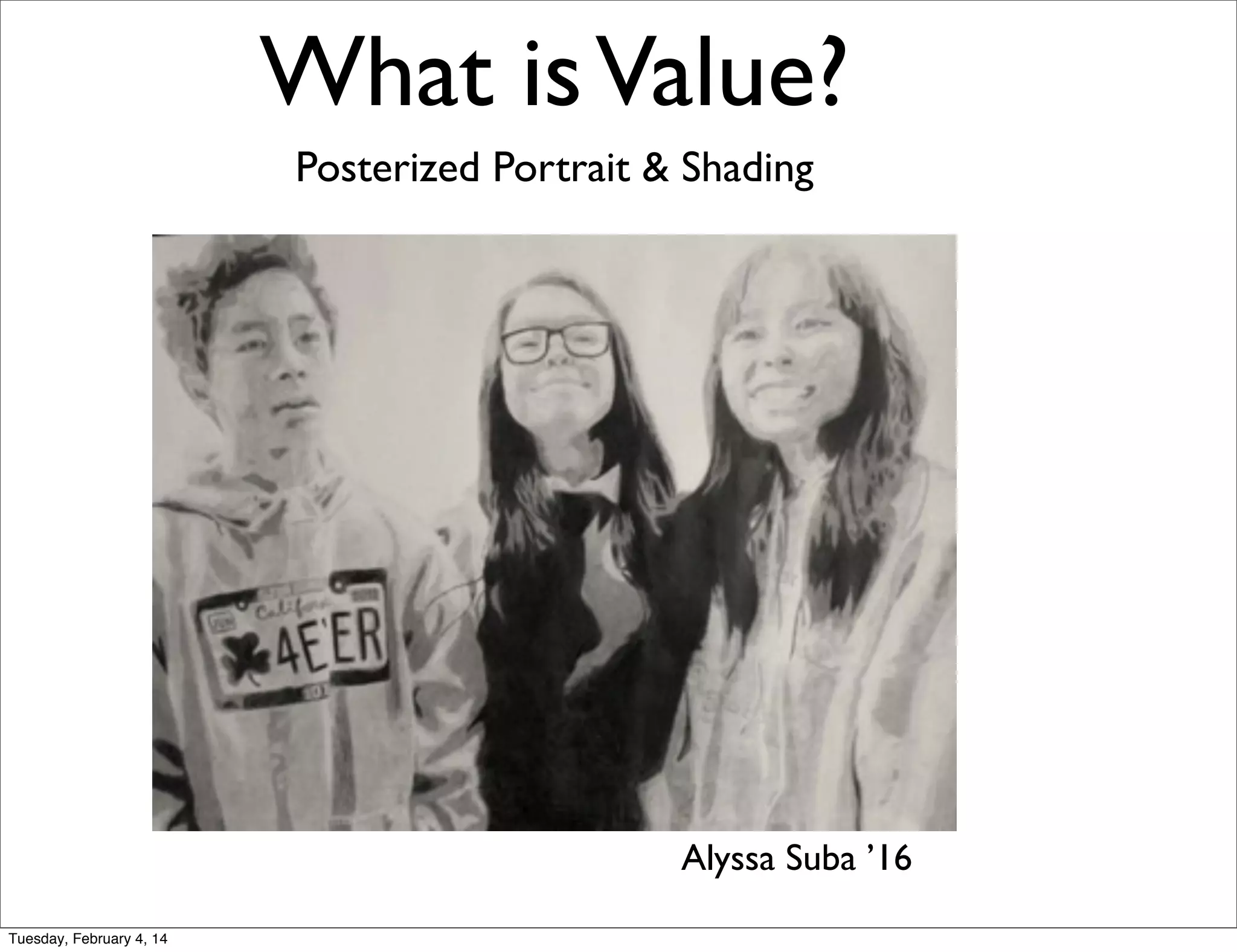
What is Value?
Posterized Portrait & Shading

Alyssa Suba ’16
Tuesday, February 4, 14
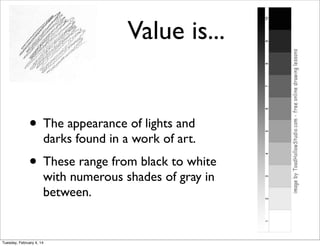
Value is...
• The appearance of lights and

darks found in a work of art.

• These range from black to white
with numerous shades of gray in
between.

Tuesday, February 4, 14
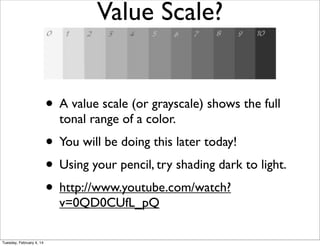
Value Scale?
• A value scale (or grayscale) shows the full
tonal range of a color.

• You will be doing this later today!
• Using your pencil, try shading dark to light.
• http://www.youtube.com/watch?
v=0QD0CUfL_pQ

Tuesday, February 4, 14
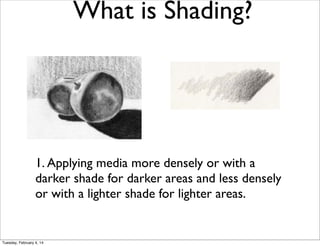
What is Shading?

1. Applying media more densely or with a
darker shade for darker areas and less densely
or with a lighter shade for lighter areas.

Tuesday, February 4, 14
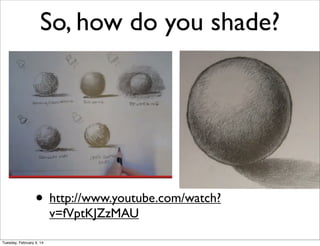
So, how do you shade?

• http://www.youtube.com/watch?
v=fVptKJZzMAU

Tuesday, February 4, 14
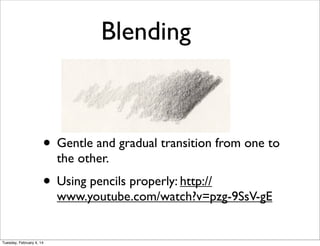
Blending

• Gentle and gradual transition from one to
the other.

• Using pencils properly: http://

www.youtube.com/watch?v=pzg-9SsV-gE

Tuesday, February 4, 14
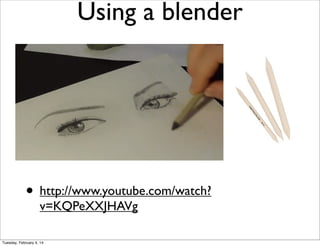
Using a blender

• http://www.youtube.com/watch?
v=KQPeXXJHAVg

Tuesday, February 4, 14
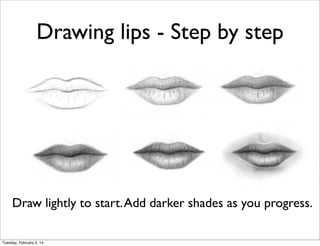
Drawing lips - Step by step

Draw lightly to start. Add darker shades as you progress.
Tuesday, February 4, 14
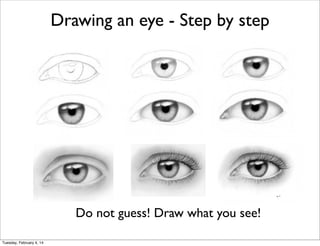
Drawing an eye - Step by step

Do not guess! Draw what you see!
Tuesday, February 4, 14
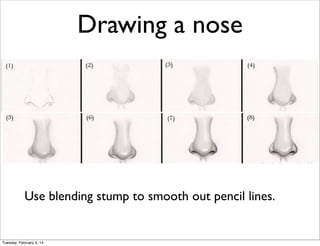
Drawing a nose

Use blending stump to smooth out pencil lines.

Tuesday, February 4, 14
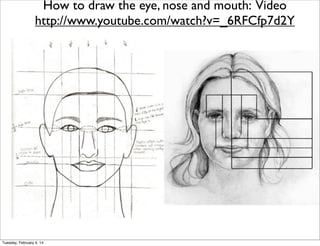
How to draw the eye, nose and mouth: Video
http://www.youtube.com/watch?v=_6RFCfp7d2Y

Tuesday, February 4, 14
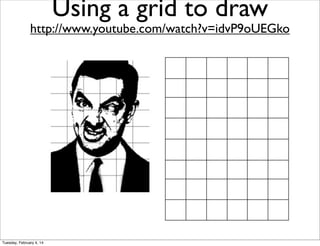
Using a grid to draw

http://www.youtube.com/watch?v=idvP9oUEGko

Tuesday, February 4, 14
Project 6: Drawing Portraits using pencil!
- Photorealism -

Chuck Close
[American Photorealist Painter, born in 1940]
Tuesday, February 4, 14
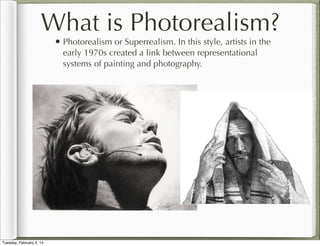
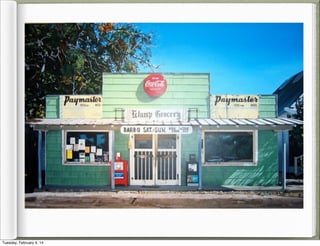
What is Photorealism?
• Photorealism or Superrealism. In this style, artists in the
early 1970s created a link between representational
systems of painting and photography.

Tuesday, February 4, 14
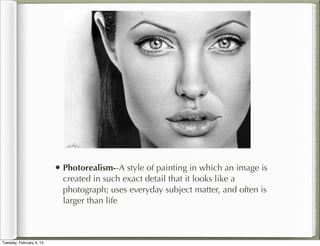
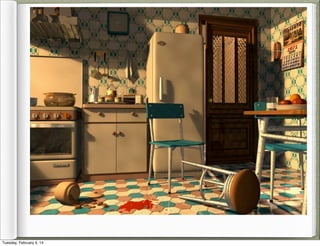
• Photorealism--A style of painting in which an image is
created in such exact detail that it looks like a
photograph; uses everyday subject matter, and often is
larger than life

Tuesday, February 4, 14
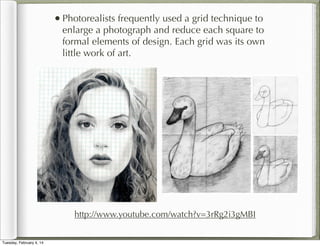
• Photorealists frequently used a grid technique to

enlarge a photograph and reduce each square to
formal elements of design. Each grid was its own
little work of art.

http://www.youtube.com/watch?v=3rRg2i3gMBI
Tuesday, February 4, 14
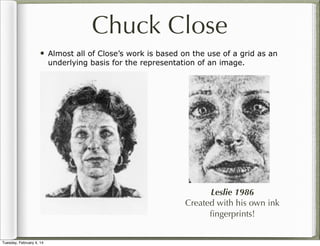
Chuck Close
•

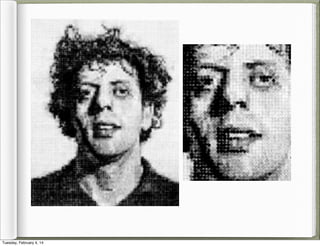
Almost all of Close’s work is based on the use of a grid as an
underlying basis for the representation of an image.

Leslie 1986
Created with his own ink
fingerprints!

Tuesday, February 4, 14
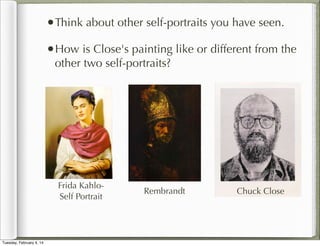
•Think about other self-portraits you have seen.
•How is Close's painting like or different from the
other two self-portraits?

Text

Frida KahloSelf Portrait

Tuesday, February 4, 14

Rembrandt

Chuck Close
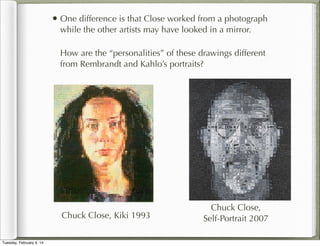
• One difference is that Close worked from a photograph
while the other artists may have looked in a mirror.

How are the “personalities” of these drawings different
from Rembrandt and Kahlo’s portraits?

Chuck Close, Kiki 1993
Tuesday, February 4, 14

Chuck Close,
Self-Portrait 2007
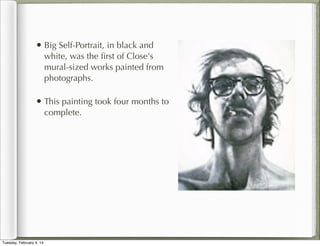
• Big Self-Portrait, in black and

white, was the first of Close's
mural-sized works painted from
photographs.

• This painting took four months to
complete.

Tuesday, February 4, 14
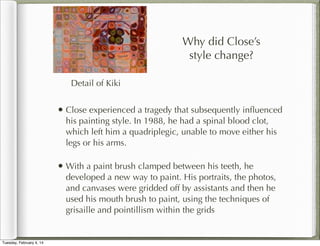
Why did Close’s
style change?
Detail of Kiki

• Close experienced a tragedy that subsequently influenced
his painting style. In 1988, he had a spinal blood clot,
which left him a quadriplegic, unable to move either his
legs or his arms.

• With a paint brush clamped between his teeth, he

developed a new way to paint. His portraits, the photos,
and canvases were gridded off by assistants and then he
used his mouth brush to paint, using the techniques of
grisaille and pointillism within the grids

Tuesday, February 4, 14
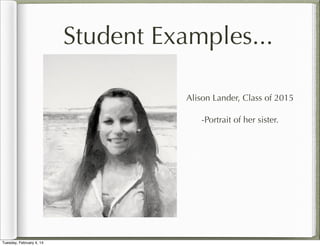
Student Examples...
Alison Lander, Class of 2015
-Portrait of her sister.

Tuesday, February 4, 14
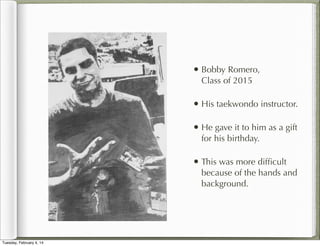
• Bobby Romero,
Class of 2015

• His taekwondo instructor.
• He gave it to him as a gift
for his birthday.

• This was more difficult

because of the hands and
background.

Tuesday, February 4, 14
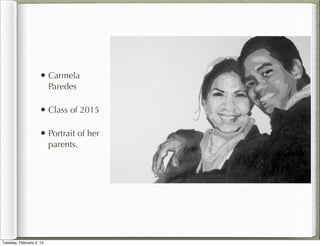
• Carmela
Paredes

• Class of 2015
• Portrait of her
parents.

Tuesday, February 4, 14
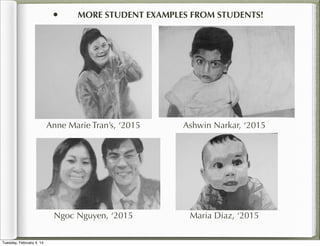
•

MORE STUDENT EXAMPLES FROM STUDENTS!

Anne Marie Tran’s, ‘2015

Ngoc Nguyen, ‘2015
Tuesday, February 4, 14

Ashwin Narkar, ‘2015

Maria Diaz, ‘2015
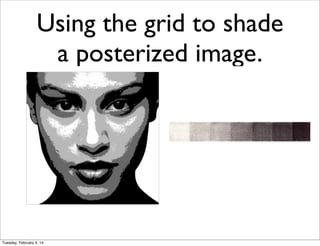
Using the grid to shade
a posterized image.

Tuesday, February 4, 14
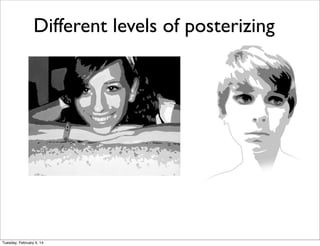
Different levels of posterizing

Tuesday, February 4, 14
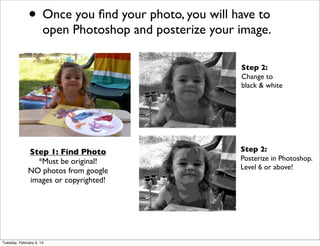
• Once you find your photo, you will have to

open Photoshop and posterize your image.
Step 2:
Change to
black & white

Step 1: Find Photo
*Must be original!
NO photos from google
images or copyrighted!

Tuesday, February 4, 14

Step 2:
Posterize in Photoshop.
Level 6 or above!
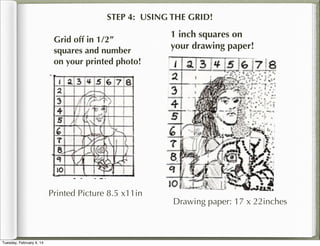
STEP 4: USING THE GRID!
Grid off in 1/2”
squares and number
on your printed photo!

Printed Picture 8.5 x11in

Tuesday, February 4, 14

1 inch squares on
your drawing paper!

Drawing paper: 17 x 22inches
The Project:

Who has influenced your heart and mind?

• parent?
• friend?
• yourself?
• coach?
• teacher?
• relative?
Tuesday, February 4, 14

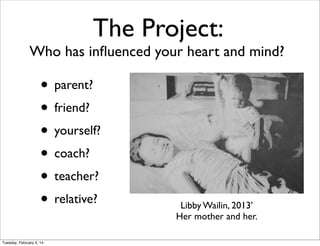
Libby Wailin, 2013’
Her mother and her.
*Find an ORIGINAL photo you have taken of the
person and have it ready for next class!

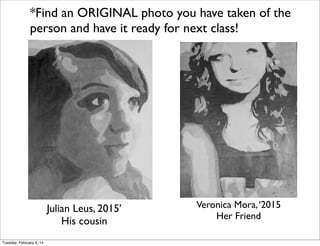
Julian Leus, 2015’
His cousin
Tuesday, February 4, 14

Veronica Mora, ‘2015
Her Friend
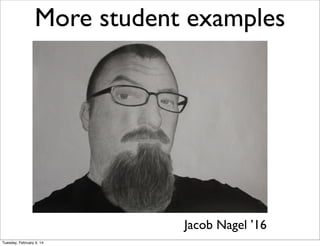
More student examples

Jacob Nagel ’16
Tuesday, February 4, 14
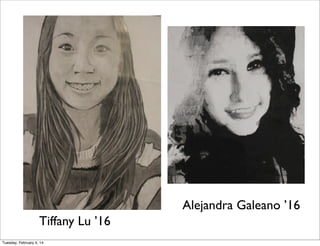
Alejandra Galeano ’16
Tiffany Lu ’16
Tuesday, February 4, 14
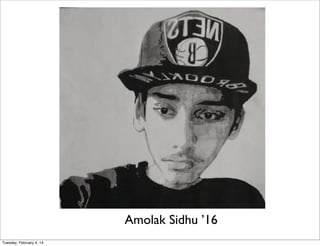
Amolak Sidhu ’16
Tuesday, February 4, 14

Shading technique slideshow 2014

  • 1.
    What is Value? PosterizedPortrait & Shading Alyssa Suba ’16 Tuesday, February 4, 14
  • 2.
    Value is... • Theappearance of lights and darks found in a work of art. • These range from black to white with numerous shades of gray in between. Tuesday, February 4, 14
  • 3.
    Value Scale? • Avalue scale (or grayscale) shows the full tonal range of a color. • You will be doing this later today! • Using your pencil, try shading dark to light. • http://www.youtube.com/watch? v=0QD0CUfL_pQ Tuesday, February 4, 14
  • 4.
    What is Shading? 1.Applying media more densely or with a darker shade for darker areas and less densely or with a lighter shade for lighter areas. Tuesday, February 4, 14
  • 5.
    So, how doyou shade? • http://www.youtube.com/watch? v=fVptKJZzMAU Tuesday, February 4, 14
  • 6.
    Blending • Gentle andgradual transition from one to the other. • Using pencils properly: http:// www.youtube.com/watch?v=pzg-9SsV-gE Tuesday, February 4, 14
  • 7.
    Using a blender •http://www.youtube.com/watch? v=KQPeXXJHAVg Tuesday, February 4, 14
  • 8.
    Drawing lips -Step by step Draw lightly to start. Add darker shades as you progress. Tuesday, February 4, 14
  • 9.
    Drawing an eye- Step by step Do not guess! Draw what you see! Tuesday, February 4, 14
  • 10.
    Drawing a nose Useblending stump to smooth out pencil lines. Tuesday, February 4, 14
  • 11.
    How to drawthe eye, nose and mouth: Video http://www.youtube.com/watch?v=_6RFCfp7d2Y Tuesday, February 4, 14
  • 12.
    Using a gridto draw http://www.youtube.com/watch?v=idvP9oUEGko Tuesday, February 4, 14
  • 13.
    Project 6: DrawingPortraits using pencil! - Photorealism - Chuck Close [American Photorealist Painter, born in 1940] Tuesday, February 4, 14
  • 14.
    What is Photorealism? •Photorealism or Superrealism. In this style, artists in the early 1970s created a link between representational systems of painting and photography. Tuesday, February 4, 14
  • 15.
    • Photorealism--A styleof painting in which an image is created in such exact detail that it looks like a photograph; uses everyday subject matter, and often is larger than life Tuesday, February 4, 14
  • 16.
  • 17.
  • 18.
    • Photorealists frequentlyused a grid technique to enlarge a photograph and reduce each square to formal elements of design. Each grid was its own little work of art. http://www.youtube.com/watch?v=3rRg2i3gMBI Tuesday, February 4, 14
  • 19.
    Chuck Close • Almost allof Close’s work is based on the use of a grid as an underlying basis for the representation of an image. Leslie 1986 Created with his own ink fingerprints! Tuesday, February 4, 14
  • 20.
  • 21.
    •Think about otherself-portraits you have seen. •How is Close's painting like or different from the other two self-portraits? Text Frida KahloSelf Portrait Tuesday, February 4, 14 Rembrandt Chuck Close
  • 22.
    • One differenceis that Close worked from a photograph while the other artists may have looked in a mirror. How are the “personalities” of these drawings different from Rembrandt and Kahlo’s portraits? Chuck Close, Kiki 1993 Tuesday, February 4, 14 Chuck Close, Self-Portrait 2007
  • 23.
    • Big Self-Portrait,in black and white, was the first of Close's mural-sized works painted from photographs. • This painting took four months to complete. Tuesday, February 4, 14
  • 24.
    Why did Close’s stylechange? Detail of Kiki • Close experienced a tragedy that subsequently influenced his painting style. In 1988, he had a spinal blood clot, which left him a quadriplegic, unable to move either his legs or his arms. • With a paint brush clamped between his teeth, he developed a new way to paint. His portraits, the photos, and canvases were gridded off by assistants and then he used his mouth brush to paint, using the techniques of grisaille and pointillism within the grids Tuesday, February 4, 14
  • 25.
    Student Examples... Alison Lander,Class of 2015 -Portrait of her sister. Tuesday, February 4, 14
  • 26.
    • Bobby Romero, Classof 2015 • His taekwondo instructor. • He gave it to him as a gift for his birthday. • This was more difficult because of the hands and background. Tuesday, February 4, 14
  • 27.
    • Carmela Paredes • Classof 2015 • Portrait of her parents. Tuesday, February 4, 14
  • 28.
    • MORE STUDENT EXAMPLESFROM STUDENTS! Anne Marie Tran’s, ‘2015 Ngoc Nguyen, ‘2015 Tuesday, February 4, 14 Ashwin Narkar, ‘2015 Maria Diaz, ‘2015
  • 29.
    Using the gridto shade a posterized image. Tuesday, February 4, 14
  • 30.
    Different levels ofposterizing Tuesday, February 4, 14
  • 31.
    • Once youfind your photo, you will have to open Photoshop and posterize your image. Step 2: Change to black & white Step 1: Find Photo *Must be original! NO photos from google images or copyrighted! Tuesday, February 4, 14 Step 2: Posterize in Photoshop. Level 6 or above!
  • 32.
    STEP 4: USINGTHE GRID! Grid off in 1/2” squares and number on your printed photo! Printed Picture 8.5 x11in Tuesday, February 4, 14 1 inch squares on your drawing paper! Drawing paper: 17 x 22inches
  • 33.
    The Project: Who hasinfluenced your heart and mind? • parent? • friend? • yourself? • coach? • teacher? • relative? Tuesday, February 4, 14 Libby Wailin, 2013’ Her mother and her.
  • 34.
    *Find an ORIGINALphoto you have taken of the person and have it ready for next class! Julian Leus, 2015’ His cousin Tuesday, February 4, 14 Veronica Mora, ‘2015 Her Friend
  • 35.
    More student examples JacobNagel ’16 Tuesday, February 4, 14
  • 36.
    Alejandra Galeano ’16 TiffanyLu ’16 Tuesday, February 4, 14
  • 37.