AS : EXAM : Unit 2 : The Theme…
TRANSFORMATION
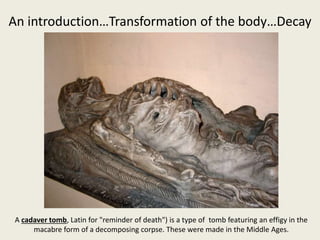
An introduction…Transformation of the body…Decay
A cadaver tomb, Latin for "reminder of death") is a type of tomb featuring an effigy in the
macabre form of a decomposing corpse. These were made in the Middle Ages.
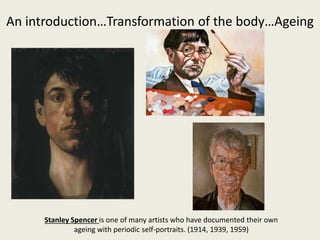
An introduction…Transformation of the body…Ageing
Stanley Spencer is one of many artists who have documented their own
ageing with periodic self-portraits. (1914, 1939, 1959)
An introduction…Transformation of the
environment… Human occupation
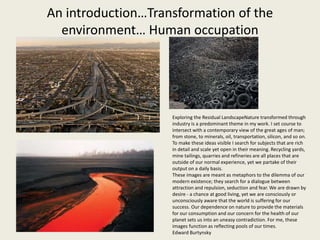
Exploring the Residual LandscapeNature transformed through
industry is a predominant theme in my work. I set course to
intersect with a contemporary view of the great ages of man;
from stone, to minerals, oil, transportation, silicon, and so on.
To make these ideas visible I search for subjects that are rich
in detail and scale yet open in their meaning. Recycling yards,
mine tailings, quarries and refineries are all places that are
outside of our normal experience, yet we partake of their
output on a daily basis.
These images are meant as metaphors to the dilemma of our
modern existence; they search for a dialogue between
attraction and repulsion, seduction and fear. We are drawn by
desire - a chance at good living, yet we are consciously or
unconsciously aware that the world is suffering for our
success. Our dependence on nature to provide the materials
for our consumption and our concern for the health of our
planet sets us into an uneasy contradiction. For me, these
images function as reflecting pools of our times.
Edward Burtynsky
An introduction…Transformation of the natural
environment
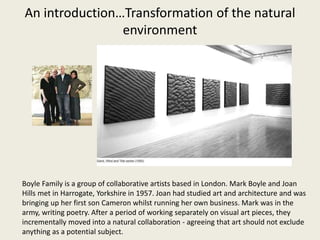
Boyle Family is a group of collaborative artists based in London. Mark Boyle and Joan
Hills met in Harrogate, Yorkshire in 1957. Joan had studied art and architecture and was
bringing up her first son Cameron whilst running her own business. Mark was in the
army, writing poetry. After a period of working separately on visual art pieces, they
incrementally moved into a natural collaboration - agreeing that art should not exclude
anything as a potential subject.
An introduction…Transformation of the city through
art intervention
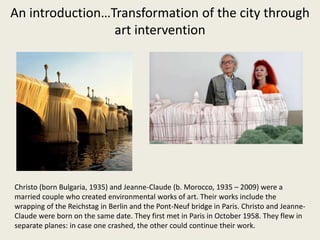
Christo (born Bulgaria, 1935) and Jeanne-Claude (b. Morocco, 1935 – 2009) were a
married couple who created environmental works of art. Their works include the
wrapping of the Reichstag in Berlin and the Pont-Neuf bridge in Paris. Christo and Jeanne-
Claude were born on the same date. They first met in Paris in October 1958. They flew in
separate planes: in case one crashed, the other could continue their work.
An introduction…Transformation of materials and the
environment
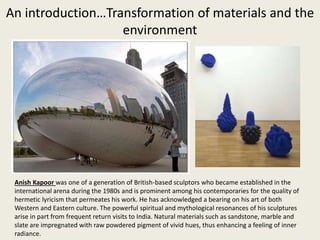
Anish Kapoor was one of a generation of British-based sculptors who became established in the
international arena during the 1980s and is prominent among his contemporaries for the quality of
hermetic lyricism that permeates his work. He has acknowledged a bearing on his art of both
Western and Eastern culture. The powerful spiritual and mythological resonances of his sculptures
arise in part from frequent return visits to India. Natural materials such as sandstone, marble and
slate are impregnated with raw powdered pigment of vivid hues, thus enhancing a feeling of inner
radiance.
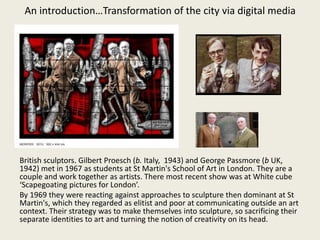
British sculptors. Gilbert Proesch (b. Italy, 1943) and George Passmore (b UK,
1942) met in 1967 as students at St Martin's School of Art in London. They are a
couple and work together as artists. There most recent show was at White cube
‘Scapegoating pictures for London’.
By 1969 they were reacting against approaches to sculpture then dominant at St
Martin's, which they regarded as elitist and poor at communicating outside an art
context. Their strategy was to make themselves into sculpture, so sacrificing their
separate identities to art and turning the notion of creativity on its head.
An introduction…Transformation of the city via digital media
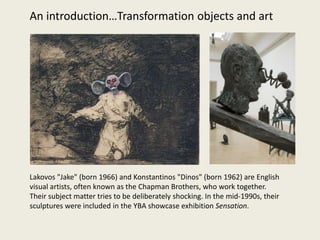
Lakovos "Jake" (born 1966) and Konstantinos "Dinos" (born 1962) are English
visual artists, often known as the Chapman Brothers, who work together.
Their subject matter tries to be deliberately shocking. In the mid-1990s, their
sculptures were included in the YBA showcase exhibition Sensation.
An introduction…Transformation objects and art
AS : Unit 2
CLASS AND
HOMEWORK TASKS
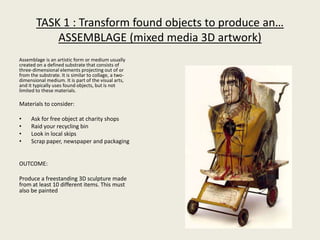
TASK 1 : Transform found objects to produce an…
ASSEMBLAGE (mixed media 3D artwork)
Assemblage is an artistic form or medium usually
created on a defined substrate that consists of
three-dimensional elements projecting out of or
from the substrate. It is similar to collage, a two-
dimensional medium. It is part of the visual arts,
and it typically uses found objects, but is not
limited to these materials.
Materials to consider:
• Ask for free object at charity shops
• Raid your recycling bin
• Look in local skips
• Scrap paper, newspaper and packaging
OUTCOME:
Produce a freestanding 3D sculpture made
from at least 10 different items. This must
also be painted
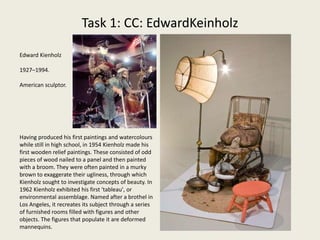
Task 1: CC: EdwardKeinholz
Edward Kienholz
1927–1994.
American sculptor.
Having produced his first paintings and watercolours
while still in high school, in 1954 Kienholz made his
first wooden relief paintings. These consisted of odd
pieces of wood nailed to a panel and then painted
with a broom. They were often painted in a murky
brown to exaggerate their ugliness, through which
Kienholz sought to investigate concepts of beauty. In
1962 Kienholz exhibited his first ‘tableau', or
environmental assemblage. Named after a brothel in
Los Angeles, it recreates its subject through a series
of furnished rooms filled with figures and other
objects. The figures that populate it are deformed
mannequins.
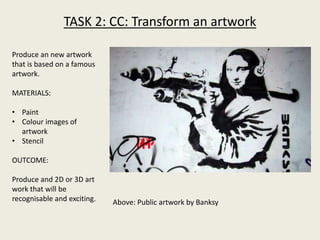
TASK 2: CC: Transform an artwork
Produce an new artwork
that is based on a famous
artwork.
MATERIALS:
• Paint
• Colour images of
artwork
• Stencil
OUTCOME:
Produce and 2D or 3D art
work that will be
recognisable and exciting. Above: Public artwork by Banksy
TASK 2: CC: Transform an artwork
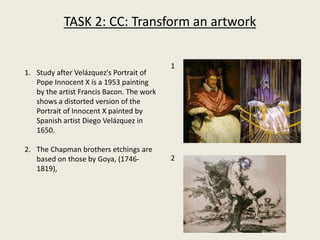
1. Study after Velázquez's Portrait of
Pope Innocent X is a 1953 painting
by the artist Francis Bacon. The work
shows a distorted version of the
Portrait of Innocent X painted by
Spanish artist Diego Velázquez in
1650.
2. The Chapman brothers etchings are
based on those by Goya, (1746-
1819),
1
2
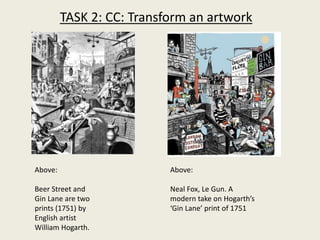
Above:
Beer Street and
Gin Lane are two
prints (1751) by
English artist
William Hogarth.
Above:
Neal Fox, Le Gun. A
modern take on Hogarth’s
‘Gin Lane’ print of 1751
TASK 2: CC: Transform an artwork
TASK 3 : Transform a self- portrait
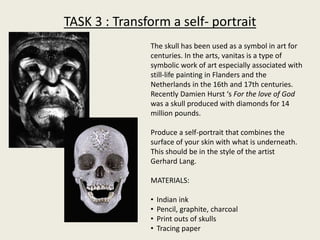
The skull has been used as a symbol in art for
centuries. In the arts, vanitas is a type of
symbolic work of art especially associated with
still-life painting in Flanders and the
Netherlands in the 16th and 17th centuries.
Recently Damien Hurst ‘s For the love of God
was a skull produced with diamonds for 14
million pounds.
Produce a self-portrait that combines the
surface of your skin with what is underneath.
This should be in the style of the artist
Gerhard Lang.
MATERIALS:
• Indian ink
• Pencil, graphite, charcoal
• Print outs of skulls
• Tracing paper
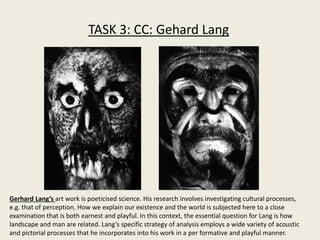
TASK 3: CC: Gehard Lang
Gerhard Lang’s art work is poeticised science. His research involves investigating cultural processes,
e.g. that of perception. How we explain our existence and the world is subjected here to a close
examination that is both earnest and playful. In this context, the essential question for Lang is how
landscape and man are related. Lang’s specific strategy of analysis employs a wide variety of acoustic
and pictorial processes that he incorporates into his work in a per formative and playful manner.
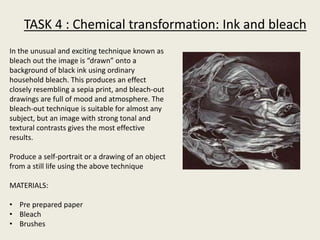
TASK 4 : Chemical transformation: Ink and bleach
In the unusual and exciting technique known as
bleach out the image is “drawn” onto a
background of black ink using ordinary
household bleach. This produces an effect
closely resembling a sepia print, and bleach-out
drawings are full of mood and atmosphere. The
bleach-out technique is suitable for almost any
subject, but an image with strong tonal and
textural contrasts gives the most effective
results.
Produce a self-portrait or a drawing of an object
from a still life using the above technique
MATERIALS:
• Pre prepared paper
• Bleach
• Brushes
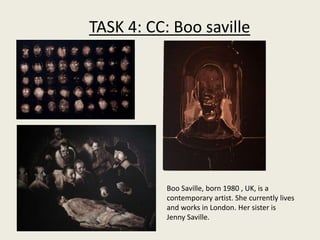
Boo Saville, born 1980 , UK, is a
contemporary artist. She currently lives
and works in London. Her sister is
Jenny Saville.
TASK 4: CC: Boo saville
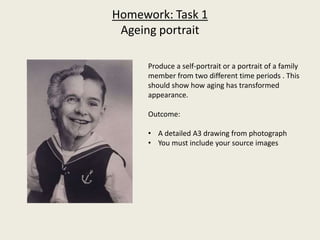
Homework: Task 1
Ageing portrait
Produce a self-portrait or a portrait of a family
member from two different time periods . This
should show how aging has transformed
appearance.
Outcome:
• A detailed A3 drawing from photograph
• You must include your source images
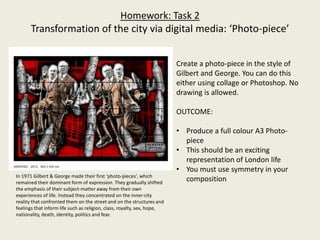
Homework: Task 2
Transformation of the city via digital media: ‘Photo-piece’
Create a photo-piece in the style of
Gilbert and George. You can do this
either using collage or Photoshop. No
drawing is allowed.
OUTCOME:
• Produce a full colour A3 Photo-
piece
• This should be an exciting
representation of London life
• You must use symmetry in your
compositionIn 1971 Gilbert & George made their first ‘photo-pieces', which
remained their dominant form of expression. They gradually shifted
the emphasis of their subject-matter away from their own
experiences of life. Instead they concentrated on the inner-city
reality that confronted them on the street and on the structures and
feelings that inform life such as religion, class, royalty, sex, hope,
nationality, death, identity, politics and fear.

AS Art exam 2016_ Transformation

  • 2.
    AS : EXAM: Unit 2 : The Theme… TRANSFORMATION
  • 3.
    An introduction…Transformation ofthe body…Decay A cadaver tomb, Latin for "reminder of death") is a type of tomb featuring an effigy in the macabre form of a decomposing corpse. These were made in the Middle Ages.
  • 4.
    An introduction…Transformation ofthe body…Ageing Stanley Spencer is one of many artists who have documented their own ageing with periodic self-portraits. (1914, 1939, 1959)
  • 5.
    An introduction…Transformation ofthe environment… Human occupation Exploring the Residual LandscapeNature transformed through industry is a predominant theme in my work. I set course to intersect with a contemporary view of the great ages of man; from stone, to minerals, oil, transportation, silicon, and so on. To make these ideas visible I search for subjects that are rich in detail and scale yet open in their meaning. Recycling yards, mine tailings, quarries and refineries are all places that are outside of our normal experience, yet we partake of their output on a daily basis. These images are meant as metaphors to the dilemma of our modern existence; they search for a dialogue between attraction and repulsion, seduction and fear. We are drawn by desire - a chance at good living, yet we are consciously or unconsciously aware that the world is suffering for our success. Our dependence on nature to provide the materials for our consumption and our concern for the health of our planet sets us into an uneasy contradiction. For me, these images function as reflecting pools of our times. Edward Burtynsky
  • 6.
    An introduction…Transformation ofthe natural environment Boyle Family is a group of collaborative artists based in London. Mark Boyle and Joan Hills met in Harrogate, Yorkshire in 1957. Joan had studied art and architecture and was bringing up her first son Cameron whilst running her own business. Mark was in the army, writing poetry. After a period of working separately on visual art pieces, they incrementally moved into a natural collaboration - agreeing that art should not exclude anything as a potential subject.
  • 7.
    An introduction…Transformation ofthe city through art intervention Christo (born Bulgaria, 1935) and Jeanne-Claude (b. Morocco, 1935 – 2009) were a married couple who created environmental works of art. Their works include the wrapping of the Reichstag in Berlin and the Pont-Neuf bridge in Paris. Christo and Jeanne- Claude were born on the same date. They first met in Paris in October 1958. They flew in separate planes: in case one crashed, the other could continue their work.
  • 8.
    An introduction…Transformation ofmaterials and the environment Anish Kapoor was one of a generation of British-based sculptors who became established in the international arena during the 1980s and is prominent among his contemporaries for the quality of hermetic lyricism that permeates his work. He has acknowledged a bearing on his art of both Western and Eastern culture. The powerful spiritual and mythological resonances of his sculptures arise in part from frequent return visits to India. Natural materials such as sandstone, marble and slate are impregnated with raw powdered pigment of vivid hues, thus enhancing a feeling of inner radiance.
  • 9.
    British sculptors. GilbertProesch (b. Italy, 1943) and George Passmore (b UK, 1942) met in 1967 as students at St Martin's School of Art in London. They are a couple and work together as artists. There most recent show was at White cube ‘Scapegoating pictures for London’. By 1969 they were reacting against approaches to sculpture then dominant at St Martin's, which they regarded as elitist and poor at communicating outside an art context. Their strategy was to make themselves into sculpture, so sacrificing their separate identities to art and turning the notion of creativity on its head. An introduction…Transformation of the city via digital media
  • 10.
    Lakovos "Jake" (born1966) and Konstantinos "Dinos" (born 1962) are English visual artists, often known as the Chapman Brothers, who work together. Their subject matter tries to be deliberately shocking. In the mid-1990s, their sculptures were included in the YBA showcase exhibition Sensation. An introduction…Transformation objects and art
  • 11.
    AS : Unit2 CLASS AND HOMEWORK TASKS
  • 12.
    TASK 1 :Transform found objects to produce an… ASSEMBLAGE (mixed media 3D artwork) Assemblage is an artistic form or medium usually created on a defined substrate that consists of three-dimensional elements projecting out of or from the substrate. It is similar to collage, a two- dimensional medium. It is part of the visual arts, and it typically uses found objects, but is not limited to these materials. Materials to consider: • Ask for free object at charity shops • Raid your recycling bin • Look in local skips • Scrap paper, newspaper and packaging OUTCOME: Produce a freestanding 3D sculpture made from at least 10 different items. This must also be painted
  • 13.
    Task 1: CC:EdwardKeinholz Edward Kienholz 1927–1994. American sculptor. Having produced his first paintings and watercolours while still in high school, in 1954 Kienholz made his first wooden relief paintings. These consisted of odd pieces of wood nailed to a panel and then painted with a broom. They were often painted in a murky brown to exaggerate their ugliness, through which Kienholz sought to investigate concepts of beauty. In 1962 Kienholz exhibited his first ‘tableau', or environmental assemblage. Named after a brothel in Los Angeles, it recreates its subject through a series of furnished rooms filled with figures and other objects. The figures that populate it are deformed mannequins.
  • 14.
    TASK 2: CC:Transform an artwork Produce an new artwork that is based on a famous artwork. MATERIALS: • Paint • Colour images of artwork • Stencil OUTCOME: Produce and 2D or 3D art work that will be recognisable and exciting. Above: Public artwork by Banksy
  • 15.
    TASK 2: CC:Transform an artwork 1. Study after Velázquez's Portrait of Pope Innocent X is a 1953 painting by the artist Francis Bacon. The work shows a distorted version of the Portrait of Innocent X painted by Spanish artist Diego Velázquez in 1650. 2. The Chapman brothers etchings are based on those by Goya, (1746- 1819), 1 2
  • 16.
    Above: Beer Street and GinLane are two prints (1751) by English artist William Hogarth. Above: Neal Fox, Le Gun. A modern take on Hogarth’s ‘Gin Lane’ print of 1751 TASK 2: CC: Transform an artwork
  • 17.
    TASK 3 :Transform a self- portrait The skull has been used as a symbol in art for centuries. In the arts, vanitas is a type of symbolic work of art especially associated with still-life painting in Flanders and the Netherlands in the 16th and 17th centuries. Recently Damien Hurst ‘s For the love of God was a skull produced with diamonds for 14 million pounds. Produce a self-portrait that combines the surface of your skin with what is underneath. This should be in the style of the artist Gerhard Lang. MATERIALS: • Indian ink • Pencil, graphite, charcoal • Print outs of skulls • Tracing paper
  • 18.
    TASK 3: CC:Gehard Lang Gerhard Lang’s art work is poeticised science. His research involves investigating cultural processes, e.g. that of perception. How we explain our existence and the world is subjected here to a close examination that is both earnest and playful. In this context, the essential question for Lang is how landscape and man are related. Lang’s specific strategy of analysis employs a wide variety of acoustic and pictorial processes that he incorporates into his work in a per formative and playful manner.
  • 19.
    TASK 4 :Chemical transformation: Ink and bleach In the unusual and exciting technique known as bleach out the image is “drawn” onto a background of black ink using ordinary household bleach. This produces an effect closely resembling a sepia print, and bleach-out drawings are full of mood and atmosphere. The bleach-out technique is suitable for almost any subject, but an image with strong tonal and textural contrasts gives the most effective results. Produce a self-portrait or a drawing of an object from a still life using the above technique MATERIALS: • Pre prepared paper • Bleach • Brushes
  • 20.
    Boo Saville, born1980 , UK, is a contemporary artist. She currently lives and works in London. Her sister is Jenny Saville. TASK 4: CC: Boo saville
  • 21.
    Homework: Task 1 Ageingportrait Produce a self-portrait or a portrait of a family member from two different time periods . This should show how aging has transformed appearance. Outcome: • A detailed A3 drawing from photograph • You must include your source images
  • 22.
    Homework: Task 2 Transformationof the city via digital media: ‘Photo-piece’ Create a photo-piece in the style of Gilbert and George. You can do this either using collage or Photoshop. No drawing is allowed. OUTCOME: • Produce a full colour A3 Photo- piece • This should be an exciting representation of London life • You must use symmetry in your compositionIn 1971 Gilbert & George made their first ‘photo-pieces', which remained their dominant form of expression. They gradually shifted the emphasis of their subject-matter away from their own experiences of life. Instead they concentrated on the inner-city reality that confronted them on the street and on the structures and feelings that inform life such as religion, class, royalty, sex, hope, nationality, death, identity, politics and fear.

Editor's Notes

  • #18 http://www.independent.co.uk/arts-entertainment/art/news/death-arts-final-taboo-812189.html