Sun Printing
Cyanotype Impressions
“The Pencil of Nature”
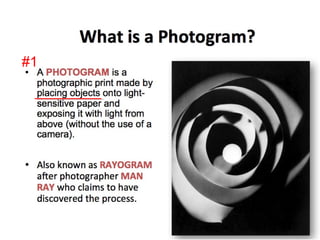
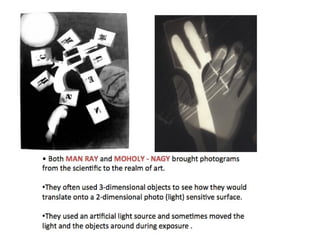
1. Photographic image made
without a camera by placing
objects directly onto the
surface of a material such as
photographic paper and then
exposing it to light.
#1
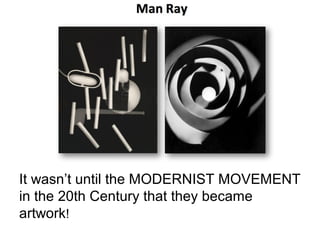
It wasn’t until the MODERNIST MOVEMENT
in the 20th Century that they became
artwork!
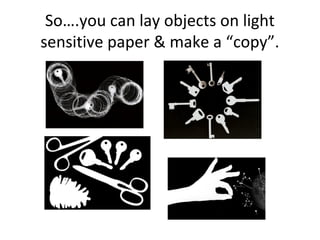
So….you can lay objects on light
sensitive paper & make a “copy”.
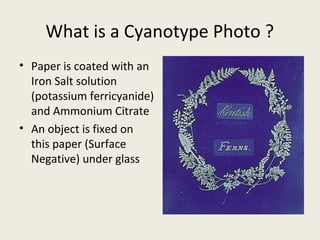
What is a Cyanotype Photo ?
• Paper is coated with an
Iron Salt solution
(potassium ferricyanide)
and Ammonium Citrate
• An object is fixed on
this paper (Surface
Negative) under glass
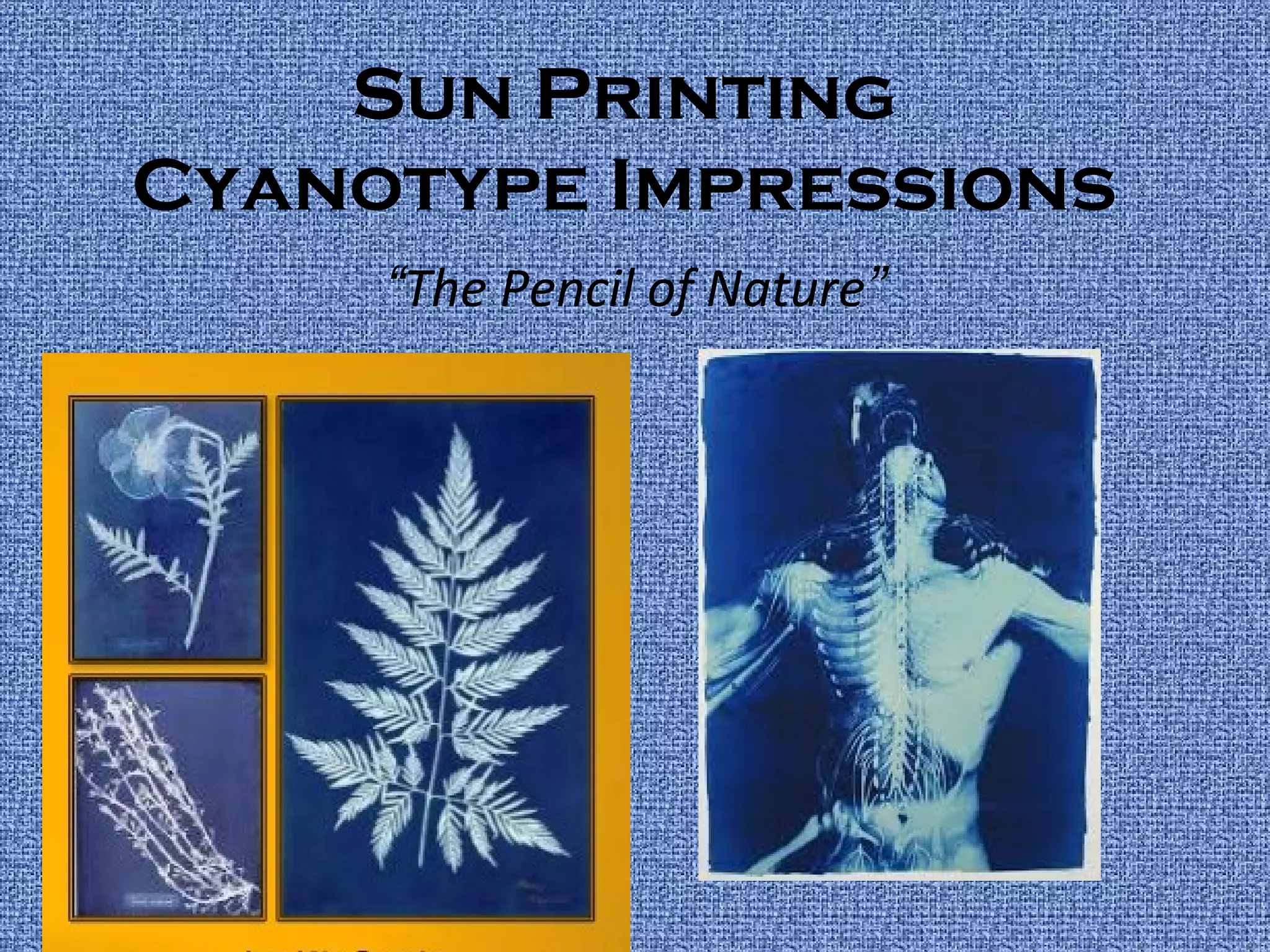
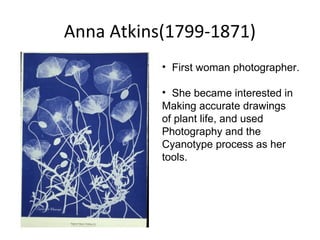
Anna Atkins(1799-1871)
• First woman photographer.
• She became interested in
Making accurate drawings
of plant life, and used
Photography and the
Cyanotype process as her
tools.
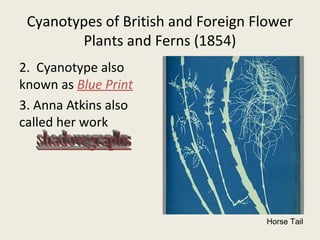
Cyanotypes of British and Foreign Flower
Plants and Ferns (1854)
2. Cyanotype also
known as Blue Print
3. Anna Atkins also
called her work
Horse Tail
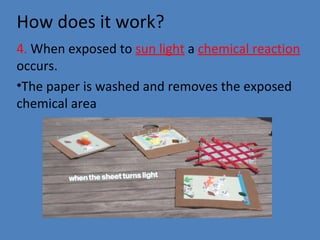
How does it work?
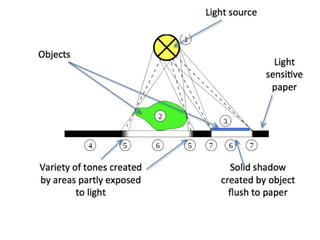
4. When exposed to sun light a chemical reaction
occurs.
•The paper is washed and removes the exposed
chemical area
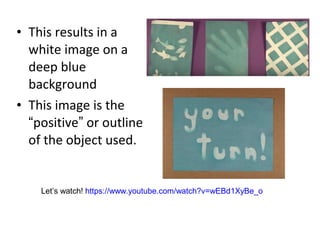
• This results in a
white image on a
deep blue
background
• This image is the
“positive” or outline
of the object used.
Let’s watch! https://www.youtube.com/watch?v=wEBd1XyBe_o
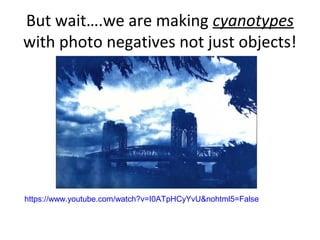
But wait….we are making cyanotypes
with photo negatives not just objects!
https://www.youtube.com/watch?v=I0ATpHCyYvU&nohtml5=False
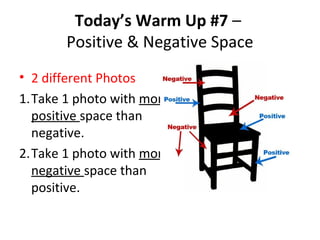
Today’s Warm Up #7 –
Positive & Negative Space
• 2 different Photos
1.Take 1 photo with more
positive space than
negative.
2.Take 1 photo with more
negative space than
positive.
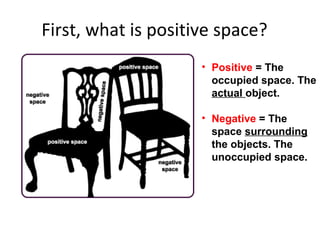
First, what is positive space?
• Positive = The
occupied space. The
actual object.
• Negative = The
space surrounding
the objects. The
unoccupied space.
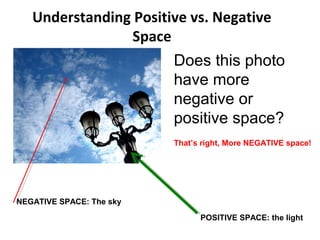
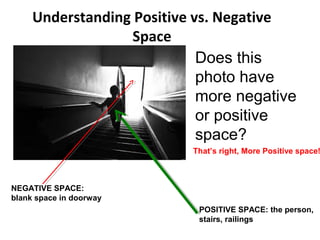
Understanding Positive vs. Negative
Space
Does this photo
have more
negative or
positive space?
NEGATIVE SPACE: The sky
POSITIVE SPACE: the light
That’s right, More NEGATIVE space!
Understanding Positive vs. Negative
Space
Does this
photo have
more negative
or positive
space?
NEGATIVE SPACE:
blank space in doorway
POSITIVE SPACE: the person,
stairs, railings
That’s right, More Positive space!
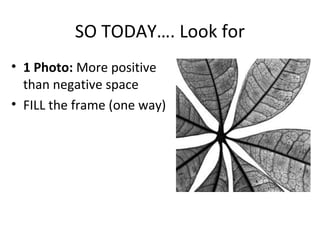
SO TODAY…. Look for
• 1 Photo: More positive
than negative space
• FILL the frame (one way)
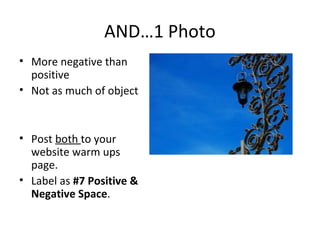
AND…1 Photo
• More negative than
positive
• Not as much of object
• Post both to your
website warm ups
page.
• Label as #7 Positive &
Negative Space.
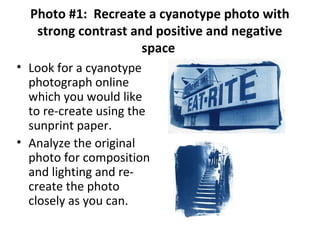
Photo #1: Recreate a cyanotype photo with
strong contrast and positive and negative
space
• Look for a cyanotype
photograph online
which you would like
to re-create using the
sunprint paper.
• Analyze the original
photo for composition
and lighting and re-
create the photo
closely as you can.
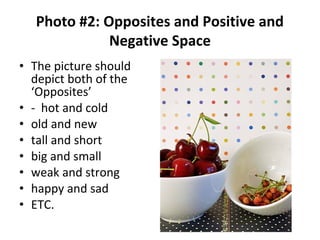
• The picture should
depict both of the
‘Opposites’
• - hot and cold
• old and new
• tall and short
• big and small
• weak and strong
• happy and sad
• ETC.
Photo #2: Opposites and Positive and
Negative Space
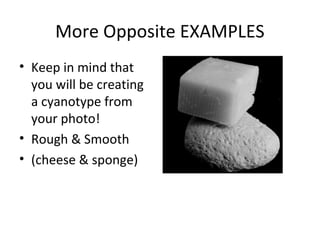
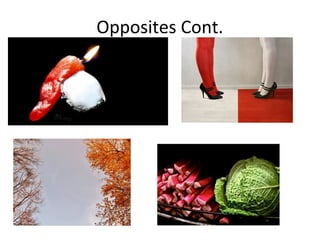
More Opposite EXAMPLES
• Keep in mind that
you will be creating
a cyanotype from
your photo!
• Rough & Smooth
• (cheese & sponge)
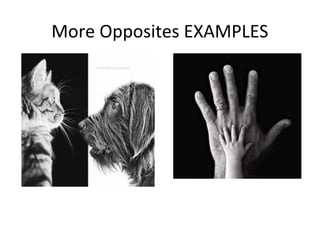
More Opposites EXAMPLES
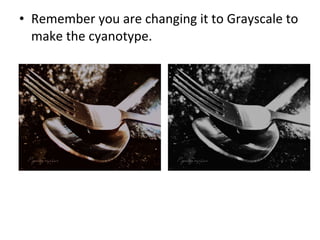
• Remember you are changing it to Grayscale to
make the cyanotype.
Opposites Cont.
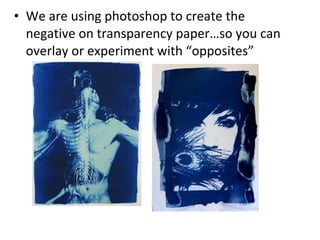
• We are using photoshop to create the
negative on transparency paper…so you can
overlay or experiment with “opposites”
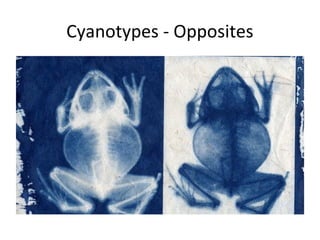
Cyanotypes - Opposites

Cyanotype slideshow

  • 1.
  • 2.
    1. Photographic imagemade without a camera by placing objects directly onto the surface of a material such as photographic paper and then exposing it to light. #1
  • 5.
    It wasn’t untilthe MODERNIST MOVEMENT in the 20th Century that they became artwork!
  • 7.
    So….you can layobjects on light sensitive paper & make a “copy”.
  • 8.
    What is aCyanotype Photo ? • Paper is coated with an Iron Salt solution (potassium ferricyanide) and Ammonium Citrate • An object is fixed on this paper (Surface Negative) under glass
  • 9.
    Anna Atkins(1799-1871) • Firstwoman photographer. • She became interested in Making accurate drawings of plant life, and used Photography and the Cyanotype process as her tools.
  • 10.
    Cyanotypes of Britishand Foreign Flower Plants and Ferns (1854) 2. Cyanotype also known as Blue Print 3. Anna Atkins also called her work Horse Tail
  • 11.
    How does itwork? 4. When exposed to sun light a chemical reaction occurs. •The paper is washed and removes the exposed chemical area
  • 12.
    • This resultsin a white image on a deep blue background • This image is the “positive” or outline of the object used. Let’s watch! https://www.youtube.com/watch?v=wEBd1XyBe_o
  • 13.
    But wait….we aremaking cyanotypes with photo negatives not just objects! https://www.youtube.com/watch?v=I0ATpHCyYvU&nohtml5=False
  • 14.
    Today’s Warm Up#7 – Positive & Negative Space • 2 different Photos 1.Take 1 photo with more positive space than negative. 2.Take 1 photo with more negative space than positive.
  • 15.
    First, what ispositive space? • Positive = The occupied space. The actual object. • Negative = The space surrounding the objects. The unoccupied space.
  • 16.
    Understanding Positive vs.Negative Space Does this photo have more negative or positive space? NEGATIVE SPACE: The sky POSITIVE SPACE: the light That’s right, More NEGATIVE space!
  • 17.
    Understanding Positive vs.Negative Space Does this photo have more negative or positive space? NEGATIVE SPACE: blank space in doorway POSITIVE SPACE: the person, stairs, railings That’s right, More Positive space!
  • 18.
    SO TODAY…. Lookfor • 1 Photo: More positive than negative space • FILL the frame (one way)
  • 19.
    AND…1 Photo • Morenegative than positive • Not as much of object • Post both to your website warm ups page. • Label as #7 Positive & Negative Space.
  • 20.
    Photo #1: Recreatea cyanotype photo with strong contrast and positive and negative space • Look for a cyanotype photograph online which you would like to re-create using the sunprint paper. • Analyze the original photo for composition and lighting and re- create the photo closely as you can.
  • 21.
    • The pictureshould depict both of the ‘Opposites’ • - hot and cold • old and new • tall and short • big and small • weak and strong • happy and sad • ETC. Photo #2: Opposites and Positive and Negative Space
  • 22.
    More Opposite EXAMPLES •Keep in mind that you will be creating a cyanotype from your photo! • Rough & Smooth • (cheese & sponge)
  • 23.
  • 24.
    • Remember youare changing it to Grayscale to make the cyanotype.
  • 25.
  • 26.
    • We areusing photoshop to create the negative on transparency paper…so you can overlay or experiment with “opposites”
  • 27.