LINE
JOT DOWN YOUR RESPONSE TO THE
FOLLOWING QUESTIONS:
1. What role does line have in art?
2. What are some different types of
lines?
3. Draw as many different lines as
possible on your paper.
LINE DEFINED
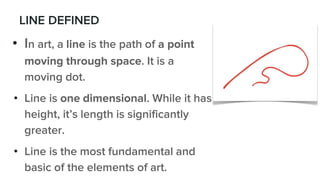
• In art, a line is the path of a point
moving through space. It is a
moving dot.
• Line is one dimensional. While it has
height, it’s length is significantly
greater.
• Line is the most fundamental and
basic of the elements of art.
USES OF LINES
• In a composition, lines are used to suggest
movement and to guide the viewer’s eye.
• Lines can be used to create the other elements of
art like shape, form, space, texture, and value.
• Lines can show where one thing stops and another
begins, defining outlines, separation of parts, and
structure.
• Lines can convey emotions and set moods within a
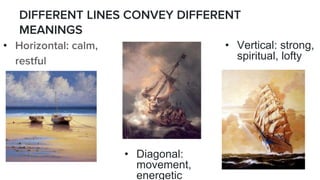
DIFFERENT LINES CONVEY DIFFERENT
MEANINGS
• Horizontal: calm,
restful
• Vertical: strong,
spiritual, lofty
• Diagonal:
movement,
energetic
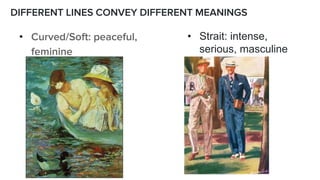
DIFFERENT LINES CONVEY DIFFERENT MEANINGS
• Curved/Soft: peaceful,
feminine
• Strait: intense,
serious, masculine
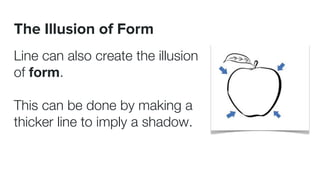
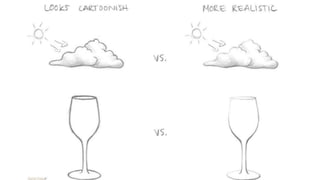
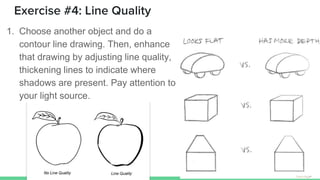
The Illusion of Form
Line can also create the illusion
of form.
This can be done by making a
thicker line to imply a shadow.
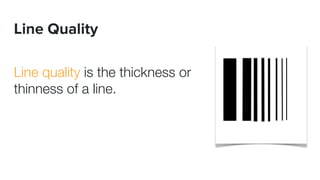
Line Quality
Line quality is the thickness or
thinness of a line.
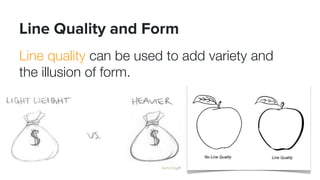
Line Quality and Form
Line quality can be used to add variety and
the illusion of form.
WHAT ARE SOME TYPES OF
LINES?
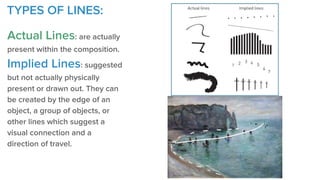
TYPES OF LINES:
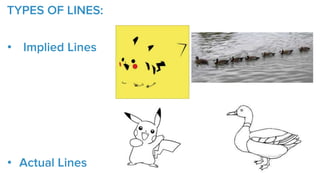
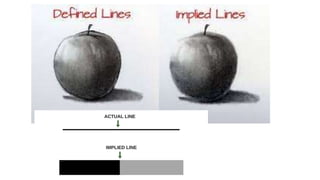
Actual Lines: are actually
present within the composition.
Implied Lines: suggested
but not actually physically
present or drawn out. They can
be created by the edge of an
object, a group of objects, or
other lines which suggest a
visual connection and a
direction of travel.
TYPES OF LINES:
• Implied Lines
• Actual Lines
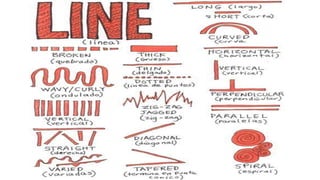
TYPES OF LINES
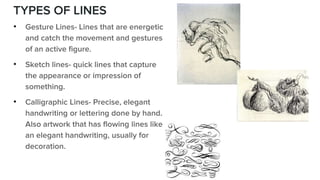
• Gesture Lines- Lines that are energetic
and catch the movement and gestures
of an active figure.
• Sketch lines- quick lines that capture
the appearance or impression of
something.
• Calligraphic Lines- Precise, elegant
handwriting or lettering done by hand.
Also artwork that has flowing lines like
an elegant handwriting, usually for
decoration.
TYPES OF LINE
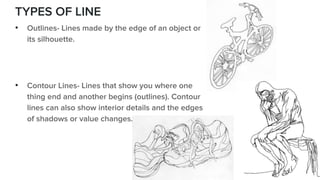
• Outlines- Lines made by the edge of an object or
its silhouette.
• Contour Lines- Lines that show you where one
thing end and another begins (outlines). Contour
lines can also show interior details and the edges
of shadows or value changes.
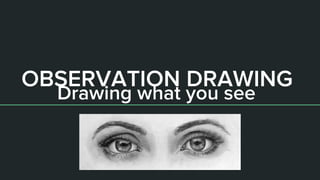
OBSERVATION DRAWING
Drawing what you see
● Don’t think about what you are drawing (ex: a face, a hand, a plant),
just look at the object and draw exactly what you see, even if it
doesn't look like the object at first.
● Make the ants journey: follow the edges (contours) of the object
slowly with your eyes.
● Break the subject matter down into simple lines and shapes.
● Pay attention to the light source and shadows.
● Notice the details.
Subject Matter
● Subject- the main idea that is represented in the artwork
Types of Subjects
● Still life- an artwork that focuses on still objects. The subject matter is
inanimate (not living) and never moves, typically with a focus on
household objects, flowers, or fruits.
● Figure- drawing the human body in its various shapes and positions
● Landscape- an artwork that depicts natural scenery such as mountains,
valleys, trees, rivers, and forests, especially where the main subject is a
wide view
● Portrait- an artwork depicting a person or animal, usually of the face
CONTOUR
LINE
CONTOUR LINE
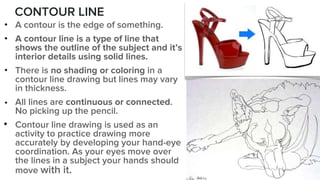
• A contour is the edge of something.
• A contour line is a type of line that
shows the outline of the subject and it’s
interior details using solid lines.
• There is no shading or coloring in a
contour line drawing but lines may vary
in thickness.
• All lines are continuous or connected.
No picking up the pencil.
• Contour line drawing is used as an
activity to practice drawing more
accurately by developing your hand-eye
coordination. As your eyes move over
the lines in a subject your hands should
move with it.
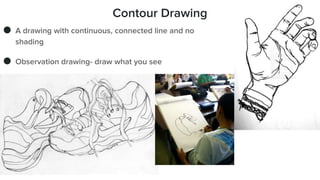
Contour Drawing
● A drawing with continuous, connected line and no
shading
● Observation drawing- draw what you see
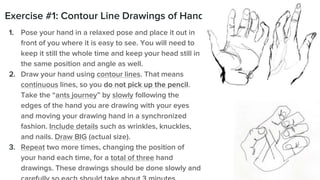
Exercise #1: Contour Line Drawings of Hand
1. Pose your hand in a relaxed pose and place it out in
front of you where it is easy to see. You will need to
keep it still the whole time and keep your head still in
the same position and angle as well.
2. Draw your hand using contour lines. That means
continuous lines, so you do not pick up the pencil.
Take the “ants journey” by slowly following the
edges of the hand you are drawing with your eyes
and moving your drawing hand in a synchronized
fashion. Include details such as wrinkles, knuckles,
and nails. Draw BIG (actual size).
3. Repeat two more times, changing the position of
your hand each time, for a total of three hand
drawings. These drawings should be done slowly and
BLIND
CONTOUR
LINE
DRAWING
BLIND CONTOUR LINE DRAWING
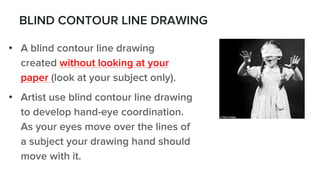
• A blind contour line drawing
created without looking at your
paper (look at your subject only).
• Artist use blind contour line drawing
to develop hand-eye coordination.
As your eyes move over the lines of
a subject your drawing hand should
move with it.
BLIND CONTOUR LINE DRAWING
Rules of a bind contour drawing:
1. You cannot look down on your paper! Use a cover sheet.
2. Slowly follow the lines of your subject with your eyes and
have your hand move along with your eyes.
3. Keep your pencil/pen on paper at all time. You cannot
pick it up.
4. No erasing.
5. Lines only (no coloring or shading).
Exercise #2: BLIND CONTOUR DRAWING
1. Get out a pen or pencil and two sheets of paper.
2. Choose a partner and position yourself across from them. If you’re at
home look in a mirror or look up a reference photograph of a person’s
face (not a cartoon or drawing).
3. Use the hand you are not drawing with to hold a cover sheet to block
your view of the paper you are drawing on so that you cannot see it.
4. Do a blind contour line drawing of your partner/self in the
mirror/photo.
5. Remember:
• Draw slowly, no lifting your pencil, and no looking at your paper!
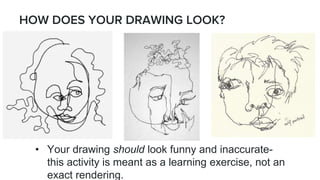
HOW DOES YOUR DRAWING LOOK?
• Your drawing should look funny and inaccurate-
this activity is meant as a learning exercise, not an
exact rendering.
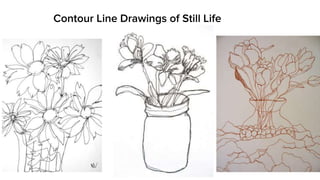
Contour Line Drawings of Still Life
Line Exercise #3: Contour Line
Drawings of Still Life
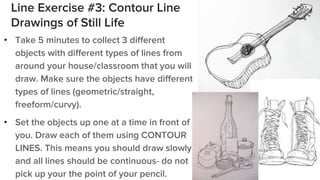
• Take 5 minutes to collect 3 different
objects with different types of lines from
around your house/classroom that you will
draw. Make sure the objects have different
types of lines (geometric/straight,
freeform/curvy).
• Set the objects up one at a time in front of
you. Draw each of them using CONTOUR
LINES. This means you should draw slowly
and all lines should be continuous- do not
pick up your the point of your pencil.
Exercise #4: Line Quality
1. Choose another object and do a
contour line drawing. Then, enhance
that drawing by adjusting line quality,
thickening lines to indicate where
shadows are present. Pay attention to
your light source.
WHAT DID YOU LEARN?
1. At the bottom of your paper, describe
the type of line you used and at least
one way you used the purposes of
line in your drawing.
2. How can this activity help you
improve your drawing skills?
CROSS
CONTOUR
LINES
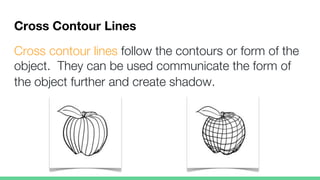
Cross Contour Lines
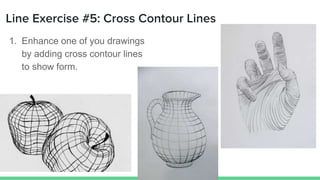
Cross contour lines follow the contours or form of the
object. They can be used communicate the form of
the object further and create shadow.
Line Exercise #5: Cross Contour Lines
1. Enhance one of you drawings
by adding cross contour lines
to show form.
Can You Answer...
1. What is a line?
2. What are contour lines and how are they
used in a drawing?
3. How can line quality enhance a drawing?
4. How can cross contour lines benefit
painting and other forms of 2-D media?

Line, contour line, and observation drawing

  • 1.
  • 2.
    JOT DOWN YOURRESPONSE TO THE FOLLOWING QUESTIONS: 1. What role does line have in art? 2. What are some different types of lines? 3. Draw as many different lines as possible on your paper.
  • 3.
    LINE DEFINED • Inart, a line is the path of a point moving through space. It is a moving dot. • Line is one dimensional. While it has height, it’s length is significantly greater. • Line is the most fundamental and basic of the elements of art.
  • 4.
    USES OF LINES •In a composition, lines are used to suggest movement and to guide the viewer’s eye. • Lines can be used to create the other elements of art like shape, form, space, texture, and value. • Lines can show where one thing stops and another begins, defining outlines, separation of parts, and structure. • Lines can convey emotions and set moods within a
  • 5.
    DIFFERENT LINES CONVEYDIFFERENT MEANINGS • Horizontal: calm, restful • Vertical: strong, spiritual, lofty • Diagonal: movement, energetic
  • 6.
    DIFFERENT LINES CONVEYDIFFERENT MEANINGS • Curved/Soft: peaceful, feminine • Strait: intense, serious, masculine
  • 7.
    The Illusion ofForm Line can also create the illusion of form. This can be done by making a thicker line to imply a shadow.
  • 8.
    Line Quality Line qualityis the thickness or thinness of a line.
  • 9.
    Line Quality andForm Line quality can be used to add variety and the illusion of form.
  • 11.
    WHAT ARE SOMETYPES OF LINES?
  • 13.
    TYPES OF LINES: ActualLines: are actually present within the composition. Implied Lines: suggested but not actually physically present or drawn out. They can be created by the edge of an object, a group of objects, or other lines which suggest a visual connection and a direction of travel.
  • 14.
    TYPES OF LINES: •Implied Lines • Actual Lines
  • 16.
    TYPES OF LINES •Gesture Lines- Lines that are energetic and catch the movement and gestures of an active figure. • Sketch lines- quick lines that capture the appearance or impression of something. • Calligraphic Lines- Precise, elegant handwriting or lettering done by hand. Also artwork that has flowing lines like an elegant handwriting, usually for decoration.
  • 17.
    TYPES OF LINE •Outlines- Lines made by the edge of an object or its silhouette. • Contour Lines- Lines that show you where one thing end and another begins (outlines). Contour lines can also show interior details and the edges of shadows or value changes.
  • 18.
  • 19.
    Drawing what yousee ● Don’t think about what you are drawing (ex: a face, a hand, a plant), just look at the object and draw exactly what you see, even if it doesn't look like the object at first. ● Make the ants journey: follow the edges (contours) of the object slowly with your eyes. ● Break the subject matter down into simple lines and shapes. ● Pay attention to the light source and shadows. ● Notice the details.
  • 20.
    Subject Matter ● Subject-the main idea that is represented in the artwork Types of Subjects ● Still life- an artwork that focuses on still objects. The subject matter is inanimate (not living) and never moves, typically with a focus on household objects, flowers, or fruits. ● Figure- drawing the human body in its various shapes and positions ● Landscape- an artwork that depicts natural scenery such as mountains, valleys, trees, rivers, and forests, especially where the main subject is a wide view ● Portrait- an artwork depicting a person or animal, usually of the face
  • 21.
  • 22.
    CONTOUR LINE • Acontour is the edge of something. • A contour line is a type of line that shows the outline of the subject and it’s interior details using solid lines. • There is no shading or coloring in a contour line drawing but lines may vary in thickness. • All lines are continuous or connected. No picking up the pencil. • Contour line drawing is used as an activity to practice drawing more accurately by developing your hand-eye coordination. As your eyes move over the lines in a subject your hands should move with it.
  • 23.
    Contour Drawing ● Adrawing with continuous, connected line and no shading ● Observation drawing- draw what you see
  • 24.
    Exercise #1: ContourLine Drawings of Hand 1. Pose your hand in a relaxed pose and place it out in front of you where it is easy to see. You will need to keep it still the whole time and keep your head still in the same position and angle as well. 2. Draw your hand using contour lines. That means continuous lines, so you do not pick up the pencil. Take the “ants journey” by slowly following the edges of the hand you are drawing with your eyes and moving your drawing hand in a synchronized fashion. Include details such as wrinkles, knuckles, and nails. Draw BIG (actual size). 3. Repeat two more times, changing the position of your hand each time, for a total of three hand drawings. These drawings should be done slowly and
  • 25.
  • 26.
    BLIND CONTOUR LINEDRAWING • A blind contour line drawing created without looking at your paper (look at your subject only). • Artist use blind contour line drawing to develop hand-eye coordination. As your eyes move over the lines of a subject your drawing hand should move with it.
  • 27.
    BLIND CONTOUR LINEDRAWING Rules of a bind contour drawing: 1. You cannot look down on your paper! Use a cover sheet. 2. Slowly follow the lines of your subject with your eyes and have your hand move along with your eyes. 3. Keep your pencil/pen on paper at all time. You cannot pick it up. 4. No erasing. 5. Lines only (no coloring or shading).
  • 28.
    Exercise #2: BLINDCONTOUR DRAWING 1. Get out a pen or pencil and two sheets of paper. 2. Choose a partner and position yourself across from them. If you’re at home look in a mirror or look up a reference photograph of a person’s face (not a cartoon or drawing). 3. Use the hand you are not drawing with to hold a cover sheet to block your view of the paper you are drawing on so that you cannot see it. 4. Do a blind contour line drawing of your partner/self in the mirror/photo. 5. Remember: • Draw slowly, no lifting your pencil, and no looking at your paper!
  • 29.
    HOW DOES YOURDRAWING LOOK? • Your drawing should look funny and inaccurate- this activity is meant as a learning exercise, not an exact rendering.
  • 30.
    Contour Line Drawingsof Still Life
  • 31.
    Line Exercise #3:Contour Line Drawings of Still Life • Take 5 minutes to collect 3 different objects with different types of lines from around your house/classroom that you will draw. Make sure the objects have different types of lines (geometric/straight, freeform/curvy). • Set the objects up one at a time in front of you. Draw each of them using CONTOUR LINES. This means you should draw slowly and all lines should be continuous- do not pick up your the point of your pencil.
  • 32.
    Exercise #4: LineQuality 1. Choose another object and do a contour line drawing. Then, enhance that drawing by adjusting line quality, thickening lines to indicate where shadows are present. Pay attention to your light source.
  • 33.
    WHAT DID YOULEARN? 1. At the bottom of your paper, describe the type of line you used and at least one way you used the purposes of line in your drawing. 2. How can this activity help you improve your drawing skills?
  • 34.
  • 35.
    Cross Contour Lines Crosscontour lines follow the contours or form of the object. They can be used communicate the form of the object further and create shadow.
  • 36.
    Line Exercise #5:Cross Contour Lines 1. Enhance one of you drawings by adding cross contour lines to show form.
  • 37.
    Can You Answer... 1.What is a line? 2. What are contour lines and how are they used in a drawing? 3. How can line quality enhance a drawing? 4. How can cross contour lines benefit painting and other forms of 2-D media?