IMPRESSIONISM & POSTIMPRESSIONISM: VINCENT VAN
GOGH
• Vincent van Gogh, one of the most well-known post-impressionist artists was born
in Groot-Zundert, Holland on March 30, 1853.The son of a pastor, Vincent was highly
emotional, lacked self-confidence and struggled with his identity and with direction.
• Between 1860 and 1880 van Gogh had already experienced much unhappiness. He
had worked unsuccessfully as a clerk in a bookstore, an art salesman, and a
preacher in a dreary mining district in Belgium where he was dismissed for
overzealousness.
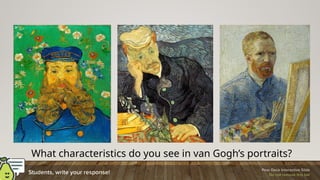
• He painted over 30 self-portraits between the years 1886 and 1889. His collection of
self-portraits places him among the most prolific self-portraitists of all time. Van
Gogh used portrait painting as a method of introspection and of developing his
skills as an artist.
• During his brief career, he did not experience much success, he sold only one
painting, lived in poverty, malnourished and overworked. The money he had was
supplied by his brother, Theo, and was used primarily for art supplies and coffee.
CHARACTERISTICS OF IMPRESSIONISM
PORTRAITS
•Realistic proportions
• Colorful- Color used to show feeling
• Textured/visual brush strokes
• Capture fleeting moments
• Showing common people, more modern subjects
5.
SURREALISM: FRIDA KAHLO
•Frida was born in 1907 in Mexico. Frida's father was German and her mother was a devout
Roman Catholic of mixed Amerindian and Spanish ancestry.
• Kahlo experience many medical issues throughout her life that she used to fuel her creative
voice. She contracted polio at the age of 6, which left her right leg thinner than her left. It was
discovered that she had Spinal Bifida. On September 7,1925, Kahlo was riding in a bus which
collided with a trolley car. She suffered serious injuries as a result of the accident, including a
broken spinal column, a broken collarbone, broken ribs, a broken pelvis, eleven fractures in
her right leg, a crushed and dislocated right foot, and a dislocated shoulder. Also, an iron
handrail pierced her abdomen. Her accident left her in a great deal of pain while she spent
three months recovering in a full body cast. Pain left her bedridden for months at a time.
• During her time of immobilization she began to paint to occupy her time, her self-portraits
became a dominant part of her life when she was immobile. She said "I paint myself because I
am so often alone and because I am the subject I know best"
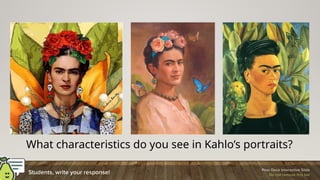
CHARACTERISTICS OF SURREALPORTRAITS
• Dream like quality- weird and bizarre
• Unrealistic scale (larger than life)
• Colorful depicting the world of dreams, nightmare, and imagination.
• Reversal of natural law
• Symbolism
8.
POP ART: ANDYWARHOL
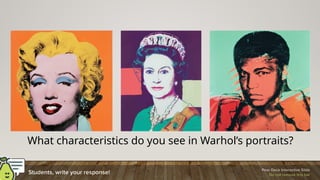
• Born on August 6, 1928, in Pittsburgh, Pennsylvania, Andy Warhol was a successful
magazine and ad illustrator who became a leading artist of the 1960s Pop art
movements.
• As a child he enjoyed drawing, listening to the radio and collecting pictures of
celebrities. Upon graduating from Carnegie Institute for Technology he became a
magazine illustrator.
• In the late 1950s, Warhol began devoting more attention to painting, and in 1961,
he debuted the concept of "pop art“.
• Warhol's life and work simultaneously satirized and celebrated materiality and
celebrity. On the one hand, his paintings of distorted brand images and celebrity
faces could be read as a critique of what he viewed as a culture obsessed with
money and celebrity. On the other hand, Warhol's focus on consumer goods and
pop-culture icons, as well as his own taste for money and fame, suggest a life in
celebration of the very aspects of American culture that his work criticized.
CHARACTERISTICS OF POPART PORTRAITS
• Realistic
• Hard edges
• Using mundane reality, irony, and parody’s
• Bright colors
• Recognizable imagery, drawn from popular media and products
• Influenced by comic books and newspapers, images of celebrities or fictional
charcaters
11.
PHOTOREALISM: CHUCK CLOSE
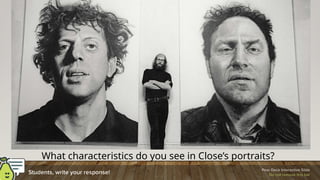
•Charles Thomas "Chuck" Close (born July 5, 1940) is an American painter, artist and
photographer who achieved fame as a photorealist, through his massive-scale portraits
• The portrait is the beating force of Close’s work, and many of his works have become the
iconic image of the artists he portrayed Alex Katz.
• The artist generally begins with a photograph of his sitter and then plots it onto a large
canvas using gridded lines. So enlarged, his sitters seem to spill out from the canvas; the
flickering quality of pointillist patches of color lend a twinkle to their eye, while exposing their
artificiality as images. In a painstaking, repetitive process of translating photographs of his
sitters to a painted (or printed) surface, Close brings life to their faces that the camera tends
to forget.
• The artist’s impaired ability to recognize faces – a condition called prosopagnosia – is often
cited as a reason for his obsessive rendering of faces. Close himself acknowledges his artistic
debt to his unusual way of taking in the world.
CHARACTERISTICS OF PHOTOREALISM
PORTRAITS
•Hyper realistic to reflect on the nature of reality- so realistic it looks like a
photograph
• Urban subject matter
• Realistic coloring
• Plain backgrounds
• Focus on expressions
14.
Contemporary: Kehinde Wiley
•Kehinde Wiley, (born February 28, 1977, Los Angeles, California, U.S.), American artist best known for
portraits that feature African Americans in the traditional settings of Old Master paintings.
• At the age of 11, he took art classes at a conservatory at California State University, and at 12 years
old he attended a six-week art program outside Leningrad (now St. Petersburg) sponsored by the
Center for U.S./U.S.S.R. Initiatives. After Wiley graduated from the Los Angeles County High School
for the Arts, he earned a Bachelor of Fine Arts degree (1999) at the San Francisco Art Institute and a
Master of Fine Arts (2001) at the School of Art at Yale University. His breakthrough work
Passing/Posing series (2001–04), in which he replaced the heroes, prophets, and saints of Old Master
paintings with young black men who were dressed in trademarked hip-hop attire.
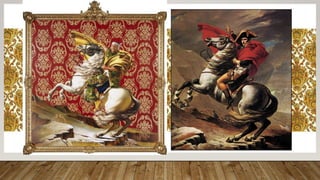
• In the series Rumors of War (2005), Wiley displaced heroic equestrians, painted by such court
painters as Diego Velázquez and Peter Paul Rubens, with contemporary men in team jerseys and
Timberland boots, but he kept the original portraits’ titles. Throughout, Wiley relied on random
encounters—“street casting”—to find his models, who went to his studio to select a pose and be
photographed. Wiley’s assistants applied the elaborately patterned backgrounds, but Wiley always
painted the figure, following the conventional hierarchy of a historic atelier.
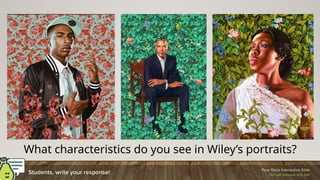
CHARACTERISTICS OF KEHINDEWILEY
• Realistic to reflect on the nature of reality
• Color for a purpose
• Detailed patterned backgrounds
• Traditional compositions/settings posing, with contemporary subjects
18.
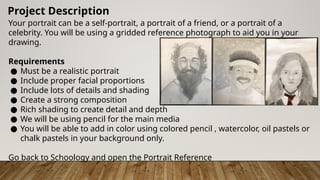
Your portrait canbe a self-portrait, a portrait of a friend, or a portrait of a
celebrity. You will be using a gridded reference photograph to aid you in your
drawing.
Requirements
● Must be a realistic portrait
● Include proper facial proportions
● Include lots of details and shading
● Create a strong composition
● Rich shading to create detail and depth
● We will be using pencil for the main media
● You will be able to add in color using colored pencil , watercolor, oil pastels or
chalk pastels in your background only.
Go back to Schoology and open the Portrait Reference
Project Description
Editor's Notes
#3 🍐 This is a Pear Deck Text Slide
🍐 To edit the type of question, go back to the "Ask Students a Question" in the Pear Deck sidebar.
#6 🍐 This is a Pear Deck Text Slide
🍐 To edit the type of question, go back to the "Ask Students a Question" in the Pear Deck sidebar.
#9 🍐 This is a Pear Deck Text Slide
🍐 To edit the type of question, go back to the "Ask Students a Question" in the Pear Deck sidebar.
#12 🍐 This is a Pear Deck Text Slide
🍐 To edit the type of question, go back to the "Ask Students a Question" in the Pear Deck sidebar.
#16 🍐 This is a Pear Deck Text Slide
🍐 To edit the type of question, go back to the "Ask Students a Question" in the Pear Deck sidebar.