Welcome to ART
Art Class Organisation
• Be punctual, well mannered and
organised
• Bring your iPad, pencilcase, A4
visual diary to class.
• Be open-minded to learning
something new.
• Listen carefully to instructions
• When doing something messy:
wear an Artsmock and clean up
after yourself.
• Put your labelled artwork in the
appropriate location (tub or dry
rack) in the room
• Be respectful to each other, all
artwork and use equipment
carefully.
Art units this year:
 Drawing Unit: expressive portraits
 Design Unit: Super food
 Ceramics unit: Indigenous cocoons
 Painting unit: Escape in the
landscape
 Discuss with a partner:
 What is your favorite art technique?
 What artwork are you most proud of?
 What would you like to learn this
year?
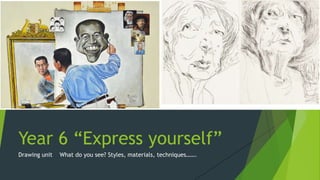
Year 6 “Express yourself”
Drawing unit What do you see? Styles, materials, techniques…….
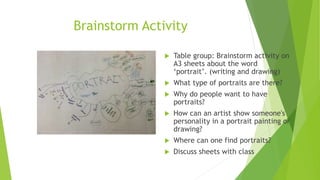
Brainstorm Activity
 Table group: Brainstorm activity on
A3 sheets about the word
‘portrait’. (writing and drawing)
 What type of portraits are there?
 Why do people want to have
portraits?
 How can an artist show someone's
personality in a portrait painting or
drawing?
 Where can one find portraits?
 Discuss sheets with class
Task1: Drawing
portraits in visual
diary
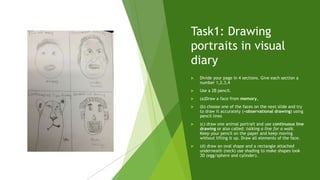
 Divide your page in 4 sections. Give each section a
number 1,2,3,4
 Use a 2B pencil.
 (a)Draw a face from memory,
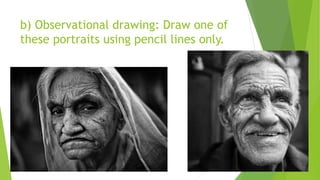
 (b) choose one of the faces on the next slide and try
to draw it accurately (=observational drawing) using
pencil lines
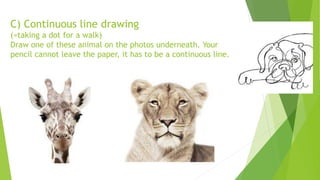
 (c) draw one animal portrait and use continuous line
drawing or also called: talking a line for a walk.
Keep your pencil on the paper and keep moving
without lifting it up. Draw all elements of the face.
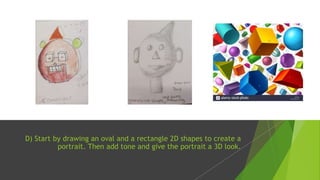
 (d) draw an oval shape and a rectangle attached
underneath (neck) use shading to make shapes look
3D (egg/sphere and cylinder).
b) Observational drawing: Draw one of
these portraits using pencil lines only.
C) Continuous line drawing
(=taking a dot for a walk)
Draw one of these animal on the photos underneath. Your
pencil cannot leave the paper, it has to be a continuous line.
D) Start by drawing an oval and a rectangle 2D shapes to create a
portrait. Then add tone and give the portrait a 3D look.
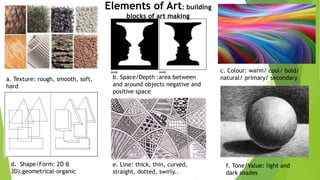
a. Texture: rough, smooth, soft,
hard
b. Space/Depth :area between
and around objects negative and
positive space
c. Colour: warm/ cool/ bold/
natural/ primary/ secondary
d. Shape/Form: 2D &
3D),geometrical-organic
e. Line: thick, thin, curved,
straight, dotted, swirly..
f. Tone/Value: light and
dark shades
Elements of Art: building
blocks of art making
Task 2a: Portrait proportions
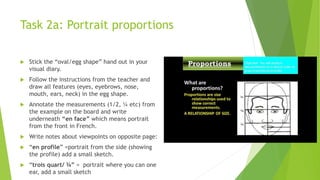
 Stick the “oval/egg shape” hand out in your
visual diary.
 Follow the instructions from the teacher and
draw all features (eyes, eyebrows, nose,
mouth, ears, neck) in the egg shape.
 Annotate the measurements (1/2, ¼ etc) from
the example on the board and write
underneath “en face” which means portrait
from the front in French.
 Write notes about viewpoints on opposite page:
 “en profile” =portrait from the side (showing
the profile) add a small sketch.
 “trois quart/ ¾” = portrait where you can one
ear, add a small sketch
Archibald Prize portrait with tone
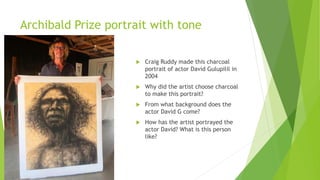
 Craig Ruddy made this charcoal
portrait of actor David Gulupilil in
2004
 Why did the artist choose charcoal
to make this portrait?
 From what background does the
actor David G come?
 How has the artist portrayed the
actor David? What is this person
like?
Task 2b: Tonal portrait
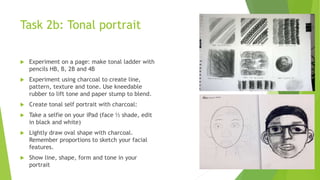
 Experiment on a page: make tonal ladder with
pencils HB, B, 2B and 4B
 Experiment using charcoal to create line,
pattern, texture and tone. Use kneedable
rubber to lift tone and paper stump to blend.
 Create tonal self portrait with charcoal:
 Take a selfie on your iPad (face ½ shade, edit
in black and white)
 Lightly draw oval shape with charcoal.
Remember proportions to sketch your facial
features.
 Show line, shape, form and tone in your
portrait
Task 3 Who are you?
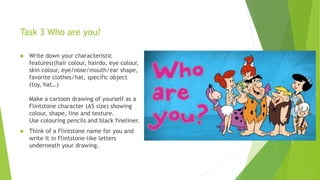
 Write down your characteristic
features((hair colour, hairdo, eye colour,
skin colour, eye/nose/mouth/ear shape,
favorite clothes/hat, specific object
(toy, hat…)
Make a cartoon drawing of yourself as a
Flintstone character (A5 size) showing
colour, shape, line and texture.
Use colouring pencils and black fineliner.
 Think of a Flintstone name for you and
write it in Flintstone-like letters
underneath your drawing.
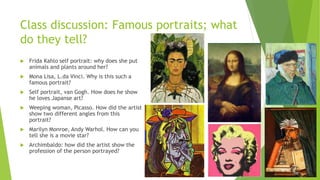
Class discussion: Famous portraits; what
do they tell?
 Frida Kahlo self portrait: why does she put
animals and plants around her?
 Mona Lisa, L.da Vinci. Why is this such a
famous portrait?
 Self portrait, van Gogh. How does he show
he loves Japanse art?
 Weeping woman, Picasso. How did the artist
show two different angles from this
portrait?
 Marilyn Monroe, Andy Warhol. How can you
tell she is a movie star?
 Archimbaldo: how did the artist show the
profession of the person portrayed?
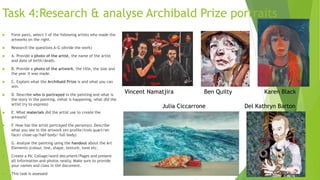
Task 4:Research & analyse Archibald Prize portraits
 Form pairs, select 1 of the following artists who made the
artworks on the right.
 Research the questions A-G (divide the work)
 A. Provide a photo of the artist, the name of the artist
and date of birth/death.
 B. Provide a photo of the artwork, the title, the size and
the year it was made.
 C. Explain what the Archibald Prize is and what you can
win.
 D. Describe who is portrayed in the painting and what is
the story in the painting. (what is happening, what did the
artist try to express)
 E. What materials did the artist use to create the
artwork?
 F. How has the artist portrayed the person(s). Describe
what you see in the artwork (en profile/trois quart/en
face/ close-up/half body/ full body)
 G. Analyse the painting using the handout about the Art
Elements (colour, line, shape, texture, tone etc.
 Create a Pic Collage/word document/Pages and present
all information and photos neatly. Make sure to provide
your names and class in the document.
 This task is assessed
Vincent Namatjira Ben Quilty Karen Black
Julia Ciccarrone Del Kathryn Barton
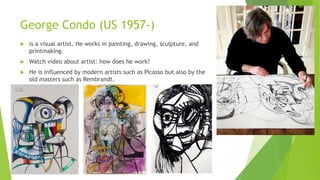
George Condo (US 1957-)
 is a visual artist. He works in painting, drawing, sculpture, and
printmaking.
 Watch video about artist: how does he work?
 He is influenced by modern artists such as Picasso but also by the
old masters such as Rembrandt.
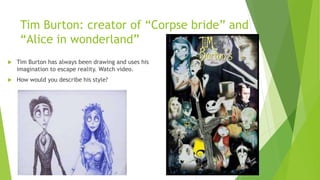
Tim Burton: creator of “Corpse bride” and
“Alice in wonderland”
 Tim Burton has always been drawing and uses his
imagination to escape reality. Watch video.
 How would you describe his style?
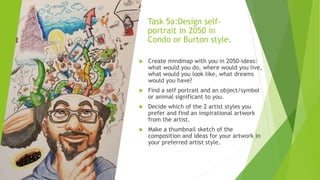
Task 5a:Design self-
portrait in 2050 in
Condo or Burton style.
 Create mindmap with you in 2050-ideas:
what would you do, where would you live,
what would you look like, what dreams
would you have?
 Find a self portrait and an object/symbol
or animal significant to you.
 Decide which of the 2 artist styles you
prefer and find an inspirational artwork
from the artist.
 Make a thumbnail sketch of the
composition and ideas for your artwork in
your preferred artist style.
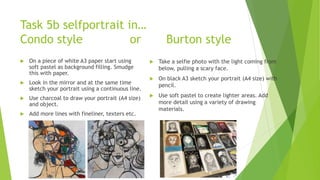
Task 5b selfportrait in…
Condo style or Burton style
 On a piece of white A3 paper start using
soft pastel as background filling. Smudge
this with paper.
 Look in the mirror and at the same time
sketch your portrait using a continuous line.
 Use charcoal to draw your portrait (A4 size)
and object.
 Add more lines with fineliner, texters etc.
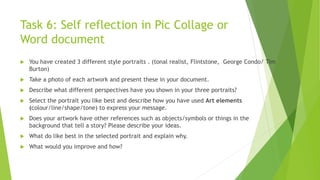
 Take a selfie photo with the light coming from
below, pulling a scary face.
 On black A3 sketch your portrait (A4 size) with
pencil.
 Use soft pastel to create lighter areas. Add
more detail using a variety of drawing
materials.
Task 6: Self reflection in Pic Collage or
Word document
 You have created 3 different style portraits . (tonal realist, Flintstone, George Condo/ Tim
Burton)
 Take a photo of each artwork and present these in your document.
 Describe what different perspectives have you shown in your three portraits?
 Select the portrait you like best and describe how you have used Art elements
(colour/line/shape/tone) to express your message.
 Does your artwork have other references such as objects/symbols or things in the
background that tell a story? Please describe your ideas.
 What do like best in the selected portrait and explain why.
 What would you improve and how?

Express yourself portrait 2022 version 1 grade 6

  • 1.
    Welcome to ART ArtClass Organisation • Be punctual, well mannered and organised • Bring your iPad, pencilcase, A4 visual diary to class. • Be open-minded to learning something new. • Listen carefully to instructions • When doing something messy: wear an Artsmock and clean up after yourself. • Put your labelled artwork in the appropriate location (tub or dry rack) in the room • Be respectful to each other, all artwork and use equipment carefully. Art units this year:  Drawing Unit: expressive portraits  Design Unit: Super food  Ceramics unit: Indigenous cocoons  Painting unit: Escape in the landscape  Discuss with a partner:  What is your favorite art technique?  What artwork are you most proud of?  What would you like to learn this year?
  • 2.
    Year 6 “Expressyourself” Drawing unit What do you see? Styles, materials, techniques…….
  • 3.
    Brainstorm Activity  Tablegroup: Brainstorm activity on A3 sheets about the word ‘portrait’. (writing and drawing)  What type of portraits are there?  Why do people want to have portraits?  How can an artist show someone's personality in a portrait painting or drawing?  Where can one find portraits?  Discuss sheets with class
  • 4.
    Task1: Drawing portraits invisual diary  Divide your page in 4 sections. Give each section a number 1,2,3,4  Use a 2B pencil.  (a)Draw a face from memory,  (b) choose one of the faces on the next slide and try to draw it accurately (=observational drawing) using pencil lines  (c) draw one animal portrait and use continuous line drawing or also called: talking a line for a walk. Keep your pencil on the paper and keep moving without lifting it up. Draw all elements of the face.  (d) draw an oval shape and a rectangle attached underneath (neck) use shading to make shapes look 3D (egg/sphere and cylinder).
  • 5.
    b) Observational drawing:Draw one of these portraits using pencil lines only.
  • 6.
    C) Continuous linedrawing (=taking a dot for a walk) Draw one of these animal on the photos underneath. Your pencil cannot leave the paper, it has to be a continuous line.
  • 7.
    D) Start bydrawing an oval and a rectangle 2D shapes to create a portrait. Then add tone and give the portrait a 3D look.
  • 8.
    a. Texture: rough,smooth, soft, hard b. Space/Depth :area between and around objects negative and positive space c. Colour: warm/ cool/ bold/ natural/ primary/ secondary d. Shape/Form: 2D & 3D),geometrical-organic e. Line: thick, thin, curved, straight, dotted, swirly.. f. Tone/Value: light and dark shades Elements of Art: building blocks of art making
  • 9.
    Task 2a: Portraitproportions  Stick the “oval/egg shape” hand out in your visual diary.  Follow the instructions from the teacher and draw all features (eyes, eyebrows, nose, mouth, ears, neck) in the egg shape.  Annotate the measurements (1/2, ¼ etc) from the example on the board and write underneath “en face” which means portrait from the front in French.  Write notes about viewpoints on opposite page:  “en profile” =portrait from the side (showing the profile) add a small sketch.  “trois quart/ ¾” = portrait where you can one ear, add a small sketch
  • 10.
    Archibald Prize portraitwith tone  Craig Ruddy made this charcoal portrait of actor David Gulupilil in 2004  Why did the artist choose charcoal to make this portrait?  From what background does the actor David G come?  How has the artist portrayed the actor David? What is this person like?
  • 11.
    Task 2b: Tonalportrait  Experiment on a page: make tonal ladder with pencils HB, B, 2B and 4B  Experiment using charcoal to create line, pattern, texture and tone. Use kneedable rubber to lift tone and paper stump to blend.  Create tonal self portrait with charcoal:  Take a selfie on your iPad (face ½ shade, edit in black and white)  Lightly draw oval shape with charcoal. Remember proportions to sketch your facial features.  Show line, shape, form and tone in your portrait
  • 12.
    Task 3 Whoare you?  Write down your characteristic features((hair colour, hairdo, eye colour, skin colour, eye/nose/mouth/ear shape, favorite clothes/hat, specific object (toy, hat…) Make a cartoon drawing of yourself as a Flintstone character (A5 size) showing colour, shape, line and texture. Use colouring pencils and black fineliner.  Think of a Flintstone name for you and write it in Flintstone-like letters underneath your drawing.
  • 13.
    Class discussion: Famousportraits; what do they tell?  Frida Kahlo self portrait: why does she put animals and plants around her?  Mona Lisa, L.da Vinci. Why is this such a famous portrait?  Self portrait, van Gogh. How does he show he loves Japanse art?  Weeping woman, Picasso. How did the artist show two different angles from this portrait?  Marilyn Monroe, Andy Warhol. How can you tell she is a movie star?  Archimbaldo: how did the artist show the profession of the person portrayed?
  • 14.
    Task 4:Research &analyse Archibald Prize portraits  Form pairs, select 1 of the following artists who made the artworks on the right.  Research the questions A-G (divide the work)  A. Provide a photo of the artist, the name of the artist and date of birth/death.  B. Provide a photo of the artwork, the title, the size and the year it was made.  C. Explain what the Archibald Prize is and what you can win.  D. Describe who is portrayed in the painting and what is the story in the painting. (what is happening, what did the artist try to express)  E. What materials did the artist use to create the artwork?  F. How has the artist portrayed the person(s). Describe what you see in the artwork (en profile/trois quart/en face/ close-up/half body/ full body)  G. Analyse the painting using the handout about the Art Elements (colour, line, shape, texture, tone etc.  Create a Pic Collage/word document/Pages and present all information and photos neatly. Make sure to provide your names and class in the document.  This task is assessed Vincent Namatjira Ben Quilty Karen Black Julia Ciccarrone Del Kathryn Barton
  • 15.
    George Condo (US1957-)  is a visual artist. He works in painting, drawing, sculpture, and printmaking.  Watch video about artist: how does he work?  He is influenced by modern artists such as Picasso but also by the old masters such as Rembrandt.
  • 16.
    Tim Burton: creatorof “Corpse bride” and “Alice in wonderland”  Tim Burton has always been drawing and uses his imagination to escape reality. Watch video.  How would you describe his style?
  • 17.
    Task 5a:Design self- portraitin 2050 in Condo or Burton style.  Create mindmap with you in 2050-ideas: what would you do, where would you live, what would you look like, what dreams would you have?  Find a self portrait and an object/symbol or animal significant to you.  Decide which of the 2 artist styles you prefer and find an inspirational artwork from the artist.  Make a thumbnail sketch of the composition and ideas for your artwork in your preferred artist style.
  • 18.
    Task 5b selfportraitin… Condo style or Burton style  On a piece of white A3 paper start using soft pastel as background filling. Smudge this with paper.  Look in the mirror and at the same time sketch your portrait using a continuous line.  Use charcoal to draw your portrait (A4 size) and object.  Add more lines with fineliner, texters etc.  Take a selfie photo with the light coming from below, pulling a scary face.  On black A3 sketch your portrait (A4 size) with pencil.  Use soft pastel to create lighter areas. Add more detail using a variety of drawing materials.
  • 19.
    Task 6: Selfreflection in Pic Collage or Word document  You have created 3 different style portraits . (tonal realist, Flintstone, George Condo/ Tim Burton)  Take a photo of each artwork and present these in your document.  Describe what different perspectives have you shown in your three portraits?  Select the portrait you like best and describe how you have used Art elements (colour/line/shape/tone) to express your message.  Does your artwork have other references such as objects/symbols or things in the background that tell a story? Please describe your ideas.  What do like best in the selected portrait and explain why.  What would you improve and how?