DRUGS USED IN SEXUALLY
TRANSMITTED INFECTION
Dr. Pravin Prasad
M.B.B.S., MD Clinical Pharmacology
Lecturer, Lumbini MedicalCollege
12 July 2018 (28 Ashadh 2075)Thursday
BYTHE END OFTHE CLASS, MBBS
SEM IV STUDENTSWILL BE ABLETO:
Understand the term sexually transmitted
infection (STI)
List the conditions included in STI
List the drugs used for the treatment of STI
Appreciate the syndromic approach for the
treatment of STI
Explain the advantages of syndromic approach
CHANGINGTERMS: CHANGING
CONCEPT
Venereal Disease (1658)
Venereal (1400s): related to sex
Considered Syphilis and
Gonorrhoea only
Chancroid, Lymphogranuloma
venerum, granuloma inguinale
also included
CHANGINGTERMS: CHANGING
CONCEPT
Sexually Transmitted Disease (1960s)
Both men and women could contract
disease
Attention to associated Clinical
Syndrome was also given
Only Symptomatic cases included
CHANGINGTERMS: CHANGING
CONCEPT
Sexually Transmitted Infections (WHO,
1994)
Included asymptomatic cases as well
STI: ETIOLOGICAL CLASSIFICATION
Disease Causative Organism
Syphilis Treponema pallidum
Chancroid Hemophilus ducreyi
Donovanosis Klebsiella granulomatis
Lymphogranuloma venerum Chlamydia trachomatis
Gonococcal genital infection Neisseria gonorrhoeae
STI: ETIOLOGICAL
CLASSIFICATION
Disease Causative Organism
Non gonococcal
genital infection
Chlamydia trachomatis
Mycoplasma genitalium
Ureoplasma urealyticum
Gardenella vaginalis
Candida albicans
Herpes genitalis Herpes simplex virus
AIDS Human immunodeficiency virus
TREATMENT: EARLY SYPHILIS
Drug of Choice:
Benzathine penicillin 2.4 mega units, im, 2
divided doses, one in each buttock
Penicillin sensitive patients:
Doxycycline 100 mg BD for 14 days
Pregnancy:
Erythromycin stearate 2g daily, qid 14
days
LATE SYPHILIS (BENIGN,
CARDIOVASCULAR):TREATMENT
Drug of Choice:
Benzathine penicillin (as above) once a
week for 3 consecutive weeks
Penicillin Sensitive:
Doxycycline 100 mg BD for 28 days
Pregnancy:
Erythromycin stearate (as above) for 28
days
OTHER SYPHILIS:TREATMENT
Neurosyphilis:
Crystalline penicillin 3-4
million units, 4-hourly, iv for
14 days
Congenital syphilis:
Procaine penicillin 50000
IU/kg im daily for28 days
CHANCROID:TREATMENT
Azithromycin 1gm SOD;
Ceftriaxone 250 mg im SD;
Ciprofloxacin 1g oral OD for 3 days;
Erythromycin base 1.5 gm daily for 7 days
GONORRHOEA:TREATMENT
Uncomplicated:
Azithromycin 2g SOD OR
Cefixime 400mg SOD OR
Ceftriaxone 125mg im SD OR
Ofloxacin 400mg SOD
Complicated:
Ceftriaxone 1g im SD OR
Cefixime 400 mg BD for 7 days
LYMPHOGRANULOMA
VENEREUM:TREATMENT
Doxycycline 200mg OD
for 21 days OR
 Erythromycin 2g OD
for 21 days
DONOVANOSIS:TREATMENT
Doxycycline 200 mg OD for 3
weeks OR
Azithromycin 1g once a week
for 3 weeks OR
Erythromycin 2g OD for 3
weeks
HERPES GENITALIS:TREATMENT
Episodic treatment:
Acyclovir 400mg TDS
orally for 7 days for 1st
episode and for 5 days
for recurrent episode
Suppressive treatment:
Acyclovir 400 mg BD for
12 months
CANDIDIASIS:TREATMENT
Topical:
Clotrimazole 1% cream
Ketoconazole 2% cream
Systemic:
Ketoconazole 200 mg OD
for 3 days OR
Fluconazole 150 mg once
a week for 4 weeks
DRUGS FOR ANTIRETROVIRAL
THERAPY (ART)
Class of Drug Example
Recommended
Dose
ReverseTranscriptase Inhibitors
Nucleoside group
(NRTIs)
Zidovudine 200mgTDS
Didanosine 125 mg BD
Stavudine 30 mg BD
Lamivudine 150 mg BD
DRUGS FOR ANTIRETROVIRAL
THERAPY (ART)
Class of Drug Example
Recommended
Dose
ReverseTranscriptase Inhibitors
Non-nucleoside Reverse
Transcriptase Inhibitors
group (NNRTIs)
Nevirapine 200 mg BD
Efavirenz 600 mg OD
Delavirdine 400 mgTDS
DRUGS FOR ART
Class of Drug Example
Recommended
Dose
Protease Inhibitors
Saquinavir 1200 mgTDS
Indinavir 800 mgTDS
Ritonavir 600 mg BD
Nelfinavir 750 mgTDS
Lopinavir 400 mg BD
HIV/AIDSTREATMENT: NNRTI
BASED REGIMEN
Preferred Regimen:
Efavirenz + Lamivudine + Zidovudine or
Stavudine
Alternative Regimen:
Efavirenz + Lamivudine + Didanosine
Nevirapine + Lamivudine + Zidovudine or
Stavudine or Didanosine
HIV/AIDSTREATMENT: PI BASED
REGIMEN
Preferred Regimen:
Lopinavir + Ritonavir + Lamivudine +
Zidovudine or Stavudine
Alternative Regimen:
Indinavir + Lamivudine +
Zidovudine/Stavudine
Indinavir + Ritonavir + Lamivudine +
Zidovudine/Stavudine
STI: CLASSIFICATION ACCORDING
TO MANIFESTATIONS
Manifestation Disease
Ulcers Herpes genitals
Chancre (primary
syphilis)
Chancroid
Donovanosis
Discharge Gonococcal infection
Chlamydial infection
Bacterial vaginosis
Trichomoniasis
Ureaplasma infection
Mycoplasma infection
Lymphadenopathy Chancroid
Syphilis
Herpes genitalis
Lymphogranuloma
venereum
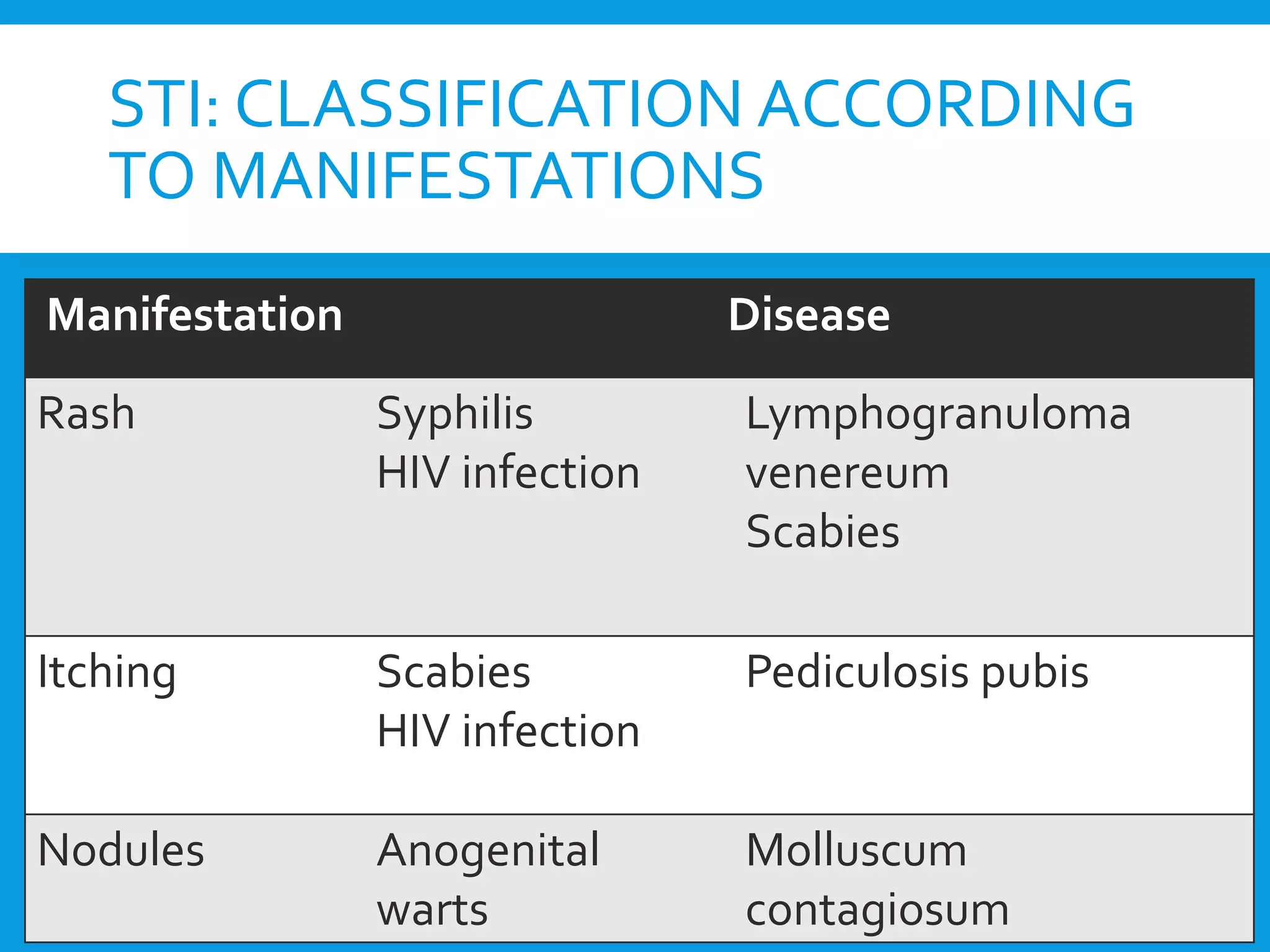
STI: CLASSIFICATION ACCORDING
TO MANIFESTATIONS
Manifestation Disease
Rash Syphilis
HIV infection
Lymphogranuloma
venereum
Scabies
Itching Scabies
HIV infection
Pediculosis pubis
Nodules Anogenital
warts
Molluscum
contagiosum
STI: SYNDROMIC APPROACH
Algorithms for implementation at
peripheral levels:
Syndrome for genital ulcer disease
Syndrome for urethral discharge
Syndrome for vaginal discharge
Syndrome for inguinal bubo
STI: ALGORITHM FOR GENITAL
ULCERTREATMENT
Patient complains of genital ulcer
Vesicles found or/and
history of recurrences
Treat for Herpes
Genitalis
Ulcers (no vesicles,
painful/painless)
Treat for syphilis
and chancroid
Examine
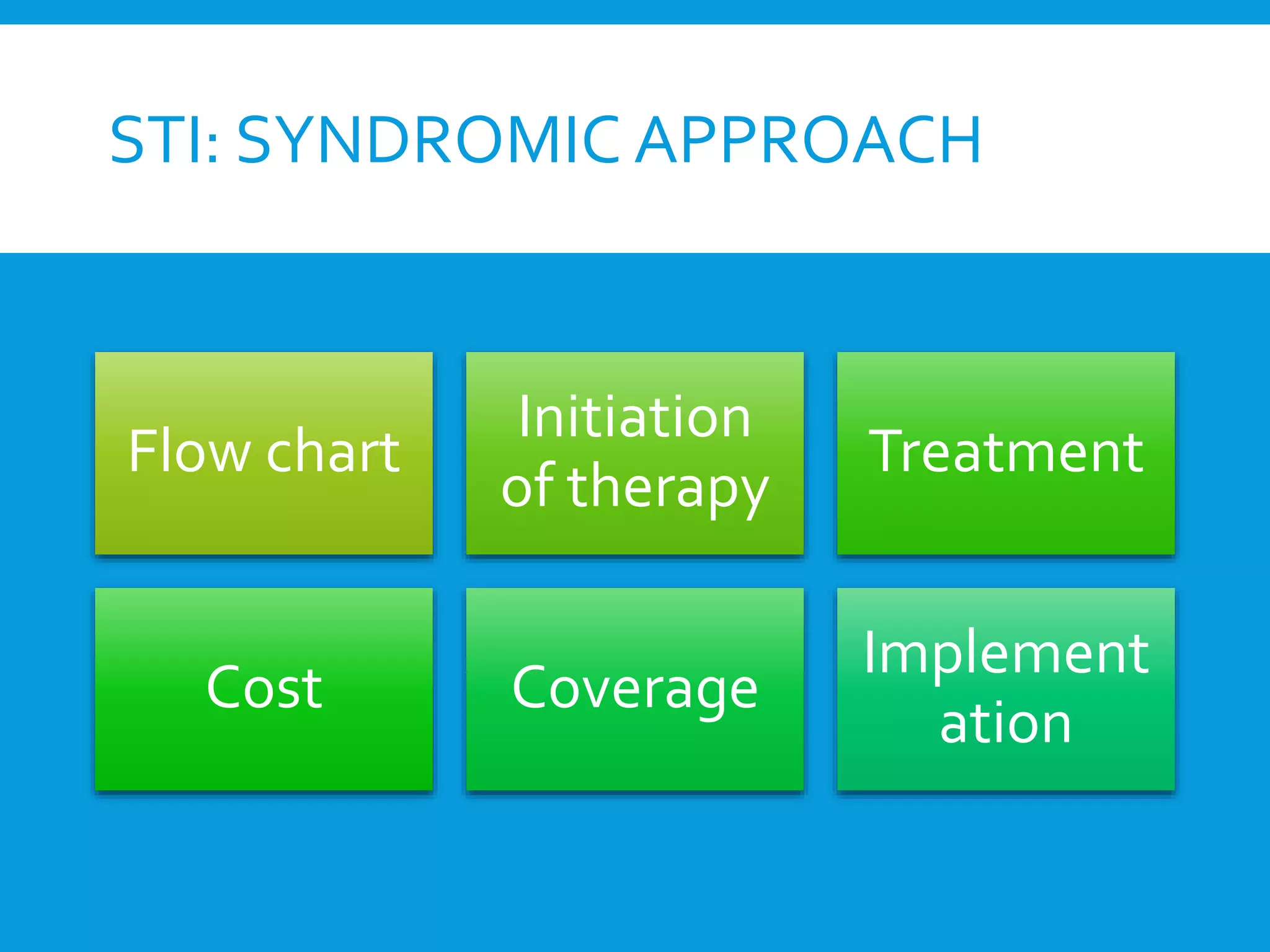
STI: SYNDROMIC APPROACH
Flow chart
Initiation
of therapy
Treatment
Cost Coverage
Implement
ation
CONCLUSION
Sexually Transmitted Infection (STI) is a
broader term, includes asymptomatic
cases as well
Can present with diverse symptoms (ulcer,
discharge, swelling)
Syndromic approach has several
advantages for the treatment of STI
Thank you!!

Sexually transmitted infections

Editor's Notes

  • #30 Basis of Syndromic Management: Case management depends on: Identification of relatively constant combination of symptoms and signs for a particular syndrome Knowledge of the causative organisms Awareness of the antimicrobial susceptibility Formulation of therapeutic regimens which cover the major pathogens responsible for causing a particular syndrome in a particular geographic area Using socio-demographic and behavioural data in an attempt to identify patients with a higher risk of developing a particular infection Service needs to be available at peripheral regions where laboratory services are either not available or reporting is delayed