Sexually Transmitted Infections
Unit 13
HIV Care and ART: A Course for
Pharmacists by Salahadin M.Ali
2
Learning Objectives
 Describe the association between STIs and HIV
 Identify the etiologies and mode of transmission
of some of the most common STIs
 Understand the major symptoms of commonly
encountered STIs
 Determine the most effective treatment
approaches for commonly encountered STIs
3
STI versus STD
 STI – Infections acquired through sexual
intercourse (may be symptomatic or
asymptomatic)
 STD – Symptomatic disease acquired through
sexual intercourse
 STI is most commonly used because it applies
to both symptomatic and asymptomatic
infections
4
Introduction
 Most STIs are treatable
 However, resistance to many of the older antibiotics is a
challenge
 Other have no cure, such as herpes, genital warts, HIV
 Many STIs can lead to related conditions such as:
 Pelvic inflammatory disease
 Cervical cancer
 Complications in pregnancy
 STIs can have socio-economic consequences
 Education about these diseases and prevention are
important
5
Link Between STIs & HIV/AIDS
 STIs facilitate HIV transmission and acquisition
 Chancroid, chlamydia, gonorrhea, syphilis, and
trichomoniasis may increase the risk of HIV
transmission by two to nine times
 STI control reduces transmission of HIV
 The prevalence of HIV in heterosexual populations is
higher in Africa than in Europe and the US where
STIs are more often treated and cured
6
Link Between STIs & HIV/AIDS (2)
 STIs and HIV infection share similar
epidemiologic determinants
 Result from risky sexual behavior
 Affect the same age group
 HIV affects the clinical presentation and
management of STIs
 In people with HIV infection, other STIs may be more
resistant to treatment
7
Interventions to Reduce Transmission
 Decrease duration of infectivity
 Early diagnosis & curative or suppressive therapy
 Decrease efficiency of transmission
 Promote safer sexual behavior
 Decrease susceptible persons’ exposure rate to
infected individuals
 Counsel to modify sexual behavior
8
Commonly Encountered STIs
 Syphilis
 Gonorrhea
 Chlamydia
 Chancroid
 Genital Herpes
 Genital warts
 Trichomoniasis
 Lymphogranularoma Venereal
9
Syndromic Approach to
STI Management
 Identification of clinical syndrome
 Giving treatment targeting all the locally known
pathogens which can cause the syndrome
10
Syndromic Approach to
STI Management (2)
 Advantages
 Simple, rapid and inexpensive
 Complete care offered at first visit
 Patients are treated for possible mixed infections
 Accessible to a broad range of health workers
 Avoids unnecessary referrals to hospitals
 Disadvantages
 Over-treatment
 Asymptomatic infections are missed
11
STI Syndromes
1. Urethral discharge or burning on urination in
men
2. Vaginal discharge
3. Genital ulcer in men and women
4. Lower abdominal pain in women
5. Scrotal swelling
6. Inguinal bubo
12
Urethral Discharge Syndrome
 Possible etiologies:
 Gonococcal infection
 Chlamydia Trachomatis
Patient complains
of urethral discharge
or dysuria
Take history
& Do P/E; milk urethra
if necessary
Discharge
confirmed
Other STIs
present?
•Educate and counsel
•Offer VCT
•Review if symptoms
persist
•Promote and provide
condoms
Use appropriate
flow chart
Treat for gonorrhea
and chlamydia
•Educate
•Counsel
•Promote and provide condoms
•Offer VCT
•Partner management
•Advise to return in 7 days
if discharge persists
yes
No No
Yes
Urethral Discharge
Syndrome
14
Recommended Treatment for Urethral
Discharge and Burning on Urination
 Ciprofloxacin 500 mg po stat, or Spectinomycin
2g IM stat
and
 Doxycycline 100 mg po BID for 7 days, or
Tetracycline 500 mg po QID for 7 days, or
Erythromycin 500 mg po QID for 7 days if the
patient has contraindications for Tetracyclines
Persistent or
Recurrent Urethral
Discharge in Men
Take history
and examine
Does history
confirm reinfection
or poor compliance
Treat for trichomonas
vaginalis
•Educate/ counsel
•Promote and provide condoms
•Return in 7 days
Improved
Discharge confirmed
Patient complains of
Persistent/ recurrent
Urethral discharge or dysuria
Other STIs
present
Use appropriate
flow chart
Repeat
urethral discharge
treatment
Refer
•Educate/ counsel
•Promote and provide condoms
• Offer VCT
Yes
No
No
Yes
Yes
•Educate/ counsel
•Promote and
provide condoms
• Offer VCT
No
Yes
No
16
Vaginal Discharge
 Common causes:
 Neisseria gonorrhea
 Chlamydia trachomatis
 Trichomonas vaginalis
 Gardnerella vaginalis
 Candida albicans
17
Patient complains
of vaginal discharge or
vulval itching/ burning
Abnormal discharge present
Take history, examine patient
(external speculum and bimanual)
and assess risk
Lower abdominal tenderness
or cervical motion tenderness
Was risk assessment positive?
Is discharge from the cervix?
Vulval edema/curd like discharge
Erythema excoriation present
Treat for bacterial vaginosis
and trichomoniasis
Treat for chlamydia, gonorrhea,
bacterial vaginosis and trichomoniasis
Use flow chart for lower abdominal pain
Educate
Counsel
Promote and provide condoms
Offer VCT
Educate
Counsel
Promote and provide condoms
Offer VCT
Treat for
Candida
albicans
No
Yes
Yes
Yes
No
No
No
Yes
Vaginal Discharge
18
Recommended Treatment for
Vaginal Discharge
Metronidazole 500mg PO BID for
7 days
and
Clotrimazole vaginal tabs 200mg
at bed time for 3 days
Ciprofloxacin 500mg PO stat, or
Spectinomycin 2gm IM stat
and
Doxycycline 100mg PO BID for 7
days
and
Metronidazole 500mg BID for 10
days
Risk Assessment Negative for
STI
Risk Assessment Positive for STI
19
Genital Ulcer Disease
Differential Diagnosis
 Herpes simplex
 Syphilis
 Chancroid
 Lymphogranuloma venereum
 Granuloma inguinale
 Others
Patient complains of genital ulcer
Take history & examine
Vesicles Or Recurrence
Treat for HSV,
Treat for syphilis if indicated
•Educate and counsel
•Promote and provide condoms
•Offer VCT
•Ask the patient to return in 7 days
Ulcers healed
Educate and counsel
Promote and provide condoms
Offer VCT
Partner management
Ulcers and sores
Treat for syphilis,
chancroid and HSV
Educate
Promote and
provide
condoms
Offer VCT
Ulcers improving Refer
Continue treatment for further 7 days
No
No
Yes
Yes
Yes
Yes
No No
Genital Ulcer
Syndrome
21
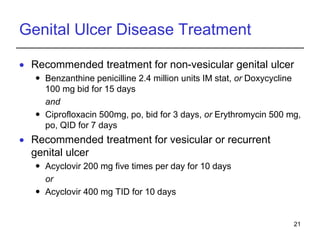
Genital Ulcer Disease Treatment
 Recommended treatment for non-vesicular genital ulcer
 Benzanthine penicilline 2.4 million units IM stat, or Doxycycline
100 mg bid for 15 days
and
 Ciprofloxacin 500mg, po, bid for 3 days, or Erythromycin 500 mg,
po, QID for 7 days
 Recommended treatment for vesicular or recurrent
genital ulcer
 Acyclovir 200 mg five times per day for 10 days
or
 Acyclovir 400 mg TID for 10 days
22
HSV Spectrum of Disease
 Persistent ulcerative HSV infections are very
common in AIDS
 Candida and HSV often occur in association
 Oral-facial
 Primary: gingivostomatitis & pharyngitis
 Reactivation: herpes labialis
 Asymptomatic shedding is common
 Thus, patients are potentially infectious even when
lesions are absent
23
Severe Chronic Herpes
Simplex Ulcers
© Slice of Life and Suzanne S. Stensaas
24
HSV in the
Immunocompromised Host
 High frequency of reactivation
 Increased severity
 Widespread local extension
 Higher incidence of dissemination
 Viremic spread to visceral organs, which is rare
but can be life threatening
25
HSV
Courtesy of CDC/ Susan Lindsley
26
HSV circumferential ulcer
Courtesy of CDC/ Dr. M. F. Rein; Susan Lindsley
27
HSV Treatment
 Primary infection
 Acyclovir 200 mg PO 5x/day for 7-14 days
or
 Acyclovir 400mg PO tid for 7-14 days
or
 Famciclovir 500 mg PO bid for 7-14 days
or
 Valacyclovir 1 gm PO bid 7-14 days
 Recurrences treated with same dosage, but may need
only 5-10 days therapy
 Suppressive therapy may be indicated for patients with
frequent recurrences, BUT
 Continued treatment risks developing resistant HSV
28
Lower Abdominal Pain Due to PID
(Pelvic Inflammatory Disease)
 PID is ascending infection of the upper genital
tract (uterus, tubes, etc) from the cervix and/or
vagina
 Common etiologies:
 Sexually transmitted: Neisseria gonorrhea, Chlamydia
trachomatis, Mycoplasma hominis
 Others (non-STI): streptococci, E. coli, etc
 Vaginal discharge is often present
29
Patient complains of
lower abdominal pain
Take history including gynecological
and examine (abdominal and vaginal)
Any of the following present
•Missed overdue period
•Recent delivery/ abortion
•Miscarriage
•Abdominal guarding
•And or rebound tenderness
•Abdominal mass
•Abnormal vaginal bleeding
Refer the patient for surgical or
gynecological opinion
and assessment
Before referral set up
an Iv line and resuscitate
if required
Is there cervical excitation tenderness
Or lower abdominal tenderness
And vaginal discharge
Manage for PID
Review in three days
Continue treatment until completed
•Educate and counsel
•Offer VCT
•Promote and provide condom
•Ask patient to return if necessary
Patient has improved Refer patient
Manage
appropriately
Any other
illness
found
Lower Abdominal Pain
Yes
No
Yes
Yes
No
No
Yes
30
Recommended Treatment for PID
Out patient Inpatient
Ciprofloxacin 500mg PO bid for 7
days, or Spectinomycin 2gm IM
stat
plus
Doxycycline 100mg BID for 14
days
plus
Metronidazole 500mg BID for 14
days
Ceftriaxone 250mg IV BID, or
Spectinomycin 2gm IM BID
plus
Doxycycline 100mg BID for 14
days
plus
Metronidazole 500mg BID for 14
days, or Chloramphenicol 500mg
IV QID
31
Scrotal Swelling
 Common STI causes of scrotal swelling are
similar to those of urethral discharge
 Neisseria gonorrhea
 Chlamydia trachomatis
 Exclude non-STI causes of scrotal swelling:
 TB
 Inguinal hernia
 Testicular torsion, etc
32
Scrotal Swelling
Patient complains of
scrotal swelling or pain
Take history, examine,
offer HIV test
Scrotal swelling or
pain present?
History of trauma or testis
elevated or rotated?
or
Diagnosis in doubt?
Refer patient to
hospital
Signs of other
STI present?
Reassure patient, educate,
counsel, provide condoms.
Review if symptoms persist
Treat according to
appropriate flowchart
Treat for chlamydia
and gonorrhea.
Review in 7 days
Patient has improved?
Complete treatment course,
reinforce
education and counseling
Review if symptoms persist
Yes
Yes
No Yes
No
No
Yes
No
33
Scrotal Swelling
Recommended Therapy
 Ciprofloxacin 500mg PO stat or Spectinomycin
2gm IM stat
and
 Doxycycline 100mg PO BID for 7 days, or
Tetracycline 500mg BID for 7 days
34
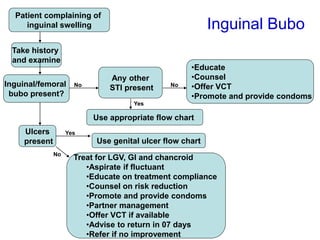
Inguinal Bubo
 Swelling of inguinal lymph nodes as a result of
STIs (or other causes)
 Common causes:
 Treponema pallidum (syphilis)
 Chlamydia trachomatis (LGV)
 Hemophylus ducreyi (chancroid)
 Calymatobacterium granulomatis (granuloma
inguinale)
Inguinal Bubo
Patient complaining of
inguinal swelling
Take history
and examine
Ulcers
present
Treat for LGV, GI and chancroid
•Aspirate if fluctuant
•Educate on treatment compliance
•Counsel on risk reduction
•Promote and provide condoms
•Partner management
•Offer VCT if available
•Advise to return in 07 days
•Refer if no improvement
Any other
STI present
Use appropriate flow chart
•Educate
•Counsel
•Offer VCT
•Promote and provide condoms
Use genital ulcer flow chart
No No
Yes
Yes
No
Inguinal/femoral
bubo present?
36
Inguinal Bubo
 Recommended treatment:
 Ciprofloxacin 500mg PO BID for 14 days
and
 Erythromycin 500mg PO QID for 14 to 21 days
37
Neonatal Conjunctivitis
 Infection of the eyes of the neonate as a result of
genital infection of the mother, transmitted
during birth
 Causes:
 Neisseria gonorrhea
 Chlamydia trachomatis
Neonatal Conjunctivitis
Neonate presents with eye discharge
Take history and examine child
Purulent conjunctivitis present?
Complete treatment course,
reinforce education and counseling
Review if necessary
Treat baby for gonococcal and
chlamydial opthalmia
AND
Treat mother and partner for gonorrhoea
and chlamydia
Educate and counsel
Review baby in 7 days or sooner
if symptoms worsen
Signs of other illness
present?
Treat appropriately
Reassure mother,
educate parents
Review if symptoms persist
Eye infection cleared?
No No
Yes
Yes
Review in
7 days
Yes
Refer for specialist opinion
and management
No
39
Neonatal Conjunctivitis: Treatment
 Treatment:
 Spectinomycin 50mg/kg IM stat or ceftriaxone 125mg
IM stat
and
 Erythromycin 50mg/kg PO in 4 divided doses for 10
days
 May lead to blindness if not treated properly
40
Key Points
 STIs are among the most common causes of
illness in the world
 Emergence and spread of HIV infection and
AIDS has major impact on the management and
control of STIs
 STIs increase the acquisition and transmission
of HIV
 HIV infection alters the clinical features and
response to therapy of STIs
41
Key Points (2)
 The syndromic approach to STIs management is
recommended by WHO
 Syndromic management is simple, rapid and
inexpensive

STI ppt.ppt

  • 1.
    Sexually Transmitted Infections Unit13 HIV Care and ART: A Course for Pharmacists by Salahadin M.Ali
  • 2.
    2 Learning Objectives  Describethe association between STIs and HIV  Identify the etiologies and mode of transmission of some of the most common STIs  Understand the major symptoms of commonly encountered STIs  Determine the most effective treatment approaches for commonly encountered STIs
  • 3.
    3 STI versus STD STI – Infections acquired through sexual intercourse (may be symptomatic or asymptomatic)  STD – Symptomatic disease acquired through sexual intercourse  STI is most commonly used because it applies to both symptomatic and asymptomatic infections
  • 4.
    4 Introduction  Most STIsare treatable  However, resistance to many of the older antibiotics is a challenge  Other have no cure, such as herpes, genital warts, HIV  Many STIs can lead to related conditions such as:  Pelvic inflammatory disease  Cervical cancer  Complications in pregnancy  STIs can have socio-economic consequences  Education about these diseases and prevention are important
  • 5.
    5 Link Between STIs& HIV/AIDS  STIs facilitate HIV transmission and acquisition  Chancroid, chlamydia, gonorrhea, syphilis, and trichomoniasis may increase the risk of HIV transmission by two to nine times  STI control reduces transmission of HIV  The prevalence of HIV in heterosexual populations is higher in Africa than in Europe and the US where STIs are more often treated and cured
  • 6.
    6 Link Between STIs& HIV/AIDS (2)  STIs and HIV infection share similar epidemiologic determinants  Result from risky sexual behavior  Affect the same age group  HIV affects the clinical presentation and management of STIs  In people with HIV infection, other STIs may be more resistant to treatment
  • 7.
    7 Interventions to ReduceTransmission  Decrease duration of infectivity  Early diagnosis & curative or suppressive therapy  Decrease efficiency of transmission  Promote safer sexual behavior  Decrease susceptible persons’ exposure rate to infected individuals  Counsel to modify sexual behavior
  • 8.
    8 Commonly Encountered STIs Syphilis  Gonorrhea  Chlamydia  Chancroid  Genital Herpes  Genital warts  Trichomoniasis  Lymphogranularoma Venereal
  • 9.
    9 Syndromic Approach to STIManagement  Identification of clinical syndrome  Giving treatment targeting all the locally known pathogens which can cause the syndrome
  • 10.
    10 Syndromic Approach to STIManagement (2)  Advantages  Simple, rapid and inexpensive  Complete care offered at first visit  Patients are treated for possible mixed infections  Accessible to a broad range of health workers  Avoids unnecessary referrals to hospitals  Disadvantages  Over-treatment  Asymptomatic infections are missed
  • 11.
    11 STI Syndromes 1. Urethraldischarge or burning on urination in men 2. Vaginal discharge 3. Genital ulcer in men and women 4. Lower abdominal pain in women 5. Scrotal swelling 6. Inguinal bubo
  • 12.
    12 Urethral Discharge Syndrome Possible etiologies:  Gonococcal infection  Chlamydia Trachomatis
  • 13.
    Patient complains of urethraldischarge or dysuria Take history & Do P/E; milk urethra if necessary Discharge confirmed Other STIs present? •Educate and counsel •Offer VCT •Review if symptoms persist •Promote and provide condoms Use appropriate flow chart Treat for gonorrhea and chlamydia •Educate •Counsel •Promote and provide condoms •Offer VCT •Partner management •Advise to return in 7 days if discharge persists yes No No Yes Urethral Discharge Syndrome
  • 14.
    14 Recommended Treatment forUrethral Discharge and Burning on Urination  Ciprofloxacin 500 mg po stat, or Spectinomycin 2g IM stat and  Doxycycline 100 mg po BID for 7 days, or Tetracycline 500 mg po QID for 7 days, or Erythromycin 500 mg po QID for 7 days if the patient has contraindications for Tetracyclines
  • 15.
    Persistent or Recurrent Urethral Dischargein Men Take history and examine Does history confirm reinfection or poor compliance Treat for trichomonas vaginalis •Educate/ counsel •Promote and provide condoms •Return in 7 days Improved Discharge confirmed Patient complains of Persistent/ recurrent Urethral discharge or dysuria Other STIs present Use appropriate flow chart Repeat urethral discharge treatment Refer •Educate/ counsel •Promote and provide condoms • Offer VCT Yes No No Yes Yes •Educate/ counsel •Promote and provide condoms • Offer VCT No Yes No
  • 16.
    16 Vaginal Discharge  Commoncauses:  Neisseria gonorrhea  Chlamydia trachomatis  Trichomonas vaginalis  Gardnerella vaginalis  Candida albicans
  • 17.
    17 Patient complains of vaginaldischarge or vulval itching/ burning Abnormal discharge present Take history, examine patient (external speculum and bimanual) and assess risk Lower abdominal tenderness or cervical motion tenderness Was risk assessment positive? Is discharge from the cervix? Vulval edema/curd like discharge Erythema excoriation present Treat for bacterial vaginosis and trichomoniasis Treat for chlamydia, gonorrhea, bacterial vaginosis and trichomoniasis Use flow chart for lower abdominal pain Educate Counsel Promote and provide condoms Offer VCT Educate Counsel Promote and provide condoms Offer VCT Treat for Candida albicans No Yes Yes Yes No No No Yes Vaginal Discharge
  • 18.
    18 Recommended Treatment for VaginalDischarge Metronidazole 500mg PO BID for 7 days and Clotrimazole vaginal tabs 200mg at bed time for 3 days Ciprofloxacin 500mg PO stat, or Spectinomycin 2gm IM stat and Doxycycline 100mg PO BID for 7 days and Metronidazole 500mg BID for 10 days Risk Assessment Negative for STI Risk Assessment Positive for STI
  • 19.
    19 Genital Ulcer Disease DifferentialDiagnosis  Herpes simplex  Syphilis  Chancroid  Lymphogranuloma venereum  Granuloma inguinale  Others
  • 20.
    Patient complains ofgenital ulcer Take history & examine Vesicles Or Recurrence Treat for HSV, Treat for syphilis if indicated •Educate and counsel •Promote and provide condoms •Offer VCT •Ask the patient to return in 7 days Ulcers healed Educate and counsel Promote and provide condoms Offer VCT Partner management Ulcers and sores Treat for syphilis, chancroid and HSV Educate Promote and provide condoms Offer VCT Ulcers improving Refer Continue treatment for further 7 days No No Yes Yes Yes Yes No No Genital Ulcer Syndrome
  • 21.
    21 Genital Ulcer DiseaseTreatment  Recommended treatment for non-vesicular genital ulcer  Benzanthine penicilline 2.4 million units IM stat, or Doxycycline 100 mg bid for 15 days and  Ciprofloxacin 500mg, po, bid for 3 days, or Erythromycin 500 mg, po, QID for 7 days  Recommended treatment for vesicular or recurrent genital ulcer  Acyclovir 200 mg five times per day for 10 days or  Acyclovir 400 mg TID for 10 days
  • 22.
    22 HSV Spectrum ofDisease  Persistent ulcerative HSV infections are very common in AIDS  Candida and HSV often occur in association  Oral-facial  Primary: gingivostomatitis & pharyngitis  Reactivation: herpes labialis  Asymptomatic shedding is common  Thus, patients are potentially infectious even when lesions are absent
  • 23.
    23 Severe Chronic Herpes SimplexUlcers © Slice of Life and Suzanne S. Stensaas
  • 24.
    24 HSV in the ImmunocompromisedHost  High frequency of reactivation  Increased severity  Widespread local extension  Higher incidence of dissemination  Viremic spread to visceral organs, which is rare but can be life threatening
  • 25.
  • 26.
    26 HSV circumferential ulcer Courtesyof CDC/ Dr. M. F. Rein; Susan Lindsley
  • 27.
    27 HSV Treatment  Primaryinfection  Acyclovir 200 mg PO 5x/day for 7-14 days or  Acyclovir 400mg PO tid for 7-14 days or  Famciclovir 500 mg PO bid for 7-14 days or  Valacyclovir 1 gm PO bid 7-14 days  Recurrences treated with same dosage, but may need only 5-10 days therapy  Suppressive therapy may be indicated for patients with frequent recurrences, BUT  Continued treatment risks developing resistant HSV
  • 28.
    28 Lower Abdominal PainDue to PID (Pelvic Inflammatory Disease)  PID is ascending infection of the upper genital tract (uterus, tubes, etc) from the cervix and/or vagina  Common etiologies:  Sexually transmitted: Neisseria gonorrhea, Chlamydia trachomatis, Mycoplasma hominis  Others (non-STI): streptococci, E. coli, etc  Vaginal discharge is often present
  • 29.
    29 Patient complains of lowerabdominal pain Take history including gynecological and examine (abdominal and vaginal) Any of the following present •Missed overdue period •Recent delivery/ abortion •Miscarriage •Abdominal guarding •And or rebound tenderness •Abdominal mass •Abnormal vaginal bleeding Refer the patient for surgical or gynecological opinion and assessment Before referral set up an Iv line and resuscitate if required Is there cervical excitation tenderness Or lower abdominal tenderness And vaginal discharge Manage for PID Review in three days Continue treatment until completed •Educate and counsel •Offer VCT •Promote and provide condom •Ask patient to return if necessary Patient has improved Refer patient Manage appropriately Any other illness found Lower Abdominal Pain Yes No Yes Yes No No Yes
  • 30.
    30 Recommended Treatment forPID Out patient Inpatient Ciprofloxacin 500mg PO bid for 7 days, or Spectinomycin 2gm IM stat plus Doxycycline 100mg BID for 14 days plus Metronidazole 500mg BID for 14 days Ceftriaxone 250mg IV BID, or Spectinomycin 2gm IM BID plus Doxycycline 100mg BID for 14 days plus Metronidazole 500mg BID for 14 days, or Chloramphenicol 500mg IV QID
  • 31.
    31 Scrotal Swelling  CommonSTI causes of scrotal swelling are similar to those of urethral discharge  Neisseria gonorrhea  Chlamydia trachomatis  Exclude non-STI causes of scrotal swelling:  TB  Inguinal hernia  Testicular torsion, etc
  • 32.
    32 Scrotal Swelling Patient complainsof scrotal swelling or pain Take history, examine, offer HIV test Scrotal swelling or pain present? History of trauma or testis elevated or rotated? or Diagnosis in doubt? Refer patient to hospital Signs of other STI present? Reassure patient, educate, counsel, provide condoms. Review if symptoms persist Treat according to appropriate flowchart Treat for chlamydia and gonorrhea. Review in 7 days Patient has improved? Complete treatment course, reinforce education and counseling Review if symptoms persist Yes Yes No Yes No No Yes No
  • 33.
    33 Scrotal Swelling Recommended Therapy Ciprofloxacin 500mg PO stat or Spectinomycin 2gm IM stat and  Doxycycline 100mg PO BID for 7 days, or Tetracycline 500mg BID for 7 days
  • 34.
    34 Inguinal Bubo  Swellingof inguinal lymph nodes as a result of STIs (or other causes)  Common causes:  Treponema pallidum (syphilis)  Chlamydia trachomatis (LGV)  Hemophylus ducreyi (chancroid)  Calymatobacterium granulomatis (granuloma inguinale)
  • 35.
    Inguinal Bubo Patient complainingof inguinal swelling Take history and examine Ulcers present Treat for LGV, GI and chancroid •Aspirate if fluctuant •Educate on treatment compliance •Counsel on risk reduction •Promote and provide condoms •Partner management •Offer VCT if available •Advise to return in 07 days •Refer if no improvement Any other STI present Use appropriate flow chart •Educate •Counsel •Offer VCT •Promote and provide condoms Use genital ulcer flow chart No No Yes Yes No Inguinal/femoral bubo present?
  • 36.
    36 Inguinal Bubo  Recommendedtreatment:  Ciprofloxacin 500mg PO BID for 14 days and  Erythromycin 500mg PO QID for 14 to 21 days
  • 37.
    37 Neonatal Conjunctivitis  Infectionof the eyes of the neonate as a result of genital infection of the mother, transmitted during birth  Causes:  Neisseria gonorrhea  Chlamydia trachomatis
  • 38.
    Neonatal Conjunctivitis Neonate presentswith eye discharge Take history and examine child Purulent conjunctivitis present? Complete treatment course, reinforce education and counseling Review if necessary Treat baby for gonococcal and chlamydial opthalmia AND Treat mother and partner for gonorrhoea and chlamydia Educate and counsel Review baby in 7 days or sooner if symptoms worsen Signs of other illness present? Treat appropriately Reassure mother, educate parents Review if symptoms persist Eye infection cleared? No No Yes Yes Review in 7 days Yes Refer for specialist opinion and management No
  • 39.
    39 Neonatal Conjunctivitis: Treatment Treatment:  Spectinomycin 50mg/kg IM stat or ceftriaxone 125mg IM stat and  Erythromycin 50mg/kg PO in 4 divided doses for 10 days  May lead to blindness if not treated properly
  • 40.
    40 Key Points  STIsare among the most common causes of illness in the world  Emergence and spread of HIV infection and AIDS has major impact on the management and control of STIs  STIs increase the acquisition and transmission of HIV  HIV infection alters the clinical features and response to therapy of STIs
  • 41.
    41 Key Points (2) The syndromic approach to STIs management is recommended by WHO  Syndromic management is simple, rapid and inexpensive

Editor's Notes

  • #2 Notes: Unit 13 should take approximately 1 hour to complete: Step 1: Unit Introduction and Learning Objectives (Slides 1-2) – 5 minutes Step 2: STDs and STIs Overview; Interaction between HIV and STIs (Slides 3-8) – 10 minutes Step 3: Syndrome Approach; STI Syndromes (Slides 9-39) – 40 minutes Step 4: Discussion of Key Points (Slides 40-41) – 5 minutes
  • #3 Notes: Step 1: Unit Introduction and Learning Objectives (Slides 1-2) – 5 minutes
  • #4 Notes: Step 2: STDs and STIs Overview; Interaction between HIV and STIs (Slides 3-8) – 10 minutes Some people use the terms STI and STD interchangeably but they actually have different meaning.
  • #5 Notes: Social and economic consequences of STIs: Husband abandoning infertile wives Beatings and/or divorce Financial burden of treating STIs and their complications Antibiotic resistance making low cost regimens ineffective
  • #6 Notes: Mechanism: Mucosal and skin barrier disruption Inflammation increasing CD4 cell concentration in genital areas Infection leading to increased HIV expression in genital secretions
  • #9 Note: Bacterial vaginosis and candidiasis are also common causes of reproductive tract infections (vaginal discharge), but are not sexually transmitted (currently debatable).
  • #10 Notes: Step 3: Syndromic Approach STI Syndromes (Slides 9-39) – 40 minutes “Syndromic Management” contrasts with “Etiologic Management.” Whereas etiologic management focuses on identifying and treating a specific etiology causing clinical symptoms, syndromic management considers the likely causative agent(s) for a given clinical syndrome and treats accordingly, without regard for identifying the specific infection. Benefits of etiologic management: focused, specific therapy, avoiding the cost and toxicity of unnecessary medications. Benefits of syndromic management: laboratory testing not needed; treatment provided immediately, without need for lab results; effective in resource-limited settings.
  • #15 Notes: (Source: National Guideline for the Management of STIs, March 2005) The gonococcal isolates in the validation study conducted by EHNRI/MOH in Ethiopia were uniformly sensitive to ciprofloxacin making it the drug of choice. However it can not be given for pregnant women and children, in which case Spectinomycin can be used.
  • #16 Notes: Recurrent discharge may reflect poor adherence to initial treatment regimen, e.g., due to GI upset. Recurrent discharge may also reflect re-infection. If neither of these seem to be present, treat for T. vaginalis. T. vaginalis was found to be common (second among causes of urethral discharge) among Ethiopian men with urethral discharge syndrome as seen in the validation study conducted by EHNRI/MOH. Treatment – Metronidazole 2g po, stat. Source: Validation of STI Treatment Algorithms, 2003-2004, EHNRI/MOH
  • #17 Note: The first three are sexually acquired and the last two are endogenous infections
  • #18 Note: Risk factors include age <25, trading sex, multiple or new partners in the last three months Source: National Guideline for the Management of Sexually Transmitted Infections, March 2005
  • #19 Notes: If assessment of risk for STI is positive likely etiologies include Neisseria, Chlamydia and Trichomonas and hence Ciprofloxacin or spectinomycin, doxycycline and metronidazole are drugs of choice respectively. If assessment of risk of STI is negative, likely etiologies are Gardnerella and candida; the drugs of choice being Metronidazole and clotrimazole
  • #22 Notes: According to the validation study conducted by MOH/ EHNRI in Ethiopia, it was found out that in genital ulcer diseases, one or more pathogens were found in males and females in 76% and 82.45 of the cases respectively. HSV2 alone was the leading cause of GUD in both males and females, constituting 44% and 75.5% of cases respectively. But the prevalence of HSV2 as it occurs in combination with other pathogens or alone constituted 52% and 78.45% in males and females respectively. Altogether, HSV2 was responsible for 70% of all GUD causes. Syphilis was the second leading cause in males (28%) as compared with females (6%). Chanchroid constituted for only 4% of GUD cases. ( Source: Validation study of the syndromic algorithm approach of the management of STIs in Ethiopia , August 2004) Source of above recommendations: National Guideline for the Management of STIs , March 2005, Ethiopia
  • #23 Note: In about 75% of EM, HSV is the precipitating event. Patients with severe HSV-associated Em should be on chronic oral suppressive Tx
  • #24 Notes: Persistence for >1 month is an AIDS-defining condition. Chronic herpes simplex can be painful and debilitating involving not only the genital area but the mouth, lips, esophagus and skin. Treatment is available for suppression but can be very expensive and will need to be taken for a long time. These can last months and may be improved with ARV treatment. Herpetic lesions can also become secondarily infected leading to more morbidity in the HIV infected patient.
  • #26 Note: Herpes genitalis outbreak on the penile shaft due to HSV-2.
  • #28 Note: Source: 2004 medical management of HIV. John G Bartlett & Joel E. Gallant Acyclovir, Famciclovir, and Valacyclovir are category B. Acyclovir is not teratogenic, but has potential to cause chromosomal damage at high doses. The CDC recommends use of acyclovir during pregnancy for severe HSV outbreaks and varicella. Use for prophylaxis in pregnancy is being investigated.
  • #31 Notes: Ask participants to identify what organisms are being treated with each antibiotic: Ciprofloxacin, Spectinomycin, Ceftriaxone: Gonorrhea Doxycycline: Chlamydia Metronidazole, Chloramphenicol: Anaerobic (and other) bacteria antibiotics have broader spectrum of action than just the organisms identified above, but this exercise helps reinforce what organisms cause PID, and the connection between causative agents and specific treatments.
  • #33 Note: Ciprofloxacin is indicated in Ethiopia for treatment of Gonorrhea
  • #37 Notes: Some experts advise treating inguinal bubo for three weeks (Source national guideline for the management of STIs, March 2005)
  • #40 Notes: Spectinomycin 50 mg /kg im stat can be replaced for ceftriaxone for gonococcal ophtalmia in Ethiopian setting. In the case of herpes conjunctivitis Acyclovir 5-10 mg /kg iv daily for 10 days is indicated Source: National Guideline for the management of STIs, March 2005
  • #41 Note: Step 4: Discussion of Key Points (Slides 40-41) – 5 minutes