SEX LINKED
INHERITANCE
INTRODUCTION
Reproduction is the production
of alike offsprings by parents. Sexual
reproduction include fusion of
haploid male and female gametes to
form zygote. The chromosomes in the
gametes transfer parental characters
into offspring, this is called as
inheritance.
SEXES IN HUMAN
 MALE – Heterogametic and have testes
and produce sperms.
 FEMALE – Homogametic and have
ovary and produce ovum.
 TRANSGENDER – Generally sterile and
may have testes / ovary as primary sex
organs.
As Transgenders are sterile, only
male and female are considered
for inheritance
CHROMOSOMES IN HUMAN
 AUTOSOMES – These are 22
homologous pairs of chromosomes
numbered from 1 to 22 and 24 to 45. They
bear genes for somatic or body
characters.
 ALLOSOMES / SEX CHROMOSOMES
– These are one pair of chromosomes
numbered 23 and 46. They bear genes for
sex determination and also some somatic
genes. They may be of two types :- X and
Y. Y chromosome is J-shaped.
ALLELES OF A GENE
 Each gene is located at a fixed position on
a chromosome, called LOCUS / LOCI.
 Each gene has two alleles, either both
dominant or both recessive (cis
arrangement) and one dominant and
other recessive (trans arrangement).
 The two alleles are located at same locus,
one on each of homologous pair of
chromosomes.
 As Y chromosome is curved, so X and Y
have some different types of genes.
ALLELES OF A GENE
 Out of two alleles
 Dominant allele :- This is the allele which
is expressed in both homozygotic and
heterozygotic conditions.
 Recessive allele :- This is the allele, which
is expressed only in heterozygous
condition.
 Homozygous Condition :- If both the
alleles are dominant or both recessive.
 Heterozygous Condition :- If one of the
alleles is dominant or and other is
recessive.
INHERITANCE BY ALLOSOMES
 Generally, X and Y chromosomes
contains genes for sex determination,
but also contain some somatic / body
genes.
 Definition :- The inheritance of somatic
genes located on sex chromosomes by
them is called as sex linked inheritance.
 Inheritance :- It is the transfer of
parental characters or genes by
chromosomes into offspring(s).
TYPES OF INHERITANCE BY ALLOSOMES
X – linked / Sex linked / Recessive
inheritance :- Genes on X chromosomes
are called as X – linked / Sex linked /
Recessive genes and their inheritance is
called so. e.g. sickle cell anaemia,
haemophilia, red – green colour
blindness etc.
Y – linked / Holandric inheritance :-
Genes on Y chromosome are called as Y
– linked / Holandric genes and their
TYPES OF INHERITANCE BY ALLOSOMES
inheritance is called as Y – linked /
Holandric inheritance. e.g. patterned
baldness, hypertrychosis.
Incomplete sex linked inheritance :-
Genes on both X and Y chromosomes
are called as Incomplete sex linked
genes and their inheritance is called as
Incomplete sex linked inheritance.
TYPES AND DOMINANT OF ALLOSOMES
Normal X chromosome :- Contain
normal allele of gene under study.
Affected X chromosome :- Contain
affected or mutant allele of gene under
study.
Normal Y chromosome :- Not contain
any allele of gene under study.
ORDER OF DOMINANCE ( Y > X > Xa)
Y is dominant to Normal and Affected X
Normal X is dominant to Affected X
CHARACTERS OF SEX LINKED INHERITANCE
This is inheritance of somatic genes by X
chromosomes.
As it is recessive to Y, it is also called as
recessive inheritance. But in case of males
it is expressed as Y lacks the
complementary genes for the said
inheritance.
Normal X is dominant to affected X.
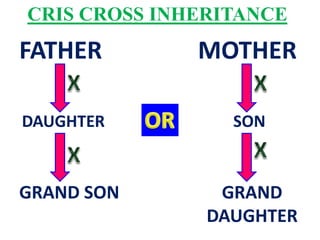
X chromosome is inherited from father to
daughter to grandson, so it is called cris-
cross inheritance.
CRIS CROSS INHERITANCE
FATHER
DAUGHTER
GRAND SON
MOTHER
SON
GRAND
DAUGHTER
CHARACTERS OF SEX LINKED INHERITANCE
If female contain two affected X
chromosomes, effect is expressed and she
is called as a victim.
If female contains one normal X and one
affected X, effect is not expressed but
hidden or she is normal in phenotype but
has a tendency to inherit the same to her
son so she is called as a carrier.
Male containing affected X, express the
effect as it has only one X and Y lacks
body genes.
EXAMPLES OF SEX LINKED INHERITANCE
Red – green colour blindness :- The victim
of this disease is unable to distinguish
between red and green colours at low
resolution.
Haemophilia / Bleeder’s Disease :- In the
victim of this disease, automatic blood
clotting is impossible due to absence of
Antihaemophilic Factor A, necessary for
blood clotting. So any injury, cut or
menstruation cause severe bleeding and
may lead to death.
EXAMPLES OF SEX LINKED INHERITANCE
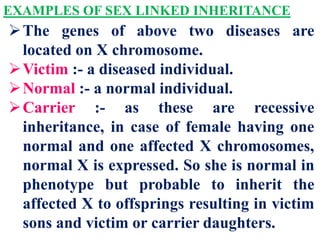
The genes of above two diseases are
located on X chromosome.
Victim :- a diseased individual.
Normal :- a normal individual.
Carrier :- as these are recessive
inheritance, in case of female having one
normal and one affected X chromosomes,
normal X is expressed. So she is normal in
phenotype but probable to inherit the
affected X to offsprings resulting in victim
sons and victim or carrier daughters.
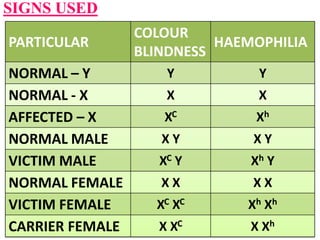
SIGNS USED
PARTICULAR
COLOUR
BLINDNESS
HAEMOPHILIA
NORMAL – Y Y Y
NORMAL - X X X
AFFECTED – X XC Xh
NORMAL MALE X Y X Y
VICTIM MALE XC Y Xh Y
NORMAL FEMALE X X X X
VICTIM FEMALE XC XC Xh Xh
CARRIER FEMALE X XC X Xh
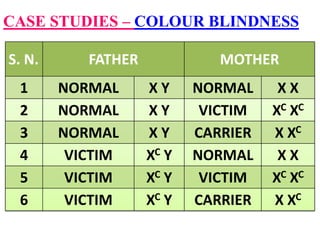
CASE STUDIES – COLOUR BLINDNESS
S. N. FATHER MOTHER
1 NORMAL X Y NORMAL X X
2 NORMAL X Y VICTIM XC XC
3 NORMAL X Y CARRIER X XC
4 VICTIM XC Y NORMAL X X
5 VICTIM XC Y VICTIM XC XC
6 VICTIM XC Y CARRIER X XC
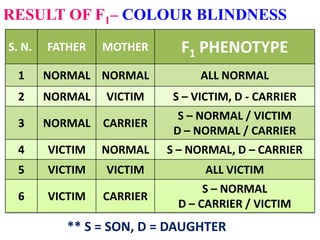
RESULT OF F1– COLOUR BLINDNESS
S. N. FATHER MOTHER F1 PHENOTYPE
1 NORMAL NORMAL ALL NORMAL
2 NORMAL VICTIM S – VICTIM, D - CARRIER
3 NORMAL CARRIER
S – NORMAL / VICTIM
D – NORMAL / CARRIER
4 VICTIM NORMAL S – NORMAL, D – CARRIER
5 VICTIM VICTIM ALL VICTIM
6 VICTIM CARRIER
S – NORMAL
D – CARRIER / VICTIM
** S = SON, D = DAUGHTER
CASE STUDIES – HAEMOPHILIA
S. N. FATHER MOTHER
1 NORMAL X Y NORMAL X X
2 NORMAL X Y CARRIER X Xh
3 VICTIM Xh Y NORMAL X X
4 VICTIM Xh Y CARRIER X Xh
IN HAEMOPHILIA :- VICTIM MOTHER CAN NOT BE
TAKEN AS SHE WILL DIE AT HER FIRST
MENSTRUATION DUE TO SEVERE BLEEDING.
RESULT OF F1– HAEMOPHILIA
S. N. FATHER MOTHER F1 PHENOTYPE
1 NORMAL NORMAL ALL NORMAL
2 NORMAL CARRIER
S – NORMAL / VICTIM
D – NORMAL / CARRIER
3 VICTIM NORMAL S – NORMAL, D – CARRIER
4 VICTIM CARRIER
S – NORMAL
D – CARRIER / VICTIM
** S = SON, D = DAUGHTER
BOTH FATHER & MOTHER NORMAL CASES SHOULD
BE AVIDED TO DESCRIBE DISEASE INHERITANCE.
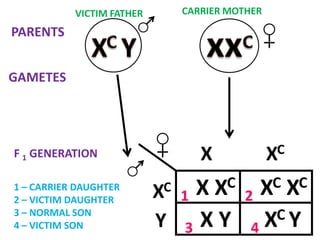
VICTIM FATHER CARRIER MOTHER
PARENTS
GAMETES
F 1 GENERATION
1 X XC
2 XC XC
3 X Y 4 XC Y
XC
Y
1 – CARRIER DAUGHTER
2 – VICTIM DAUGHTER
3 – NORMAL SON
4 – VICTIM SON
X
XC
CONCLUSION
In above crosses I have described that, the
probable phenotype and genotype of offspring (son /
daughter) may be told. Here percentage should not
be used as we are telling the type of offspring going to
be born during the study.
In above case study with victim father and
carrier mother, one daughter was victim and one was
carrier and one son was normal and other victim. It
does not mean that 50% of daughter will be carrier
and 50% will be victim or 50% of sons normal and
50% son victim rather it means the offspring going to
be born may have any one of the possible genotype
and phenotype depending on its sex.

Sex Linked Inheritance in Man

  • 1.
  • 2.
    INTRODUCTION Reproduction is theproduction of alike offsprings by parents. Sexual reproduction include fusion of haploid male and female gametes to form zygote. The chromosomes in the gametes transfer parental characters into offspring, this is called as inheritance.
  • 3.
    SEXES IN HUMAN MALE – Heterogametic and have testes and produce sperms.  FEMALE – Homogametic and have ovary and produce ovum.  TRANSGENDER – Generally sterile and may have testes / ovary as primary sex organs. As Transgenders are sterile, only male and female are considered for inheritance
  • 4.
    CHROMOSOMES IN HUMAN AUTOSOMES – These are 22 homologous pairs of chromosomes numbered from 1 to 22 and 24 to 45. They bear genes for somatic or body characters.  ALLOSOMES / SEX CHROMOSOMES – These are one pair of chromosomes numbered 23 and 46. They bear genes for sex determination and also some somatic genes. They may be of two types :- X and Y. Y chromosome is J-shaped.
  • 5.
    ALLELES OF AGENE  Each gene is located at a fixed position on a chromosome, called LOCUS / LOCI.  Each gene has two alleles, either both dominant or both recessive (cis arrangement) and one dominant and other recessive (trans arrangement).  The two alleles are located at same locus, one on each of homologous pair of chromosomes.  As Y chromosome is curved, so X and Y have some different types of genes.
  • 6.
    ALLELES OF AGENE  Out of two alleles  Dominant allele :- This is the allele which is expressed in both homozygotic and heterozygotic conditions.  Recessive allele :- This is the allele, which is expressed only in heterozygous condition.  Homozygous Condition :- If both the alleles are dominant or both recessive.  Heterozygous Condition :- If one of the alleles is dominant or and other is recessive.
  • 7.
    INHERITANCE BY ALLOSOMES Generally, X and Y chromosomes contains genes for sex determination, but also contain some somatic / body genes.  Definition :- The inheritance of somatic genes located on sex chromosomes by them is called as sex linked inheritance.  Inheritance :- It is the transfer of parental characters or genes by chromosomes into offspring(s).
  • 8.
    TYPES OF INHERITANCEBY ALLOSOMES X – linked / Sex linked / Recessive inheritance :- Genes on X chromosomes are called as X – linked / Sex linked / Recessive genes and their inheritance is called so. e.g. sickle cell anaemia, haemophilia, red – green colour blindness etc. Y – linked / Holandric inheritance :- Genes on Y chromosome are called as Y – linked / Holandric genes and their
  • 9.
    TYPES OF INHERITANCEBY ALLOSOMES inheritance is called as Y – linked / Holandric inheritance. e.g. patterned baldness, hypertrychosis. Incomplete sex linked inheritance :- Genes on both X and Y chromosomes are called as Incomplete sex linked genes and their inheritance is called as Incomplete sex linked inheritance.
  • 10.
    TYPES AND DOMINANTOF ALLOSOMES Normal X chromosome :- Contain normal allele of gene under study. Affected X chromosome :- Contain affected or mutant allele of gene under study. Normal Y chromosome :- Not contain any allele of gene under study. ORDER OF DOMINANCE ( Y > X > Xa) Y is dominant to Normal and Affected X Normal X is dominant to Affected X
  • 11.
    CHARACTERS OF SEXLINKED INHERITANCE This is inheritance of somatic genes by X chromosomes. As it is recessive to Y, it is also called as recessive inheritance. But in case of males it is expressed as Y lacks the complementary genes for the said inheritance. Normal X is dominant to affected X. X chromosome is inherited from father to daughter to grandson, so it is called cris- cross inheritance.
  • 12.
    CRIS CROSS INHERITANCE FATHER DAUGHTER GRANDSON MOTHER SON GRAND DAUGHTER
  • 13.
    CHARACTERS OF SEXLINKED INHERITANCE If female contain two affected X chromosomes, effect is expressed and she is called as a victim. If female contains one normal X and one affected X, effect is not expressed but hidden or she is normal in phenotype but has a tendency to inherit the same to her son so she is called as a carrier. Male containing affected X, express the effect as it has only one X and Y lacks body genes.
  • 14.
    EXAMPLES OF SEXLINKED INHERITANCE Red – green colour blindness :- The victim of this disease is unable to distinguish between red and green colours at low resolution. Haemophilia / Bleeder’s Disease :- In the victim of this disease, automatic blood clotting is impossible due to absence of Antihaemophilic Factor A, necessary for blood clotting. So any injury, cut or menstruation cause severe bleeding and may lead to death.
  • 15.
    EXAMPLES OF SEXLINKED INHERITANCE The genes of above two diseases are located on X chromosome. Victim :- a diseased individual. Normal :- a normal individual. Carrier :- as these are recessive inheritance, in case of female having one normal and one affected X chromosomes, normal X is expressed. So she is normal in phenotype but probable to inherit the affected X to offsprings resulting in victim sons and victim or carrier daughters.
  • 16.
    SIGNS USED PARTICULAR COLOUR BLINDNESS HAEMOPHILIA NORMAL –Y Y Y NORMAL - X X X AFFECTED – X XC Xh NORMAL MALE X Y X Y VICTIM MALE XC Y Xh Y NORMAL FEMALE X X X X VICTIM FEMALE XC XC Xh Xh CARRIER FEMALE X XC X Xh
  • 17.
    CASE STUDIES –COLOUR BLINDNESS S. N. FATHER MOTHER 1 NORMAL X Y NORMAL X X 2 NORMAL X Y VICTIM XC XC 3 NORMAL X Y CARRIER X XC 4 VICTIM XC Y NORMAL X X 5 VICTIM XC Y VICTIM XC XC 6 VICTIM XC Y CARRIER X XC
  • 18.
    RESULT OF F1–COLOUR BLINDNESS S. N. FATHER MOTHER F1 PHENOTYPE 1 NORMAL NORMAL ALL NORMAL 2 NORMAL VICTIM S – VICTIM, D - CARRIER 3 NORMAL CARRIER S – NORMAL / VICTIM D – NORMAL / CARRIER 4 VICTIM NORMAL S – NORMAL, D – CARRIER 5 VICTIM VICTIM ALL VICTIM 6 VICTIM CARRIER S – NORMAL D – CARRIER / VICTIM ** S = SON, D = DAUGHTER
  • 19.
    CASE STUDIES –HAEMOPHILIA S. N. FATHER MOTHER 1 NORMAL X Y NORMAL X X 2 NORMAL X Y CARRIER X Xh 3 VICTIM Xh Y NORMAL X X 4 VICTIM Xh Y CARRIER X Xh IN HAEMOPHILIA :- VICTIM MOTHER CAN NOT BE TAKEN AS SHE WILL DIE AT HER FIRST MENSTRUATION DUE TO SEVERE BLEEDING.
  • 20.
    RESULT OF F1–HAEMOPHILIA S. N. FATHER MOTHER F1 PHENOTYPE 1 NORMAL NORMAL ALL NORMAL 2 NORMAL CARRIER S – NORMAL / VICTIM D – NORMAL / CARRIER 3 VICTIM NORMAL S – NORMAL, D – CARRIER 4 VICTIM CARRIER S – NORMAL D – CARRIER / VICTIM ** S = SON, D = DAUGHTER BOTH FATHER & MOTHER NORMAL CASES SHOULD BE AVIDED TO DESCRIBE DISEASE INHERITANCE.
  • 21.
    VICTIM FATHER CARRIERMOTHER PARENTS GAMETES F 1 GENERATION 1 X XC 2 XC XC 3 X Y 4 XC Y XC Y 1 – CARRIER DAUGHTER 2 – VICTIM DAUGHTER 3 – NORMAL SON 4 – VICTIM SON X XC
  • 22.
    CONCLUSION In above crossesI have described that, the probable phenotype and genotype of offspring (son / daughter) may be told. Here percentage should not be used as we are telling the type of offspring going to be born during the study. In above case study with victim father and carrier mother, one daughter was victim and one was carrier and one son was normal and other victim. It does not mean that 50% of daughter will be carrier and 50% will be victim or 50% of sons normal and 50% son victim rather it means the offspring going to be born may have any one of the possible genotype and phenotype depending on its sex.