Patterns of
Inheritance
What are the different ways in which a genetic condition can be inherited?
AutosomalSex Linked
Sex linked is carried on the sex
chromosomes either X or Y
Carried on any other chromosome
(chromosomes 1-22).
INHERITANCE
What are the different ways in which a genetic condition can be inherited?
AutosomalSex Linked INHERITANCE
Autosomal
dominant
Autosomal
Recessive
One mutated
copy of the
gene in each
cell is
sufficient for a
person to be
affected
What are the different ways in which a genetic condition can be inherited?
AutosomalSex Linked INHERITANCE
Autosomal
dominant
Autosomal
Recessive
One mutated
copy of the
gene in each
cell is
sufficient for a
person to be
affected
Both copies of the gene
in each cell have the
disorder. Typically are
not seen in every
generation of an affected
family.
What are the different ways in which a genetic condition can be inherited?
AutosomalSex Linked INHERITANCE
Autosomal
dominant
Autosomal
Recessive
X-linked
recessive
X-linked
Dominant
Y-linked
One mutated
copy of the
gene in each
cell is
sufficient for a
person to be
affected
Both copies of the gene
in each cell have the
disorder. Typically are
not seen in every
generation of an affected
family.
X-linked
Caused by mutations in genes
on the X chromosome. (no
male-to-male transmission)
In females, a mutation
in one of the two
copies of the gene is
sufficient to cause the
disorder. In males, a
mutation in the only
copy of the gene in
each cell causes the
disorder
What are the different ways in which a genetic condition can be inherited?
AutosomalSex Linked INHERITANCE
Autosomal
dominant
Autosomal
Recessive
X-linked
recessive
X-linked
Dominant
One mutated
copy of the
gene in each
cell is
sufficient for a
person to be
affected
Both copies of the gene
in each cell have the
disorder. Typically are
not seen in every
generation of an affected
family.
In females, a mutation
in one of the two
copies of the gene is
sufficient to cause the
disorder. In males, a
mutation in the only
copy of the gene in
each cell causes the
disorder
X-linked
In males (only one X
chromosome), one altered
copy of the gene in each cell is
sufficient to cause the
condition. In females (who
have two X chromosomes), a
mutation would have to occur
in both copies of the gene to
cause the disorder.
Caused by mutations in genes
on the X chromosome. (no
male-to-male transmission)
Y-linked
What are the different ways in which a genetic condition can be inherited?
AutosomalSex Linked INHERITANCE
Autosomal
dominant
Autosomal
Recessive
X-linked
recessive
X-linked
Dominant
One mutated
copy of the
gene in each
cell is
sufficient for a
person to be
affected
Both copies of the gene
in each cell have the
disorder. Typically are
not seen in every
generation of an affected
family.
In females, a mutation
in one of the two
copies of the gene is
sufficient to cause the
disorder. In males, a
mutation in the only
copy of the gene in
each cell causes the
disorder
X-linked
In males (only one X
chromosome), one altered
copy of the gene in each cell is
sufficient to cause the
condition. In females (who
have two X chromosomes), a
mutation would have to occur
in both copies of the gene to
cause the disorder.
Caused by mutations in genes
on the X chromosome. (no
male-to-male transmission)
Y-linked disorders are
rare
Y-linked
SEX LINKED DISORDERS
Why males have a higher risk to suffer from
an x-linked disorder?
Males are at a much greater risk for
inheriting sex-disorders because they
only inherit one X, so if the X has the
allele for the disorder, they will suffer
from the disorder.
Color
blindness
Myopia
Night
blindness
Hemophilia
SEX LINKED DISORDERS
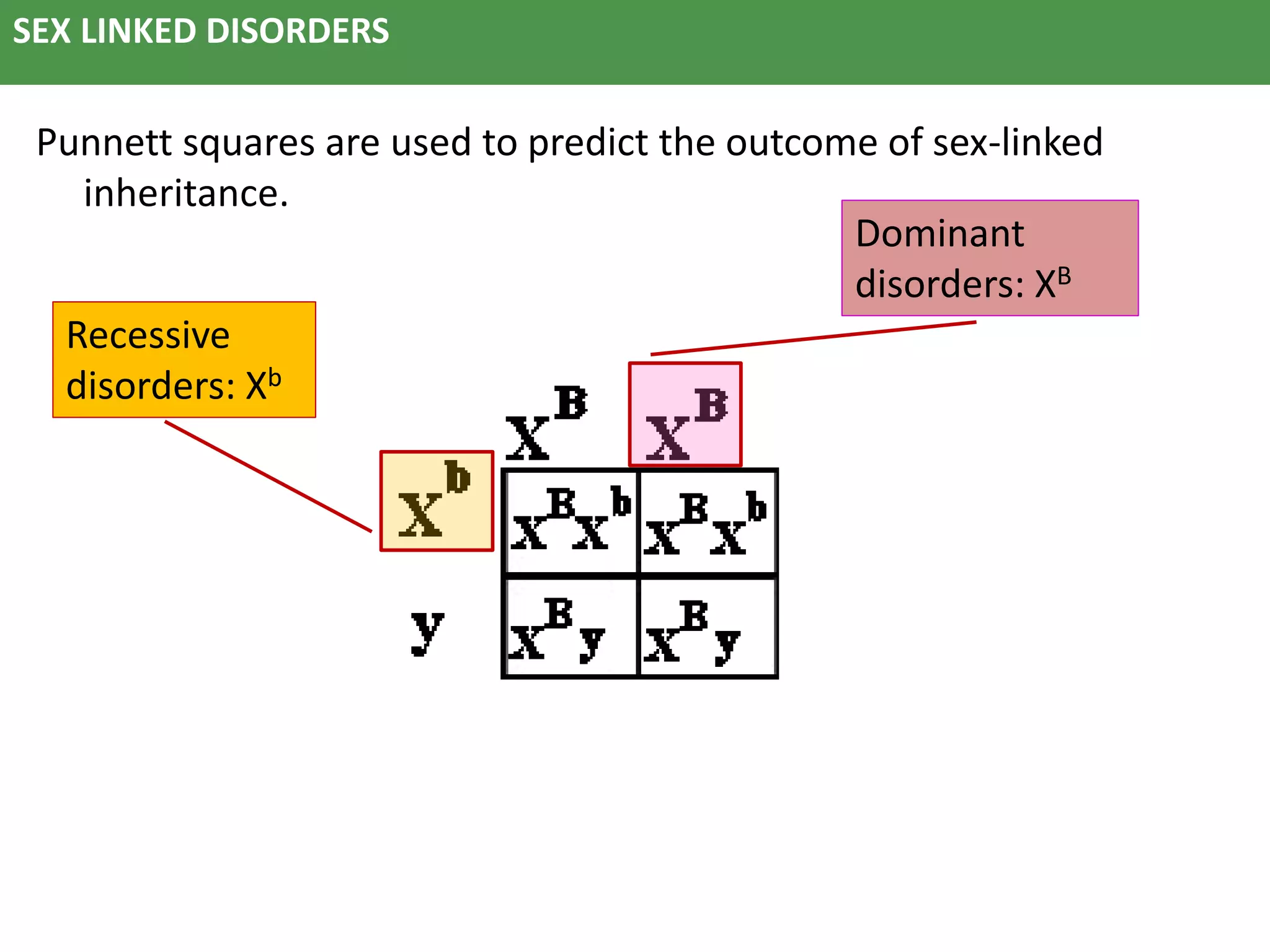
Punnett squares are used to predict the outcome of sex-linked
inheritance.
Recessive
disorders: Xb
Dominant
disorders: XB
SEX LINKED DISORDERS
XNXN
Knowing that hemophilia is a recessive X-linked recessive Of the
following genotypes, identify the male and females between normal,
carriers or affected.
XNXn XnXn
XNY XnY
Normal
female
Carrier
female
Affected
female
Normal
male
Affected
male
SEX LINKED DISORDERS
Hemophilia is a recessive X-linked disorder. What is the probability
of a couple having a hemophiliac child if the man does not have
hemophilia and the woman is a carrier?
♀:
♂:
XNXn
XNY
XN Xn
XN
Y
XN
XN
Xn
Xn
XN
Y
XN
Y
♀
♂
Affected
Unaffected
SEX LINKED DISORDERS
Color-blindness is caused by a recessive allele on the X sex
chromosome. What chance of a colour-blind child in the cross between
a color blind male and a carrier mother? (X-linked recessive disorder)
♀:
♂:
XNXn
XnY
XN Xn
Xn
Y
XN
XN
Xn
Xn
Xn
Y
Xn
Y
♀
♂
Affected
Unaffected
PATTERNS OF INHERITANCE
A pedigree is a genetic
family tree that shows
how prevalent a trait is
in a family unit from
generation to
generation.
They are often used to
track the expression of
genetic conditions and
disorders.
Squares represent
males and circles
females.
A coloured in
shape means that
person has the
trait in question.
A half coloured in
shape means that
they are carrying
an allele for a
recessive trait.
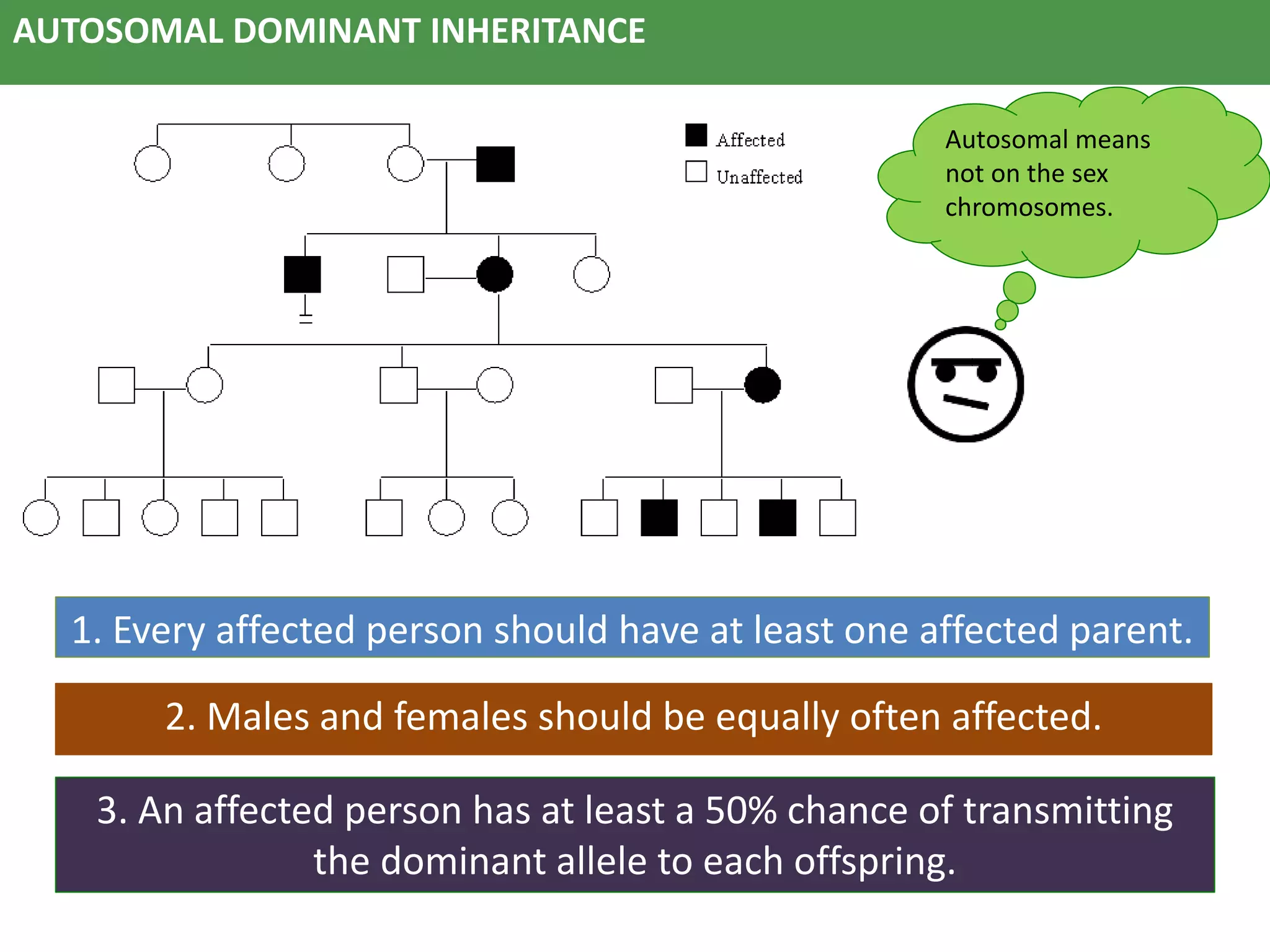
AUTOSOMAL DOMINANT INHERITANCE
3. An affected person has at least a 50% chance of transmitting
the dominant allele to each offspring.
Autosomal means
not on the sex
chromosomes.
1. Every affected person should have at least one affected parent.
2. Males and females should be equally often affected.
AUTOSOMAL DOMINANT INHERITANCE
Autosomal means
not on the sex
chromosomes.
EXAMPLES
 Progeria (caused by a
mutation) in which the person
ages very rapidly. They die
before they can reproduce.
AUTOSOMAL DOMINANT INHERITANCE
Autosomal means
not on the sex
chromosomes.
EXAMPLES
 Huntington’s
Disease in which the
central nervous system
starts to break down
around the age of 30.
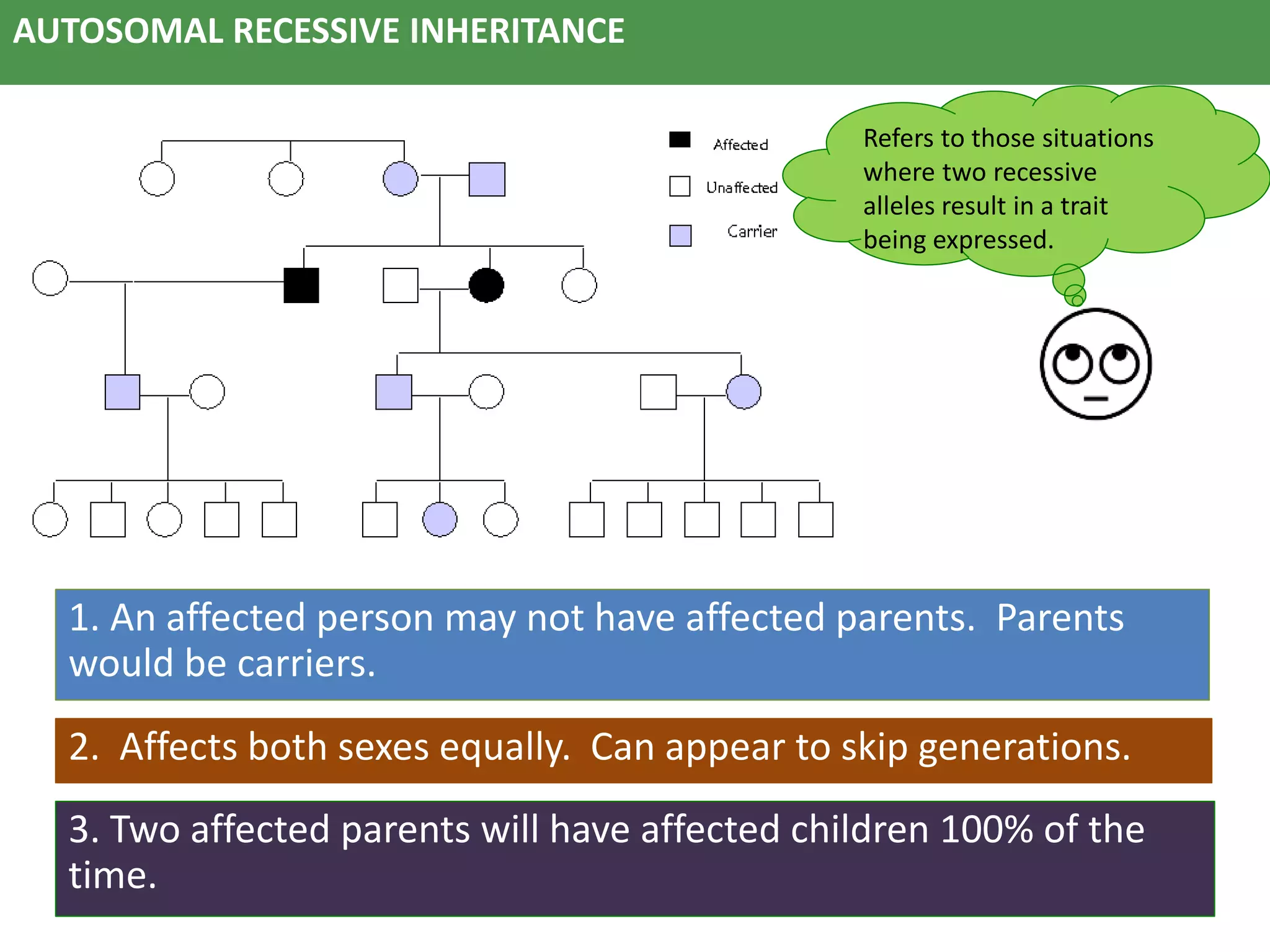
AUTOSOMAL RECESSIVE INHERITANCE
3. Two affected parents will have affected children 100% of the
time.
1. An affected person may not have affected parents. Parents
would be carriers.
2. Affects both sexes equally. Can appear to skip generations.
Refers to those situations
where two recessive
alleles result in a trait
being expressed.
AUTOSOMAL RECESSIVE INHERITANCE
Refers to those situations
where two recessive
alleles result in a trait
being expressed.
EXAMPLES
 Albinism is a genetic
condition which is the loss
of pigment in hair, skin and
eyes
AUTOSOMAL RECESSIVE INHERITANCE
Refers to those situations
where two recessive
alleles result in a trait
being expressed.
EXAMPLES
 Tay Sachs is a genetic
disorder which is a build up
of fatty deposits in the
brain, eventually proving to
be fatal.
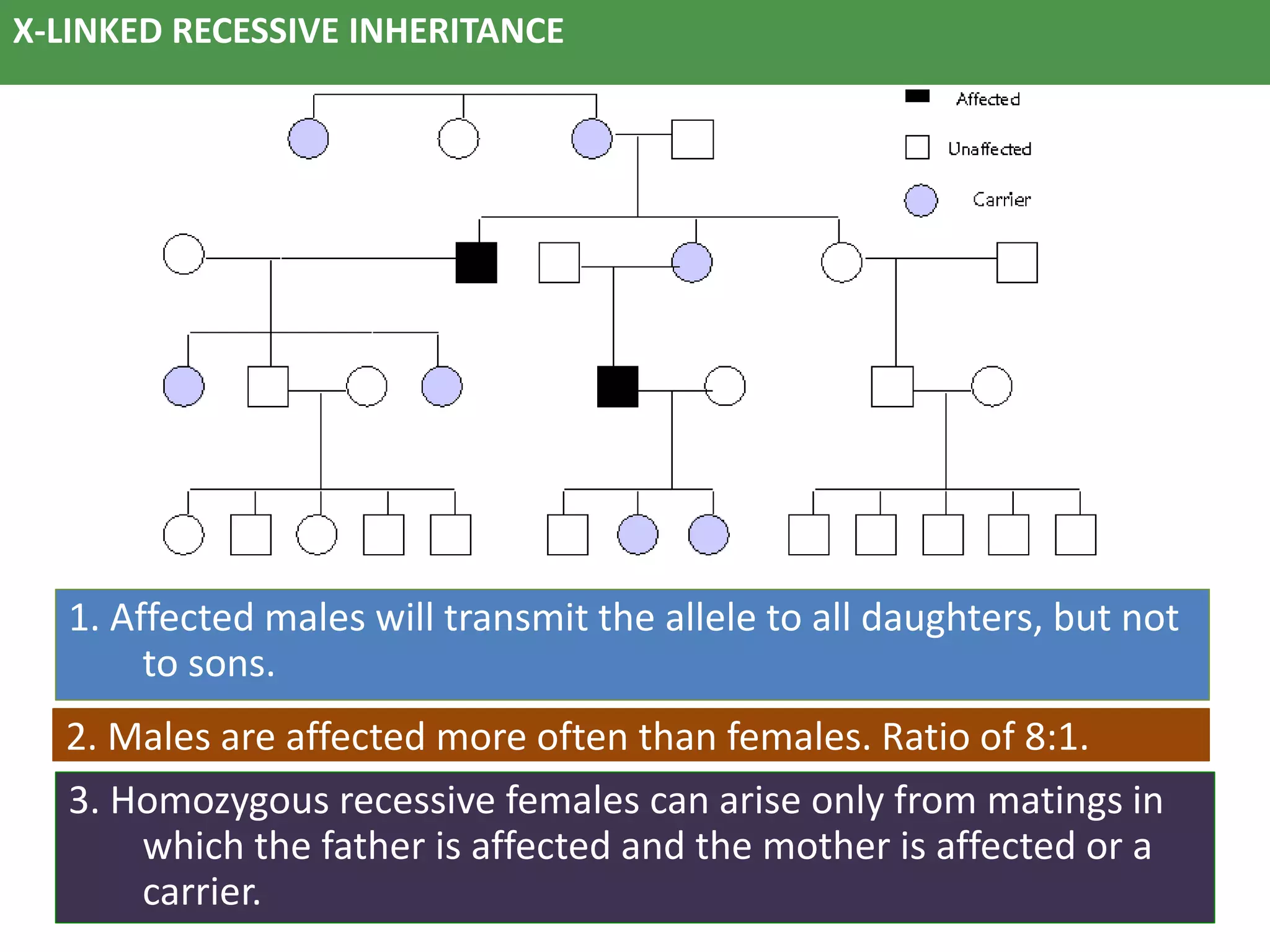
X-LINKED RECESSIVE INHERITANCE
3. Homozygous recessive females can arise only from matings in
which the father is affected and the mother is affected or a
carrier.
1. Affected males will transmit the allele to all daughters, but not
to sons.
2. Males are affected more often than females. Ratio of 8:1.
X-LINKED RECESSIVE INHERITANCE
EXAMPLES
 Hemophilia which is the inability of
the blood to clot properly.
 Duchenne Muscular Dystrophy
which causes progressive and
degenerative muscle weakness.
X-LINKED DOMINANT INHERITANCE
3. All the daughters of an affected male will be affected but none
of the sons
1. Twice as many females are affected as males.
2. Usually half the children of an affected female will be affected,
regardless of sex.
X-LINKED DOMINANT INHERITANCE
EXAMPLES
 Vitamin D resistant
rickets which can lead to
bone deformities,
particularly in the lower
limbs (bowed legs).
LET’S PRACTICE
Analysis of pedigree charts to deduce the pattern of
inheritance of genetic diseases
LET’S PRACTICE
1. Analysis of pedigree charts to deduce the pattern of inheritance of genetic
diseases
CA B
Sex-Linked, Recessive:
• Trait is able to skip
generations
• Males are
predominantly affected
Autosomal, Recessive:
• Trait is able to skip
generations
• No major sex-bias
in expression
Autosomal, Dominant:
• Trait cannot skip
generations
• No major sex-bias in
expression
LET’S PRACTICE
2. Analysis of pedigree charts to deduce the pattern of inheritance of genetic
diseases
Autosomal or sex-linked?
Dominant or recessive?
DOMINANT: A and B are both affected
but have produced unaffected (D&F).
Therefore A and B must have been
carrying recessive healthy alleles.
If it were recessive, it would need to be
homozygous to be expressed in A & B –
and then all offspring would be
homozygous recessive.
AUTOSOMAL: Male C can only pass one X
chromosome. If it were carried on X, daughter
H would be affected by the dominant allele
Tip: Don’t get hung up on the number of
individuals with each phenotype – each
reproductive event is a matter of chance.
Instead focus on possible and impossible
LET’S PRACTICE
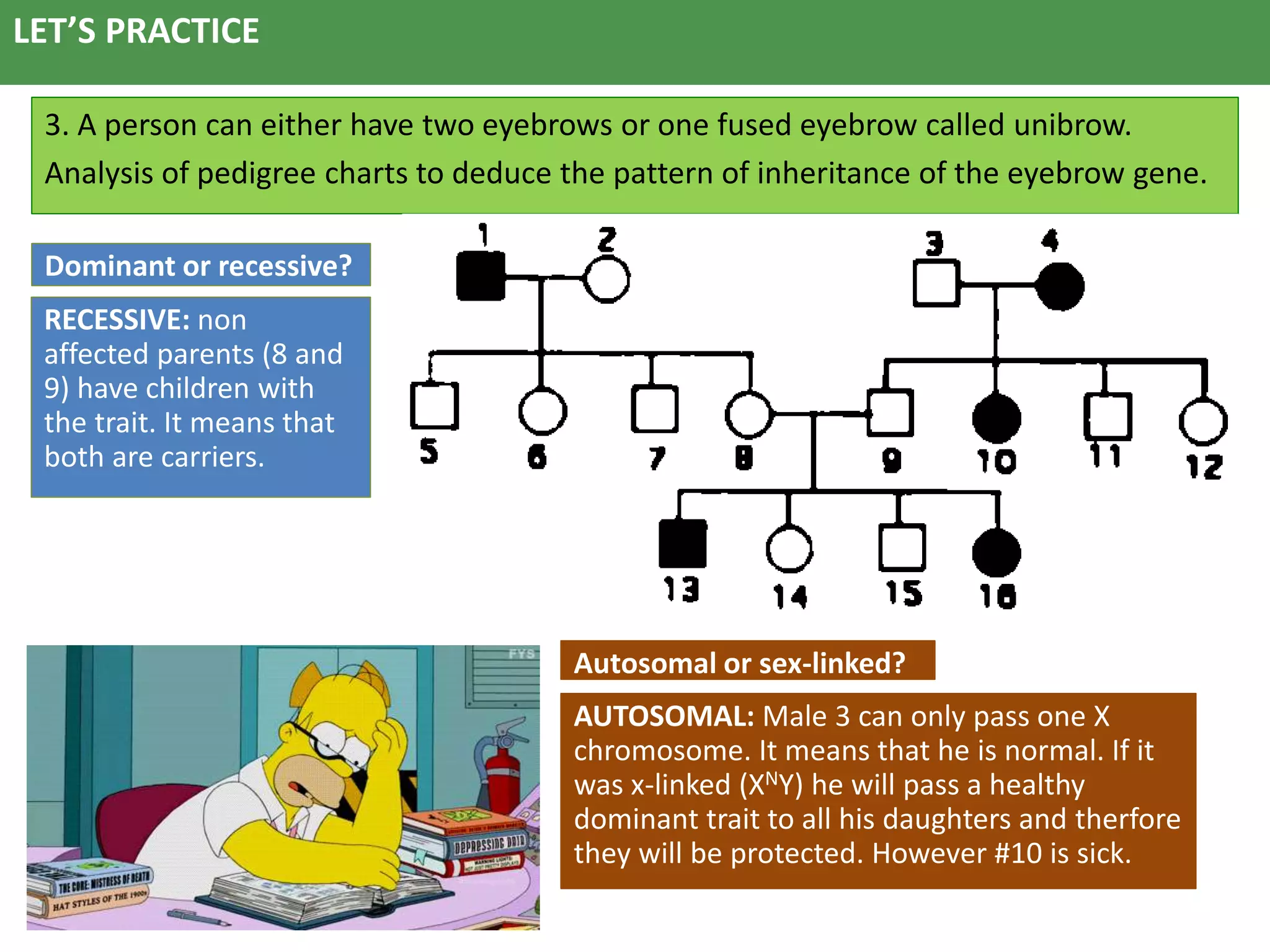
3. A person can either have two eyebrows or one fused eyebrow called unibrow.
Analysis of pedigree charts to deduce the pattern of inheritance of the eyebrow gene.
Autosomal or sex-linked?
AUTOSOMAL: Male 3 can only pass one X
chromosome. It means that he is normal. If it
was x-linked (XNY) he will pass a healthy
dominant trait to all his daughters and therfore
they will be protected. However #10 is sick.
Dominant or recessive?
RECESSIVE: non
affected parents (8 and
9) have children with
the trait. It means that
both are carriers.
LET’S PRACTICE
4. Identify the genotypes of the following individuals using the pedigree above.
(homozygous dominant, homozygous recessive, heterozygous)
Homozygous recessive
Heterozygous
Homozygous recessive
Heterozygous
III-3:
II-1:
I-1:
II-4:
Patterns of  inheritance

Patterns of inheritance

  • 1.
  • 2.
    What are thedifferent ways in which a genetic condition can be inherited? AutosomalSex Linked Sex linked is carried on the sex chromosomes either X or Y Carried on any other chromosome (chromosomes 1-22). INHERITANCE
  • 3.
    What are thedifferent ways in which a genetic condition can be inherited? AutosomalSex Linked INHERITANCE Autosomal dominant Autosomal Recessive One mutated copy of the gene in each cell is sufficient for a person to be affected
  • 4.
    What are thedifferent ways in which a genetic condition can be inherited?
  • 5.
    What are thedifferent ways in which a genetic condition can be inherited? AutosomalSex Linked INHERITANCE Autosomal dominant Autosomal Recessive One mutated copy of the gene in each cell is sufficient for a person to be affected Both copies of the gene in each cell have the disorder. Typically are not seen in every generation of an affected family.
  • 6.
    What are thedifferent ways in which a genetic condition can be inherited?
  • 7.
    What are thedifferent ways in which a genetic condition can be inherited? AutosomalSex Linked INHERITANCE Autosomal dominant Autosomal Recessive X-linked recessive X-linked Dominant Y-linked One mutated copy of the gene in each cell is sufficient for a person to be affected Both copies of the gene in each cell have the disorder. Typically are not seen in every generation of an affected family. X-linked Caused by mutations in genes on the X chromosome. (no male-to-male transmission) In females, a mutation in one of the two copies of the gene is sufficient to cause the disorder. In males, a mutation in the only copy of the gene in each cell causes the disorder
  • 8.
    What are thedifferent ways in which a genetic condition can be inherited?
  • 9.
    What are thedifferent ways in which a genetic condition can be inherited? AutosomalSex Linked INHERITANCE Autosomal dominant Autosomal Recessive X-linked recessive X-linked Dominant One mutated copy of the gene in each cell is sufficient for a person to be affected Both copies of the gene in each cell have the disorder. Typically are not seen in every generation of an affected family. In females, a mutation in one of the two copies of the gene is sufficient to cause the disorder. In males, a mutation in the only copy of the gene in each cell causes the disorder X-linked In males (only one X chromosome), one altered copy of the gene in each cell is sufficient to cause the condition. In females (who have two X chromosomes), a mutation would have to occur in both copies of the gene to cause the disorder. Caused by mutations in genes on the X chromosome. (no male-to-male transmission) Y-linked
  • 10.
    What are thedifferent ways in which a genetic condition can be inherited?
  • 11.
    What are thedifferent ways in which a genetic condition can be inherited? AutosomalSex Linked INHERITANCE Autosomal dominant Autosomal Recessive X-linked recessive X-linked Dominant One mutated copy of the gene in each cell is sufficient for a person to be affected Both copies of the gene in each cell have the disorder. Typically are not seen in every generation of an affected family. In females, a mutation in one of the two copies of the gene is sufficient to cause the disorder. In males, a mutation in the only copy of the gene in each cell causes the disorder X-linked In males (only one X chromosome), one altered copy of the gene in each cell is sufficient to cause the condition. In females (who have two X chromosomes), a mutation would have to occur in both copies of the gene to cause the disorder. Caused by mutations in genes on the X chromosome. (no male-to-male transmission) Y-linked disorders are rare Y-linked
  • 12.
    SEX LINKED DISORDERS Whymales have a higher risk to suffer from an x-linked disorder? Males are at a much greater risk for inheriting sex-disorders because they only inherit one X, so if the X has the allele for the disorder, they will suffer from the disorder. Color blindness Myopia Night blindness Hemophilia
  • 13.
    SEX LINKED DISORDERS Punnettsquares are used to predict the outcome of sex-linked inheritance. Recessive disorders: Xb Dominant disorders: XB
  • 14.
  • 15.
    SEX LINKED DISORDERS XNXN Knowingthat hemophilia is a recessive X-linked recessive Of the following genotypes, identify the male and females between normal, carriers or affected. XNXn XnXn XNY XnY Normal female Carrier female Affected female Normal male Affected male
  • 16.
    SEX LINKED DISORDERS Hemophiliais a recessive X-linked disorder. What is the probability of a couple having a hemophiliac child if the man does not have hemophilia and the woman is a carrier? ♀: ♂: XNXn XNY XN Xn XN Y XN XN Xn Xn XN Y XN Y ♀ ♂ Affected Unaffected
  • 17.
    SEX LINKED DISORDERS Color-blindnessis caused by a recessive allele on the X sex chromosome. What chance of a colour-blind child in the cross between a color blind male and a carrier mother? (X-linked recessive disorder) ♀: ♂: XNXn XnY XN Xn Xn Y XN XN Xn Xn Xn Y Xn Y ♀ ♂ Affected Unaffected
  • 18.
  • 19.
    PATTERNS OF INHERITANCE Apedigree is a genetic family tree that shows how prevalent a trait is in a family unit from generation to generation. They are often used to track the expression of genetic conditions and disorders. Squares represent males and circles females. A coloured in shape means that person has the trait in question. A half coloured in shape means that they are carrying an allele for a recessive trait.
  • 20.
    AUTOSOMAL DOMINANT INHERITANCE 3.An affected person has at least a 50% chance of transmitting the dominant allele to each offspring. Autosomal means not on the sex chromosomes. 1. Every affected person should have at least one affected parent. 2. Males and females should be equally often affected.
  • 21.
    AUTOSOMAL DOMINANT INHERITANCE Autosomalmeans not on the sex chromosomes. EXAMPLES  Progeria (caused by a mutation) in which the person ages very rapidly. They die before they can reproduce.
  • 22.
    AUTOSOMAL DOMINANT INHERITANCE Autosomalmeans not on the sex chromosomes. EXAMPLES  Huntington’s Disease in which the central nervous system starts to break down around the age of 30.
  • 23.
    AUTOSOMAL RECESSIVE INHERITANCE 3.Two affected parents will have affected children 100% of the time. 1. An affected person may not have affected parents. Parents would be carriers. 2. Affects both sexes equally. Can appear to skip generations. Refers to those situations where two recessive alleles result in a trait being expressed.
  • 24.
    AUTOSOMAL RECESSIVE INHERITANCE Refersto those situations where two recessive alleles result in a trait being expressed. EXAMPLES  Albinism is a genetic condition which is the loss of pigment in hair, skin and eyes
  • 25.
    AUTOSOMAL RECESSIVE INHERITANCE Refersto those situations where two recessive alleles result in a trait being expressed. EXAMPLES  Tay Sachs is a genetic disorder which is a build up of fatty deposits in the brain, eventually proving to be fatal.
  • 26.
    X-LINKED RECESSIVE INHERITANCE 3.Homozygous recessive females can arise only from matings in which the father is affected and the mother is affected or a carrier. 1. Affected males will transmit the allele to all daughters, but not to sons. 2. Males are affected more often than females. Ratio of 8:1.
  • 27.
    X-LINKED RECESSIVE INHERITANCE EXAMPLES Hemophilia which is the inability of the blood to clot properly.  Duchenne Muscular Dystrophy which causes progressive and degenerative muscle weakness.
  • 28.
    X-LINKED DOMINANT INHERITANCE 3.All the daughters of an affected male will be affected but none of the sons 1. Twice as many females are affected as males. 2. Usually half the children of an affected female will be affected, regardless of sex.
  • 29.
    X-LINKED DOMINANT INHERITANCE EXAMPLES Vitamin D resistant rickets which can lead to bone deformities, particularly in the lower limbs (bowed legs).
  • 30.
    LET’S PRACTICE Analysis ofpedigree charts to deduce the pattern of inheritance of genetic diseases
  • 31.
    LET’S PRACTICE 1. Analysisof pedigree charts to deduce the pattern of inheritance of genetic diseases CA B Sex-Linked, Recessive: • Trait is able to skip generations • Males are predominantly affected Autosomal, Recessive: • Trait is able to skip generations • No major sex-bias in expression Autosomal, Dominant: • Trait cannot skip generations • No major sex-bias in expression
  • 32.
    LET’S PRACTICE 2. Analysisof pedigree charts to deduce the pattern of inheritance of genetic diseases Autosomal or sex-linked? Dominant or recessive? DOMINANT: A and B are both affected but have produced unaffected (D&F). Therefore A and B must have been carrying recessive healthy alleles. If it were recessive, it would need to be homozygous to be expressed in A & B – and then all offspring would be homozygous recessive. AUTOSOMAL: Male C can only pass one X chromosome. If it were carried on X, daughter H would be affected by the dominant allele Tip: Don’t get hung up on the number of individuals with each phenotype – each reproductive event is a matter of chance. Instead focus on possible and impossible
  • 33.
    LET’S PRACTICE 3. Aperson can either have two eyebrows or one fused eyebrow called unibrow. Analysis of pedigree charts to deduce the pattern of inheritance of the eyebrow gene. Autosomal or sex-linked? AUTOSOMAL: Male 3 can only pass one X chromosome. It means that he is normal. If it was x-linked (XNY) he will pass a healthy dominant trait to all his daughters and therfore they will be protected. However #10 is sick. Dominant or recessive? RECESSIVE: non affected parents (8 and 9) have children with the trait. It means that both are carriers.
  • 34.
    LET’S PRACTICE 4. Identifythe genotypes of the following individuals using the pedigree above. (homozygous dominant, homozygous recessive, heterozygous) Homozygous recessive Heterozygous Homozygous recessive Heterozygous III-3: II-1: I-1: II-4: