Sex linkage is the phenotypic expression of an
allele related to the chromosomal sex of the
individual. This mode of inheritance is in
contrast to the inheritance of traits on autosomal
chromosomes, where both sexes have the same
probability of inheritance.
In mammals, XY develops testicles, which secrete male sex
hormones, and the fetus develops into a male. An XX fetus
develops into a female. Thus sperm can be either X or Y;
ova are always X.

Sex linked inheritance involves genes located on either the
X or the Y chromosome. Females can be homozygous or
heterozygous for genes carried on the X chromosome; males
can only be hemizygous.
X-linked recessive:

The most common type of sex-linked inheritance involves
genes on the X chromosome, which behave more or less as
recessives.

Females, having two X chromosomes, have a good chance
of having the normal gene on one of the two. Males,
however, have only one copy of the X chromosome - and the
Y chromosome does not carry many of the same genes as the
X, so there is no normal gene to counter the defective X.

 ♀♀♀♀♀♀♀♀♀♀♀♀♀♀♀♀♀♀♀♀
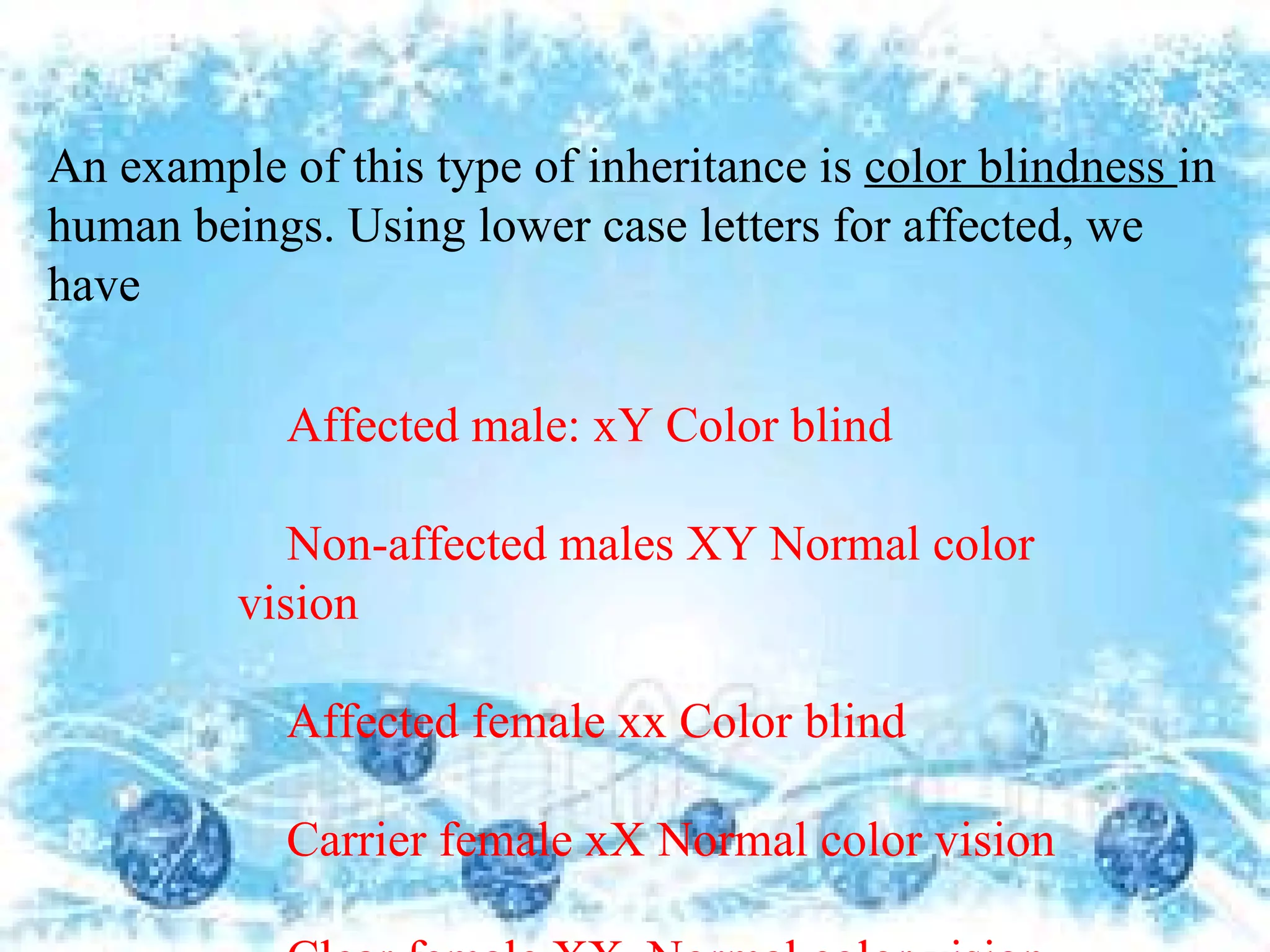
An example of this type of inheritance is color blindness in
human beings. Using lower case letters for affected, we
have

            Affected male: xY Color blind

            Non-affected males XY Normal color
         vision

            Affected female xx Color blind

            Carrier female xX Normal color vision
THE POSSIBLE MATINGS:

xY to xx (both parents affected) xx females and xY males, all offspring affected.
xY to Xx (affected father, carrier mother) half the females will be xX and carriers, half will be xx
and affected. Half the males will be XY and clear, half will be xY and affected.
xY to XX (affected father, clear mother) all male ofspring XY clear, all daughters Xx carriers.
Note that the daughters of an affected male are obligate carriers or affected. The unaffected sons
of an affected male cannot carry the problem.
XY to xx (father clear, mother affected) xY males (affected) and xX daughters (carriers.)
XY to Xx (father clear, mother carrier) half the males affected (xY) and half clear (XY); half
females clear (XX) and half carriers (Xx)
XY to XX (father and mother both genetic clears) all offspring clear.
Note that all female offspring of affected males are obligate carriers (if not affected.) Likewise,
any female who has an affected son is a carrier. Non-affected sons of affected fathers are
genetically clear.
This type of inheritance may be complicated by the sublethal effect of some X-linked genes.
Hemophilia A in many mammals (including dogs and people) is a severe bleeding disorder
inherited just like the color-blindness above. Many affected individuals will die before breeding,
but for those who are kept alive and bred for other outstanding traits, non-affected sons will not
have or produce the disease. All daughters, however, will be carriers.
X-Linked Dominant Inheritance

    A male or female child of a mother affected with an
X-Linked dominant trait has a 50% chance of inheriting
the mutation and thus being affected with the disorder.

   All female children of an affected father will be
affected (daughters possess their fathers' X-
chromosome). No male children of an affected father will
be affected (sons do not inherit their fathers' X-
chromosome).
Y-linked inheritance:


The Y chromosome in most species is very short with very
few genes other than those that determine maleness. Y-linked
inheritance would show sons the same as their fathers, with no
effect from the mother or in daughters.
In humans, hairy ears appear to be inherited through the Y
chromosome. Padgett does not list any known problem in dogs
as being Y-linked.


   ♂♂♂♂♂♂♂♂♂♂♂♂♂♂♂♂♂♂♂♂♂♂♂♂♂♂
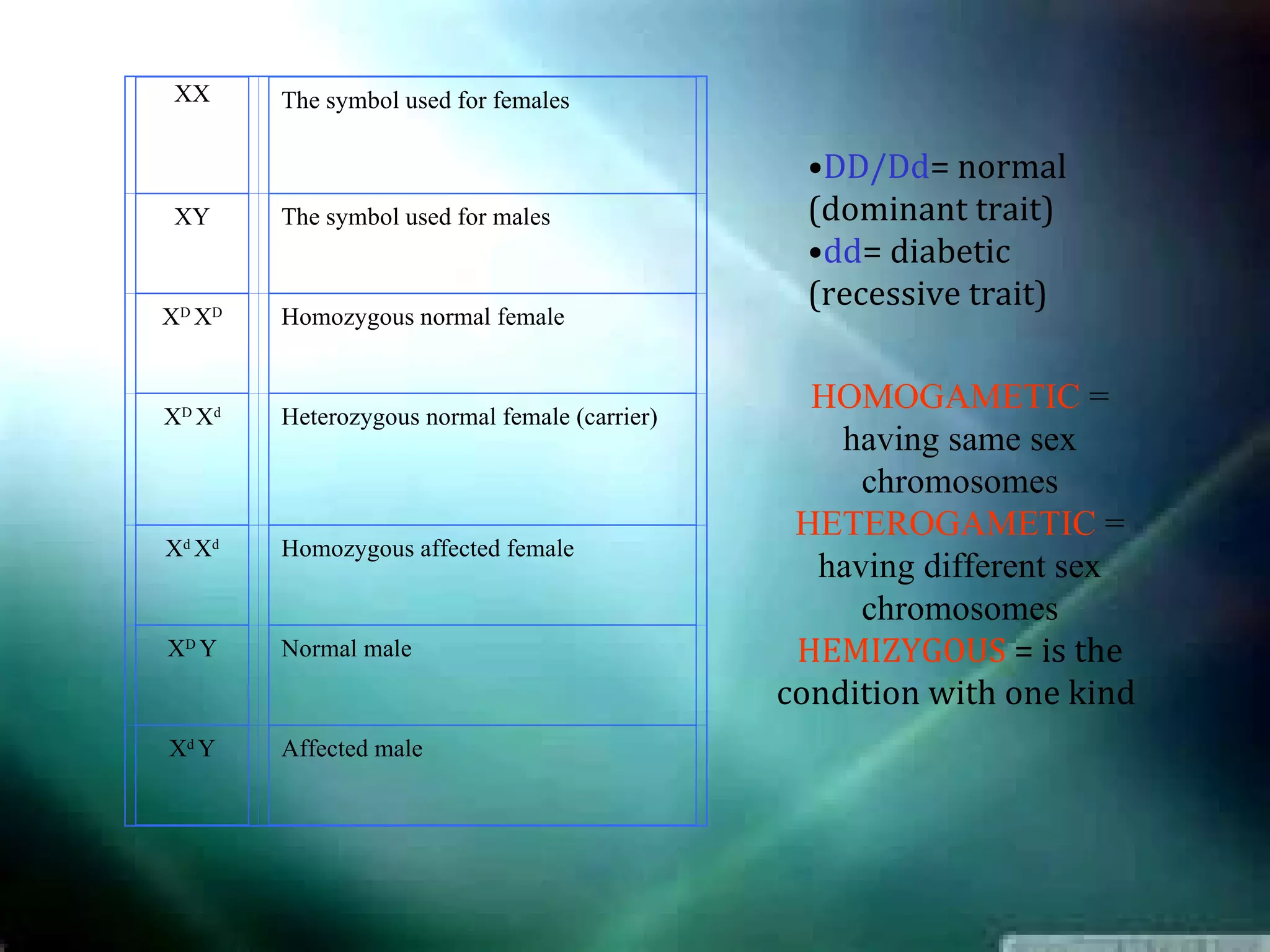
XX      The symbol used for females

                                                 •DD/Dd= normal
 XY      The symbol used for males               (dominant trait)
                                                 •dd= diabetic
                                                 (recessive trait)
XD XD    Homozygous normal female


XD X d   Heterozygous normal female (carrier)
                                                  HOMOGAMETIC =
                                                    having same sex
                                                     chromosomes
                                                 HETEROGAMETIC =
Xd Xd    Homozygous affected female
                                                  having different sex
                                                     chromosomes
XD Y     Normal male                             HEMIZYGOUS = is the
                                                condition with one kind
Xd Y     Affected male
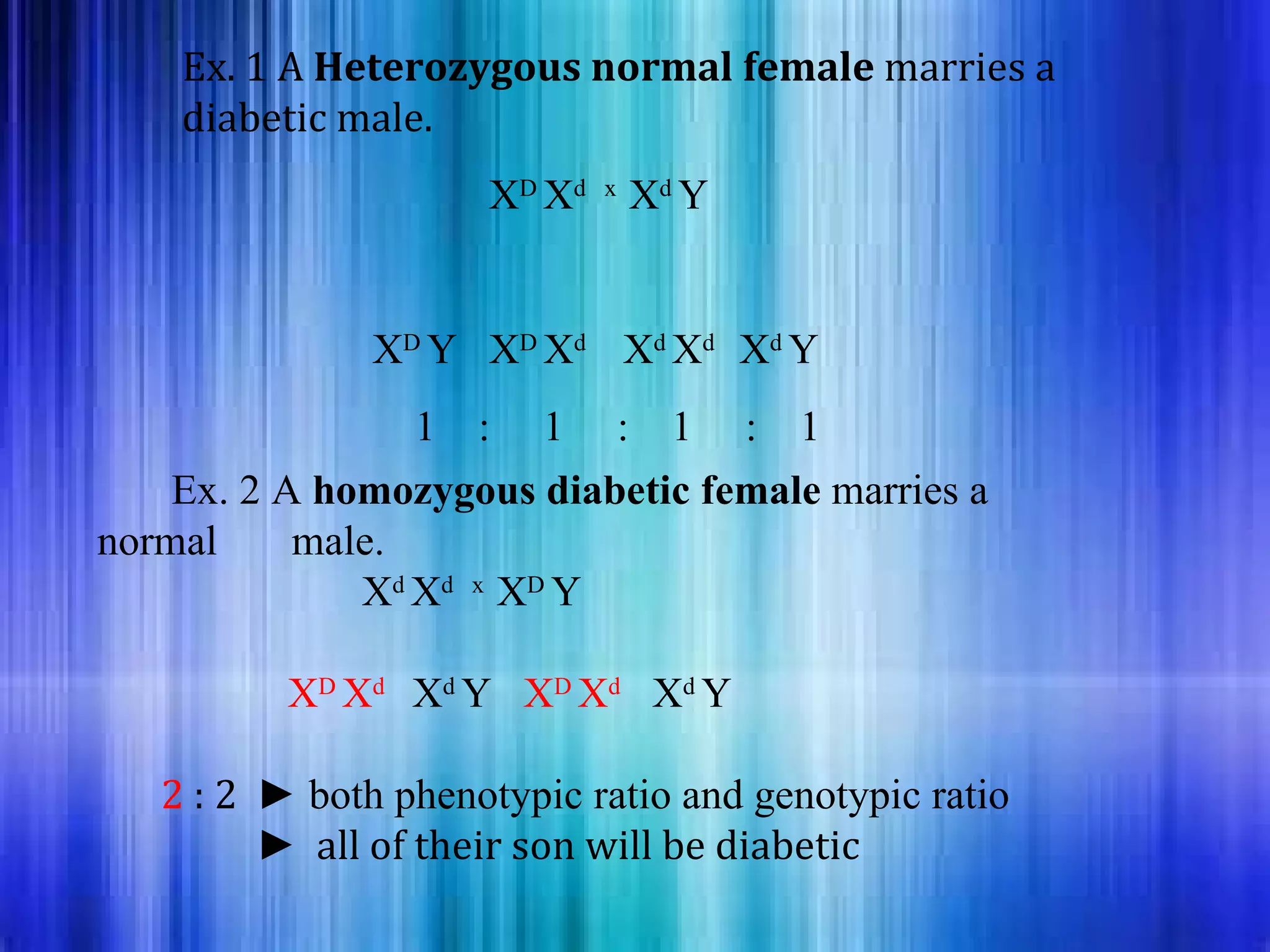
Ex. 1 A Heterozygous normal female marries a
    diabetic male.
                     XD Xd   x
                                 Xd Y


               XD Y XD Xd Xd Xd Xd Y
                 1 : 1 : 1 : 1
    Ex. 2 A homozygous diabetic female marries a
normal     male.
              Xd Xd x XD Y

          XD Xd Xd Y XD Xd Xd Y

   2 : 2 ► both phenotypic ratio and genotypic ratio
         ► all of their son will be diabetic
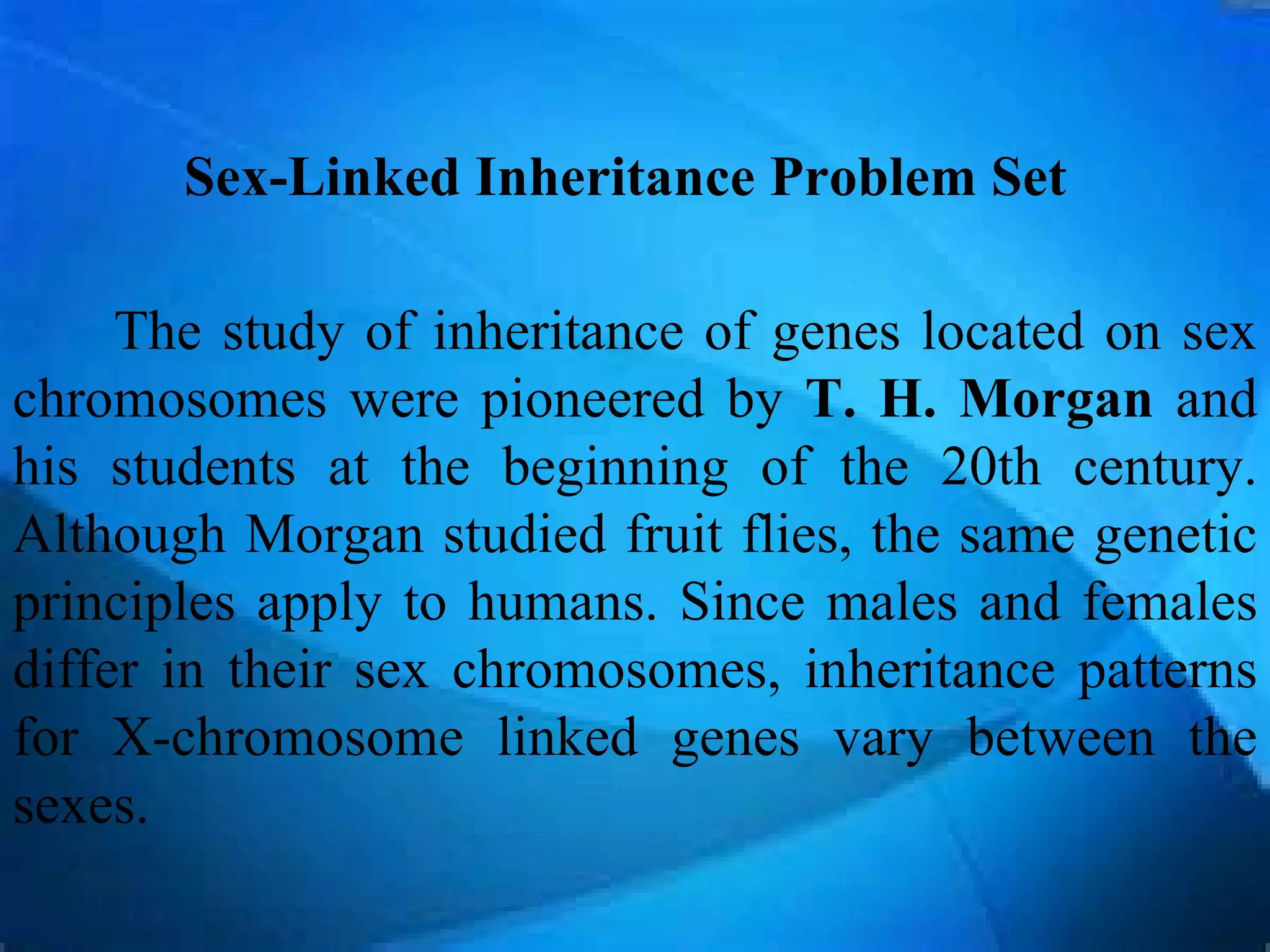
Sex-Linked Inheritance Problem Set

     The study of inheritance of genes located on sex
chromosomes were pioneered by T. H. Morgan and
his students at the beginning of the 20th century.
Although Morgan studied fruit flies, the same genetic
principles apply to humans. Since males and females
differ in their sex chromosomes, inheritance patterns
for X-chromosome linked genes vary between the
sexes.
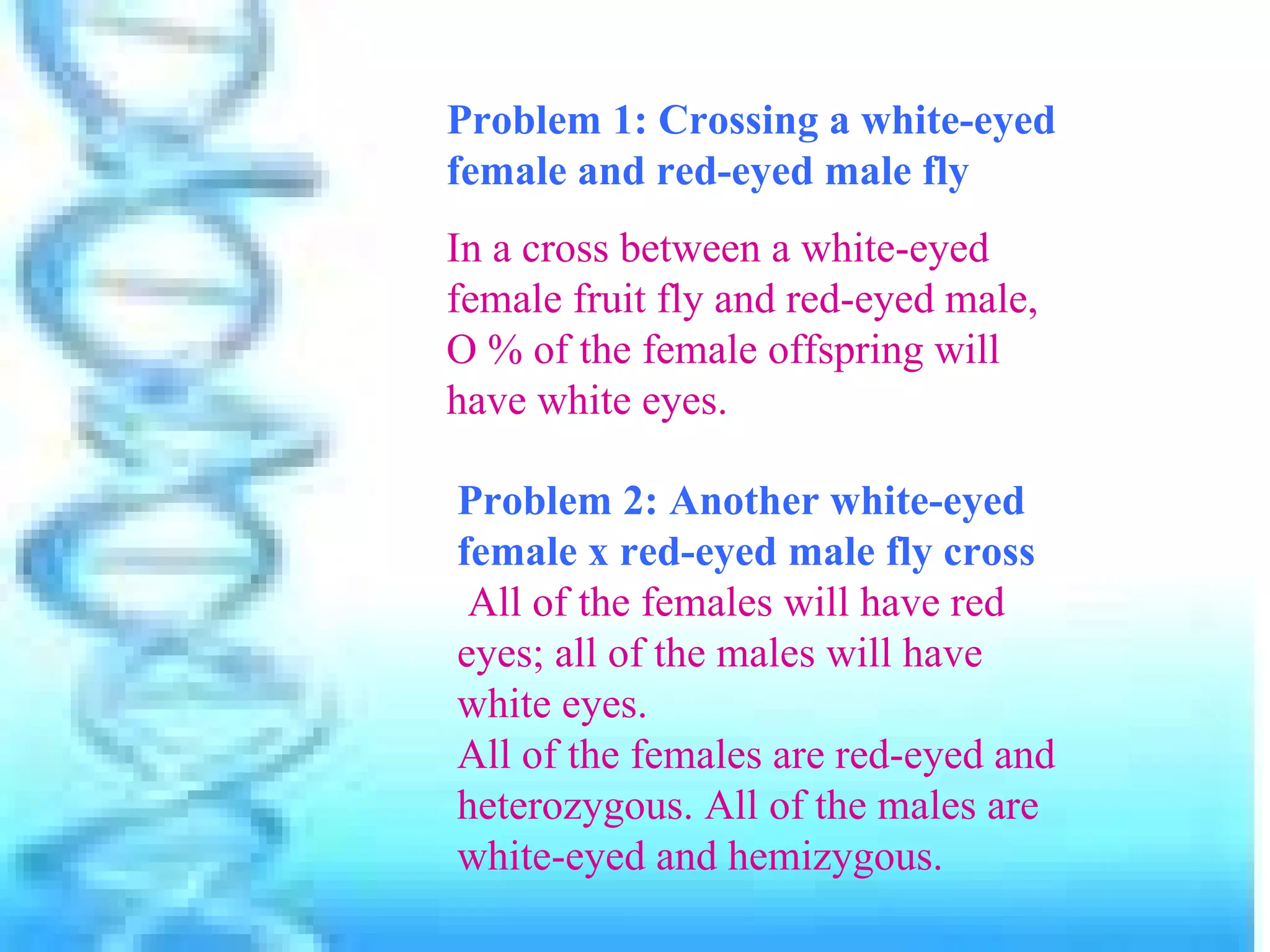
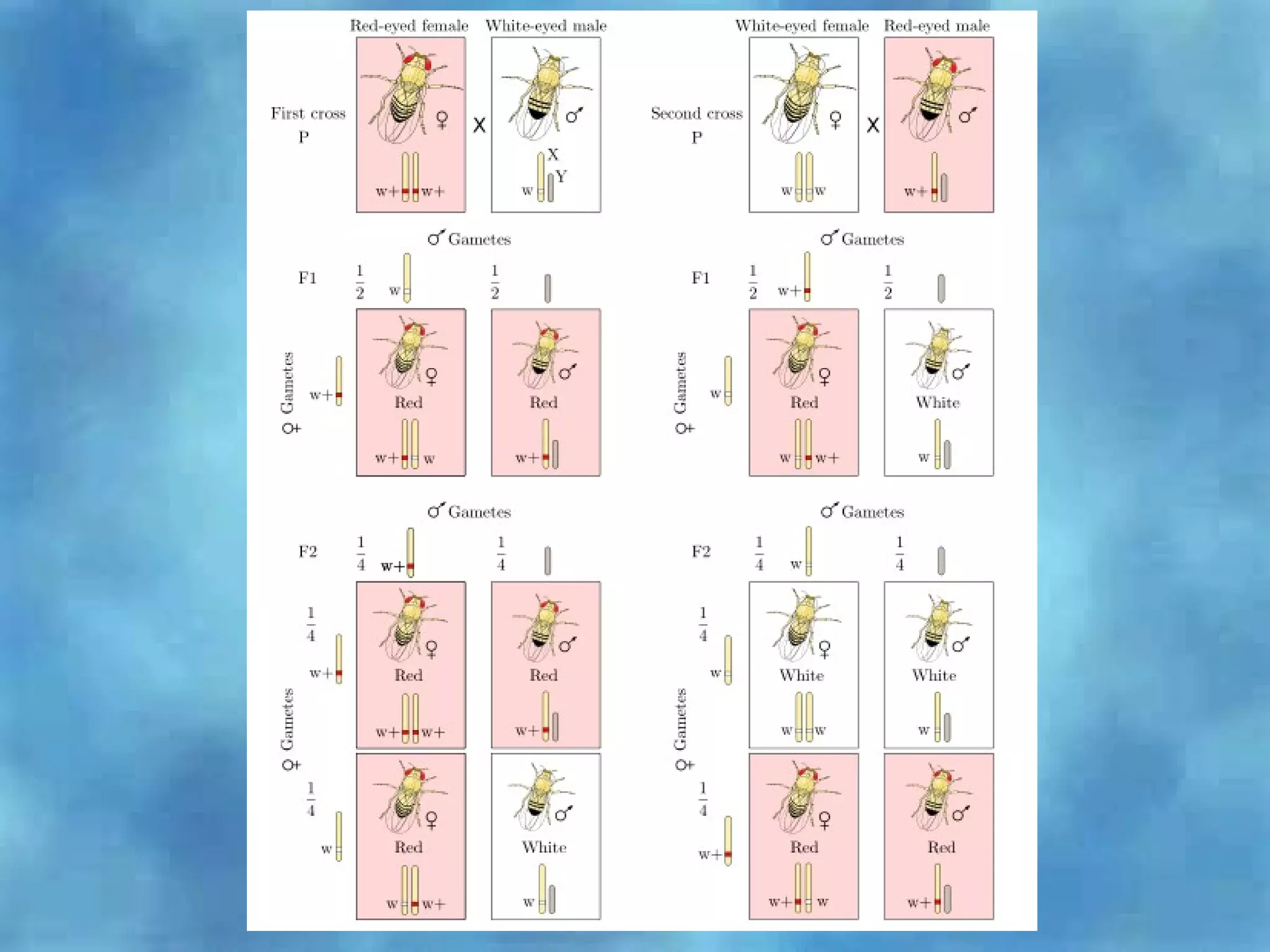
Problem 1: Crossing a white-eyed
female and red-eyed male fly
In a cross between a white-eyed
female fruit fly and red-eyed male,
O % of the female offspring will
have white eyes.

Problem 2: Another white-eyed
female x red-eyed male fly cross
 All of the females will have red
eyes; all of the males will have
white eyes.
All of the females are red-eyed and
heterozygous. All of the males are
white-eyed and hemizygous.
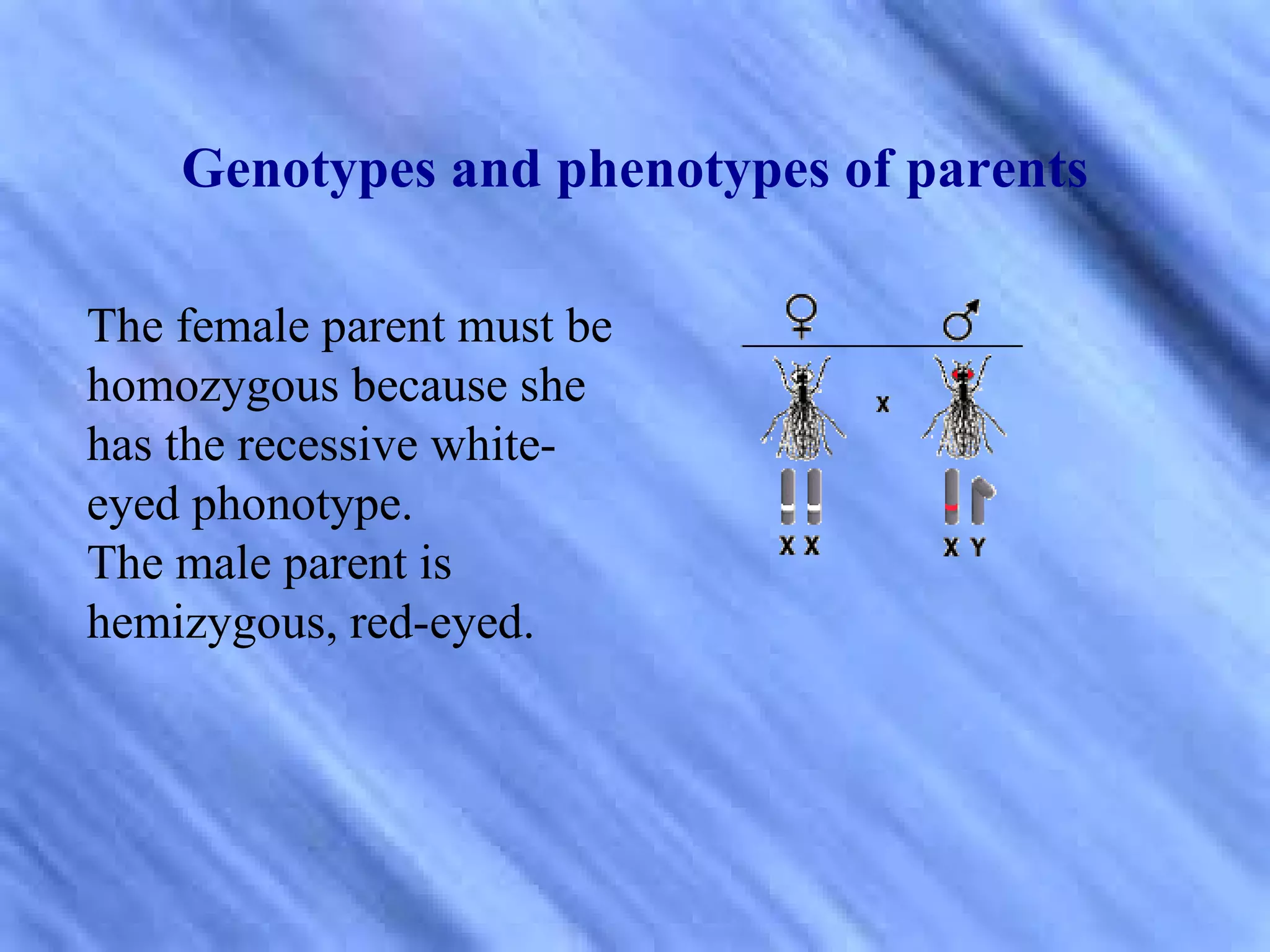
Genotypes and phenotypes of parents

The female parent must be
homozygous because she
has the recessive white-
eyed phonotype.
The male parent is
hemizygous, red-eyed.
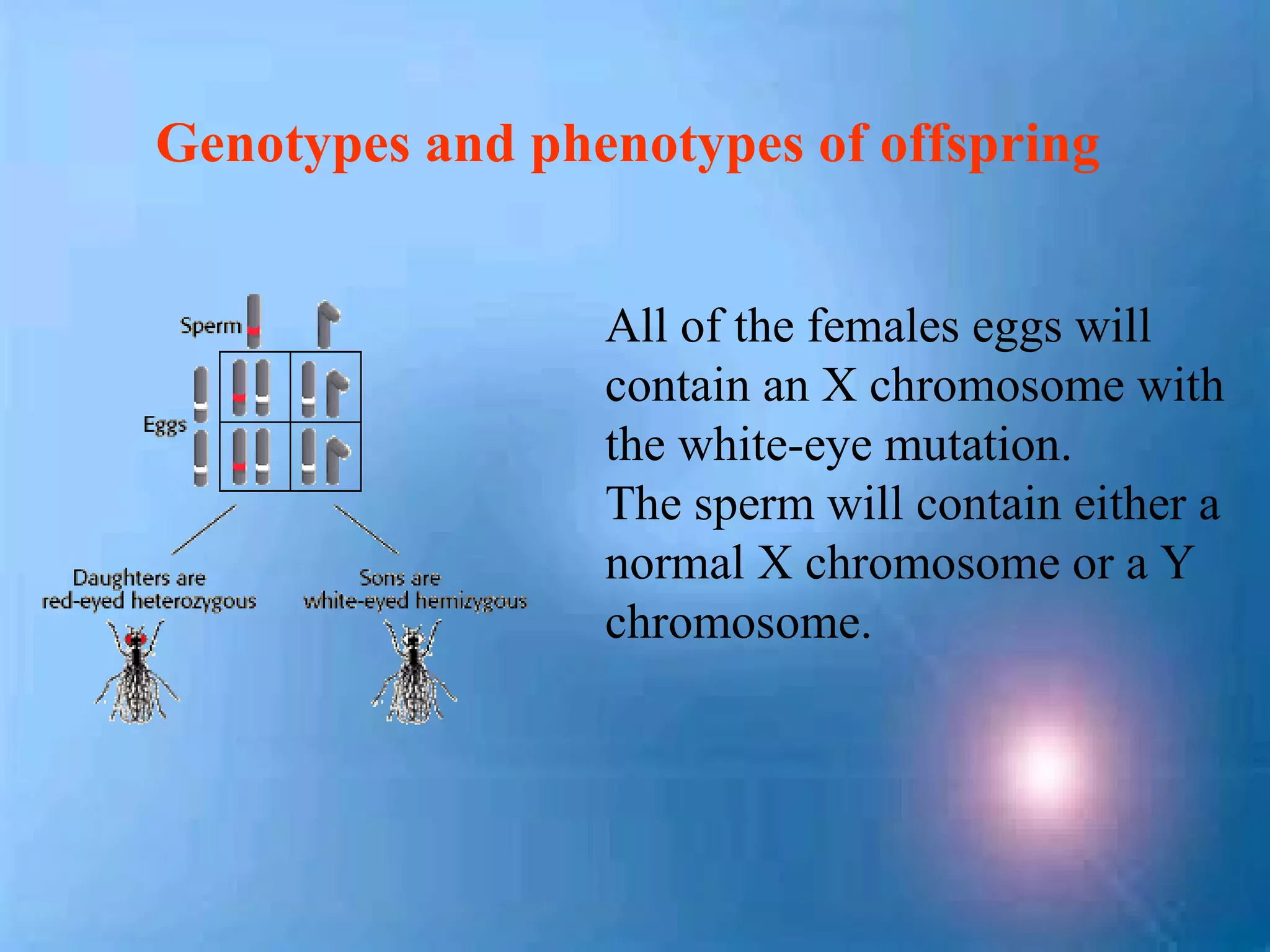
Genotypes and phenotypes of offspring


                 All of the females eggs will
                 contain an X chromosome with
                 the white-eye mutation.
                 The sperm will contain either a
                 normal X chromosome or a Y
                 chromosome.
Summary

    We use a Punnett Square to predict the outcome of this
cross Female offspring receive an X chromosome from both
the sperm and egg. All females receive the dominant, red-eyed
allele from their fathers and the recessive, white-eyed allele
from their mothers.
Sex-linked inheritance by Puzon and Tope

Sex-linked inheritance by Puzon and Tope

  • 2.
    Sex linkage isthe phenotypic expression of an allele related to the chromosomal sex of the individual. This mode of inheritance is in contrast to the inheritance of traits on autosomal chromosomes, where both sexes have the same probability of inheritance.
  • 3.
    In mammals, XYdevelops testicles, which secrete male sex hormones, and the fetus develops into a male. An XX fetus develops into a female. Thus sperm can be either X or Y; ova are always X. Sex linked inheritance involves genes located on either the X or the Y chromosome. Females can be homozygous or heterozygous for genes carried on the X chromosome; males can only be hemizygous.
  • 4.
    X-linked recessive: The mostcommon type of sex-linked inheritance involves genes on the X chromosome, which behave more or less as recessives. Females, having two X chromosomes, have a good chance of having the normal gene on one of the two. Males, however, have only one copy of the X chromosome - and the Y chromosome does not carry many of the same genes as the X, so there is no normal gene to counter the defective X. ♀♀♀♀♀♀♀♀♀♀♀♀♀♀♀♀♀♀♀♀
  • 5.
    An example ofthis type of inheritance is color blindness in human beings. Using lower case letters for affected, we have Affected male: xY Color blind Non-affected males XY Normal color vision Affected female xx Color blind Carrier female xX Normal color vision
  • 6.
    THE POSSIBLE MATINGS: xYto xx (both parents affected) xx females and xY males, all offspring affected. xY to Xx (affected father, carrier mother) half the females will be xX and carriers, half will be xx and affected. Half the males will be XY and clear, half will be xY and affected. xY to XX (affected father, clear mother) all male ofspring XY clear, all daughters Xx carriers. Note that the daughters of an affected male are obligate carriers or affected. The unaffected sons of an affected male cannot carry the problem. XY to xx (father clear, mother affected) xY males (affected) and xX daughters (carriers.) XY to Xx (father clear, mother carrier) half the males affected (xY) and half clear (XY); half females clear (XX) and half carriers (Xx) XY to XX (father and mother both genetic clears) all offspring clear. Note that all female offspring of affected males are obligate carriers (if not affected.) Likewise, any female who has an affected son is a carrier. Non-affected sons of affected fathers are genetically clear. This type of inheritance may be complicated by the sublethal effect of some X-linked genes. Hemophilia A in many mammals (including dogs and people) is a severe bleeding disorder inherited just like the color-blindness above. Many affected individuals will die before breeding, but for those who are kept alive and bred for other outstanding traits, non-affected sons will not have or produce the disease. All daughters, however, will be carriers.
  • 7.
    X-Linked Dominant Inheritance A male or female child of a mother affected with an X-Linked dominant trait has a 50% chance of inheriting the mutation and thus being affected with the disorder. All female children of an affected father will be affected (daughters possess their fathers' X- chromosome). No male children of an affected father will be affected (sons do not inherit their fathers' X- chromosome).
  • 8.
    Y-linked inheritance: The Ychromosome in most species is very short with very few genes other than those that determine maleness. Y-linked inheritance would show sons the same as their fathers, with no effect from the mother or in daughters. In humans, hairy ears appear to be inherited through the Y chromosome. Padgett does not list any known problem in dogs as being Y-linked. ♂♂♂♂♂♂♂♂♂♂♂♂♂♂♂♂♂♂♂♂♂♂♂♂♂♂
  • 9.
    XX The symbol used for females •DD/Dd= normal XY The symbol used for males (dominant trait) •dd= diabetic (recessive trait) XD XD Homozygous normal female XD X d Heterozygous normal female (carrier) HOMOGAMETIC = having same sex chromosomes HETEROGAMETIC = Xd Xd Homozygous affected female having different sex chromosomes XD Y Normal male HEMIZYGOUS = is the condition with one kind Xd Y Affected male
  • 10.
    Ex. 1 AHeterozygous normal female marries a diabetic male. XD Xd x Xd Y XD Y XD Xd Xd Xd Xd Y 1 : 1 : 1 : 1 Ex. 2 A homozygous diabetic female marries a normal male. Xd Xd x XD Y XD Xd Xd Y XD Xd Xd Y 2 : 2 ► both phenotypic ratio and genotypic ratio ► all of their son will be diabetic
  • 11.
    Sex-Linked Inheritance ProblemSet The study of inheritance of genes located on sex chromosomes were pioneered by T. H. Morgan and his students at the beginning of the 20th century. Although Morgan studied fruit flies, the same genetic principles apply to humans. Since males and females differ in their sex chromosomes, inheritance patterns for X-chromosome linked genes vary between the sexes.
  • 12.
    Problem 1: Crossinga white-eyed female and red-eyed male fly In a cross between a white-eyed female fruit fly and red-eyed male, O % of the female offspring will have white eyes. Problem 2: Another white-eyed female x red-eyed male fly cross All of the females will have red eyes; all of the males will have white eyes. All of the females are red-eyed and heterozygous. All of the males are white-eyed and hemizygous.
  • 13.
    Genotypes and phenotypesof parents The female parent must be homozygous because she has the recessive white- eyed phonotype. The male parent is hemizygous, red-eyed.
  • 14.
    Genotypes and phenotypesof offspring All of the females eggs will contain an X chromosome with the white-eye mutation. The sperm will contain either a normal X chromosome or a Y chromosome.
  • 15.
    Summary We use a Punnett Square to predict the outcome of this cross Female offspring receive an X chromosome from both the sperm and egg. All females receive the dominant, red-eyed allele from their fathers and the recessive, white-eyed allele from their mothers.