LINKED INHERITANCE
Name: Jeny Jose
Subject: Cytogenetics
Semester: 1
Course: Agricultural Biotechnology
University: Szent Istvan University
Inheritance
 Inheritance means the pattern in which the gene will be transferred from parents to
off-springs, i.e. from one generation to the next.
 The gene to be transferred if present on the 22 autosomal pair in case of humans
or generally in autosomes are called Autosomal Linked Inheritance.
 If the gene to be transferred is present on any of the sex chromosomes of our body
is called Sex Linked Inheritance.
Autosomal Inheritance
 All the genes produce proteins in our body e.g. Hepatocytes produces enzymes for
digestion and metabolism, the genes responsible for which are present in the
autosomes of our body.
 The autosomal inheritance will look like
 A- dominant allele, AA, aa homozygous pair of genes.
 a- Recessive allele, Aa heterozygous pair of genes.
 For instance When the dominant gene is responsible for eye colour blue recessive
allele is responsible for an eye colour black and the inherited genes are ‘aa’, only
then will the off-spring show black eye colour.
 It is not dependant on gender, both female and male have equal chance of
inheriting the genes and exhibiting the characteristic property of the gene.
Mendelian Genetics
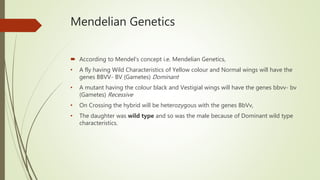
 According to Mendel’s concept i.e. Mendelian Genetics,
• A fly having Wild Characteristics of Yellow colour and Normal wings will have the
genes BBVV- BV (Gametes) Dominant
• A mutant having the colour black and Vestigial wings will have the genes bbvv- bv
(Gametes) Recessive
• On Crossing the hybrid will be heterozygous with the genes BbVv,
• The daughter was wild type and so was the male because of Dominant wild type
characteristics.
Crossing of Hybrid and Mutant
 On crossing the hybrid(BbVv) with homozygous mutant (bbvv).
The gametes of hybrid would be:
 BV, Bv, bV, bv
 The gametes of mutant would be:
 bv
The progeny will have the genes:
 BbVv (Yellow and normal wings)
 Bbvv (Yellow and vestigial wings)
 bbVv (Black and Normal wings)
 Bbvv ( Black and Vestigial wings)
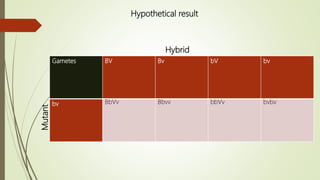
the ratio hypothetically was supposed to be 1:1:1:1
Gametes BV Bv bV bv
bv BbVv Bbvv bbVv bvbv
Hybrid
Mutant
Hypothetical result
Actual Results
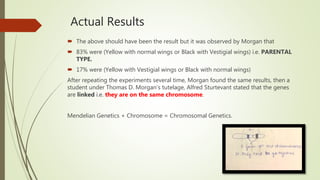
 The above should have been the result but it was observed by Morgan that
 83% were (Yellow with normal wings or Black with Vestigial wings) i.e. PARENTAL
TYPE.
 17% were (Yellow with Vestigial wings or Black with normal wings)
After repeating the experiments several time, Morgan found the same results, then a
student under Thomas D. Morgan’s tutelage, Alfred Sturtevant stated that the genes
are linked i.e. they are on the same chromosome.
Mendelian Genetics + Chromosome = Chromosomal Genetics.
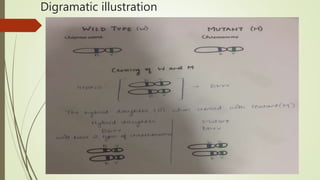
Digramatic illustration
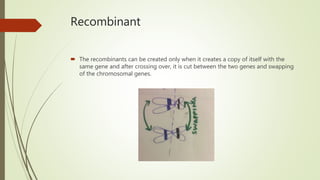
Recombinant
 The recombinants can be created only when it creates a copy of itself with the
same gene and after crossing over, it is cut between the two genes and swapping
of the chromosomal genes.
Inference
 If the two genes are really far, then crossing over is random and cutting can be any
place.
 But if the two genes are closer, it is less likely to cut between the two genes in
order to create recombinant chromosome.
 To have recombinant chromosome the crossing over should be such that it cuts
the chromosome into half.
 Frequency of recombination depends on the relative position of genes.
 If it is less than 50% then the genes are linked otherwise they are on different
chromosomes.
Genetic Linkage
 Genetic linkage is the tendency of DNA sequences that are close together on
a chromosome to be inherited together during the meiosis phase of sexual
reproduction. Two genetic markers that are physically near to each other are
unlikely to be separated onto different chromatids during chromosomal crossover,
and are therefore said to be more linked than markers that are far apart.
 Genetic linkage is the most prominent exception to Gregor Mendel's Law of
Independent Assortment. The first experiment to demonstrate linkage was carried
out in 1905.
Sex-Linked inheritance
 In mammals there are male and females alleles and several characteristics
differentiate a man from woman for which a whole set of genes work together.
 XY- Sex determining chromosome (MALE)
 XX- Sex determining chromosome (FEMALE)
They do not just have sext determining traits. They also:
• X- Codes for 1500 genes
• Y- codes for 78 genes (SRY gene that plays a role in development of testes)
X- linked inheritance
 X-linked inheritance means that the gene causing the trait or the disorder is
located on the X chromosome.
 Females have two X chromosomes, while males have one X and one Y
chromosome.
 Carrier females who have only one copy of the mutation do not usually express
the phenotype, although differences in X chromosome inactivation can lead to
varying degrees of clinical expression in carrier females since some cells will
express one X allele and some will express the other.
Examples of X-Linked Recessive disorder
The most common X-linked recessive disorders are:
 Red-green color blindness, a very common trait in humans and frequently used to explain X-
linked disorders. Between seven and ten percent of men and 0.49% to 1% of women are affected.
Its commonness may be explained by its relatively benign nature. It is also known as daltonism.
 Hemophilia A, a blood clotting disorder caused by a mutation of the Factor VIII gene and leading
to a deficiency of Factor VIII. It was once thought to be the "royal disease" found in the
descendants of Queen Victoria. This is now known to have been Hemophilia B
 Hemophilia B, also known as Christmas Disease, a blood clotting disorder caused by
a mutation of the Factor IX gene and leading to a deficiency of Factor IX. It is rarer than hemophilia
A. As noted above, it was common among the descendants of Queen Victoria.
 Duchenne muscular dystrophy, which is associated with mutations in the dystrophin gene. It is
characterized by rapid progression of muscle degeneration, eventually leading to loss of skeletal
muscle control, respiratory failure, and death.
Continued..
 Becker's muscular dystrophy, a milder form of Duchenne, which causes slowly progressive muscle
weakness of the legs and pelvis.
 X-linked ichthyosis, a form of ichthyosis caused by a hereditary deficiency of the steroid
sulfatase (STS) enzyme. It is fairly rare, affecting one in 2,000 to one in 6,000 males.
 X-linked agammaglobulinemia (XLA), which affects the body's ability to fight infection. XLA
patients do not generate mature B cells. B cells are part of the immune system and normally
manufacture antibodies (also called immunoglobulins) which defends the body from infections
(the humoral response). Patients with untreated XLA are prone to develop serious and even fatal
infections.
 Glucose-6-phosphate dehydrogenase deficiency, which causes nonimmune hemolytic anaemia
in response to a number of causes, most commonly infection or exposure to certain medications,
chemicals, or foods. Commonly known as "favism", as it can be triggered by chemicals existing
naturally in broad (or fava) beans.
Explanation of X-linked chromosome with
examples
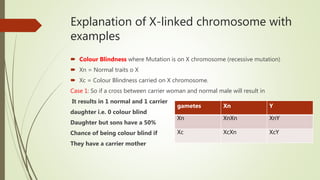
 Colour Blindness where Mutation is on X chromosome (recessive mutation)
 Xn = Normal traits o X
 Xc = Colour Blindness carried on X chromosome.
Case 1: So if a cross between carrier woman and normal male will result in
It results in 1 normal and 1 carrier
daughter i.e. 0 colour blind
Daughter but sons have a 50%
Chance of being colour blind if
They have a carrier mother
gametes Xn Y
Xn XnXn XnY
Xc XcXn XcY
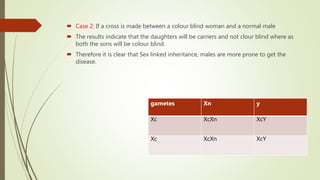
 Case 2: If a cross is made between a colour blind woman and a normal male
 The results indicate that the daughters will be carriers and not clour blind where as
both the sons will be colour blind.
 Therefore it is clear that Sex linked inheritance, males are more prone to get the
disease.
gametes Xn y
Xc XcXn XcY
Xc XcXn XcY
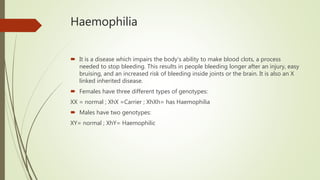
Haemophilia
 It is a disease which impairs the body's ability to make blood clots, a process
needed to stop bleeding. This results in people bleeding longer after an injury, easy
bruising, and an increased risk of bleeding inside joints or the brain. It is also an X
linked inherited disease.
 Females have three different types of genotypes:
XX = normal ; XhX =Carrier ; XhXh= has Haemophilia
 Males have two genotypes:
XY= normal ; XhY= Haemophilic
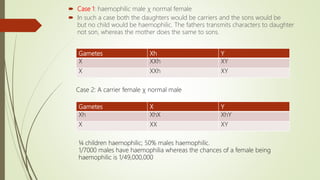
 Case 1: haemophilic male χ normal female
 In such a case both the daughters would be carriers and the sons would be
but no child would be haemophilic. The fathers transmits characters to daughter
not son, whereas the mother does the same to sons.
Gametes Xh Y
X XXh XY
X XXh XY
Case 2: A carrier female χ normal male
Gametes X Y
Xh XhX XhY
X XX XY
¼ children haemophilic; 50% males haemophilic.
1/7000 males have haemophilia whereas the chances of a female being
haemophilic is 1/49,000,000
References
 https://www.youtube.com/watch?v=Wfxf9xmYI_M
 https://www.youtube.com/watch?v=-ROhfKyxgCo
 https://www.youtube.com/watch?v=KaxSDryqB6M
 https://www.youtube.com/watch?v=3CtM4AaOxQ0
Thankyou

Linked inheritance

  • 1.
    LINKED INHERITANCE Name: JenyJose Subject: Cytogenetics Semester: 1 Course: Agricultural Biotechnology University: Szent Istvan University
  • 2.
    Inheritance  Inheritance meansthe pattern in which the gene will be transferred from parents to off-springs, i.e. from one generation to the next.  The gene to be transferred if present on the 22 autosomal pair in case of humans or generally in autosomes are called Autosomal Linked Inheritance.  If the gene to be transferred is present on any of the sex chromosomes of our body is called Sex Linked Inheritance.
  • 3.
    Autosomal Inheritance  Allthe genes produce proteins in our body e.g. Hepatocytes produces enzymes for digestion and metabolism, the genes responsible for which are present in the autosomes of our body.  The autosomal inheritance will look like  A- dominant allele, AA, aa homozygous pair of genes.  a- Recessive allele, Aa heterozygous pair of genes.  For instance When the dominant gene is responsible for eye colour blue recessive allele is responsible for an eye colour black and the inherited genes are ‘aa’, only then will the off-spring show black eye colour.  It is not dependant on gender, both female and male have equal chance of inheriting the genes and exhibiting the characteristic property of the gene.
  • 4.
    Mendelian Genetics  Accordingto Mendel’s concept i.e. Mendelian Genetics, • A fly having Wild Characteristics of Yellow colour and Normal wings will have the genes BBVV- BV (Gametes) Dominant • A mutant having the colour black and Vestigial wings will have the genes bbvv- bv (Gametes) Recessive • On Crossing the hybrid will be heterozygous with the genes BbVv, • The daughter was wild type and so was the male because of Dominant wild type characteristics.
  • 5.
    Crossing of Hybridand Mutant  On crossing the hybrid(BbVv) with homozygous mutant (bbvv). The gametes of hybrid would be:  BV, Bv, bV, bv  The gametes of mutant would be:  bv The progeny will have the genes:  BbVv (Yellow and normal wings)  Bbvv (Yellow and vestigial wings)  bbVv (Black and Normal wings)  Bbvv ( Black and Vestigial wings) the ratio hypothetically was supposed to be 1:1:1:1
  • 6.
    Gametes BV BvbV bv bv BbVv Bbvv bbVv bvbv Hybrid Mutant Hypothetical result
  • 7.
    Actual Results  Theabove should have been the result but it was observed by Morgan that  83% were (Yellow with normal wings or Black with Vestigial wings) i.e. PARENTAL TYPE.  17% were (Yellow with Vestigial wings or Black with normal wings) After repeating the experiments several time, Morgan found the same results, then a student under Thomas D. Morgan’s tutelage, Alfred Sturtevant stated that the genes are linked i.e. they are on the same chromosome. Mendelian Genetics + Chromosome = Chromosomal Genetics.
  • 8.
  • 9.
    Recombinant  The recombinantscan be created only when it creates a copy of itself with the same gene and after crossing over, it is cut between the two genes and swapping of the chromosomal genes.
  • 10.
    Inference  If thetwo genes are really far, then crossing over is random and cutting can be any place.  But if the two genes are closer, it is less likely to cut between the two genes in order to create recombinant chromosome.  To have recombinant chromosome the crossing over should be such that it cuts the chromosome into half.  Frequency of recombination depends on the relative position of genes.  If it is less than 50% then the genes are linked otherwise they are on different chromosomes.
  • 11.
    Genetic Linkage  Geneticlinkage is the tendency of DNA sequences that are close together on a chromosome to be inherited together during the meiosis phase of sexual reproduction. Two genetic markers that are physically near to each other are unlikely to be separated onto different chromatids during chromosomal crossover, and are therefore said to be more linked than markers that are far apart.  Genetic linkage is the most prominent exception to Gregor Mendel's Law of Independent Assortment. The first experiment to demonstrate linkage was carried out in 1905.
  • 12.
    Sex-Linked inheritance  Inmammals there are male and females alleles and several characteristics differentiate a man from woman for which a whole set of genes work together.  XY- Sex determining chromosome (MALE)  XX- Sex determining chromosome (FEMALE) They do not just have sext determining traits. They also: • X- Codes for 1500 genes • Y- codes for 78 genes (SRY gene that plays a role in development of testes)
  • 13.
    X- linked inheritance X-linked inheritance means that the gene causing the trait or the disorder is located on the X chromosome.  Females have two X chromosomes, while males have one X and one Y chromosome.  Carrier females who have only one copy of the mutation do not usually express the phenotype, although differences in X chromosome inactivation can lead to varying degrees of clinical expression in carrier females since some cells will express one X allele and some will express the other.
  • 14.
    Examples of X-LinkedRecessive disorder The most common X-linked recessive disorders are:  Red-green color blindness, a very common trait in humans and frequently used to explain X- linked disorders. Between seven and ten percent of men and 0.49% to 1% of women are affected. Its commonness may be explained by its relatively benign nature. It is also known as daltonism.  Hemophilia A, a blood clotting disorder caused by a mutation of the Factor VIII gene and leading to a deficiency of Factor VIII. It was once thought to be the "royal disease" found in the descendants of Queen Victoria. This is now known to have been Hemophilia B  Hemophilia B, also known as Christmas Disease, a blood clotting disorder caused by a mutation of the Factor IX gene and leading to a deficiency of Factor IX. It is rarer than hemophilia A. As noted above, it was common among the descendants of Queen Victoria.  Duchenne muscular dystrophy, which is associated with mutations in the dystrophin gene. It is characterized by rapid progression of muscle degeneration, eventually leading to loss of skeletal muscle control, respiratory failure, and death.
  • 15.
    Continued..  Becker's musculardystrophy, a milder form of Duchenne, which causes slowly progressive muscle weakness of the legs and pelvis.  X-linked ichthyosis, a form of ichthyosis caused by a hereditary deficiency of the steroid sulfatase (STS) enzyme. It is fairly rare, affecting one in 2,000 to one in 6,000 males.  X-linked agammaglobulinemia (XLA), which affects the body's ability to fight infection. XLA patients do not generate mature B cells. B cells are part of the immune system and normally manufacture antibodies (also called immunoglobulins) which defends the body from infections (the humoral response). Patients with untreated XLA are prone to develop serious and even fatal infections.  Glucose-6-phosphate dehydrogenase deficiency, which causes nonimmune hemolytic anaemia in response to a number of causes, most commonly infection or exposure to certain medications, chemicals, or foods. Commonly known as "favism", as it can be triggered by chemicals existing naturally in broad (or fava) beans.
  • 16.
    Explanation of X-linkedchromosome with examples  Colour Blindness where Mutation is on X chromosome (recessive mutation)  Xn = Normal traits o X  Xc = Colour Blindness carried on X chromosome. Case 1: So if a cross between carrier woman and normal male will result in It results in 1 normal and 1 carrier daughter i.e. 0 colour blind Daughter but sons have a 50% Chance of being colour blind if They have a carrier mother gametes Xn Y Xn XnXn XnY Xc XcXn XcY
  • 17.
     Case 2:If a cross is made between a colour blind woman and a normal male  The results indicate that the daughters will be carriers and not clour blind where as both the sons will be colour blind.  Therefore it is clear that Sex linked inheritance, males are more prone to get the disease. gametes Xn y Xc XcXn XcY Xc XcXn XcY
  • 18.
    Haemophilia  It isa disease which impairs the body's ability to make blood clots, a process needed to stop bleeding. This results in people bleeding longer after an injury, easy bruising, and an increased risk of bleeding inside joints or the brain. It is also an X linked inherited disease.  Females have three different types of genotypes: XX = normal ; XhX =Carrier ; XhXh= has Haemophilia  Males have two genotypes: XY= normal ; XhY= Haemophilic
  • 19.
     Case 1:haemophilic male χ normal female  In such a case both the daughters would be carriers and the sons would be but no child would be haemophilic. The fathers transmits characters to daughter not son, whereas the mother does the same to sons. Gametes Xh Y X XXh XY X XXh XY Case 2: A carrier female χ normal male Gametes X Y Xh XhX XhY X XX XY ¼ children haemophilic; 50% males haemophilic. 1/7000 males have haemophilia whereas the chances of a female being haemophilic is 1/49,000,000
  • 20.
    References  https://www.youtube.com/watch?v=Wfxf9xmYI_M  https://www.youtube.com/watch?v=-ROhfKyxgCo https://www.youtube.com/watch?v=KaxSDryqB6M  https://www.youtube.com/watch?v=KaxSDryqB6M  https://www.youtube.com/watch?v=3CtM4AaOxQ0
  • 21.