1
Assignment
Course Title: Apparel Manufacturing-IV
Course Code: TE-427
Topic: Sewing defects (With causes and Remedies)
Submitted To:
Abdullah Al Mamun
Associate Professor
Department of TE
Daffodil International University
Submitted By:
Name: Md. Toukir Ahmed Srabon
ID: 152-23-4325
Department of TE
Daffodil International University
Date of Submission: 16-04-2020
2
Introduction:
Sewing is the process of attaching two fabric parts by using stitches which is made with a needle
and thread. Sewing is one of the basic steps of garments manufacturing process. Also sewing
section is the most significant section of a ready-made garments industry. Different types of
faults or defects arise in sewing section which should be reduced to maintain the required quality
of apparel. As its importance, in this article we will discuss on various causes of sewing defects
and their remedies.
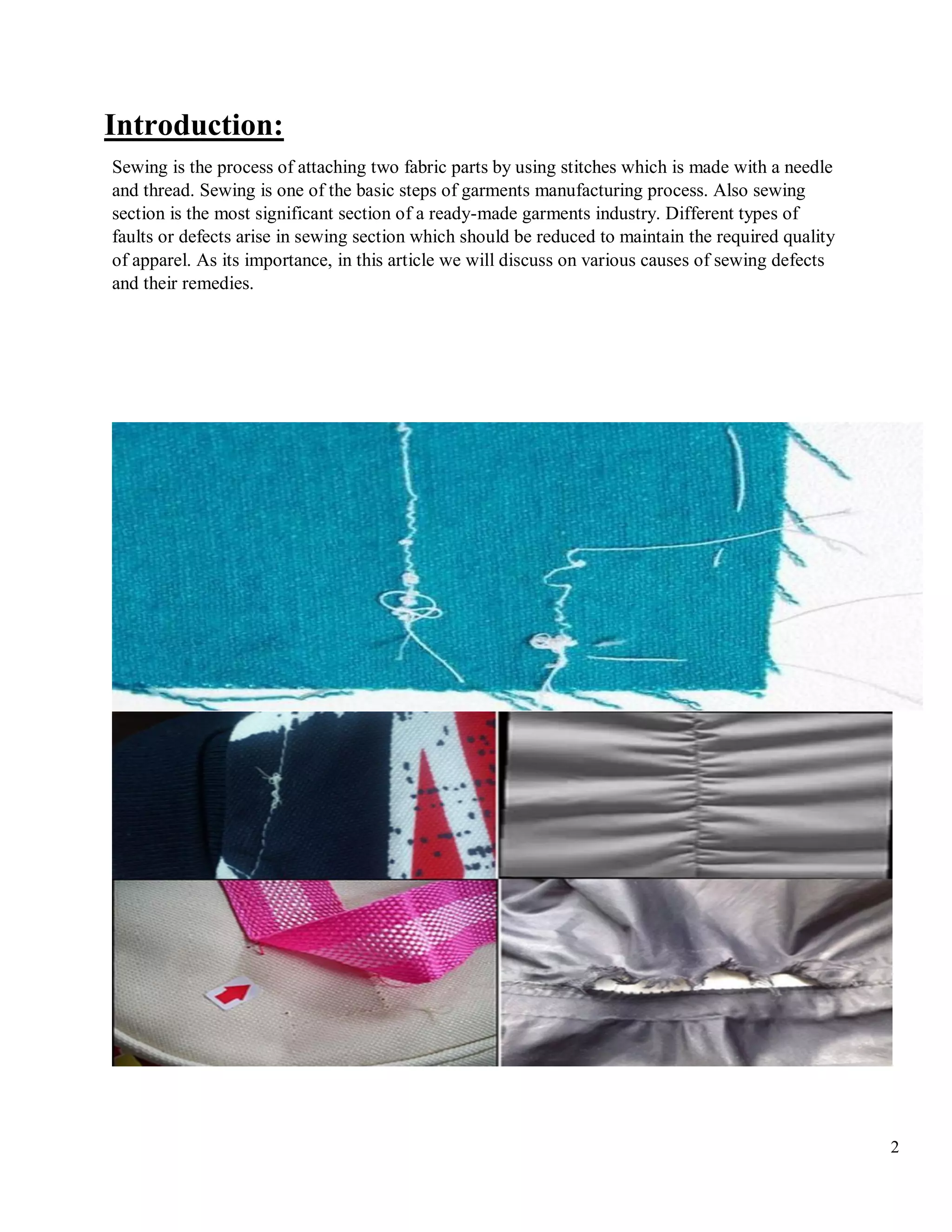
Different types of sewing faults in garments
3
Common Sewing Problem with Causes and Remedies:
Various types of sewing problem which are arise during sewing the garments are-
1. Skipped stitches
2. Unbalance stitch
3. Seam slippage
4. Needle thread breakage
5. Frequent thread breakage/Brocken stitch
6. Seam grin
7. Variable stitch density
8. Seam puckering
9. Bobbin or looped thread breakage
10. Thread fusing when sewing machine stops
11. Uneven Stich
12. Irregular stitch
13. Pitch error
14. Needle Mark
15. Wavy/Staggered stitch
All the above sewing faults have explained in the below with their
causes and remedies:
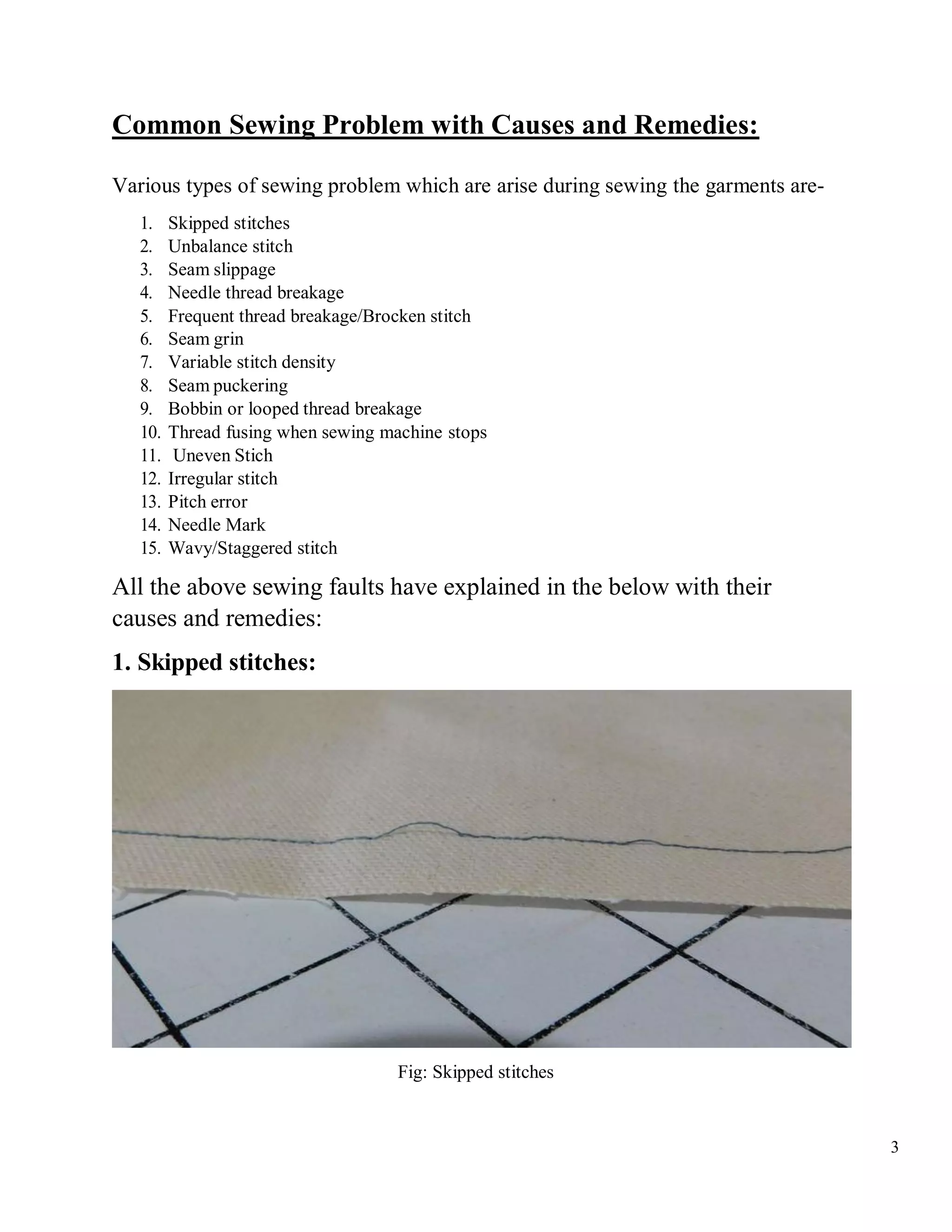
1. Skipped stitches:
Fig: Skipped stitches
4
SL No. Causes Remedies
1 Failure of hook or looper and needle to
enter loop at correct time.
Examine the setting and timing between
needle and hook or looper.
2 Irregular thread tension on upper or
lower loop.
The tension of thread should be adjusted.
3 Due to needle deflection. Needle should be changed.
4 If needle thread loop size is too small. Needle size and thread should be adjusted.
5 When flagging of fabrics is happened
during sewing.
The pressure of pressure foot should be
adjusted perfectly.
6 If sewing thread is unable to form loop. Thread should be changed.
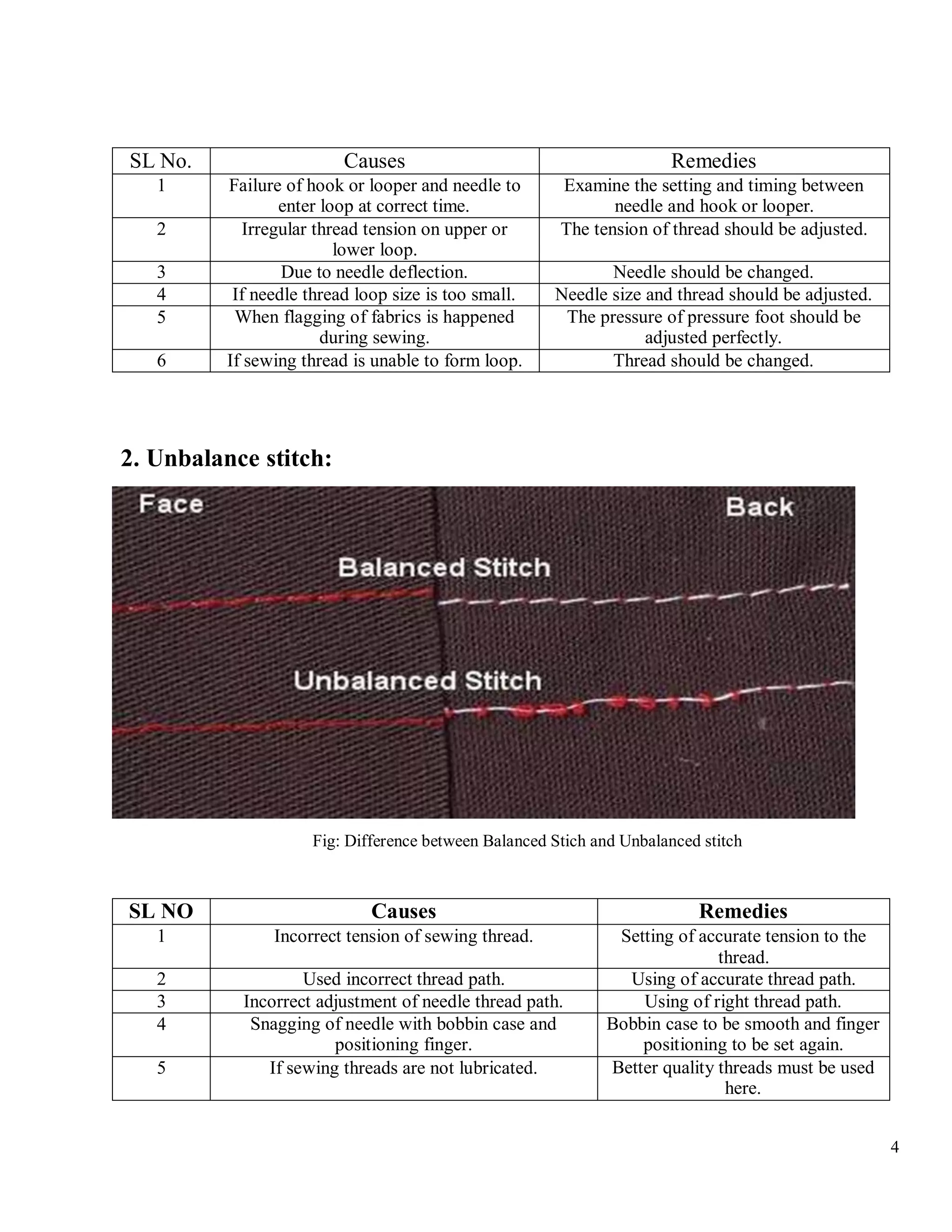
2. Unbalance stitch:
Fig: Difference between Balanced Stich and Unbalanced stitch
SL NO Causes Remedies
1 Incorrect tension of sewing thread. Setting of accurate tension to the
thread.
2 Used incorrect thread path. Using of accurate thread path.
3 Incorrect adjustment of needle thread path. Using of right thread path.
4 Snagging of needle with bobbin case and
positioning finger.
Bobbin case to be smooth and finger
positioning to be set again.
5 If sewing threads are not lubricated. Better quality threads must be used
here.
5
3. Seam slippage:
Causes:
Fig: Seam slippage
 This happens when the yarns in the fabric are pulled out of the seam and are more
frequent in fabrics made from continuous filament yarns
Remedial Measures:
 French seam type can be tried
 Seam width can be increased
 Stitch density should be optimized
4. Needle thread breakage:
6
Causes:
 Thread gets trapped at the thread guide
 Snarling of thread before tension disc
 Excessive needle thread tension
 Irregularities or damages in needle guard, throat plate, bobbin case and needle eye
 Excessive needle heat, groove or eye blocked with melted fabric
 Overheating of hook
 Quality of needle thread is inferior
Remedial Measures:
 Use a foam pad or a similar device to prevent the package from tilting
 Ensure that the rethreading is done correctly
 The needle thread tension can be reduced and the condition of the disc tensioner should
be checked
 Replace the needle with one of better quality
 Change to a correctly finished thread of a better quality
5. Frequent thread breakage/Brocken stitch:
Causes:
 Improper unwinding of thread from package.
 Higher thread tension.
 Excess needle heating.
 Lower quality of thread.
7
Remedies:
 Reduce tension in tension in tension disc.
 Reduce thread tension.
 Use of strong yarn.
 Change the needle if required.
 Use coarser needle.
 Use of high quality needle.
 Use lubricant.
 Use needle cooler.
 Confirm oil supply.
 Change of thread.
6. Seam grin:
Fig: Seam grin
Causes:
 When two fabric panels are opened at opposite sides of one another to the seam, a gap is
revealed between the two fabric panels
Remedial Measures:
 Increase stitching tensions
 Stitches per inch (SPI) can be increased
8
7. Variable stitch density:
Fig: Variable stitch density
SL No. Causes Remedies
01 Incorrect unwinding of thread form
package during sewing.
The position of thread guide should be 2.5
times higher than the position of thread.
02 Twisting of needle thread in the bottom of
thread package.
Foam pad should use to the bottom of
thread package.
03 Twisting of thread in thread guide. Correct threading of sewing thread during
sewing.
04 Excessive tension of thread. Tension of thread should be less or use of
higher strength threads.
05 Using of broken check spring. Check spring should be changed.
9
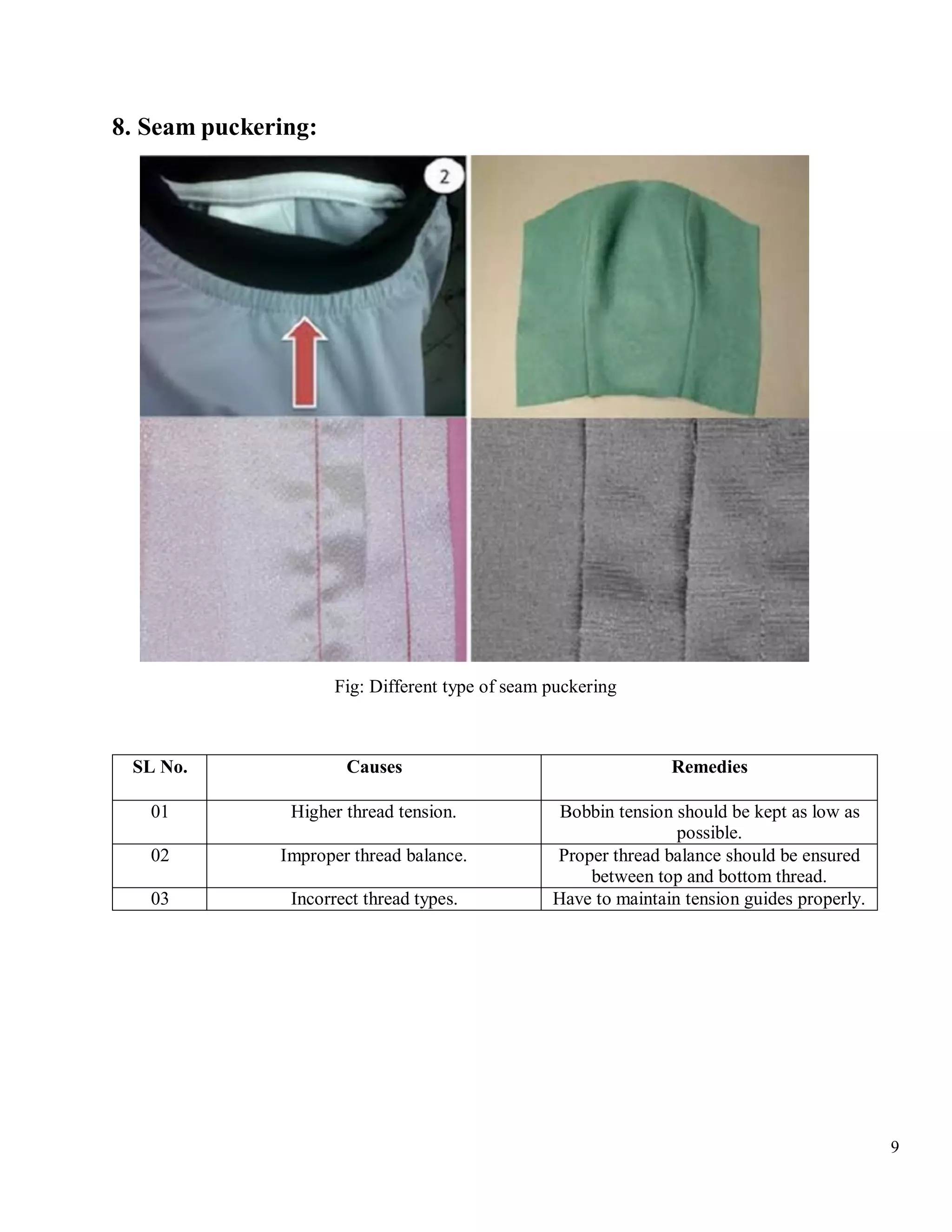
8. Seam puckering:
Fig: Different type of seam puckering
SL No. Causes Remedies
01 Higher thread tension. Bobbin tension should be kept as low as
possible.
02 Improper thread balance. Proper thread balance should be ensured
between top and bottom thread.
03 Incorrect thread types. Have to maintain tension guides properly.
10
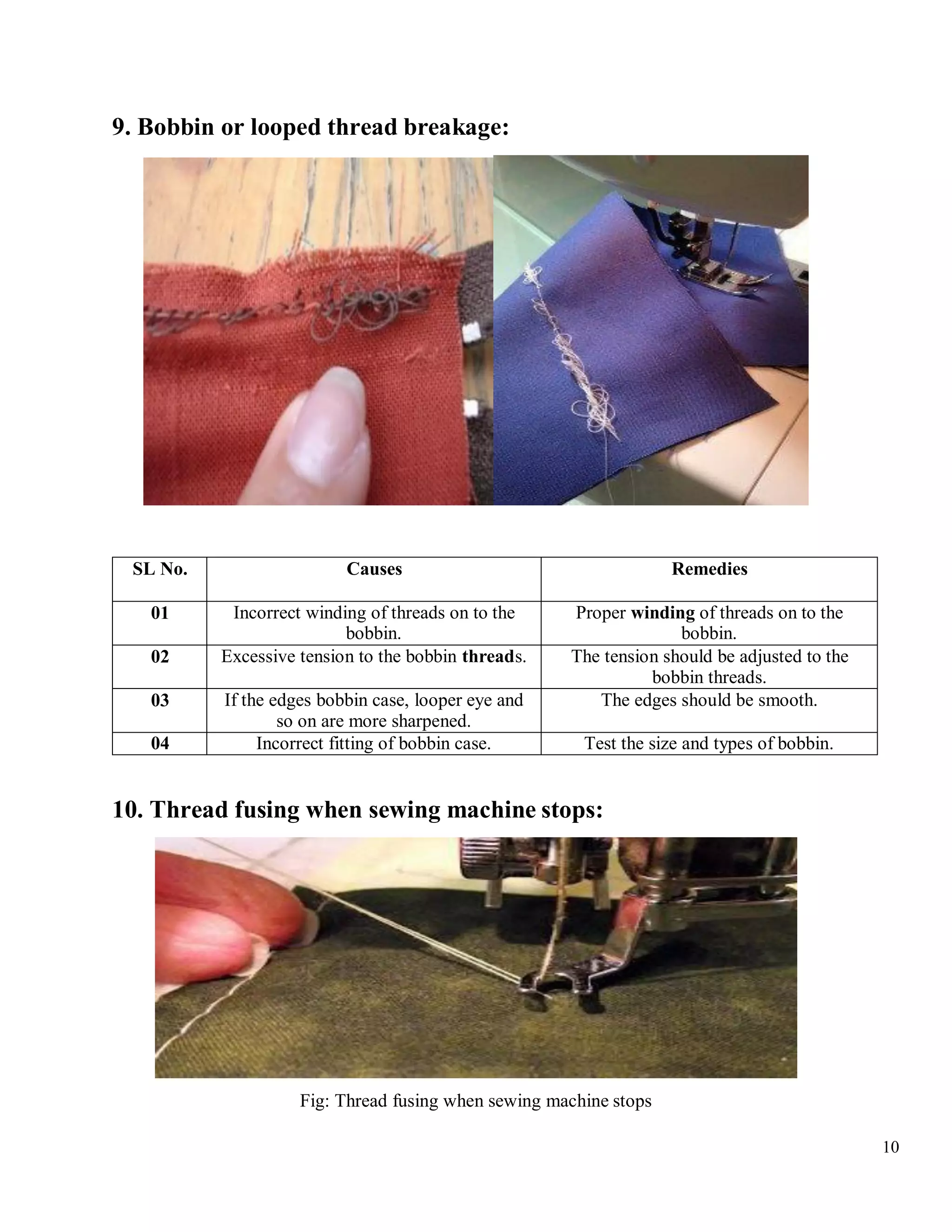
9. Bobbin or looped thread breakage:
SL No. Causes Remedies
01 Incorrect winding of threads on to the
bobbin.
Proper winding of threads on to the
bobbin.
02 Excessive tension to the bobbin threads. The tension should be adjusted to the
bobbin threads.
03 If the edges bobbin case, looper eye and
so on are more sharpened.
The edges should be smooth.
04 Incorrect fitting of bobbin case. Test the size and types of bobbin.
10. Thread fusing when sewing machine stops:
Fig: Thread fusing when sewing machine stops
11
SL No. Causes Remedies
01 Faulty sewing thread. Should be used better quality thread.
02 Densely woven fabric which is poorly
finished.
Should be improved fabric finishing.
03 Damaged needle after sewing thread
breakage.
Should be changed the needle.
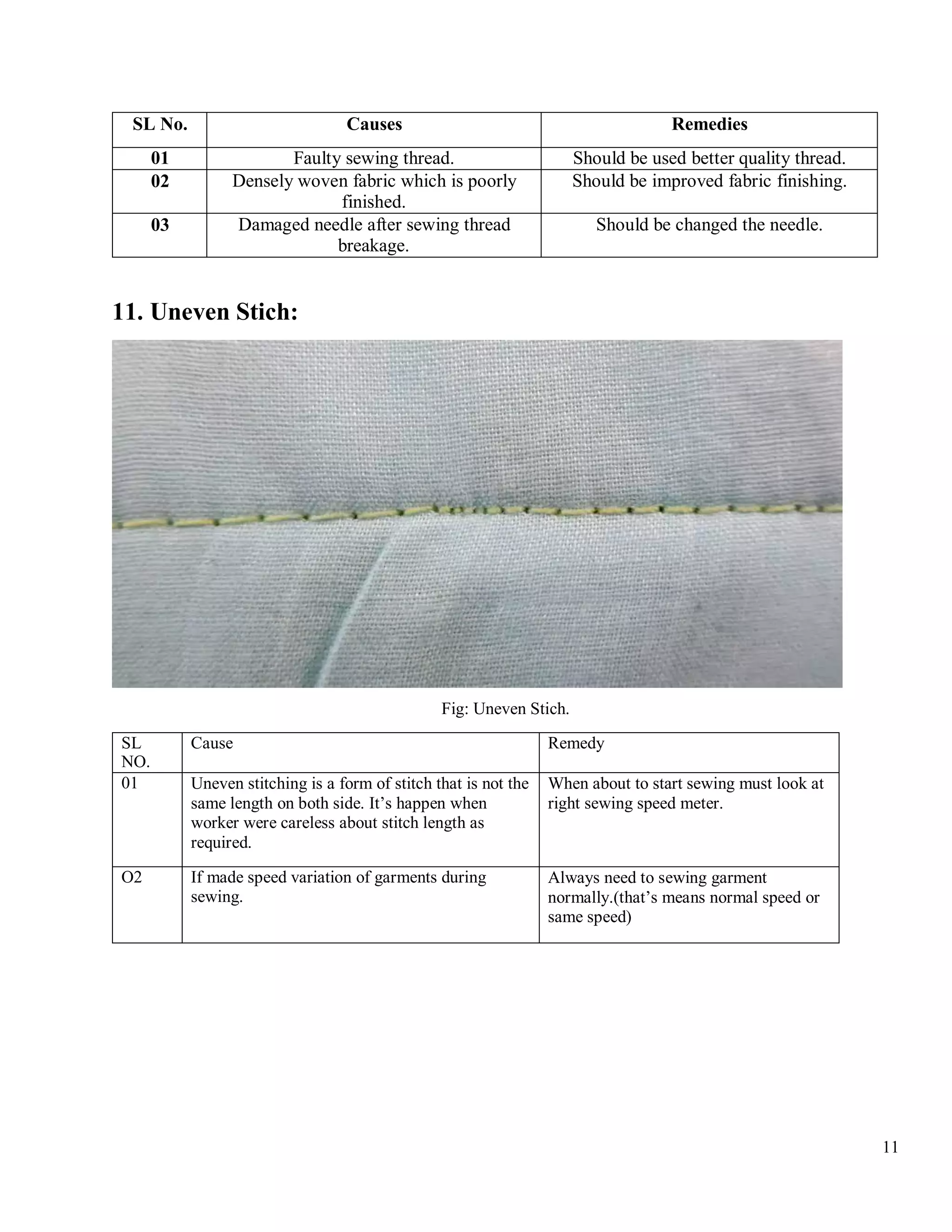
11. Uneven Stich:
Fig: Uneven Stich.
SL
NO.
Cause Remedy
01 Uneven stitching is a form of stitch that is not the
same length on both side. It’s happen when
worker were careless about stitch length as
required.
When about to start sewing must look at
right sewing speed meter.
O2 If made speed variation of garments during
sewing.
Always need to sewing garment
normally.(that’s means normal speed or
same speed)
12
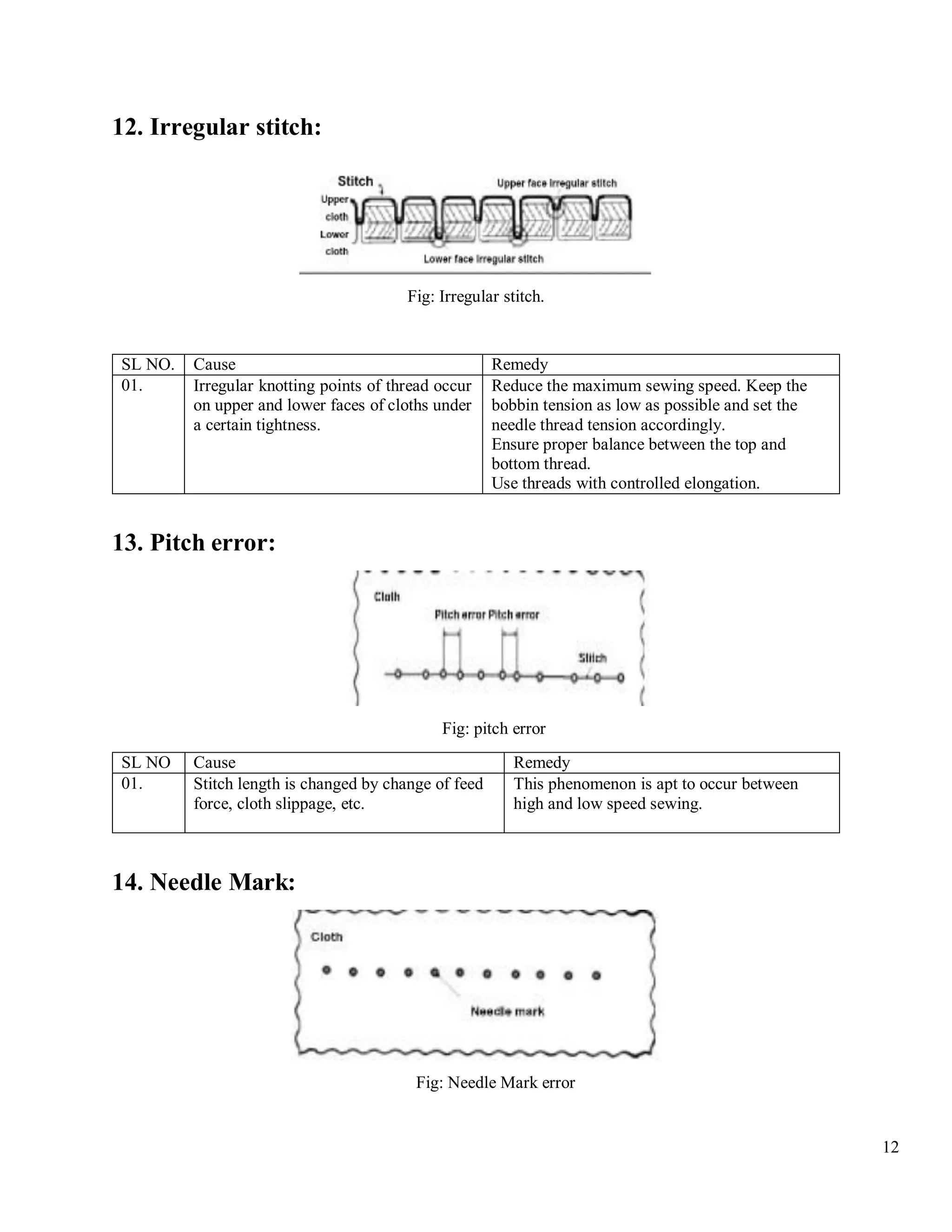
12. Irregular stitch:
Fig: Irregular stitch.
SL NO. Cause Remedy
01. Irregular knotting points of thread occur
on upper and lower faces of cloths under
a certain tightness.
Reduce the maximum sewing speed. Keep the
bobbin tension as low as possible and set the
needle thread tension accordingly.
Ensure proper balance between the top and
bottom thread.
Use threads with controlled elongation.
13. Pitch error:
Fig: pitch error
SL NO Cause Remedy
01. Stitch length is changed by change of feed
force, cloth slippage, etc.
This phenomenon is apt to occur between
high and low speed sewing.
14. Needle Mark:
Fig: Needle Mark error
13
SL NO. Cause Remedy
01. Trace of hole of sewing machine needle due to re-
sewing.
Right needle need to choose.
That’s means choose right size
of needle for every fabric.
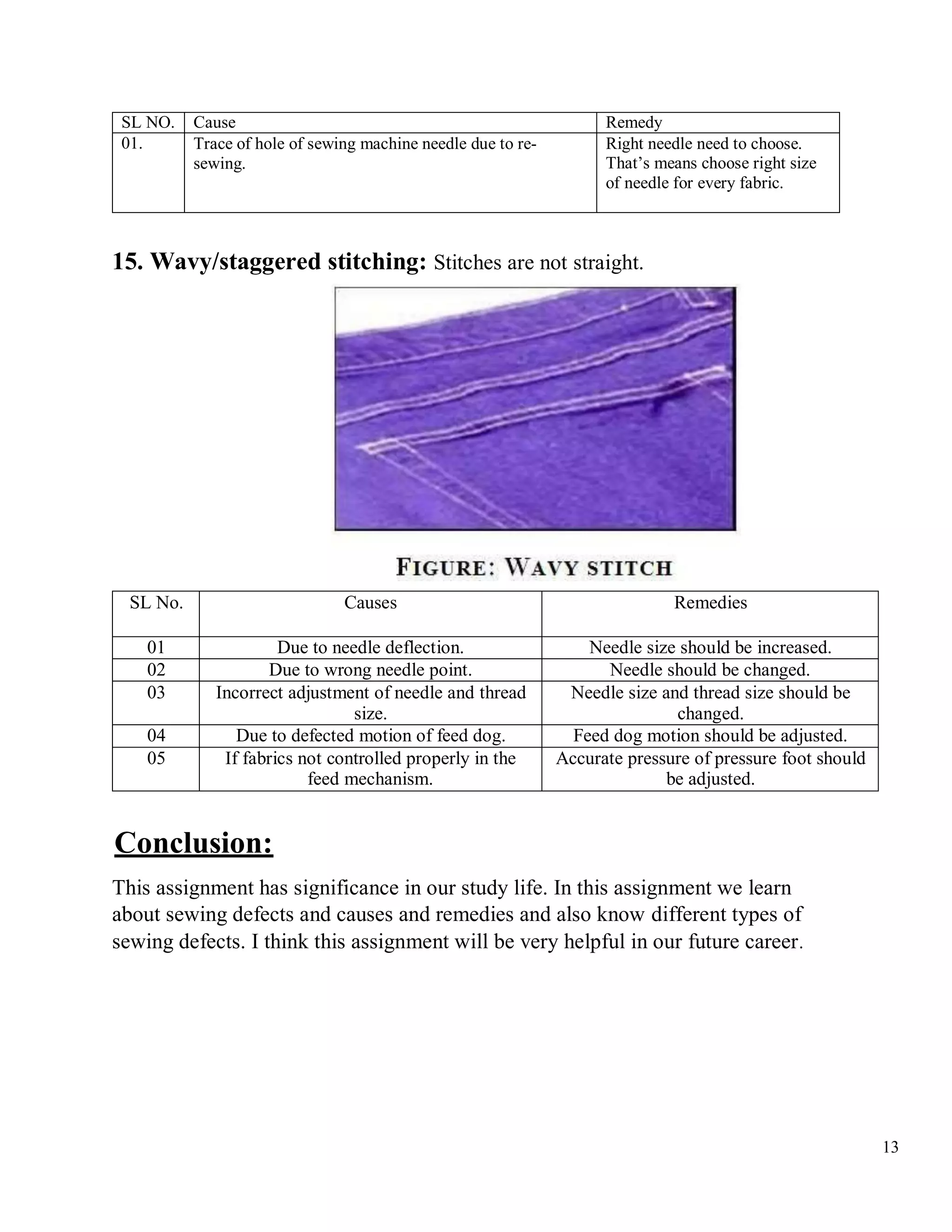
15. Wavy/staggered stitching: Stitches are not straight.
SL No. Causes Remedies
01 Due to needle deflection. Needle size should be increased.
02 Due to wrong needle point. Needle should be changed.
03 Incorrect adjustment of needle and thread
size.
Needle size and thread size should be
changed.
04 Due to defected motion of feed dog. Feed dog motion should be adjusted.
05 If fabrics not controlled properly in the
feed mechanism.
Accurate pressure of pressure foot should
be adjusted.
Conclusion:
This assignment has significance in our study life. In this assignment we learn
about sewing defects and causes and remedies and also know different types of
sewing defects. I think this assignment will be very helpful in our future career.

Sewing Defects.

  • 1.
    1 Assignment Course Title: ApparelManufacturing-IV Course Code: TE-427 Topic: Sewing defects (With causes and Remedies) Submitted To: Abdullah Al Mamun Associate Professor Department of TE Daffodil International University Submitted By: Name: Md. Toukir Ahmed Srabon ID: 152-23-4325 Department of TE Daffodil International University Date of Submission: 16-04-2020
  • 2.
    2 Introduction: Sewing is theprocess of attaching two fabric parts by using stitches which is made with a needle and thread. Sewing is one of the basic steps of garments manufacturing process. Also sewing section is the most significant section of a ready-made garments industry. Different types of faults or defects arise in sewing section which should be reduced to maintain the required quality of apparel. As its importance, in this article we will discuss on various causes of sewing defects and their remedies. Different types of sewing faults in garments
  • 3.
    3 Common Sewing Problemwith Causes and Remedies: Various types of sewing problem which are arise during sewing the garments are- 1. Skipped stitches 2. Unbalance stitch 3. Seam slippage 4. Needle thread breakage 5. Frequent thread breakage/Brocken stitch 6. Seam grin 7. Variable stitch density 8. Seam puckering 9. Bobbin or looped thread breakage 10. Thread fusing when sewing machine stops 11. Uneven Stich 12. Irregular stitch 13. Pitch error 14. Needle Mark 15. Wavy/Staggered stitch All the above sewing faults have explained in the below with their causes and remedies: 1. Skipped stitches: Fig: Skipped stitches
  • 4.
    4 SL No. CausesRemedies 1 Failure of hook or looper and needle to enter loop at correct time. Examine the setting and timing between needle and hook or looper. 2 Irregular thread tension on upper or lower loop. The tension of thread should be adjusted. 3 Due to needle deflection. Needle should be changed. 4 If needle thread loop size is too small. Needle size and thread should be adjusted. 5 When flagging of fabrics is happened during sewing. The pressure of pressure foot should be adjusted perfectly. 6 If sewing thread is unable to form loop. Thread should be changed. 2. Unbalance stitch: Fig: Difference between Balanced Stich and Unbalanced stitch SL NO Causes Remedies 1 Incorrect tension of sewing thread. Setting of accurate tension to the thread. 2 Used incorrect thread path. Using of accurate thread path. 3 Incorrect adjustment of needle thread path. Using of right thread path. 4 Snagging of needle with bobbin case and positioning finger. Bobbin case to be smooth and finger positioning to be set again. 5 If sewing threads are not lubricated. Better quality threads must be used here.
  • 5.
    5 3. Seam slippage: Causes: Fig:Seam slippage  This happens when the yarns in the fabric are pulled out of the seam and are more frequent in fabrics made from continuous filament yarns Remedial Measures:  French seam type can be tried  Seam width can be increased  Stitch density should be optimized 4. Needle thread breakage:
  • 6.
    6 Causes:  Thread getstrapped at the thread guide  Snarling of thread before tension disc  Excessive needle thread tension  Irregularities or damages in needle guard, throat plate, bobbin case and needle eye  Excessive needle heat, groove or eye blocked with melted fabric  Overheating of hook  Quality of needle thread is inferior Remedial Measures:  Use a foam pad or a similar device to prevent the package from tilting  Ensure that the rethreading is done correctly  The needle thread tension can be reduced and the condition of the disc tensioner should be checked  Replace the needle with one of better quality  Change to a correctly finished thread of a better quality 5. Frequent thread breakage/Brocken stitch: Causes:  Improper unwinding of thread from package.  Higher thread tension.  Excess needle heating.  Lower quality of thread.
  • 7.
    7 Remedies:  Reduce tensionin tension in tension disc.  Reduce thread tension.  Use of strong yarn.  Change the needle if required.  Use coarser needle.  Use of high quality needle.  Use lubricant.  Use needle cooler.  Confirm oil supply.  Change of thread. 6. Seam grin: Fig: Seam grin Causes:  When two fabric panels are opened at opposite sides of one another to the seam, a gap is revealed between the two fabric panels Remedial Measures:  Increase stitching tensions  Stitches per inch (SPI) can be increased
  • 8.
    8 7. Variable stitchdensity: Fig: Variable stitch density SL No. Causes Remedies 01 Incorrect unwinding of thread form package during sewing. The position of thread guide should be 2.5 times higher than the position of thread. 02 Twisting of needle thread in the bottom of thread package. Foam pad should use to the bottom of thread package. 03 Twisting of thread in thread guide. Correct threading of sewing thread during sewing. 04 Excessive tension of thread. Tension of thread should be less or use of higher strength threads. 05 Using of broken check spring. Check spring should be changed.
  • 9.
    9 8. Seam puckering: Fig:Different type of seam puckering SL No. Causes Remedies 01 Higher thread tension. Bobbin tension should be kept as low as possible. 02 Improper thread balance. Proper thread balance should be ensured between top and bottom thread. 03 Incorrect thread types. Have to maintain tension guides properly.
  • 10.
    10 9. Bobbin orlooped thread breakage: SL No. Causes Remedies 01 Incorrect winding of threads on to the bobbin. Proper winding of threads on to the bobbin. 02 Excessive tension to the bobbin threads. The tension should be adjusted to the bobbin threads. 03 If the edges bobbin case, looper eye and so on are more sharpened. The edges should be smooth. 04 Incorrect fitting of bobbin case. Test the size and types of bobbin. 10. Thread fusing when sewing machine stops: Fig: Thread fusing when sewing machine stops
  • 11.
    11 SL No. CausesRemedies 01 Faulty sewing thread. Should be used better quality thread. 02 Densely woven fabric which is poorly finished. Should be improved fabric finishing. 03 Damaged needle after sewing thread breakage. Should be changed the needle. 11. Uneven Stich: Fig: Uneven Stich. SL NO. Cause Remedy 01 Uneven stitching is a form of stitch that is not the same length on both side. It’s happen when worker were careless about stitch length as required. When about to start sewing must look at right sewing speed meter. O2 If made speed variation of garments during sewing. Always need to sewing garment normally.(that’s means normal speed or same speed)
  • 12.
    12 12. Irregular stitch: Fig:Irregular stitch. SL NO. Cause Remedy 01. Irregular knotting points of thread occur on upper and lower faces of cloths under a certain tightness. Reduce the maximum sewing speed. Keep the bobbin tension as low as possible and set the needle thread tension accordingly. Ensure proper balance between the top and bottom thread. Use threads with controlled elongation. 13. Pitch error: Fig: pitch error SL NO Cause Remedy 01. Stitch length is changed by change of feed force, cloth slippage, etc. This phenomenon is apt to occur between high and low speed sewing. 14. Needle Mark: Fig: Needle Mark error
  • 13.
    13 SL NO. CauseRemedy 01. Trace of hole of sewing machine needle due to re- sewing. Right needle need to choose. That’s means choose right size of needle for every fabric. 15. Wavy/staggered stitching: Stitches are not straight. SL No. Causes Remedies 01 Due to needle deflection. Needle size should be increased. 02 Due to wrong needle point. Needle should be changed. 03 Incorrect adjustment of needle and thread size. Needle size and thread size should be changed. 04 Due to defected motion of feed dog. Feed dog motion should be adjusted. 05 If fabrics not controlled properly in the feed mechanism. Accurate pressure of pressure foot should be adjusted. Conclusion: This assignment has significance in our study life. In this assignment we learn about sewing defects and causes and remedies and also know different types of sewing defects. I think this assignment will be very helpful in our future career.