1
Assignment
Course Code : TE-133
Course Title : Polymer Science
Topic :- Polymer Reaction Technique
Submitted To : Taslima Akter
AssistantProfessor, Dept of GED,DIU
Submitted By : Md. Toukir Ahmed Srabon
ID-152-23-4325
Section-C1
Dept of TE,DIU
Submission Date:12-04-2020
2
Index
Name Of The Topic Page No
Polymer & Polymerization 04
Monomers 05
Repeat Unit 06
Example Of Polymer , Monomer &
Repeat Unit
07
How Big Are Polymers 08
ClassificationOf Polymers Depending
On Their Structure
09-10
Types Of Polymer & Polymerizations 11
Addition Polymers 12
Addition Polymerizations 13
Mechanism Of Addition
Polymerization
14
Mechanism Of Polyethylene 15
Conclusion 16
Reference 17
3
Signifiance Of The Study
1. To know about polymer & polymerization.
2. To know about Monomers.
3. To know about repeat unit.
4. Knowledge about example of polymer ,monomer
& repeat unit.
5 .To know about how bigger are the polymer size.
6. To know about the classificationof polymer
depending of their structure.
7. To know about types of polymer &
polymerization.
8. To briefly discuss aboutadditionof polymer.
9. To gain about mechanism of addition
polymerization.
10. To gain about mechanism of polyethylene.
4
Description Of The Study
Polymers & Polymerizations:
Polymers are macromoleculesbuilt up by the
linking together of large numbers of much smaller
molecules. The process of linkingthe repeatingunits
is termed as Polymerization.
5
Monomers
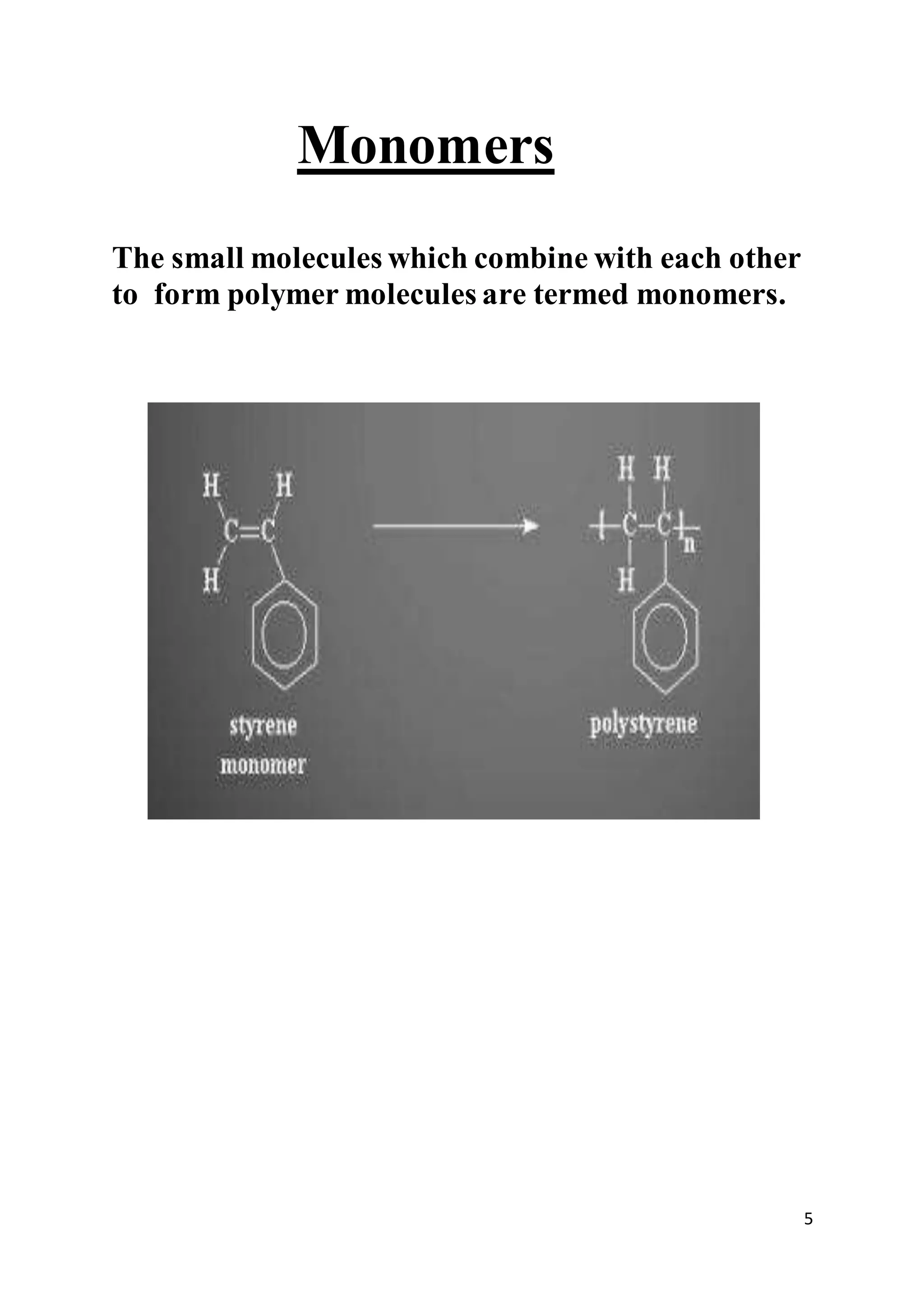
The small molecules which combine with each other
to form polymer molecules are termed monomers.
6
Repeat Unit
A repeatunit or repeatingunit is a part of a polymer whose
repetition would producethe complete polymerchain (exceptfor
the end-groupsby linking the repeatunits together successively
along the chain,like the beads of a necklace.
A repeatunitis sometimes called a mer or unit."Mer" originates
from the Greek word "meros," which meansa part. The word
polymer derivesits meaning from this, which means "many mers."
A repeatunit(or mer), is not to be confusedwith the
term monomer,which refersto the small molecule from which a
polymer is synthesized.
One of the simplestrepeatunits is that of the addition polymer
polyvinylchloride, -[CH2-CHCl]n-, whose repeatunit is -[CH2-CHCl]-.
In this case the repeatunit has the same atoms as the
monomervinylchloride CH2=CHCl.When the polymer is formed,
the C=C double bond in the monomer is replaced by a C-C single
bond in the polymer repeatunit, which links by two new bonds to
adjoining repeatunits.
In condensationpolymers (seeexamplesbelow),the repeatunit
contains fewer atoms than the monomeror monomers from which
it is formed.
The subscript"n" denotes the degreeof polymerisation,that is, the
number ofunits linked together.The molecularmass of the repeat
unit, MR, is simply the sum of the atomic massesof
the atoms within the repeatunit. The molecularmass of the chain is
just the productnMR.Other than monodisperse polymers,there is
normally a molar mass distribution caused by chains of different
length.
In copolymers there are two or more types of repeatunit, which
may be arranged in alternation,or at random,or in other more
complex patterns.
7
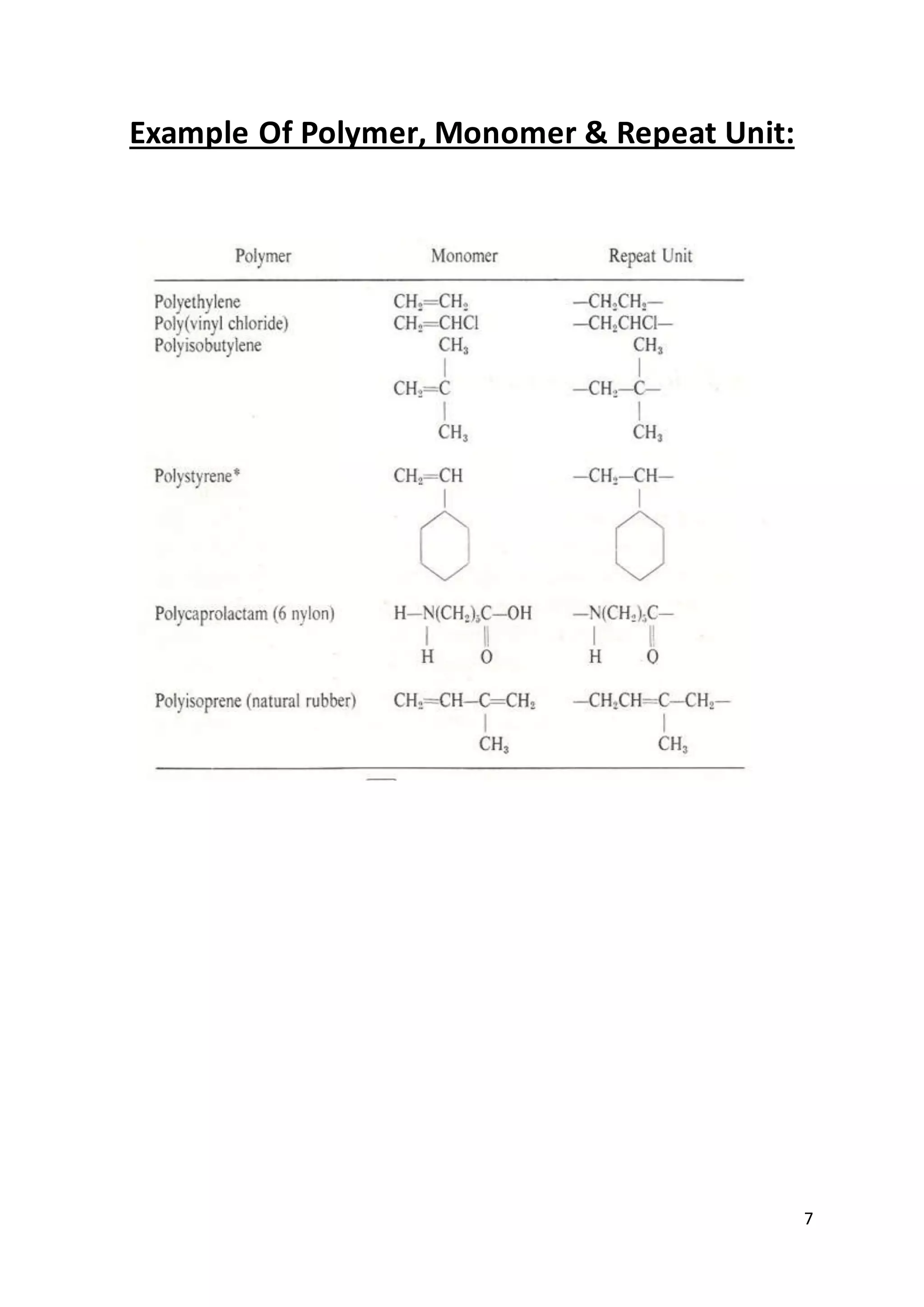
Example Of Polymer, Monomer & Repeat Unit:
8
How big are polymers?
Let CH2-
CH2 ≈ 1 inch
This ends up with a chain of approximately 1/4 inch (6.4 mm) in diameter and 1/2 mile (805
m) long.
9
Classification of polymers
depending on their
structure:
Linear polymers:
Branched polymers:
10
Linear polymers & Branched polymer:
Cross-linkPolymer:
11
Types of polymers &
polymerizations:
Classification of Polymers:
1.Polymer Structure:
 Condensation Polymer
 Addition Polymer
2.Polymerization Mechanism
 Step Polymerization
 Chain Polymerization
Type of Polymerization:
Monomers undergo polymerizaton by two types. They
are:
 Addition or chain polymerization
 Condensation or step polymerization
12
Addition Polymers
What are addition polymers?
Addition polymers are those formed from monomers without
the loss of a small molecule.
The addition-condensation system:
Condensationpolymers:
Polymers whose repeating units are joined together by
functional units such as ester (-OCO-), amide (- NHCO-),
urethane (-OCONH-), sulfide (-SO2-) and other linkages.
-R-Z-R-Z-R-Z-R-Z-R-Z-
R is aliphatic or aromatic grouping and Z is functional unit.
The major addition polymers are those formed by polymerization of
monomers containing carbon-carbon double bond; such monomers
are called vinyl monomers or substituted ethylenes.
13
Addition polymerization
Self addition of several bifunctional monomers to each
ohter takes place by chain reaction without the elimination of
any simple molecules.
GENERAL REACTION:
n [CH2=CH] - [-CH2-CH-]n
_
Addition polymerization is initiated by small qty of
substance called Initiators.
–
E.g.-Zeigler-Natta catalyst, potassium persulphate ,
dibenzoyl sulphat e.
Condensationpolymerization
Self addition of several bifunctional monomer to each other
takes place accompanying elimination of simple molecules
like H2O,NH3 & HCL
E.g..
 Terylene is obtained by condensing terpthalic acid
[HOOC-C6H4-COOH] with ethylene glycol [HO-
C2H4-OH]
 Nylon is made by the condensation of adipic acid
[HOOC-(CH2)4-COOH] with hexamethylene diamine
[NH2-(CH2)6-NH2]
14
MECHANISM OF ADDITION
POLYMERIZATION:
FREE RADICLE REACTION MECHANISM
 Free Radical Mechanism of chain reaction involves 3 stages namely
1. Initiation
2. Propagation
3. Termination
 SCHEMATIC REPRESENTATION
[ R* - Free radical
M* - Unsaturated Monomer]
Generation of free radical :
I > 2R E.g. <> CH2=CH2
Initiation :
R+ M <> RM1
Propagation :
RM1+ M <> RM2
RM2+ M <> RM3
RM( x – 1 )+ M <> RM x
RM( y – 1 )+ M <> RM y
Termination :
RM x + RM y <> RM x + y (COUPLING)
RM x + RM y <> RM x + RM y
15
Mechanism Of Addition
Polymerization Of Polyethylene:
Synthesis of poly-ethylene -(CH2-CH2)- n from Ethylene, CH2=CH2 using di-benzoyl
peroxide(C6H5COO)2 as the indicator
n CH2=CH2 <> -(CH2-CH2)- n
(C6H5COO)2
Termination
By coupling (by the combination of two radicals)
R-(CH2-CH2)X-CH2-CH2 + CH2-CH2-(CH2-CH2)Y-R
R-(CH2-CH2)X-CH2-CH2-CH2-CH2-(CH2-CH2)Y-R
By disproportionation
R-(CH2-CH2)X-CH2-CH2 + R-(CH2-CH2)Y-CH2-CH2
R(CH2CH2)X-CH2-CH3 + R(CH2CH2)Y-CH=CH2
16
Conclusion:
By doing this assignment I gained a lot
knowledge about polymer reactiontechnique.Beside
that I also know about the polymerization,repeating
unit ,monomer ,additionpolymer and addition
polymerization,mechanismof polymer and
polymerizationand many others things .These
things will help me in future a lot.
17
References:
Taslima Akter
Assistant Professor,Dept of GED,DIU
www.textiletoday.com.bd
www.danti.it
www.textileschool.com
www.encyclopedia.com
THE END

Polymer Reaction Technique

  • 1.
    1 Assignment Course Code :TE-133 Course Title : Polymer Science Topic :- Polymer Reaction Technique Submitted To : Taslima Akter AssistantProfessor, Dept of GED,DIU Submitted By : Md. Toukir Ahmed Srabon ID-152-23-4325 Section-C1 Dept of TE,DIU Submission Date:12-04-2020
  • 2.
    2 Index Name Of TheTopic Page No Polymer & Polymerization 04 Monomers 05 Repeat Unit 06 Example Of Polymer , Monomer & Repeat Unit 07 How Big Are Polymers 08 ClassificationOf Polymers Depending On Their Structure 09-10 Types Of Polymer & Polymerizations 11 Addition Polymers 12 Addition Polymerizations 13 Mechanism Of Addition Polymerization 14 Mechanism Of Polyethylene 15 Conclusion 16 Reference 17
  • 3.
    3 Signifiance Of TheStudy 1. To know about polymer & polymerization. 2. To know about Monomers. 3. To know about repeat unit. 4. Knowledge about example of polymer ,monomer & repeat unit. 5 .To know about how bigger are the polymer size. 6. To know about the classificationof polymer depending of their structure. 7. To know about types of polymer & polymerization. 8. To briefly discuss aboutadditionof polymer. 9. To gain about mechanism of addition polymerization. 10. To gain about mechanism of polyethylene.
  • 4.
    4 Description Of TheStudy Polymers & Polymerizations: Polymers are macromoleculesbuilt up by the linking together of large numbers of much smaller molecules. The process of linkingthe repeatingunits is termed as Polymerization.
  • 5.
    5 Monomers The small moleculeswhich combine with each other to form polymer molecules are termed monomers.
  • 6.
    6 Repeat Unit A repeatunitor repeatingunit is a part of a polymer whose repetition would producethe complete polymerchain (exceptfor the end-groupsby linking the repeatunits together successively along the chain,like the beads of a necklace. A repeatunitis sometimes called a mer or unit."Mer" originates from the Greek word "meros," which meansa part. The word polymer derivesits meaning from this, which means "many mers." A repeatunit(or mer), is not to be confusedwith the term monomer,which refersto the small molecule from which a polymer is synthesized. One of the simplestrepeatunits is that of the addition polymer polyvinylchloride, -[CH2-CHCl]n-, whose repeatunit is -[CH2-CHCl]-. In this case the repeatunit has the same atoms as the monomervinylchloride CH2=CHCl.When the polymer is formed, the C=C double bond in the monomer is replaced by a C-C single bond in the polymer repeatunit, which links by two new bonds to adjoining repeatunits. In condensationpolymers (seeexamplesbelow),the repeatunit contains fewer atoms than the monomeror monomers from which it is formed. The subscript"n" denotes the degreeof polymerisation,that is, the number ofunits linked together.The molecularmass of the repeat unit, MR, is simply the sum of the atomic massesof the atoms within the repeatunit. The molecularmass of the chain is just the productnMR.Other than monodisperse polymers,there is normally a molar mass distribution caused by chains of different length. In copolymers there are two or more types of repeatunit, which may be arranged in alternation,or at random,or in other more complex patterns.
  • 7.
    7 Example Of Polymer,Monomer & Repeat Unit:
  • 8.
    8 How big arepolymers? Let CH2- CH2 ≈ 1 inch This ends up with a chain of approximately 1/4 inch (6.4 mm) in diameter and 1/2 mile (805 m) long.
  • 9.
    9 Classification of polymers dependingon their structure: Linear polymers: Branched polymers:
  • 10.
    10 Linear polymers &Branched polymer: Cross-linkPolymer:
  • 11.
    11 Types of polymers& polymerizations: Classification of Polymers: 1.Polymer Structure:  Condensation Polymer  Addition Polymer 2.Polymerization Mechanism  Step Polymerization  Chain Polymerization Type of Polymerization: Monomers undergo polymerizaton by two types. They are:  Addition or chain polymerization  Condensation or step polymerization
  • 12.
    12 Addition Polymers What areaddition polymers? Addition polymers are those formed from monomers without the loss of a small molecule. The addition-condensation system: Condensationpolymers: Polymers whose repeating units are joined together by functional units such as ester (-OCO-), amide (- NHCO-), urethane (-OCONH-), sulfide (-SO2-) and other linkages. -R-Z-R-Z-R-Z-R-Z-R-Z- R is aliphatic or aromatic grouping and Z is functional unit. The major addition polymers are those formed by polymerization of monomers containing carbon-carbon double bond; such monomers are called vinyl monomers or substituted ethylenes.
  • 13.
    13 Addition polymerization Self additionof several bifunctional monomers to each ohter takes place by chain reaction without the elimination of any simple molecules. GENERAL REACTION: n [CH2=CH] - [-CH2-CH-]n _ Addition polymerization is initiated by small qty of substance called Initiators. – E.g.-Zeigler-Natta catalyst, potassium persulphate , dibenzoyl sulphat e. Condensationpolymerization Self addition of several bifunctional monomer to each other takes place accompanying elimination of simple molecules like H2O,NH3 & HCL E.g..  Terylene is obtained by condensing terpthalic acid [HOOC-C6H4-COOH] with ethylene glycol [HO- C2H4-OH]  Nylon is made by the condensation of adipic acid [HOOC-(CH2)4-COOH] with hexamethylene diamine [NH2-(CH2)6-NH2]
  • 14.
    14 MECHANISM OF ADDITION POLYMERIZATION: FREERADICLE REACTION MECHANISM  Free Radical Mechanism of chain reaction involves 3 stages namely 1. Initiation 2. Propagation 3. Termination  SCHEMATIC REPRESENTATION [ R* - Free radical M* - Unsaturated Monomer] Generation of free radical : I > 2R E.g. <> CH2=CH2 Initiation : R+ M <> RM1 Propagation : RM1+ M <> RM2 RM2+ M <> RM3 RM( x – 1 )+ M <> RM x RM( y – 1 )+ M <> RM y Termination : RM x + RM y <> RM x + y (COUPLING) RM x + RM y <> RM x + RM y
  • 15.
    15 Mechanism Of Addition PolymerizationOf Polyethylene: Synthesis of poly-ethylene -(CH2-CH2)- n from Ethylene, CH2=CH2 using di-benzoyl peroxide(C6H5COO)2 as the indicator n CH2=CH2 <> -(CH2-CH2)- n (C6H5COO)2 Termination By coupling (by the combination of two radicals) R-(CH2-CH2)X-CH2-CH2 + CH2-CH2-(CH2-CH2)Y-R R-(CH2-CH2)X-CH2-CH2-CH2-CH2-(CH2-CH2)Y-R By disproportionation R-(CH2-CH2)X-CH2-CH2 + R-(CH2-CH2)Y-CH2-CH2 R(CH2CH2)X-CH2-CH3 + R(CH2CH2)Y-CH=CH2
  • 16.
    16 Conclusion: By doing thisassignment I gained a lot knowledge about polymer reactiontechnique.Beside that I also know about the polymerization,repeating unit ,monomer ,additionpolymer and addition polymerization,mechanismof polymer and polymerizationand many others things .These things will help me in future a lot.
  • 17.
    17 References: Taslima Akter Assistant Professor,Deptof GED,DIU www.textiletoday.com.bd www.danti.it www.textileschool.com www.encyclopedia.com THE END