Business Psychology
Productive and Counterproductive Behavior
Syed Md. Sajjad Kabir
Lecturer, Dept.of Psychology, CU
SMS Kabir,
smskabir@psy.jnu.ac.bd;
1
Topic 7 Productive and Counterproductive Employee Behavior: Productive
Behavior- Job Performance; Counterproductive Behavior- Withdrawal,
Aggression, Mistreatment, Sabotage, and Theft
 Productive behavior includes job performance and
organizational citizenship performance, such as helping co-
workers.
Counterproductive behavior includes withdrawal (turnover,
lateness, and absence), aggression, mistreatment, sabotage, and
theft.
Productive Behavior: Job Performance
Good Performance enhances organizational productivity.
Several factors are relevant to performance:
a. Ability b. Motivation c. Organizational
constraints
SMS Kabir,
smskabir@psy.jnu.ac.bd;
2
Ability and Performance
 KSAOs necessary for the specific job.
Selection procedures are used to hire individuals
with the necessary abilities.
Additional abilities (knowledge and skills)
needed for good performance is developed through
training.
The nature of the job determines the mix of
specific abilities needed.
Specifically, cognitive abilities have been shown
to correlate with job performance.
Employees whose abilities match their jobs are
more satisfied.
SMS Kabir,
smskabir@psy.jnu.ac.bd;
3
Motivation and Performance
 Arise from within the worker or environmental conditions.
 Focus more on variations with the structure of jobs than on individual
selection.
Personal Characteristics and Performance
The big five and performance –
•Extraversion: sociable, gregarious, assertive, talkative.
•Emotional stability: anxious, depressed, angry, worried, insecure.
•Agreeableness: courteous, flexible, good-natured, cooperative.
•Conscientiousness: dependable, responsible, hardworking, achievement-
oriented.
•Openness to experience: imaginative, curious, broadminded, intelligent.
Locus of control and performance -
• Locus of control concerns people’s belief about their own ability to control
reinforcements in their environment.
•Individuals with an internal locus of control (internals) believe they have
control; those with an external locus of control (externals) do not.
•Internals show higher levels of job motivation than externals.
Age and performance -
•Job performance declines with age is a stereotype that is incorrect.
•Results suggest that any decline in ability is possibly compensated for by better
task strategies, better management of time, and more efficient approaches.
SMS Kabir,
smskabir@psy.jnu.ac.bd;
4
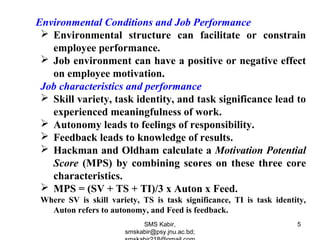
Environmental Conditions and Job Performance
 Environmental structure can facilitate or constrain
employee performance.
 Job environment can have a positive or negative effect
on employee motivation.
Job characteristics and performance
 Skill variety, task identity, and task significance lead to
experienced meaningfulness of work.
 Autonomy leads to feelings of responsibility.
 Feedback leads to knowledge of results.
 Hackman and Oldham calculate a Motivation Potential
Score (MPS) by combining scores on these three core
characteristics.
 MPS = (SV + TS + TI)/3 x Auton x Feed.
Where SV is skill variety, TS is task significance, TI is task identity,
Auton refers to autonomy, and Feed is feedback.
SMS Kabir,
smskabir@psy.jnu.ac.bd;
5
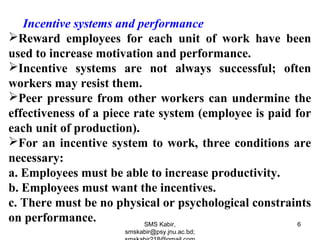
Incentive systems and performance
Reward employees for each unit of work have been
used to increase motivation and performance.
Incentive systems are not always successful; often
workers may resist them.
Peer pressure from other workers can undermine the
effectiveness of a piece rate system (employee is paid for
each unit of production).
For an incentive system to work, three conditions are
necessary:
a. Employees must be able to increase productivity.
b. Employees must want the incentives.
c. There must be no physical or psychological constraints
on performance. SMS Kabir,
smskabir@psy.jnu.ac.bd;
6
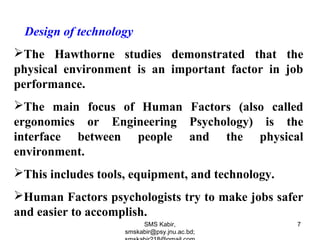
Design of technology
The Hawthorne studies demonstrated that the
physical environment is an important factor in job
performance.
The main focus of Human Factors (also called
ergonomics or Engineering Psychology) is the
interface between people and the physical
environment.
This includes tools, equipment, and technology.
Human Factors psychologists try to make jobs safer
and easier to accomplish.
SMS Kabir,
smskabir@psy.jnu.ac.bd;
7
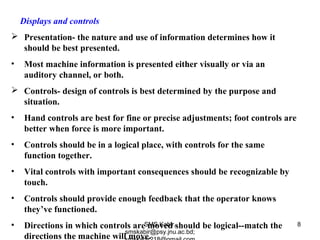
Displays and controls
 Presentation- the nature and use of information determines how it
should be best presented.
• Most machine information is presented either visually or via an
auditory channel, or both.
 Controls- design of controls is best determined by the purpose and
situation.
• Hand controls are best for fine or precise adjustments; foot controls are
better when force is more important.
• Controls should be in a logical place, with controls for the same
function together.
• Vital controls with important consequences should be recognizable by
touch.
• Controls should provide enough feedback that the operator knows
they’ve functioned.
• Directions in which controls are moved should be logical--match the
directions the machine will move.
SMS Kabir,
smskabir@psy.jnu.ac.bd;
8
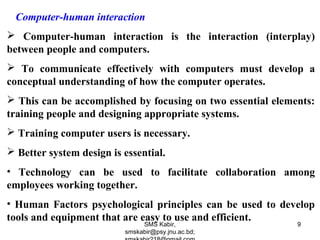
Computer-human interaction
 Computer-human interaction is the interaction (interplay)
between people and computers.
 To communicate effectively with computers must develop a
conceptual understanding of how the computer operates.
 This can be accomplished by focusing on two essential elements:
training people and designing appropriate systems.
 Training computer users is necessary.
 Better system design is essential.
• Technology can be used to facilitate collaboration among
employees working together.
• Human Factors psychological principles can be used to develop
tools and equipment that are easy to use and efficient.
SMS Kabir,
smskabir@psy.jnu.ac.bd;
9
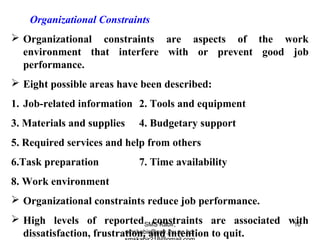
Organizational Constraints
 Organizational constraints are aspects of the work
environment that interfere with or prevent good job
performance.
 Eight possible areas have been described:
1. Job-related information 2. Tools and equipment
3. Materials and supplies 4. Budgetary support
5. Required services and help from others
6.Task preparation 7. Time availability
8. Work environment
 Organizational constraints reduce job performance.
 High levels of reported constraints are associated with
dissatisfaction, frustration, and intention to quit.
SMS Kabir,
smskabir@psy.jnu.ac.bd;
10
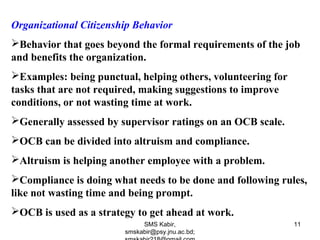
Organizational Citizenship Behavior
Behavior that goes beyond the formal requirements of the job
and benefits the organization.
Examples: being punctual, helping others, volunteering for
tasks that are not required, making suggestions to improve
conditions, or not wasting time at work.
Generally assessed by supervisor ratings on an OCB scale.
OCB can be divided into altruism and compliance.
Altruism is helping another employee with a problem.
Compliance is doing what needs to be done and following rules,
like not wasting time and being prompt.
OCB is used as a strategy to get ahead at work.
SMS Kabir,
smskabir@psy.jnu.ac.bd;
11
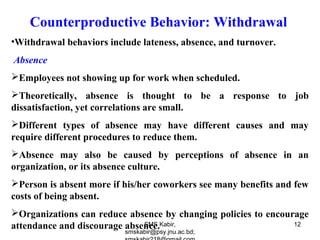
Counterproductive Behavior: Withdrawal
•Withdrawal behaviors include lateness, absence, and turnover.
Absence
Employees not showing up for work when scheduled.
Theoretically, absence is thought to be a response to job
dissatisfaction, yet correlations are small.
Different types of absence may have different causes and may
require different procedures to reduce them.
Absence may also be caused by perceptions of absence in an
organization, or its absence culture.
Person is absent more if his/her coworkers see many benefits and few
costs of being absent.
Organizations can reduce absence by changing policies to encourage
attendance and discourage absence.SMS Kabir,
smskabir@psy.jnu.ac.bd;
12
Lateness
Lateness has many causes, such as job dissatisfaction,
commuting distance, work-family conflict, and culture.
Organizations have their own lateness cultures as well.
Turnover
 Turnover refers to employees quitting.
 When turnover is excessive, an organization is less
productive.
 Best and poor performers are more likely to quit.
 Job satisfaction is a central variable in turnover.
Dissatisfaction leads to intention to quit, which leads to
turnover.
 Other factors in turnover: Health reasons; Becoming
disabled on the job; Pursuit of other life interests-education,
child rearing; Family problems- illness, divorce, death;
Relocation.
 Organizations can reduce turnover from some of these
causes.
SMS Kabir,
smskabir@psy.jnu.ac.bd;
13
Counterproductive Behavior: Aggression, Mistreatment, Sabotage, and Theft
Counterproductive work behavior (CWB) refers to behaviors intended to
harm the organization and other people at work.
1. Sabotage is very expensive, directly from damage to equipment and
property, or indirectly from loss of productivity.
2. Theft has been estimated to cost billions a year, with more spent to
control it. Interestingly, employees were found to be responsible for more
theft than were shoplifters.
3. Supervisors are frequent targets of aggressive responses by
subordinates who received negative performance appraisals.
4. Mistreatment or Mobbing is the harassment, aggression, nastiness, and
rudeness of an employee by others at work.
a. Sexual harassment is one form of mistreatment in the U.S.
b. Causes include lack of management control of behavior, stressful work
conditions, lack of support by coworkers, and the personality of the victim.
5. Labor Unrest and Strikes.
During disputes employees often feel frustrated and believe that management
is being unfair. These conditions normally precede counterproductive
behavior, as violence and sabotage often follow.
SMS Kabir,
smskabir@psy.jnu.ac.bd;
14

Productive and Non-productive Behavior

  • 1.
    Business Psychology Productive andCounterproductive Behavior Syed Md. Sajjad Kabir Lecturer, Dept.of Psychology, CU SMS Kabir, smskabir@psy.jnu.ac.bd; 1
  • 2.
    Topic 7 Productiveand Counterproductive Employee Behavior: Productive Behavior- Job Performance; Counterproductive Behavior- Withdrawal, Aggression, Mistreatment, Sabotage, and Theft  Productive behavior includes job performance and organizational citizenship performance, such as helping co- workers. Counterproductive behavior includes withdrawal (turnover, lateness, and absence), aggression, mistreatment, sabotage, and theft. Productive Behavior: Job Performance Good Performance enhances organizational productivity. Several factors are relevant to performance: a. Ability b. Motivation c. Organizational constraints SMS Kabir, smskabir@psy.jnu.ac.bd; 2
  • 3.
    Ability and Performance KSAOs necessary for the specific job. Selection procedures are used to hire individuals with the necessary abilities. Additional abilities (knowledge and skills) needed for good performance is developed through training. The nature of the job determines the mix of specific abilities needed. Specifically, cognitive abilities have been shown to correlate with job performance. Employees whose abilities match their jobs are more satisfied. SMS Kabir, smskabir@psy.jnu.ac.bd; 3
  • 4.
    Motivation and Performance Arise from within the worker or environmental conditions.  Focus more on variations with the structure of jobs than on individual selection. Personal Characteristics and Performance The big five and performance – •Extraversion: sociable, gregarious, assertive, talkative. •Emotional stability: anxious, depressed, angry, worried, insecure. •Agreeableness: courteous, flexible, good-natured, cooperative. •Conscientiousness: dependable, responsible, hardworking, achievement- oriented. •Openness to experience: imaginative, curious, broadminded, intelligent. Locus of control and performance - • Locus of control concerns people’s belief about their own ability to control reinforcements in their environment. •Individuals with an internal locus of control (internals) believe they have control; those with an external locus of control (externals) do not. •Internals show higher levels of job motivation than externals. Age and performance - •Job performance declines with age is a stereotype that is incorrect. •Results suggest that any decline in ability is possibly compensated for by better task strategies, better management of time, and more efficient approaches. SMS Kabir, smskabir@psy.jnu.ac.bd; 4
  • 5.
    Environmental Conditions andJob Performance  Environmental structure can facilitate or constrain employee performance.  Job environment can have a positive or negative effect on employee motivation. Job characteristics and performance  Skill variety, task identity, and task significance lead to experienced meaningfulness of work.  Autonomy leads to feelings of responsibility.  Feedback leads to knowledge of results.  Hackman and Oldham calculate a Motivation Potential Score (MPS) by combining scores on these three core characteristics.  MPS = (SV + TS + TI)/3 x Auton x Feed. Where SV is skill variety, TS is task significance, TI is task identity, Auton refers to autonomy, and Feed is feedback. SMS Kabir, smskabir@psy.jnu.ac.bd; 5
  • 6.
    Incentive systems andperformance Reward employees for each unit of work have been used to increase motivation and performance. Incentive systems are not always successful; often workers may resist them. Peer pressure from other workers can undermine the effectiveness of a piece rate system (employee is paid for each unit of production). For an incentive system to work, three conditions are necessary: a. Employees must be able to increase productivity. b. Employees must want the incentives. c. There must be no physical or psychological constraints on performance. SMS Kabir, smskabir@psy.jnu.ac.bd; 6
  • 7.
    Design of technology TheHawthorne studies demonstrated that the physical environment is an important factor in job performance. The main focus of Human Factors (also called ergonomics or Engineering Psychology) is the interface between people and the physical environment. This includes tools, equipment, and technology. Human Factors psychologists try to make jobs safer and easier to accomplish. SMS Kabir, smskabir@psy.jnu.ac.bd; 7
  • 8.
    Displays and controls Presentation- the nature and use of information determines how it should be best presented. • Most machine information is presented either visually or via an auditory channel, or both.  Controls- design of controls is best determined by the purpose and situation. • Hand controls are best for fine or precise adjustments; foot controls are better when force is more important. • Controls should be in a logical place, with controls for the same function together. • Vital controls with important consequences should be recognizable by touch. • Controls should provide enough feedback that the operator knows they’ve functioned. • Directions in which controls are moved should be logical--match the directions the machine will move. SMS Kabir, smskabir@psy.jnu.ac.bd; 8
  • 9.
    Computer-human interaction  Computer-humaninteraction is the interaction (interplay) between people and computers.  To communicate effectively with computers must develop a conceptual understanding of how the computer operates.  This can be accomplished by focusing on two essential elements: training people and designing appropriate systems.  Training computer users is necessary.  Better system design is essential. • Technology can be used to facilitate collaboration among employees working together. • Human Factors psychological principles can be used to develop tools and equipment that are easy to use and efficient. SMS Kabir, smskabir@psy.jnu.ac.bd; 9
  • 10.
    Organizational Constraints  Organizationalconstraints are aspects of the work environment that interfere with or prevent good job performance.  Eight possible areas have been described: 1. Job-related information 2. Tools and equipment 3. Materials and supplies 4. Budgetary support 5. Required services and help from others 6.Task preparation 7. Time availability 8. Work environment  Organizational constraints reduce job performance.  High levels of reported constraints are associated with dissatisfaction, frustration, and intention to quit. SMS Kabir, smskabir@psy.jnu.ac.bd; 10
  • 11.
    Organizational Citizenship Behavior Behaviorthat goes beyond the formal requirements of the job and benefits the organization. Examples: being punctual, helping others, volunteering for tasks that are not required, making suggestions to improve conditions, or not wasting time at work. Generally assessed by supervisor ratings on an OCB scale. OCB can be divided into altruism and compliance. Altruism is helping another employee with a problem. Compliance is doing what needs to be done and following rules, like not wasting time and being prompt. OCB is used as a strategy to get ahead at work. SMS Kabir, smskabir@psy.jnu.ac.bd; 11
  • 12.
    Counterproductive Behavior: Withdrawal •Withdrawalbehaviors include lateness, absence, and turnover. Absence Employees not showing up for work when scheduled. Theoretically, absence is thought to be a response to job dissatisfaction, yet correlations are small. Different types of absence may have different causes and may require different procedures to reduce them. Absence may also be caused by perceptions of absence in an organization, or its absence culture. Person is absent more if his/her coworkers see many benefits and few costs of being absent. Organizations can reduce absence by changing policies to encourage attendance and discourage absence.SMS Kabir, smskabir@psy.jnu.ac.bd; 12
  • 13.
    Lateness Lateness has manycauses, such as job dissatisfaction, commuting distance, work-family conflict, and culture. Organizations have their own lateness cultures as well. Turnover  Turnover refers to employees quitting.  When turnover is excessive, an organization is less productive.  Best and poor performers are more likely to quit.  Job satisfaction is a central variable in turnover. Dissatisfaction leads to intention to quit, which leads to turnover.  Other factors in turnover: Health reasons; Becoming disabled on the job; Pursuit of other life interests-education, child rearing; Family problems- illness, divorce, death; Relocation.  Organizations can reduce turnover from some of these causes. SMS Kabir, smskabir@psy.jnu.ac.bd; 13
  • 14.
    Counterproductive Behavior: Aggression,Mistreatment, Sabotage, and Theft Counterproductive work behavior (CWB) refers to behaviors intended to harm the organization and other people at work. 1. Sabotage is very expensive, directly from damage to equipment and property, or indirectly from loss of productivity. 2. Theft has been estimated to cost billions a year, with more spent to control it. Interestingly, employees were found to be responsible for more theft than were shoplifters. 3. Supervisors are frequent targets of aggressive responses by subordinates who received negative performance appraisals. 4. Mistreatment or Mobbing is the harassment, aggression, nastiness, and rudeness of an employee by others at work. a. Sexual harassment is one form of mistreatment in the U.S. b. Causes include lack of management control of behavior, stressful work conditions, lack of support by coworkers, and the personality of the victim. 5. Labor Unrest and Strikes. During disputes employees often feel frustrated and believe that management is being unfair. These conditions normally precede counterproductive behavior, as violence and sabotage often follow. SMS Kabir, smskabir@psy.jnu.ac.bd; 14