ORGANIZATIONAL COMMITMENT
PRESENTED BY
SONDARVA YAGNESH M
M .Sc.(AGRI) 1ST SEM
REG NO : 04 -2664 -2015
is the individual's psychological attachment to
the organization.
organizational commitment
• An employee’s loyalty to the organization,
willingness to exert effort on behalf of the
organization, associated with the acceptance of
the organization’s goal and values and desire to
maintain membership.
• A worker’s feeling and attitudes about the
entire work organizations.
Organizational Commitment
predicts work variables such as
 turnover,
 organizational citizenship behavior,
 job performance.
Some of the factors such as
 role stress,
 empowerment,
Job insecurity
 employability,
 distribution of leadership
have been shown to be connected to a worker's sense of organizational
commitment
.
Organizational commitment can be contrasted with other work-related attitudes,
job satisfaction : an employee's feelings about their job,
organizational identification : the degree to which an employee experiences a
'sense of oneness' with their organization.
importance of Organizational commitment
• The strength of an individual’s
identification with an organization.
• Three kinds of organizational commitment:
1. Affective
2. Continuance
3. Normative
Organizational Commitment
Kinds of Organizational Commitment
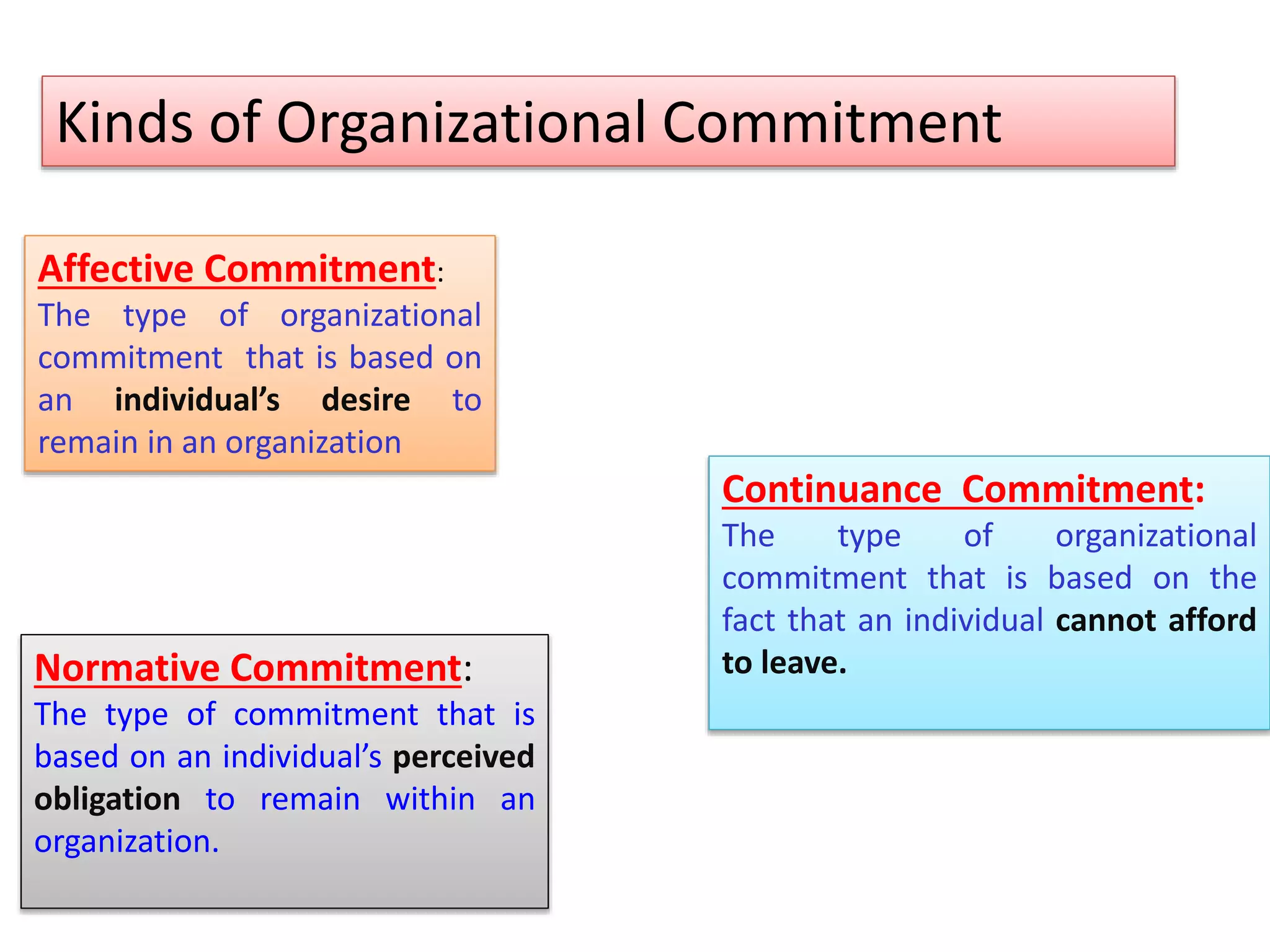
Affective Commitment:
The type of organizational
commitment that is based on
an individual’s desire to
remain in an organization
Continuance Commitment:
The type of organizational
commitment that is based on the
fact that an individual cannot afford
to leave.Normative Commitment:
The type of commitment that is
based on an individual’s perceived
obligation to remain within an
organization.
Meyer and Allen use the tri-dimensional model to conceptualize
organizational commitment in three dimensions namely,
affective,
continuance
normative commitments.
These dimensions describe the different ways of organizational commitment
development and the implications for employees’ behavior.
Figure presents the tri-dimensional organizational commitment model
model of commitment
ORGANISATIONAL
CHARACTERISTICS
􀂃 Size
􀂃 Structure
􀂃 Climate. Etc.
PERSONAL CHARACTERISTICS
􀂃 Demographics
􀂃 Values
􀂃 Expectations,
SOCIALISATION EXPERIENCES
􀂃 Cultural
􀂃 Familial
􀂃 Organisational
MANAGEMENT PRACTICES
􀂃 Selection
􀂃 Training
􀂃 Compensation
ENVIRONMENTAL CONDITIONS
􀂃 Unemployment rate
􀂃 Family responsibility
􀂃 Union Status
RETENTION
􀂃 Withdrawal Cognition
􀂃 Turnover Intention
􀂃 Turnover
PRODUCTIVE BEHAVIOUR
􀂃 Attendance
􀂃 Performance
􀂃 Citizenship
EMPLOYEE WELL-BEING
􀂃 Psychological Health
􀂃 Physical Health
􀂃 Career Progress
WORK
EXPERIENCES
􀂃 Job scope
􀂃 Relationships
􀂃 Participation
􀂃 Support
􀂃 Justice
ROLE STATES
􀂃 Ambiguity
􀂃 Conflict
􀂃 Overload
PSYCHOLOGICAL
CONTRACT
􀂃 Economic
Exchange
􀂃 Social Exchange
AFFECT-RELATED
􀂃 Attribution
􀂃 Rationalisation
􀂃 Met
expectations
􀂃 Person –Job Fit
􀂃 Need satisfaction
NORM RELATED
􀂃 Expectations
􀂃 Obligations
COST RELATED
􀂃 Alternatives
􀂃 Investments
AFFECTIVE
COMMITMENT
􀂃 Organisation
􀂃 Union
􀂃 Team
CONTINUANCE
COMMITMENT
􀂃 Organisation
􀂃 Union
􀂃 Team
NORMATIVE
COMMITMENT
􀂃 Organisation
􀂃 Union
􀂃 Team
RETENTION
􀂃 Withdrawal
Cognition
􀂃 Turnover Intention
􀂃 Turnover
PRODUCTIVE
BEHAVIOUR
􀂃 Attendance
􀂃 Performance
􀂃 Citizenship
EMPLOYEE WELL-
BEING
􀂃 Psychological Health
􀂃 Physical Health
􀂃 Career Progress
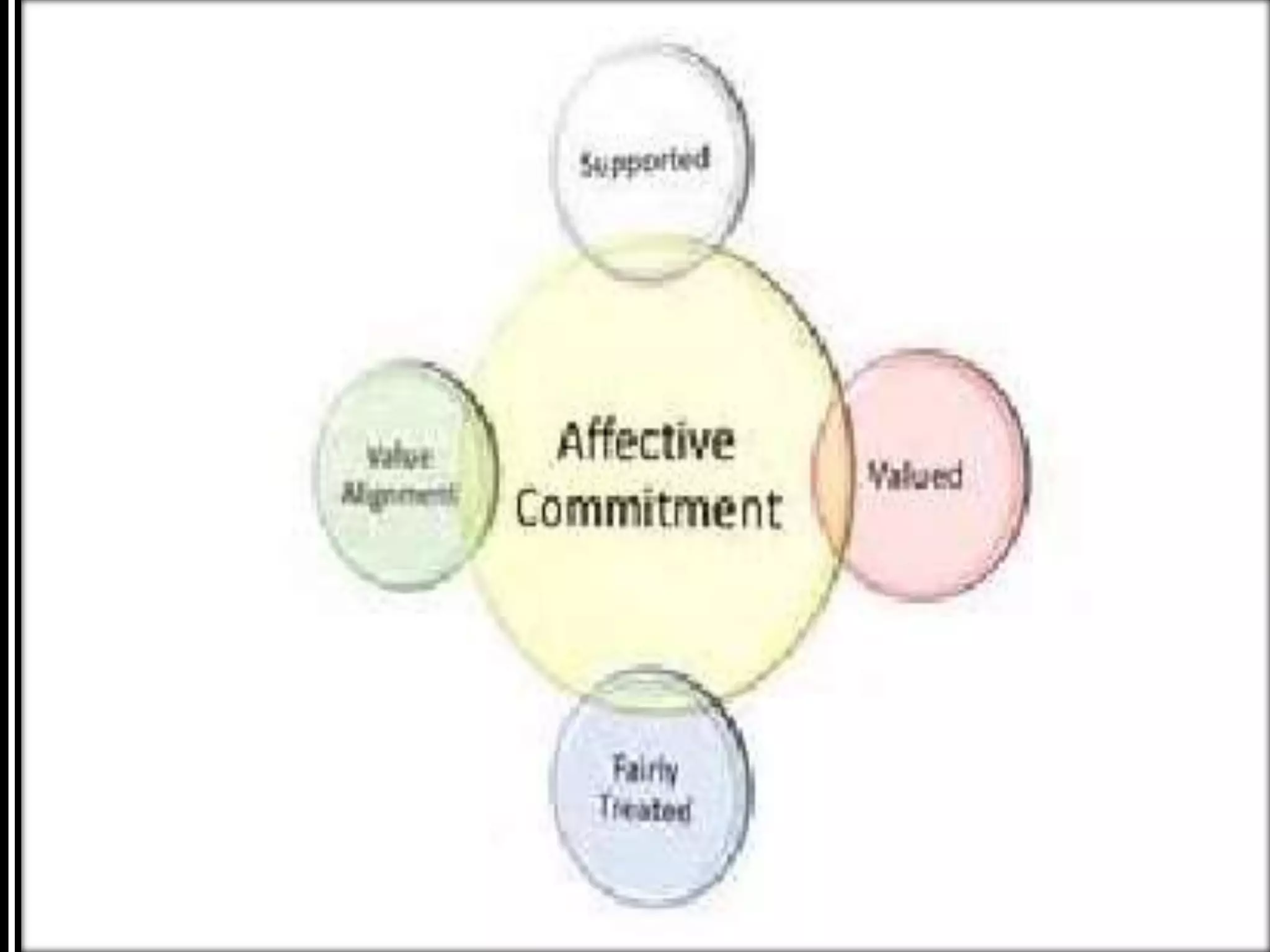
Affective Commitment
A desire on the part of an employee to
remain a member of an organization
because of an emotional attachment
to, or involvement in, that organization
You stay because you want to
What would you feel if you left
anyway
employee's positive emotional attachment to the organization.
Meyer and Allen Defined as the “desire” component of organizational commitment.
An employee who is affectively committed strongly identifies with the goals of the
organization and desires to remain a part of the organization.
This employee commits to the organization because he/she "wants to".
This commitment can be influenced by many different demographic characteristics:
age, tenure, sex, and education but these influences are neither strong nor consistent.
The problem with these characteristics is that while they can be seen, they cannot be
clearly defined.
Meyer and Allen gave this example that “positive relationships between tenure and
commitment maybe due to tenure-related differences in job status and quality”
Affective Commitment
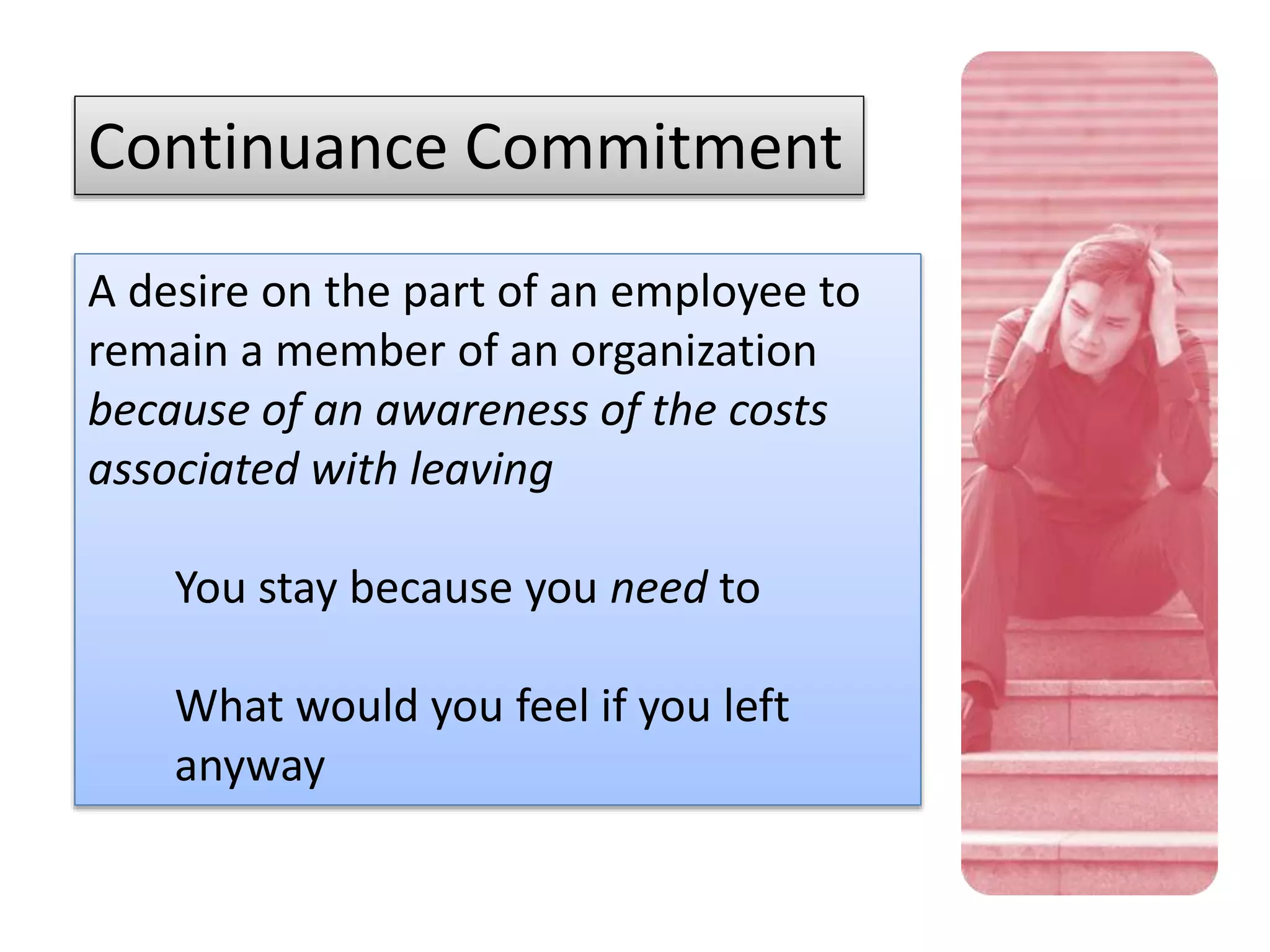
Continuance Commitment
A desire on the part of an employee to
remain a member of an organization
because of an awareness of the costs
associated with leaving
You stay because you need to
What would you feel if you left
anyway
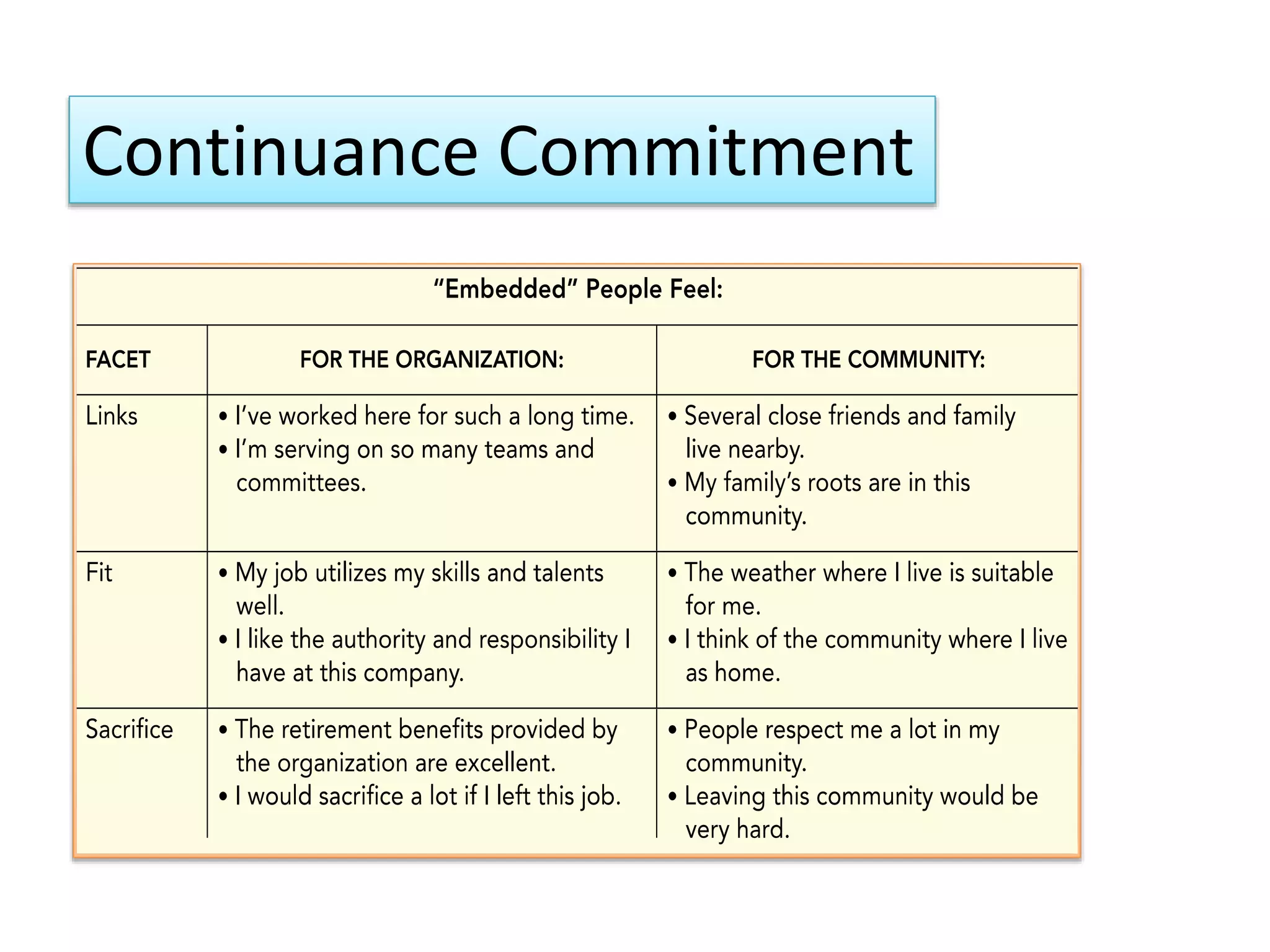
Continuance Commitment
Continuance Commitment is the “need” component or the gains verses losses of
working in an organization.
“Side bets,” or investments, are the gains and losses that may occur should an
individual stay or leave an organization.
An individual may commit to the organization because he/she perceives a high cost
of losing organizational membership
[Things like economic costs (such as pension accruals)
social costs (friendship ties with co-workers)
would be costs of losing organizational membership.
But an individual doesn’t see the positive costs as enough to stay with an
organization they must also take into account the availability of
alternatives (such as another organization),
disrupt personal relationships,
other “side bets” that would be incurred from leaving their organization.
The problem with this is that these “side bets” don’t occur at once but that they
“accumulate with age and tenure
A desire on the part of an employee
to remain a member of an
organization because of a feeling of
obligation
You stay because you ought to
What would you feel if you left
anyway?
Normative Commitment
The individual commits to and remains with an organization because of feelings of
obligation, the last component of organizational commitment.
These feelings may derive from a strain on an individual before and after joining an
organization.
For example, the organization may have invested resources in training an employee
who then feels a 'moral' obligation to put forth effort on the job and stay with the
organization to 'repay the debt.'
It may also reflect an internalized norm, developed before the person joins the
organization through family or other socialization processes, that one should be loyal
to one's organization.
The employee stays with the organization because he/she "ought to". But generally if
an individual invest a great deal they will receive “advanced rewards.”
Normative commitment is higher in organizations that value loyalty and systematically
communicate the fact to employees with rewards, incentives and other strategies.
Normative commitment in employees is also high where employees regularly
see visible examples of the employer being committed to employee well-
being.
An employee with greater organizational commitment has a greater chance
of contributing to organizational success and will also experience higher levels
of job satisfaction. High levels of job satisfaction, in turn, reduces employee
turnover and increases the organization’s ability to recruit and retain talent.
Exit-Voice-Loyalty-Neglect
A framework that includes potential responses
to negative events.
Exit
 Ending or restricting organizational
membership
Voice
A constructive response where individuals
attempt to improve the situation
Exit-Voice-Loyalty-Neglect
A framework that includes potential responses to negative
events
Loyalty
 A passive response where the employee remains
supportive while hoping for improvement
Neglect
 Interest and effort in the job is reduced
Exit-Voice-Loyalty-Neglect
Withdrawal
Increasing Job
Satisfaction &
Organization
Commitment
Positive
Employee
Attitudes &
Behaviors
Benefit
programs
Flexible
work
schedules
Changes in
pay
structure
Job rotation – moving workers from one specialized job to another.
Job enlargement – the practice of allowing worker to take on additional ,
varied task in effort to make them feel that they are more valuable
members of the organization.
Job enrichment – raising the responsibility associated with a particular
job by allowing workers a greater voice in the planning , execution and
evaluation of their own activities.
Changes in job structure
Skill-based pay – paying employees an hourly rate based on
their knowledge and skills.
Merit pay – a plan in which the amount of compensation is
directly a function of a employee’s performances.
Gainsharing – make pay contingent on effective group
performance.
Profit sharing – all employees receive a small share of the
organization’s profits.
Changes in pay structure
Compressed work weeks – the number of workdays is decrease while the
number of hours worked per day is increased.
Flextime – a scheduling system whereby a worker is committed to a
specified number of hours per week but has some flexibility concerning the
starting and ending times of any particular workday.
Flexible work schedules
Benefit program
Flexible working hours
Variety of health care option
Different retirement plans
Career development programs
Health promotion programs
Employee-sponsor childcare
Organizational Citizenship Behaviors
consists of efforts by organizational members that advance or promote
the work organization , its image , and its goals.
Positive affect and employee well-being
the role of positive emotions , or positive affect , in influencing
employee attitudes , such as job satisfaction and fostering positive
employee behaviors.
Positive Employee Attitudes & Behaviors
the nutshell, employee’s commitment plays a vital role in
organization.
This means that with a committed employees, it will help an
organization to boost up its performances as well as the
productivity which can leads to a success in this society.
Hence, commitment is a fundamental requirement and
quality for employees in order to be a part of an organization
and optimize the organization performance.
Application
Employees are more committed when employers are committed
to them
 Perceived organization support
 Fostered when organizations:
 Protect job security
Provide rewards
Improve work conditions
Minimize politics
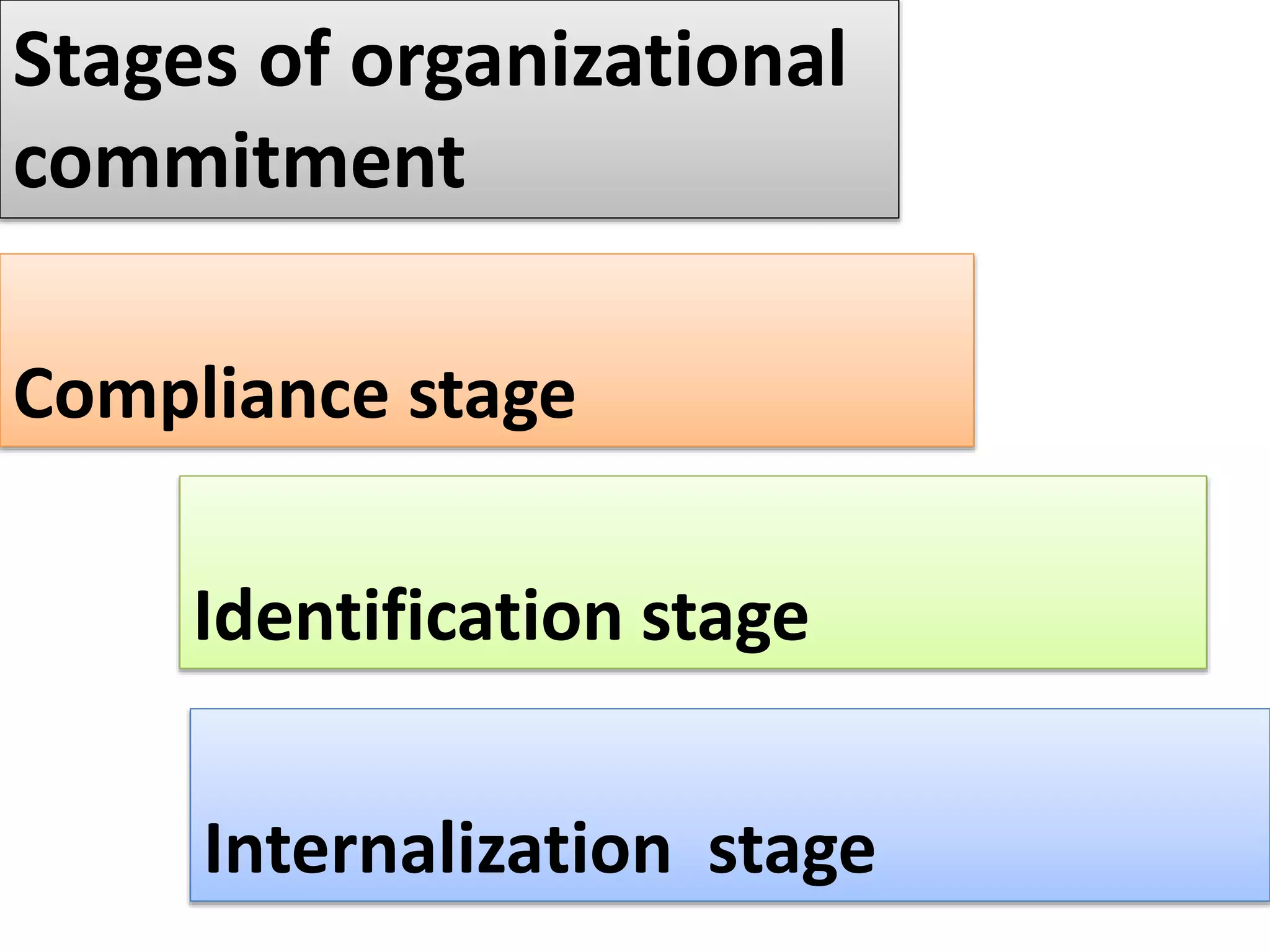
Stages of organizational
commitment
Compliance stage
Identification stage
Internalization stage
employee accepting the influence of others mainly to benefit
from them, through remuneration or promotion .
At this stage, attitudes and behaviors are adopted not because of
shared beliefs but simply to gain specific rewards.
The nature of organizational commitment in the compliance stage
is associated with the continuance dimension commitment,
where the employee is calculative with the need to stay in the
organization when evaluating the rewards
This implies that at this stage employees stay in the organization
because of what they receive
Compliance stage
identification occurs when employees accept the influence of others in
order to maintain a satisfying self-defining relationship with the
organization .
Employees feel proud to be part of the organization;
they may regard the roles they have in the organization as part their
self-identity
Organizational commitment at this stage is based on the normative
dimension
The individual stays because he or she should and is guided by a sense
of duty and loyalty towards the organization.
Identification stage
Internalization takes place when the employee finds the values of the organization
to be intrinsically rewarding and congruent with his or her personal values
Organizational commitment at this level is based on the affective dimension
The employee at this stage develops not only the sense of belonging but passion to
belong to the organization hence the commitment is based on a “want to stay” basis.
The values of the individual are therefore congruent with those of the group and the
organization
Internalization stage
There are different levels of organizational commitment which are related to
the individual’s development of the individual’s organizational commitment
 High level of organizational commitment
 Moderate level of organizational commitment
 Lower level of organizational commitment
,
Levels of organizational commitment
high level of organizational commitment is characterized by a strong
acceptance of the organization's values and willingness to exert efforts to
remain with the organization
“high organizational commitment means identifying with one’s employing
organization”.
The “will to stay” suggests that the behavioral tendencies at this level relate
closely with affective dimension of commitment, where individuals stay
because they want
High level of organizational commitment
Moderate level of organizational commitment
moderate level of organizational commitment is characterized by a reasonable
acceptance of organizational goals and values as well as the willingness to exert
effort to remain in the organization .
This level can be viewed as a reasonable or average commitment, which implies
partial commitment.
The willingness to stay is an attribution of a moral commitment associated with
the normative dimension of commitment.
The individuals stay in the organization because they should do so
Lower level of organizational commitment
,
The low level of organizational commitment is characterized by a
lack of neither acceptance of organizational goals and values nor the
willingness to exert effort to remain with the organization .
The employee who operates on this level must be disillusioned
about the organization; such an employee may stay because he or
she needs to stay as associated with the continuance dimension
Given an option they will leave the organization.
FACTORS AFFECTING ORGANISATIONAL COMMITMENT
 Job-related factor
 Employment opportunities
 Personal characteristics
 working environment
 Positive relationships
 Organizational structure
Job-related factor
Organizational commitment is an important job-related outcome at the individual
level, which may have an impact on other job-related outcomes such as turnover,
absenteeism, job effort, job role and performance or visa versa
The job role that is ambiguous may lead to lack of commitment to the organization
and promotional opportunities can also enhance or diminish organizational
commitment
Other job factors that could have an impact on commitment are the level of
responsibility and autonomy.
the higher the level of responsibility and autonomy connected with a given job, the
lesser repetitive and more interesting it is, and the higher the level of commitment
expressed by the person who fill it.
Employment opportunities
The existence of employment opportunities can affect organizational commitment
Individuals who have a strong perception that they stand a chance of finding
another job may become less committed to the organization as they ponder on
such desirable alternatives.
Where there is lack of other employment opportunities, there is a tendency of high
level of organizational commitment
As a result, membership in the organization is based on continuance commitment,
where employees are continuously calculating the risks of remaining and leaving
Personal characteristics
Organizational commitment can also be affected by the employee's personal
characteristics such as age, years of service and gender.
older employees, those with tenure or seniority, and those who are satisfied
with their own levels of work performance tend to report higher levels of
organizational commitment than others.
This implies that older people are seen to be more committed to the
organization than other age groups. Another personal characteristic that may
affect organizational commitment is associated with gender.
However, it is argued that gender differences in commitment are due to
different work characteristics and experiences that are linked to gender
One of the common working environmental conditions that may affect organizational
commitment positively is partial ownership of a company.
Ownership of any kind gives employees a sense of importance and they feel part of
the decision-making process
This concept of ownership which includes participation in decision-making on new
developments and changes in the working practices, creates a sense of belonging (
managers who participate in budget decision-making tend to have a high level of
organizational commitment.
Another factor within the work environment that may affect organizational
commitment is work practices in relation to recruitment and selection, performance
appraisal, promotions and management style
working environment
Positive relationships
The organization as a workplace environment is built up of working relationships; one of
which is the supervisory relationship.
the supervisory relationship can affect organizational commitment either positively or
negatively”. A positive supervisory relationship depends on how work-related practices such
as performance management are being implemented in the organization
When individuals find the supervisory relationship to be fair in its practices, they tend to be
more committed to the organization.
Other work relationships, such as teams or groups, which exist in the workplace, can affect
organizational commitment. Organizational members can demonstrate commitment when
they are able to find value through work relationships
Organizational structure
Bureaucratic structures tend to have a negative effect on organizational
commitment.
"the removal of bureaucratic barriers and the creation of more flexible structure are
more likely to contribute to the enhancement of employee commitment both in
terms of their loyalty and attachment to the organization".
The management can increase the level of commitment by providing the employees
with greater direction and influence
"the answer to the question of employee commitment, morale, loyalty and
attachment may consist not only in providing motivators, but also to remove
demotivators such as styles of management not suited to their context and to
contemporary employee aspirations".
A management style that encourages employee involvement can help to satisfy
employee's desire for empowerment and demand for a commitment to
organizational goals.
“more flexible and participatory management styles can strongly and positively
enhance organizational commitment”.
Organisations need to ensure that their management strategies
are aimed at improving employee commitment rather than compliance
Management style
I
EFFECTS OF ORGANISATIONAL COMMITMENT
Organizational commitment can have either a
 Negative effect on the organization
 Positive effect on the organization.
negative effect implies that the level of organizational commitment is low.
Employees with a low level of organizational commitment tend to be
unproductive and some become loafers at work
“lack of organizational commitment or loyalty is cited as an explanation of
employee absenteeism, turnover, reduced effort expenditure, theft, job
dissatisfaction and unwillingness to relocate”.
Organizational commitment is regarded to be the best predictor of
employees’ turnover, than the far more frequently used job satisfaction
predictor
employees who operate in a continuance commitment dimension are
calculative of their stay, one would deduce that such employees may
continuously stay away from work when they feel like, doing so.
Negative effect on the organization
Committed organizational members contribute positively to the organization which is not the case
with less committed members. “organizations whose members have higher levels of commitment
show higher performance and productivity and lower levels of absenteeism and tardiness”. This
implies that employees with a high level of commitment tend to take greater efforts to perform
and invest their resources in the organization
Organizational commitment can result in a stable and productive workforce
It enables employees to release their creativity and to contribute towards organizational
development initiatives
Employees who are highly committed do not leave the organization because they are dissatisfied
and tend to take challenging work activities Committed members are normally achievement and
innovative orientated with the ultimate aim of engaging in and improving performance
Positive effect of organizational commitment
MANAGING ORGANISATIONAL COMMITMENT
Organizations are continuously faced with the demand and supply challenges of the changing
market. In order for the organization to adapt to the intense competition in the market place
and the rapid changes in technology,
it requires organizational members have to be internally committed .
The organization is then faced with a challenge of managing its employees’ commitment
throughout, to ensure sustainability. the structural and job design techniques can be used to
foster organizational commitment in the following ways:
Another important mechanism to manage organizational commitment is through substantial
human resource policies and practices that are fair.
Perceived Self
Worth
Perceived
Cost of Loss
Perceive Need
to Reciprocate
Affective
commitment
Continuo's
commitment
Normative
commitment
HRM Policies
and Practices
More recently, scholars have proposed a five component model of
commitment,[though it has been developed in the context of product and
service consumption.
This model proposes habitual and forced commitment as two additional
dimensions which are very germane in consumption settings.
It seems, however, that habitual commitment or inertial may also
become relevant in many job settings. People get habituated to a job—
the routine, the processes, the cognitive schemas associated with a job
can make people develop a latent commitment to the job – just as it may
occur in a consumption setting..
A five component commitment model

organizational commitment

  • 1.
    ORGANIZATIONAL COMMITMENT PRESENTED BY SONDARVAYAGNESH M M .Sc.(AGRI) 1ST SEM REG NO : 04 -2664 -2015
  • 7.
    is the individual'spsychological attachment to the organization. organizational commitment
  • 9.
    • An employee’sloyalty to the organization, willingness to exert effort on behalf of the organization, associated with the acceptance of the organization’s goal and values and desire to maintain membership. • A worker’s feeling and attitudes about the entire work organizations. Organizational Commitment
  • 10.
    predicts work variablessuch as  turnover,  organizational citizenship behavior,  job performance. Some of the factors such as  role stress,  empowerment, Job insecurity  employability,  distribution of leadership have been shown to be connected to a worker's sense of organizational commitment . Organizational commitment can be contrasted with other work-related attitudes, job satisfaction : an employee's feelings about their job, organizational identification : the degree to which an employee experiences a 'sense of oneness' with their organization. importance of Organizational commitment
  • 11.
    • The strengthof an individual’s identification with an organization. • Three kinds of organizational commitment: 1. Affective 2. Continuance 3. Normative Organizational Commitment
  • 13.
    Kinds of OrganizationalCommitment Affective Commitment: The type of organizational commitment that is based on an individual’s desire to remain in an organization Continuance Commitment: The type of organizational commitment that is based on the fact that an individual cannot afford to leave.Normative Commitment: The type of commitment that is based on an individual’s perceived obligation to remain within an organization.
  • 14.
    Meyer and Allenuse the tri-dimensional model to conceptualize organizational commitment in three dimensions namely, affective, continuance normative commitments. These dimensions describe the different ways of organizational commitment development and the implications for employees’ behavior. Figure presents the tri-dimensional organizational commitment model model of commitment
  • 15.
    ORGANISATIONAL CHARACTERISTICS 􀂃 Size 􀂃 Structure 􀂃Climate. Etc. PERSONAL CHARACTERISTICS 􀂃 Demographics 􀂃 Values 􀂃 Expectations, SOCIALISATION EXPERIENCES 􀂃 Cultural 􀂃 Familial 􀂃 Organisational MANAGEMENT PRACTICES 􀂃 Selection 􀂃 Training 􀂃 Compensation ENVIRONMENTAL CONDITIONS 􀂃 Unemployment rate 􀂃 Family responsibility 􀂃 Union Status RETENTION 􀂃 Withdrawal Cognition 􀂃 Turnover Intention 􀂃 Turnover PRODUCTIVE BEHAVIOUR 􀂃 Attendance 􀂃 Performance 􀂃 Citizenship EMPLOYEE WELL-BEING 􀂃 Psychological Health 􀂃 Physical Health 􀂃 Career Progress WORK EXPERIENCES 􀂃 Job scope 􀂃 Relationships 􀂃 Participation 􀂃 Support 􀂃 Justice ROLE STATES 􀂃 Ambiguity 􀂃 Conflict 􀂃 Overload PSYCHOLOGICAL CONTRACT 􀂃 Economic Exchange 􀂃 Social Exchange AFFECT-RELATED 􀂃 Attribution 􀂃 Rationalisation 􀂃 Met expectations 􀂃 Person –Job Fit 􀂃 Need satisfaction NORM RELATED 􀂃 Expectations 􀂃 Obligations COST RELATED 􀂃 Alternatives 􀂃 Investments AFFECTIVE COMMITMENT 􀂃 Organisation 􀂃 Union 􀂃 Team CONTINUANCE COMMITMENT 􀂃 Organisation 􀂃 Union 􀂃 Team NORMATIVE COMMITMENT 􀂃 Organisation 􀂃 Union 􀂃 Team RETENTION 􀂃 Withdrawal Cognition 􀂃 Turnover Intention 􀂃 Turnover PRODUCTIVE BEHAVIOUR 􀂃 Attendance 􀂃 Performance 􀂃 Citizenship EMPLOYEE WELL- BEING 􀂃 Psychological Health 􀂃 Physical Health 􀂃 Career Progress
  • 16.
    Affective Commitment A desireon the part of an employee to remain a member of an organization because of an emotional attachment to, or involvement in, that organization You stay because you want to What would you feel if you left anyway
  • 17.
    employee's positive emotionalattachment to the organization. Meyer and Allen Defined as the “desire” component of organizational commitment. An employee who is affectively committed strongly identifies with the goals of the organization and desires to remain a part of the organization. This employee commits to the organization because he/she "wants to". This commitment can be influenced by many different demographic characteristics: age, tenure, sex, and education but these influences are neither strong nor consistent. The problem with these characteristics is that while they can be seen, they cannot be clearly defined. Meyer and Allen gave this example that “positive relationships between tenure and commitment maybe due to tenure-related differences in job status and quality” Affective Commitment
  • 19.
  • 20.
    Continuance Commitment A desireon the part of an employee to remain a member of an organization because of an awareness of the costs associated with leaving You stay because you need to What would you feel if you left anyway
  • 21.
  • 22.
    Continuance Commitment isthe “need” component or the gains verses losses of working in an organization. “Side bets,” or investments, are the gains and losses that may occur should an individual stay or leave an organization. An individual may commit to the organization because he/she perceives a high cost of losing organizational membership [Things like economic costs (such as pension accruals) social costs (friendship ties with co-workers) would be costs of losing organizational membership. But an individual doesn’t see the positive costs as enough to stay with an organization they must also take into account the availability of alternatives (such as another organization), disrupt personal relationships, other “side bets” that would be incurred from leaving their organization. The problem with this is that these “side bets” don’t occur at once but that they “accumulate with age and tenure
  • 23.
    A desire onthe part of an employee to remain a member of an organization because of a feeling of obligation You stay because you ought to What would you feel if you left anyway? Normative Commitment
  • 24.
    The individual commitsto and remains with an organization because of feelings of obligation, the last component of organizational commitment. These feelings may derive from a strain on an individual before and after joining an organization. For example, the organization may have invested resources in training an employee who then feels a 'moral' obligation to put forth effort on the job and stay with the organization to 'repay the debt.' It may also reflect an internalized norm, developed before the person joins the organization through family or other socialization processes, that one should be loyal to one's organization. The employee stays with the organization because he/she "ought to". But generally if an individual invest a great deal they will receive “advanced rewards.” Normative commitment is higher in organizations that value loyalty and systematically communicate the fact to employees with rewards, incentives and other strategies.
  • 25.
    Normative commitment inemployees is also high where employees regularly see visible examples of the employer being committed to employee well- being. An employee with greater organizational commitment has a greater chance of contributing to organizational success and will also experience higher levels of job satisfaction. High levels of job satisfaction, in turn, reduces employee turnover and increases the organization’s ability to recruit and retain talent.
  • 29.
    Exit-Voice-Loyalty-Neglect A framework thatincludes potential responses to negative events. Exit  Ending or restricting organizational membership Voice A constructive response where individuals attempt to improve the situation
  • 30.
    Exit-Voice-Loyalty-Neglect A framework thatincludes potential responses to negative events Loyalty  A passive response where the employee remains supportive while hoping for improvement Neglect  Interest and effort in the job is reduced
  • 31.
  • 32.
  • 33.
    Increasing Job Satisfaction & Organization Commitment Positive Employee Attitudes& Behaviors Benefit programs Flexible work schedules Changes in pay structure
  • 34.
    Job rotation –moving workers from one specialized job to another. Job enlargement – the practice of allowing worker to take on additional , varied task in effort to make them feel that they are more valuable members of the organization. Job enrichment – raising the responsibility associated with a particular job by allowing workers a greater voice in the planning , execution and evaluation of their own activities. Changes in job structure
  • 35.
    Skill-based pay –paying employees an hourly rate based on their knowledge and skills. Merit pay – a plan in which the amount of compensation is directly a function of a employee’s performances. Gainsharing – make pay contingent on effective group performance. Profit sharing – all employees receive a small share of the organization’s profits. Changes in pay structure
  • 36.
    Compressed work weeks– the number of workdays is decrease while the number of hours worked per day is increased. Flextime – a scheduling system whereby a worker is committed to a specified number of hours per week but has some flexibility concerning the starting and ending times of any particular workday. Flexible work schedules
  • 37.
    Benefit program Flexible workinghours Variety of health care option Different retirement plans Career development programs Health promotion programs Employee-sponsor childcare
  • 38.
    Organizational Citizenship Behaviors consistsof efforts by organizational members that advance or promote the work organization , its image , and its goals. Positive affect and employee well-being the role of positive emotions , or positive affect , in influencing employee attitudes , such as job satisfaction and fostering positive employee behaviors. Positive Employee Attitudes & Behaviors
  • 39.
    the nutshell, employee’scommitment plays a vital role in organization. This means that with a committed employees, it will help an organization to boost up its performances as well as the productivity which can leads to a success in this society. Hence, commitment is a fundamental requirement and quality for employees in order to be a part of an organization and optimize the organization performance.
  • 40.
    Application Employees are morecommitted when employers are committed to them  Perceived organization support  Fostered when organizations:  Protect job security Provide rewards Improve work conditions Minimize politics
  • 41.
    Stages of organizational commitment Compliancestage Identification stage Internalization stage
  • 42.
    employee accepting theinfluence of others mainly to benefit from them, through remuneration or promotion . At this stage, attitudes and behaviors are adopted not because of shared beliefs but simply to gain specific rewards. The nature of organizational commitment in the compliance stage is associated with the continuance dimension commitment, where the employee is calculative with the need to stay in the organization when evaluating the rewards This implies that at this stage employees stay in the organization because of what they receive Compliance stage
  • 43.
    identification occurs whenemployees accept the influence of others in order to maintain a satisfying self-defining relationship with the organization . Employees feel proud to be part of the organization; they may regard the roles they have in the organization as part their self-identity Organizational commitment at this stage is based on the normative dimension The individual stays because he or she should and is guided by a sense of duty and loyalty towards the organization. Identification stage
  • 44.
    Internalization takes placewhen the employee finds the values of the organization to be intrinsically rewarding and congruent with his or her personal values Organizational commitment at this level is based on the affective dimension The employee at this stage develops not only the sense of belonging but passion to belong to the organization hence the commitment is based on a “want to stay” basis. The values of the individual are therefore congruent with those of the group and the organization Internalization stage
  • 45.
    There are differentlevels of organizational commitment which are related to the individual’s development of the individual’s organizational commitment  High level of organizational commitment  Moderate level of organizational commitment  Lower level of organizational commitment , Levels of organizational commitment
  • 46.
    high level oforganizational commitment is characterized by a strong acceptance of the organization's values and willingness to exert efforts to remain with the organization “high organizational commitment means identifying with one’s employing organization”. The “will to stay” suggests that the behavioral tendencies at this level relate closely with affective dimension of commitment, where individuals stay because they want High level of organizational commitment
  • 47.
    Moderate level oforganizational commitment moderate level of organizational commitment is characterized by a reasonable acceptance of organizational goals and values as well as the willingness to exert effort to remain in the organization . This level can be viewed as a reasonable or average commitment, which implies partial commitment. The willingness to stay is an attribution of a moral commitment associated with the normative dimension of commitment. The individuals stay in the organization because they should do so
  • 48.
    Lower level oforganizational commitment , The low level of organizational commitment is characterized by a lack of neither acceptance of organizational goals and values nor the willingness to exert effort to remain with the organization . The employee who operates on this level must be disillusioned about the organization; such an employee may stay because he or she needs to stay as associated with the continuance dimension Given an option they will leave the organization.
  • 49.
    FACTORS AFFECTING ORGANISATIONALCOMMITMENT  Job-related factor  Employment opportunities  Personal characteristics  working environment  Positive relationships  Organizational structure
  • 50.
    Job-related factor Organizational commitmentis an important job-related outcome at the individual level, which may have an impact on other job-related outcomes such as turnover, absenteeism, job effort, job role and performance or visa versa The job role that is ambiguous may lead to lack of commitment to the organization and promotional opportunities can also enhance or diminish organizational commitment Other job factors that could have an impact on commitment are the level of responsibility and autonomy. the higher the level of responsibility and autonomy connected with a given job, the lesser repetitive and more interesting it is, and the higher the level of commitment expressed by the person who fill it.
  • 51.
    Employment opportunities The existenceof employment opportunities can affect organizational commitment Individuals who have a strong perception that they stand a chance of finding another job may become less committed to the organization as they ponder on such desirable alternatives. Where there is lack of other employment opportunities, there is a tendency of high level of organizational commitment As a result, membership in the organization is based on continuance commitment, where employees are continuously calculating the risks of remaining and leaving
  • 52.
    Personal characteristics Organizational commitmentcan also be affected by the employee's personal characteristics such as age, years of service and gender. older employees, those with tenure or seniority, and those who are satisfied with their own levels of work performance tend to report higher levels of organizational commitment than others. This implies that older people are seen to be more committed to the organization than other age groups. Another personal characteristic that may affect organizational commitment is associated with gender. However, it is argued that gender differences in commitment are due to different work characteristics and experiences that are linked to gender
  • 53.
    One of thecommon working environmental conditions that may affect organizational commitment positively is partial ownership of a company. Ownership of any kind gives employees a sense of importance and they feel part of the decision-making process This concept of ownership which includes participation in decision-making on new developments and changes in the working practices, creates a sense of belonging ( managers who participate in budget decision-making tend to have a high level of organizational commitment. Another factor within the work environment that may affect organizational commitment is work practices in relation to recruitment and selection, performance appraisal, promotions and management style working environment
  • 54.
    Positive relationships The organizationas a workplace environment is built up of working relationships; one of which is the supervisory relationship. the supervisory relationship can affect organizational commitment either positively or negatively”. A positive supervisory relationship depends on how work-related practices such as performance management are being implemented in the organization When individuals find the supervisory relationship to be fair in its practices, they tend to be more committed to the organization. Other work relationships, such as teams or groups, which exist in the workplace, can affect organizational commitment. Organizational members can demonstrate commitment when they are able to find value through work relationships
  • 55.
    Organizational structure Bureaucratic structurestend to have a negative effect on organizational commitment. "the removal of bureaucratic barriers and the creation of more flexible structure are more likely to contribute to the enhancement of employee commitment both in terms of their loyalty and attachment to the organization". The management can increase the level of commitment by providing the employees with greater direction and influence
  • 56.
    "the answer tothe question of employee commitment, morale, loyalty and attachment may consist not only in providing motivators, but also to remove demotivators such as styles of management not suited to their context and to contemporary employee aspirations". A management style that encourages employee involvement can help to satisfy employee's desire for empowerment and demand for a commitment to organizational goals. “more flexible and participatory management styles can strongly and positively enhance organizational commitment”. Organisations need to ensure that their management strategies are aimed at improving employee commitment rather than compliance Management style I
  • 57.
    EFFECTS OF ORGANISATIONALCOMMITMENT Organizational commitment can have either a  Negative effect on the organization  Positive effect on the organization.
  • 58.
    negative effect impliesthat the level of organizational commitment is low. Employees with a low level of organizational commitment tend to be unproductive and some become loafers at work “lack of organizational commitment or loyalty is cited as an explanation of employee absenteeism, turnover, reduced effort expenditure, theft, job dissatisfaction and unwillingness to relocate”. Organizational commitment is regarded to be the best predictor of employees’ turnover, than the far more frequently used job satisfaction predictor employees who operate in a continuance commitment dimension are calculative of their stay, one would deduce that such employees may continuously stay away from work when they feel like, doing so. Negative effect on the organization
  • 59.
    Committed organizational memberscontribute positively to the organization which is not the case with less committed members. “organizations whose members have higher levels of commitment show higher performance and productivity and lower levels of absenteeism and tardiness”. This implies that employees with a high level of commitment tend to take greater efforts to perform and invest their resources in the organization Organizational commitment can result in a stable and productive workforce It enables employees to release their creativity and to contribute towards organizational development initiatives Employees who are highly committed do not leave the organization because they are dissatisfied and tend to take challenging work activities Committed members are normally achievement and innovative orientated with the ultimate aim of engaging in and improving performance Positive effect of organizational commitment
  • 60.
    MANAGING ORGANISATIONAL COMMITMENT Organizationsare continuously faced with the demand and supply challenges of the changing market. In order for the organization to adapt to the intense competition in the market place and the rapid changes in technology, it requires organizational members have to be internally committed . The organization is then faced with a challenge of managing its employees’ commitment throughout, to ensure sustainability. the structural and job design techniques can be used to foster organizational commitment in the following ways: Another important mechanism to manage organizational commitment is through substantial human resource policies and practices that are fair.
  • 61.
    Perceived Self Worth Perceived Cost ofLoss Perceive Need to Reciprocate Affective commitment Continuo's commitment Normative commitment HRM Policies and Practices
  • 62.
    More recently, scholarshave proposed a five component model of commitment,[though it has been developed in the context of product and service consumption. This model proposes habitual and forced commitment as two additional dimensions which are very germane in consumption settings. It seems, however, that habitual commitment or inertial may also become relevant in many job settings. People get habituated to a job— the routine, the processes, the cognitive schemas associated with a job can make people develop a latent commitment to the job – just as it may occur in a consumption setting.. A five component commitment model