SELECTION
PROCESS
SELECTION :-
Selection refer to the process by which qualified applicant are
selected by mean of various test in pre determined numbers,
out of large number of applicant.
Recruitment is a positive process but
Selection is a negative process because under it effort are
made to reduce the no of applicant
DEFINITION:-
“selection is a process in which candidate for
employment are divided into two classes, those
who are to be offered employment and those who
are not”
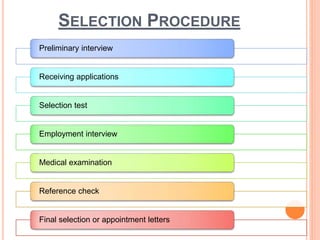
SELECTION PROCEDURE
Preliminary interview
Receiving applications
Selection test
Employment interview
Medical examination
Reference check
Final selection or appointment letters
1) Preliminary interview:-
The object of preliminary interview is to ensure whether the applicant is
physically and mentally fit for the job. During preliminary interview,
candidate are asked question related to their experience, education,
taste, age, etc. Those candidate who are successful in the preliminary
interview are asked to fill the blank application form.
2) Blank application form :-
Blank application form are the printed form of the organization. For
different post there are different form because for each post, person of
different qualification are required.
While preparing these form two things must be kept in view:-
These should convey maximum possible information
Question should be directly related to the post.
3)SELECTION/EMPLOYMENT TEST
“Employment tests are devices to check the areal
knowledge of candidate for the respective jobs.
These tests enable the management to bring out the
right person for the job”
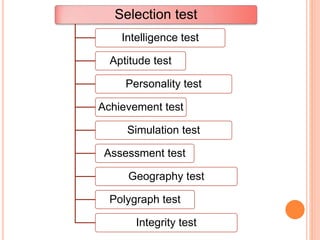
Selection test
Intelligence test
Aptitude test
Personality test
Achievement test
Simulation test
Assessment test
Geography test
Polygraph test
Integrity test
Intelligence test:-
It test the mental ability of candidate. These test
measure the learning ability of candidate & their
power to take quick decisions on crucial points
Aptitude tests:-
It test an individual’s capacity to learn a particular
skill.
 Cognitive tests:- which measure intellectual, mental
aptitudes.
 Motor tests:- these test check the hand-eye
coordination of employees.
Proficiency tests:-
These test are designed to measure the skills already by
the individuals. They are used to test the level of
knowledge.
Personality tests:-
These tests judge the psychological make-up of any person.
These tests check an individual’s motivational level,
emotions, integrity, sympathy, sensitivity, etc.
In this test a controversial situation is presented to the
person
Interest test:-
These test will suggest what type of jobs may be satisfying
to the employees. They help the individuals in selecting
occupations of their interest
Achievement test:- These are designed to
measure what the applicant can do on the job currently.
These tests are also known as work sample test.
Simulation test:- It measure the ability of the
person to face various problems while at work. These
test are used for hiring managers.
Graphology test:- these test involve using a trained
evaluator to flourish a person’s handwriting to assess the
person's personality & emotional make-up
Integrity test:-
These test are designed to measure employee’s honestly to
predict those who are more likely to steal from an employer
or otherwise act in a manner unacceptable to the
organization.
In it many “yes” or “no” type question are asked.
BENEFITS:-
 It tends to eliminate biasness in the selection of
personnel
 Tests can identify talents of individuals which might
otherwise be overlooked
 These tests reduce the cost of selection because large
on of people can be evaluated
 These tests measure the aptitude of candidates
 Tests provide a healthy basis for comparing applicants
background.
LIMITATION
 These test measure only a part of total information
 These test are far from perfection, it does not make
perfect prediction of an individual’s ability.
 No test can measure with guarantee the complex
combination of characteristics required in numerous
positions.
SELECTION INTERVIEW
Interview is the oral examination of candidates for
employment. In this step the interviewer matches the
information obtained about the candidate through
various means to the job requirement and to the
information obtained through his own observations
during the Interview.
Types of Interview:
Several types of interview are commonly used
depending on the nature and importance of the
position to be filled within an organisation.
1) Structured Interview: In this type of interview a list of
questions asked by the interviewer is prepared in advance
on the basis of an analysis of job satisfaction.
2) Unstructured Interview: In this type of interview list of
questions asked by the interviewer is not prepared in
advance. In this type of interview questions are asked as
what comes in interviewer’s mind.
3) Panel Interview: In panel interview candidate is screened
by a group of interviewers who are specialists in their
respective fields. They call upon the candidates one by one
and assess his qualities.
4) Stress Interview: under it, the interviewer deliberately
creates a situation that puts the candidate to a considerable
strain. Frequent interruptions, criticism of candidate’s
opinion, keeping silence for extended period of time are
some of the methods of creating stress.
INTERVIEW PROCESS
HR experts have identified certain steps to be allowed while
conducting interview:
1) Preparation: Effective interviews do not just happen. They
are planned. This involves:
 Establishing the objectives of the interview.
 Reviewing the candidate’s application and resume, noting
areas that may show candidate’s strengths and weaknesses
on which questions could be asked.
 Keeping the test scores ready.
 Selecting the interview method to be followed.
 choosing the panel of experts who would interview the
candidates
2) Reception: The candidate should properly received and led
into the interview . As a rule, treat all candidates even unsolicited
drop-ins at your office courteously, not on humanitarian grounds
but because your company’s reputation is at stake. Start the
interview on time.
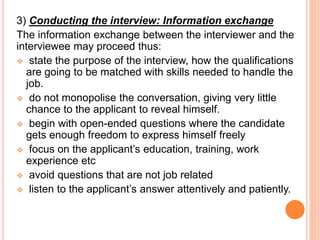
3) Conducting the interview: Information exchange
The information exchange between the interviewer and the
interviewee may proceed thus:
 state the purpose of the interview, how the qualifications
are going to be matched with skills needed to handle the
job.
 do not monopolise the conversation, giving very little
chance to the applicant to reveal himself.
 begin with open-ended questions where the candidate
gets enough freedom to express himself freely
 focus on the applicant’s education, training, work
experience etc
 avoid questions that are not job related
 listen to the applicant’s answer attentively and patiently.
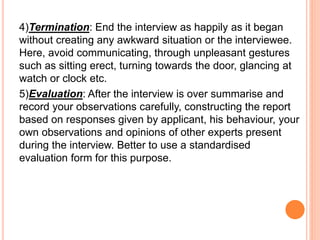
4)Termination: End the interview as happily as it began
without creating any awkward situation or the interviewee.
Here, avoid communicating, through unpleasant gestures
such as sitting erect, turning towards the door, glancing at
watch or clock etc.
5)Evaluation: After the interview is over summarise and
record your observations carefully, constructing the report
based on responses given by applicant, his behaviour, your
own observations and opinions of other experts present
during the interview. Better to use a standardised
evaluation form for this purpose.
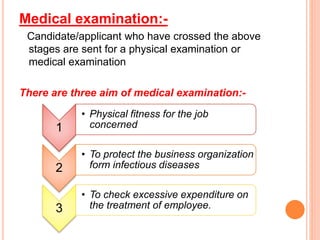
Medical examination:-
Candidate/applicant who have crossed the above
stages are sent for a physical examination or
medical examination
There are three aim of medical examination:-
1
• Physical fitness for the job
concerned
2
• To protect the business organization
form infectious diseases
3
• To check excessive expenditure on
the treatment of employee.
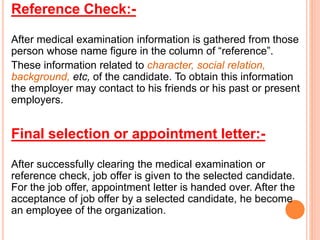
Reference Check:-
After medical examination information is gathered from those
person whose name figure in the column of “reference”.
These information related to character, social relation,
background, etc, of the candidate. To obtain this information
the employer may contact to his friends or his past or present
employers.
Final selection or appointment letter:-
After successfully clearing the medical examination or
reference check, job offer is given to the selected candidate.
For the job offer, appointment letter is handed over. After the
acceptance of job offer by a selected candidate, he become
an employee of the organization.
Selection process

Selection process

  • 1.
  • 2.
    SELECTION :- Selection referto the process by which qualified applicant are selected by mean of various test in pre determined numbers, out of large number of applicant. Recruitment is a positive process but Selection is a negative process because under it effort are made to reduce the no of applicant
  • 3.
    DEFINITION:- “selection is aprocess in which candidate for employment are divided into two classes, those who are to be offered employment and those who are not”
  • 4.
    SELECTION PROCEDURE Preliminary interview Receivingapplications Selection test Employment interview Medical examination Reference check Final selection or appointment letters
  • 5.
    1) Preliminary interview:- Theobject of preliminary interview is to ensure whether the applicant is physically and mentally fit for the job. During preliminary interview, candidate are asked question related to their experience, education, taste, age, etc. Those candidate who are successful in the preliminary interview are asked to fill the blank application form. 2) Blank application form :- Blank application form are the printed form of the organization. For different post there are different form because for each post, person of different qualification are required. While preparing these form two things must be kept in view:- These should convey maximum possible information Question should be directly related to the post.
  • 6.
    3)SELECTION/EMPLOYMENT TEST “Employment testsare devices to check the areal knowledge of candidate for the respective jobs. These tests enable the management to bring out the right person for the job”
  • 7.
    Selection test Intelligence test Aptitudetest Personality test Achievement test Simulation test Assessment test Geography test Polygraph test Integrity test
  • 8.
    Intelligence test:- It testthe mental ability of candidate. These test measure the learning ability of candidate & their power to take quick decisions on crucial points Aptitude tests:- It test an individual’s capacity to learn a particular skill.  Cognitive tests:- which measure intellectual, mental aptitudes.  Motor tests:- these test check the hand-eye coordination of employees.
  • 9.
    Proficiency tests:- These testare designed to measure the skills already by the individuals. They are used to test the level of knowledge. Personality tests:- These tests judge the psychological make-up of any person. These tests check an individual’s motivational level, emotions, integrity, sympathy, sensitivity, etc. In this test a controversial situation is presented to the person Interest test:- These test will suggest what type of jobs may be satisfying to the employees. They help the individuals in selecting occupations of their interest
  • 10.
    Achievement test:- Theseare designed to measure what the applicant can do on the job currently. These tests are also known as work sample test. Simulation test:- It measure the ability of the person to face various problems while at work. These test are used for hiring managers. Graphology test:- these test involve using a trained evaluator to flourish a person’s handwriting to assess the person's personality & emotional make-up
  • 11.
    Integrity test:- These testare designed to measure employee’s honestly to predict those who are more likely to steal from an employer or otherwise act in a manner unacceptable to the organization. In it many “yes” or “no” type question are asked.
  • 12.
    BENEFITS:-  It tendsto eliminate biasness in the selection of personnel  Tests can identify talents of individuals which might otherwise be overlooked  These tests reduce the cost of selection because large on of people can be evaluated  These tests measure the aptitude of candidates  Tests provide a healthy basis for comparing applicants background.
  • 13.
    LIMITATION  These testmeasure only a part of total information  These test are far from perfection, it does not make perfect prediction of an individual’s ability.  No test can measure with guarantee the complex combination of characteristics required in numerous positions.
  • 14.
    SELECTION INTERVIEW Interview isthe oral examination of candidates for employment. In this step the interviewer matches the information obtained about the candidate through various means to the job requirement and to the information obtained through his own observations during the Interview. Types of Interview: Several types of interview are commonly used depending on the nature and importance of the position to be filled within an organisation.
  • 15.
    1) Structured Interview:In this type of interview a list of questions asked by the interviewer is prepared in advance on the basis of an analysis of job satisfaction. 2) Unstructured Interview: In this type of interview list of questions asked by the interviewer is not prepared in advance. In this type of interview questions are asked as what comes in interviewer’s mind. 3) Panel Interview: In panel interview candidate is screened by a group of interviewers who are specialists in their respective fields. They call upon the candidates one by one and assess his qualities. 4) Stress Interview: under it, the interviewer deliberately creates a situation that puts the candidate to a considerable strain. Frequent interruptions, criticism of candidate’s opinion, keeping silence for extended period of time are some of the methods of creating stress.
  • 16.
    INTERVIEW PROCESS HR expertshave identified certain steps to be allowed while conducting interview: 1) Preparation: Effective interviews do not just happen. They are planned. This involves:  Establishing the objectives of the interview.  Reviewing the candidate’s application and resume, noting areas that may show candidate’s strengths and weaknesses on which questions could be asked.  Keeping the test scores ready.  Selecting the interview method to be followed.  choosing the panel of experts who would interview the candidates 2) Reception: The candidate should properly received and led into the interview . As a rule, treat all candidates even unsolicited drop-ins at your office courteously, not on humanitarian grounds but because your company’s reputation is at stake. Start the interview on time.
  • 17.
    3) Conducting theinterview: Information exchange The information exchange between the interviewer and the interviewee may proceed thus:  state the purpose of the interview, how the qualifications are going to be matched with skills needed to handle the job.  do not monopolise the conversation, giving very little chance to the applicant to reveal himself.  begin with open-ended questions where the candidate gets enough freedom to express himself freely  focus on the applicant’s education, training, work experience etc  avoid questions that are not job related  listen to the applicant’s answer attentively and patiently.
  • 18.
    4)Termination: End theinterview as happily as it began without creating any awkward situation or the interviewee. Here, avoid communicating, through unpleasant gestures such as sitting erect, turning towards the door, glancing at watch or clock etc. 5)Evaluation: After the interview is over summarise and record your observations carefully, constructing the report based on responses given by applicant, his behaviour, your own observations and opinions of other experts present during the interview. Better to use a standardised evaluation form for this purpose.
  • 19.
    Medical examination:- Candidate/applicant whohave crossed the above stages are sent for a physical examination or medical examination There are three aim of medical examination:- 1 • Physical fitness for the job concerned 2 • To protect the business organization form infectious diseases 3 • To check excessive expenditure on the treatment of employee.
  • 20.
    Reference Check:- After medicalexamination information is gathered from those person whose name figure in the column of “reference”. These information related to character, social relation, background, etc, of the candidate. To obtain this information the employer may contact to his friends or his past or present employers. Final selection or appointment letter:- After successfully clearing the medical examination or reference check, job offer is given to the selected candidate. For the job offer, appointment letter is handed over. After the acceptance of job offer by a selected candidate, he become an employee of the organization.